Baseball Bingo: Ballpark Prompts for the Whole Game
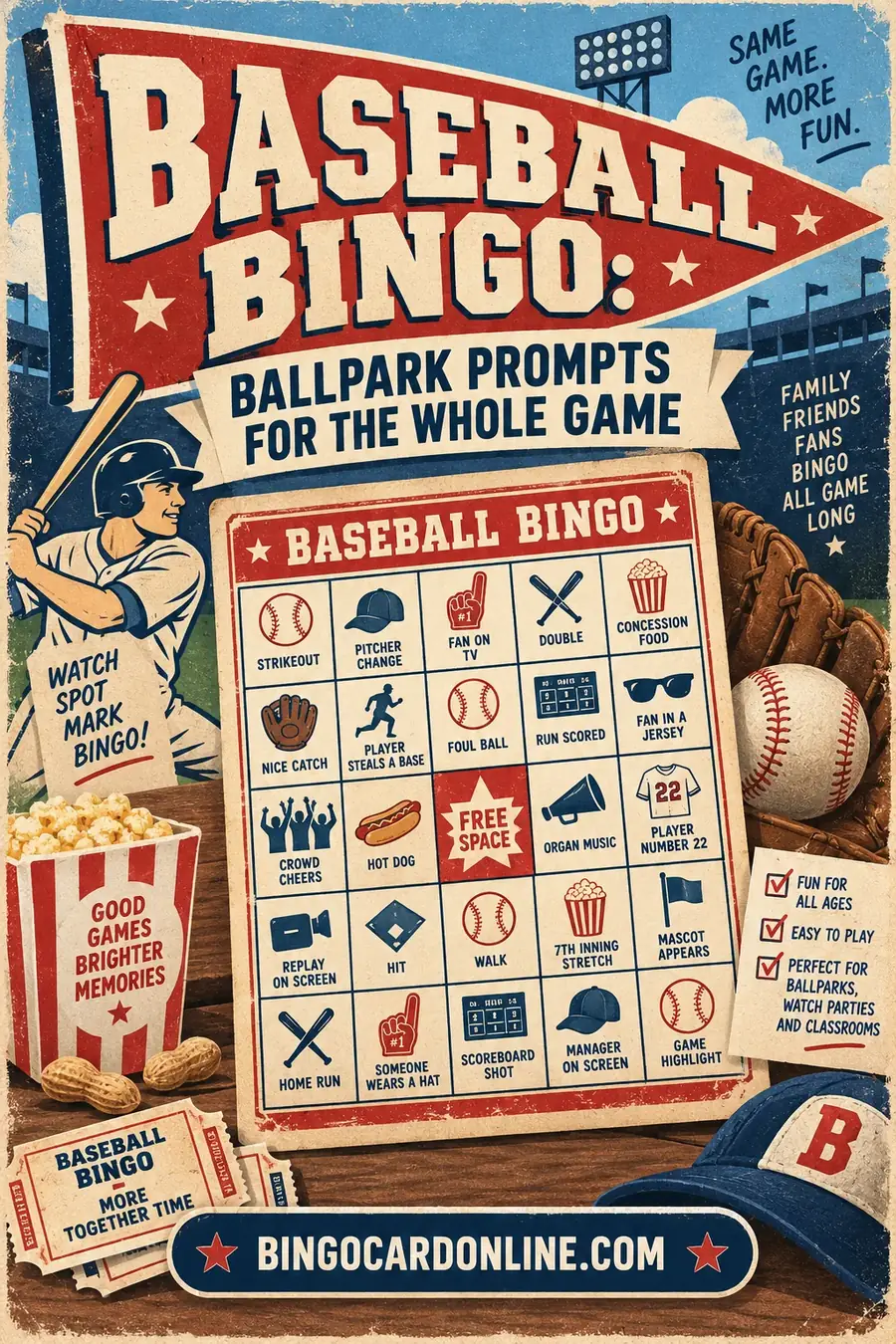
Baseball bingo works better than almost any other sport for this format, because baseball has long gaps and a huge number of small discrete events. The pauses that make baseball a hard sport to watch with restless kids are exactly what makes a bingo card work — there's always time to check your square.
The whole design question is prompt frequency: too common and the card fills by the third inning, too rare and nobody marks anything.
Prompt Frequency Tiers
Near-certain (use 4-6 per card): strikeout, base hit, ball four, foul ball into the stands, pitching change, a called strike three.
Likely (use 8-12 per card): double play, stolen base attempt, extra-base hit, a full count, a run scored, batter steps out to adjust gloves, catcher visits the mound.
Uncommon (use 4-6 per card): home run, error, hit by pitch, bases loaded, a diving catch, a pitcher covering first.
Rare (use 1-2 as a bonus square): triple, balk, grand slam, ejection, a play at the plate.
A 5x5 card with roughly that mix will fill somewhere around the seventh inning, which is the right pacing for a nine-inning game.
Ballpark Squares (Being There)
The in-stadium version can include things that have nothing to do with play, which is what makes it work for people who aren't following closely:
- The wave starts
- Someone catches a foul ball bare-handed
- Kiss cam
- A vendor walks past your row
- A fan on the jumbotron isn't watching the game
- "Take Me Out to the Ball Game" during the seventh-inning stretch
- Someone leaves before the ninth
- A dropped foul ball gets booed
- Mascot appears in your section
- Someone with a glove who never gets a chance to use it
Couch Squares (Watching on TV)
Broadcast-specific squares that only work at home:
- Announcer mentions a player's batting average
- Slow-motion replay of a swing
- Shot of the dugout
- Manager shown chewing
- "He's been hot lately"
- Statistic involving "since 2019"
- Camera finds a fan in a jersey of a retired player
- Commercial break immediately after a pitching change
- Announcer says a pitcher is "dealing"
- Shot of the bullpen warming up
Youth Game Squares
For a parent at a Little League game with younger siblings in tow — the prompts have to be gentle and never about a specific child's failure:
- Coach claps and shouts encouragement
- A player waves to the crowd from the field
- Someone chases a ball into the outfield grass
- The whole dugout cheers at once
- A player adjusts their helmet three times
- Someone finds a bug in the outfield
- A hit that lands fair
- Player runs the bases with obvious joy
- Snack discussion in the dugout
- A parent takes a photo
Keep these positive. Squares like "someone strikes out" or "an error" name a real child's bad moment in a game their family is watching, which sours the whole thing.
Running It
One card per person, or teams of two. Baseball is long enough that solo cards work fine even for kids.
Agree the interpretation rules first. Does a foul tip count as a foul ball? Does a pitching change include a pinch runner? Two minutes of agreement up front prevents an argument in the eighth.
Free space in the middle is standard and helps a lot with a nine-inning window.
Consider a "first to a line" prize and a separate "full card" prize. Lines land around the fourth or fifth inning, which keeps interest alive well before anyone fills a card.
Play across a doubleheader or a series with the same cards if you're at a multi-game event — turns it into a running game rather than a one-off.
Building the Cards
Everyone needs a different arrangement, or the whole group shouts at once on the first strikeout. That means shuffling the same prompt list into a distinct layout per card — the tedious part of any custom bingo set.
A bingo card generator takes your prompt list and prints a set where every card differs. For a ballpark trip, print on cardstock — regular paper doesn't survive a humid afternoon in a stadium seat — and bring pens, since chips and markers slide off laps.
Scaling by Group
| Group | Grid | Prompt mix | Expect to fill |
|---|---|---|---|
| Kids at a youth game | 3x3 | Mostly near-certain | Third or fourth inning |
| Family at the ballpark | 4x4 | Balanced, ballpark-flavored | Sixth inning |
| Adults watching on TV | 5x5 | Heavier on uncommon + broadcast | Seventh to ninth |
| Long series or doubleheader | 5x5 | Include rare squares | Across two games |
Writing Prompts That Land
The difference between a card people mark constantly and one that sits untouched is almost entirely in how the prompts are worded.
Be specific enough to be unambiguous. "Good play" is subjective and produces arguments. "A diving catch" is a thing that either happened or didn't.
Be loose enough to actually occur. "A triple to right field in the fifth" is so specific it will never be marked. "A triple" already sits in the rare tier.
Avoid anything requiring a stat lookup. "A batter with an average over .300 gets a hit" turns your bingo game into a research task.
Prefer observable to inferred. "The pitcher looks frustrated" is a judgment call; "the pitching coach visits the mound" is an event.
Write for the whole game, not the first inning. A card of prompts that all resolve in the first twenty minutes leaves seven innings of nothing.
Include two or three near-certainties per card. Everyone needs an early mark to stay invested. A card where nothing happens for two innings loses the room.
Adapting for Different Audiences
Kids at their first game. Focus on the sensory and the spectacle rather than the baseball — the organ music, a mascot, the seventh-inning stretch, someone catching a foul ball. Baseball's pace is genuinely hard for a young child, and a card about the whole experience works far better than one about the play.
Fans watching seriously. Weight toward the uncommon and rare tiers, and include tactical prompts — a defensive shift, an intentional walk, a pinch hitter, a double switch. Serious fans want the card to reward attention rather than mark itself.
A mixed group. Two different cards, not one compromise card. The casual watchers get the spectacle version; the fans get the tactical one. Same game, same room, different sheets.
A long series or doubleheader. Include the rare tier and a few multi-game prompts, so the card spans the whole event rather than filling in game one.
Fantasy or fan-league groups. Prompts about specific statistical events — a stolen base, an RBI, a strikeout by a starter — connect the card to what they're already tracking.
Prize and Format Ideas
First to a line, then full card. Two prizes keeps interest alive, since lines land around the fourth inning and full cards near the end.
Blackout for a doubleheader. Only realistic across two games, which makes it a genuine achievement.
Team play in pairs. Two people, one card, discussing what counts. Better for children, who benefit from an adult adjudicating.
Running tally across a series. Everyone keeps their card for a whole homestand, marking across several games. Turns it into an ongoing joke rather than a one-off.
No prize at all. Frequently the best option. The game is the point, and introducing a prize sometimes creates arguments over marginal calls that nobody would otherwise care about.
Why Baseball Suits This Format
Worth understanding, because it explains which prompts to write.
The gaps are the feature. Roughly eighteen minutes of a three-hour baseball game involve the ball actually in play. For most sports that would be a problem; for bingo it's ideal, because there's always time to look at your card without missing anything.
Events are discrete and countable. A pitch is a pitch. A strikeout either happened or didn't. Compare that to soccer, where "a good attack" is a judgment call.
The event vocabulary is shared. Even casual fans know what a home run, a strikeout and a stolen base are, which means prompts need no explanation.
The game has natural chapters. Innings give you checkpoints — "we're through five and I need three more" — that a continuous-clock sport doesn't provide.
Attendance is often long and social. People at a ballpark are frequently there for the outing rather than the baseball, and a card gives the non-fans something to do that doesn't require following the game closely.
Multi-Game and Season Formats
Series card. One card across a three-game homestand. Include rare prompts that won't appear in a single game — a triple, an ejection, extra innings.
Season-long card. Twenty-five prompts covering things that happen a handful of times per season. Marked over months, which turns it into a running conversation rather than an afternoon activity.
Head-to-head. Two people, two cards, same game, first to a line. Works well for a parent and child watching together.
Group pool. Everyone contributes a small stake, cards distributed randomly, first full card takes it. Standard office-pool structure applied to a single game.
Card Design Details
Small choices that determine whether a card survives an afternoon at a ballpark.
Print on cardstock. Standard paper wilts in humidity and tears on a stadium seat. Cardstock survives a doubleheader.
Keep prompts short. Four to seven words per square. A square requiring a full sentence can't be read at a glance while watching, which defeats the point.
Use a readable font size. Small print in variable stadium lighting is genuinely hard. Bigger squares with fewer of them beats a dense 5x5 nobody can read.
Bring pens, not chips. Markers and chips slide off laps and disappear under seats. A pen and a printed card is the reliable combination.
Add a line for a name. Cards get put down and picked up. Without names, a group of five ends up with an argument over whose card is whose.
Print spares. Someone always wants to join, and someone always drops theirs.
Keeping It Fun for Non-Fans
The real audience for baseball bingo is frequently the person at the game who doesn't much care about baseball.
Weight their card toward the ballpark experience rather than the play — vendors, the crowd, the scoreboard, the mascot, the food. They'll mark constantly and stay engaged with the outing.
Avoid jargon entirely on their card. "A sacrifice fly" means nothing to someone who doesn't follow the sport. "Someone catches a foul ball" is universal.
Let them ask what things mean. A card with two or three baseball-specific squares gives them a natural reason to ask a question, which is often how casual interest starts.
Don't make it competitive against fans. A fan will fill a tactical card faster than a newcomer fills an experience card. Separate the two, or don't score it at all.
Bingo at Other Sports Events
The frequency-tier method transfers to any sport, and a couple of adjacent games share the name without sharing the format.
Superbowl bingo. The easiest transfer, because the audience is much the same — a room where half the people came for the food and the commercials. A superbowl bingo card should lean heavily on the broadcast and the party rather than the play: a commercial with a talking animal, someone explains a rule to someone else, a halftime guest appearance, the score wrong on somebody's phone, a person who announces they only came for the snacks. Two or three football events — a field goal, a turnover, a challenge flag — are plenty.
Basketball and hockey. Both run continuously, so weight toward stoppages: free throws, timeouts, line changes, a replay review.
Golf. Worth a note because of the name collision. Bingo bango bongo is a golf side game rather than a card game: three points on every hole, awarded for the first ball on the green, the ball closest to the pin once everyone is on, and the first ball in the hole. Anyone searching for the bingo bango bongo golf game wants a scoring system, not a printed card. It happens to be an excellent format for a mixed-ability group, which is exactly why the name gets confused with the party game.
If you do want a card for a round of golf, build a bingo set from things that happen on any course — a lost ball, a putt that stops on the lip, someone blaming the wind.
Frequently Asked Questions
How many squares should a baseball bingo card have? A 5x5 grid suits a full nine-inning game for adults. Use 4x4 for a family at the ballpark and 3x3 for younger children, whose attention won't stretch across a whole game.
What prompts should I avoid? Anything that depends on a specific outcome for a specific player, especially at youth games — squares naming a strikeout or an error single out a real child's bad moment in front of their family.
Does a foul ball count if it stays in play? That's exactly the kind of thing to settle before the first pitch. A common convention is that "foul ball" means one that reaches the stands, with foul tips excluded — but any consistent rule works as long as everyone agrees up front.
Can the same card be used for a TV game and a ballpark game? Partly. Squares about the wave, vendors and the kiss cam only work in person, and squares about replays and announcer phrases only work on a broadcast. A mixed card leaves several squares unmarkable, so it's better to build two prompt lists.