Bird Watching Bingo: Backyard and Park Birds to Spot
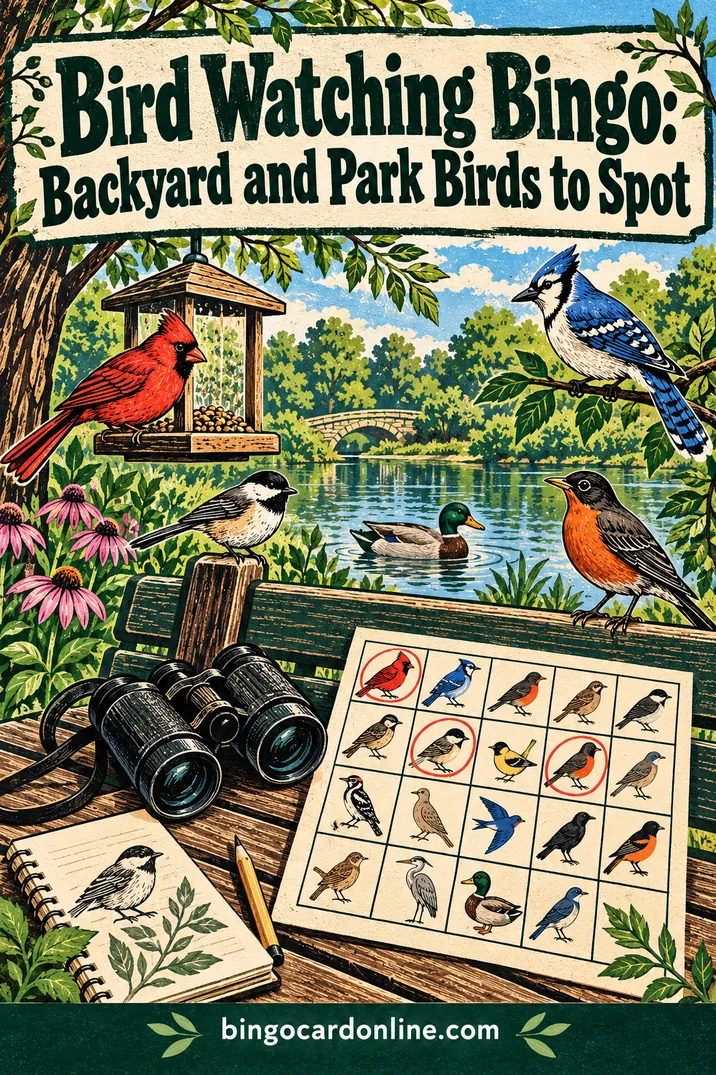
Bird watching bingo is a simple card of common birds that you mark off as you see or hear them, on a backyard morning, a park walk or a stroll around a pond. Below are ready bird lists by habitat and season for North America, so you can build a card that matches where you are actually walking, plus tips for spotting each bird and marking your card fairly.
This version is made for adults: walking groups, senior centers, retirees, couples on a weekend stroll and casual birders who want a little structure on a walk. You do not need special gear or years of experience. A card, a pencil and a bit of patience are enough.
Bird Lists for Your Bird Watching Bingo Card
Pick the list that matches your spot, then choose 24 birds for a 5x5 card or 8 for a quick 3x3 card. Common birds should take up most of the card, with just a few harder ones for a challenge.
Backyard and Feeder Birds
These are the birds most people in the United States and southern Canada can find around homes, feeders and quiet streets.
- American robin
- Northern cardinal
- Blue jay
- Black-capped or Carolina chickadee
- Tufted titmouse
- American goldfinch
- House finch
- House sparrow
- Song sparrow
- Dark-eyed junco (mostly in colder months)
- Mourning dove
- Downy woodpecker
- Red-bellied woodpecker
- White-breasted nuthatch
- Northern mockingbird
- Gray catbird
- European starling
- Common grackle
- Carolina wren or house wren
- Ruby-throated hummingbird (warm months, eastern areas)
City Park Birds
Parks mix open lawns, tall trees and paths, so they bring in a slightly different crowd.
- Rock pigeon
- American crow
- Red-winged blackbird
- Northern flicker
- Cedar waxwing
- Brown-headed cowbird
- Chipping sparrow
- Eastern bluebird (open areas with nest boxes)
- Barn swallow
- Chimney swift
- Red-tailed hawk
- Turkey vulture
- Killdeer (on open fields and gravel lots)
- Eastern phoebe
- Baltimore oriole (spring and summer, eastern areas)
Pond, Lake and Wetland Birds
Any body of water, even a small retention pond, can hold a few of these.
- Mallard
- Canada goose
- Great blue heron
- Great egret
- Belted kingfisher
- Ring-billed gull
- Double-crested cormorant
- Wood duck
- American coot
- Pied-billed grebe
- Tree swallow
- Osprey
- Bald eagle
- Mute swan or trumpeter swan, depending on your area
- Green heron
Western Backyard Swaps
If you live in the western United States, swap in a few of these where they fit your area:
- California scrub-jay or Steller's jay
- Anna's hummingbird
- Lesser goldfinch
- Spotted towhee
- Bushtit
- Black phoebe
- Western bluebird
- Acorn woodpecker
Every region is a little different. A local bird club, nature center or park ranger can tell you which birds are most common where you live, and you can adjust your card from there.
Seasonal Cards
Birds come and go with the seasons. A card that matches the time of year makes the game more fun and keeps it fair.
| Season | Good squares to add | Squares to skip |
|---|---|---|
| Spring | Returning robins, red-winged blackbirds, swallows, orioles, warblers, nest building | Winter-only birds like juncos in many areas |
| Summer | Hummingbirds, fledglings following parents, swallows over water, catbirds | Migrating flocks |
| Fall | Geese in V-shaped flocks, flocks of blackbirds, hawks overhead, goldfinches in duller feathers | Hummingbirds in northern areas late in the season |
| Winter | Juncos, cardinals in bare trees, chickadees, woodpeckers at suet, ducks on open water | Most songbirds that head south |
Spring Migration Squares
Spring migration is the most exciting time to play bird watching bingo, because new birds show up almost every week. Try squares like these:
- Hear a bird singing before sunrise
- See a bird carrying nesting material
- Spot a warbler (any kind)
- See a hummingbird at a flower or feeder
- Watch swallows skimming over water
- Hear a red-winged blackbird calling from a cattail
- Spot an oriole
- See a robin pulling up a worm
Behavior Squares
Behavior squares are great for mixed groups, because they do not require naming the bird.
- A bird taking a bath
- A bird eating a seed
- A bird singing from the top of a tree
- Two birds chasing each other
- A woodpecker drumming
- A bird building a nest
- A bird feeding its young
- A flock flying together
- A bird perched on a wire
- A duck tipping upside down to feed
- A hawk circling high overhead
- A bird hopping on the ground
Mix five or six behavior squares into any card. They give new birders an easy start and keep the game moving when birds are hard to identify.
🐦 Ready to play? Turn these ideas into printable backyard bird bingo cards with the free generator: every card is unique, ready in seconds, no sign-up.
Make my bingo cards →How to Play Bird Watching Bingo
- Choose your spot. A backyard, a park loop or a lake trail all work.
- Build your card. Use the lists above to fill a 5x5 or 3x3 card. Make each player's card a little different so not everyone wins at once.
- Set the rules for marking. Decide as a group whether hearing a bird counts or whether you must see it. Many groups count a clear song only if someone in the group knows it well.
- Walk slowly and look up, down and around. Birds hide in bushes, sit on wires, walk on lawns and float on water.
- Mark as you go. Pencil works better than pen outdoors because it does not smear.
- Call bingo. The first player with a row, column or diagonal wins the round. Keep walking for a full card if your group wants a longer game.
You can make printable, shuffled cards in seconds with the free bingo card generator. Paste your list of birds, choose the grid size and print one card per walker.
Tips for Spotting Each Bird
Listen first. You will often hear a bird before you see it. Stop for a minute, stay quiet and turn your head slowly toward the sound.
Look for movement. A twitching branch or a flash of color is usually the first sign. Once you see movement, keep your eyes on that spot.
Watch the edges. Birds love the border where a lawn meets bushes, or where a path meets the water.
Learn a few shapes. Even from far away, you can often tell a duck from a heron, or a hawk from a crow, by its shape and the way it flies.
Notice size and color. Is it robin-sized, smaller or bigger? Does it have a bright patch on the head, wings or tail? These clues narrow things down fast.
Go early. Birds are most active in the morning. A walk in the first few hours after sunrise usually brings the fullest card.
Bring binoculars if you have them, but do not let a lack of gear stop you. Many birds on these lists are easy to see with the naked eye.
Quick Clues for Common Birds
New players often get stuck on the same handful of look-alikes. This short table gives one or two easy clues for birds that show up on most cards.
| Bird | Easy clue |
|---|---|
| American robin | Gray back with a warm orange-red breast; often runs and stops on lawns |
| Northern cardinal | Male is bright red with a crest; female is warm tan with a red-orange bill |
| Blue jay | Blue, white and black with a crest; loud, harsh calls |
| Chickadee | Small and round with a black cap and black bib; often says its own name |
| Mourning dove | Soft tan-gray with a long pointed tail; gentle cooing song |
| American goldfinch | Male is bright yellow with black wings in summer; duller in winter |
| Downy woodpecker | Small black-and-white woodpecker; climbs up tree trunks |
| Red-winged blackbird | Male is black with red and yellow shoulder patches; loves cattails |
| Mallard | Male has a shiny green head; female is mottled brown |
| Great blue heron | Very tall gray wader standing still at the water's edge |
| Turkey vulture | Large dark bird soaring with wings held in a shallow V, rocking side to side |
| Canada goose | Black neck and head with a white chin strap |
Two Ready Sample Cards
If you want to head out today, here are two quick 3x3 cards you can copy onto paper.
Backyard morning card: American robin, Northern cardinal, Blue jay, Mourning dove, FREE (any bird singing), House finch, Chickadee, Downy woodpecker, A bird taking a bath.
Pond loop card: Mallard, Canada goose, Great blue heron, Red-winged blackbird, FREE (a duck tipping upside down), Ring-billed gull, Tree swallow, Belted kingfisher, A turtle on a log (a fun bonus square).
Both cards lean on common birds, with one or two harder squares to keep things interesting. If your group finishes quickly, flip the paper over and build a 5x5 card for the walk back.
Keeping a Simple Bird Log
Many players enjoy saving their cards. Write the date, the place and the weather on the back of each one. Over a few months, you will start to see patterns: the week the robins came back, the first hummingbird of summer, the morning the geese flew over in a long V. It is a gentle way to notice the seasons change, and it turns each bingo card into a small keepsake from a good walk.
Playing With a Group
Bird watching bingo works well for walking clubs, senior centers and community groups.
- Pair new birders with experienced ones. It turns the game into a friendly lesson.
- Use picture cards. Cards with a small drawing or photo of each bird help players who are still learning names.
- Keep the pace easy. Choose a flat, short loop with benches, especially for older players.
- Agree on what counts. Decide before you start whether a quick glimpse, a clear song or a group sighting is enough.
- Share the finds. At the end, go around and let everyone name their favorite sighting.
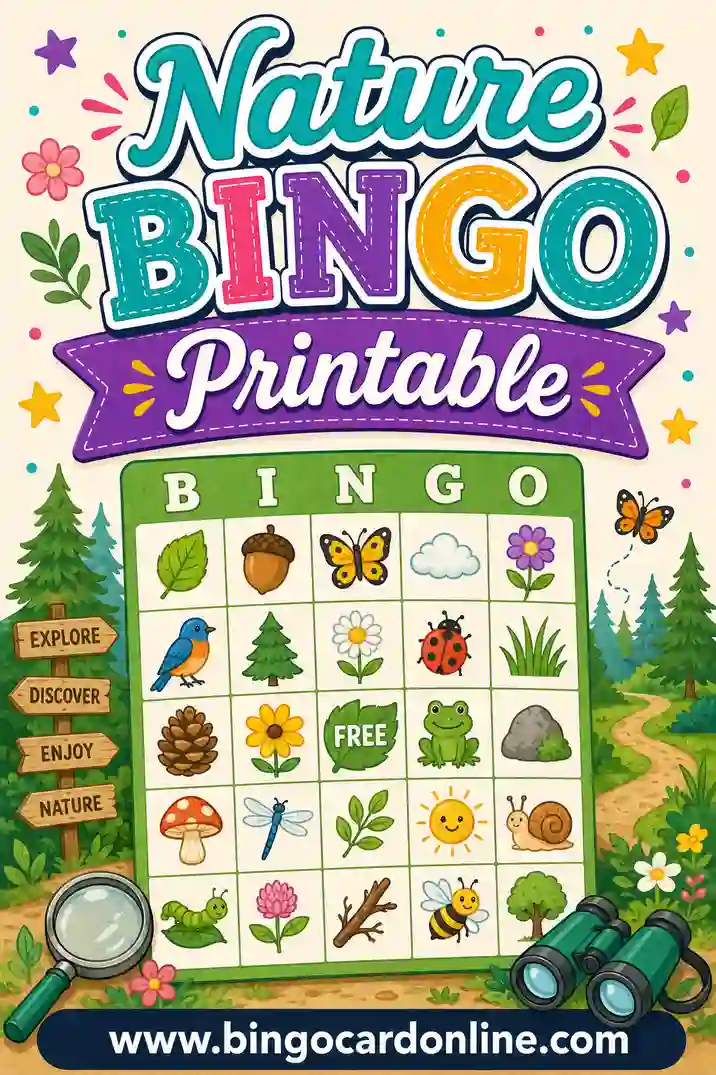
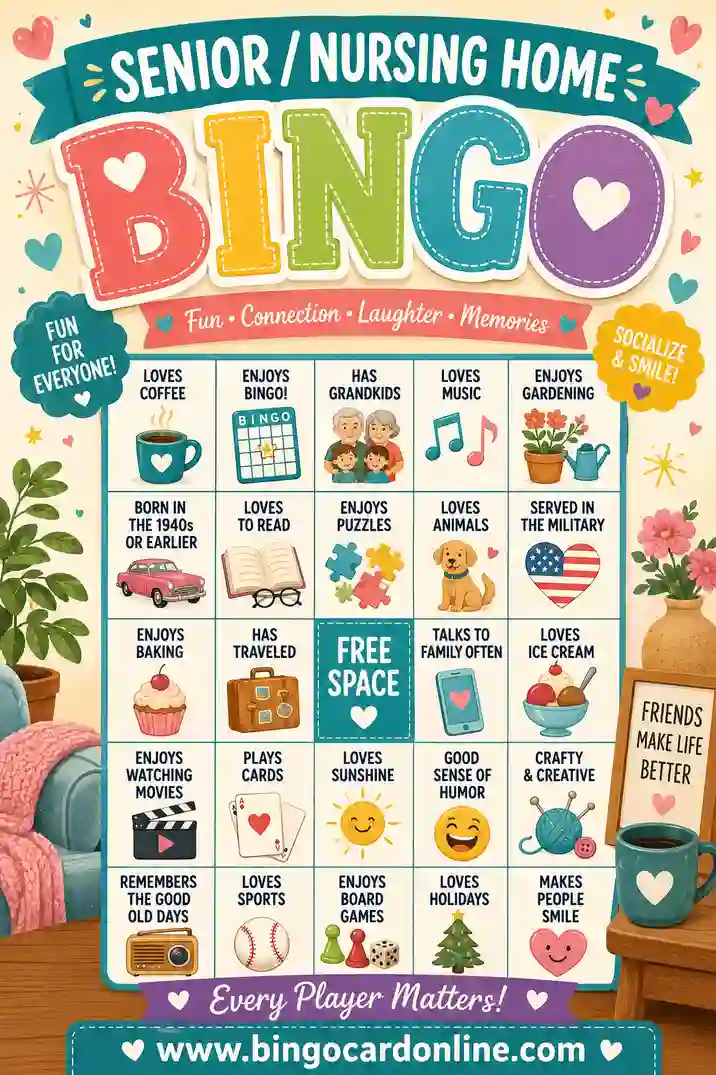
Our guide to senior and nursing home bingo has more ideas for adapting cards with large print and easy rules. For a broader outdoor game with leaves, rocks and clouds, see nature bingo.
Bird Watching Bingo on the Road
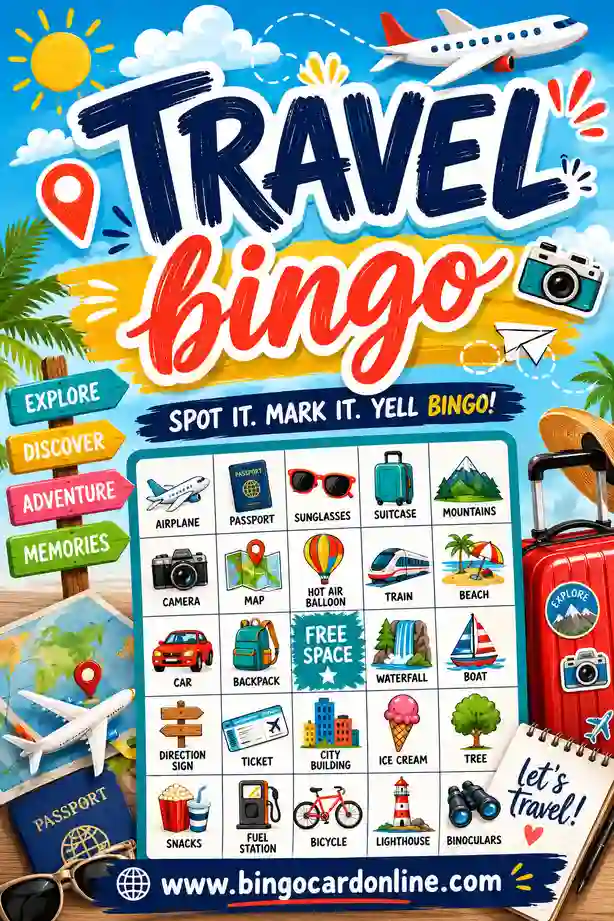
You do not need to stay home to play. Bring a card on vacations, camping trips and long drives. Birds change from region to region, so a coastal trip might bring pelicans and sandpipers, while a mountain trip might bring jays and nuthatches. Pair a bird card with our travel bingo or road trip bingo cards for a full day of spotting.
Being a Good Bird Watcher
A friendly game should also be kind to the birds.
- Keep your distance. If a bird stops what it is doing to watch you, you are too close.
- Leave nests alone. Watch from far away and never touch eggs or young birds.
- Stay on the path. It protects plants and nesting spots.
- Do not chase birds to get a better look or to mark a square.
- Keep noise low. You will see more birds anyway.
- Do not feed bread to ducks and geese. It is not good for them.
Mistakes to Avoid
- Making the card too hard. If most squares are rare birds, players get discouraged. Keep most squares to common birds.
- Ignoring the season. A winter card full of hummingbirds and orioles cannot be finished in many areas.
- Ignoring the region. Use local birds. A western card should not be full of eastern species.
- Skipping the rules about hearing vs. seeing. Decide before the walk, not during an argument.
- Walking too fast. Birds are easy to miss at a brisk pace. Slow down and stop often.
- Forgetting a pencil. Pens can smear in damp air, and markers bleed through thin paper.
Your backyard bird bingo game is one click away. Add your own squares, choose a 3x3, 4x4 or 5x5 grid and print up to 100 unique cards free.
Open the free bingo card generator →FAQ
What birds are easiest to put on a bird watching bingo card?
Robins, cardinals, blue jays, mourning doves, house sparrows, crows, mallards and Canada geese are common in much of North America and make great starter squares.
Does hearing a bird count?
That is up to your group. Many groups only count a bird by sound if someone knows the song well. Decide before you start so the game stays friendly.
When is the best time of day to play?
Morning is usually best, since birds are most active in the hours after sunrise. Late afternoon can be good too, especially near water.
Can I play bird watching bingo from home?
Yes. A window that faces a feeder, a bush or a tree is enough for a backyard card. Many people play from a porch with a cup of coffee.
What is the best card size?
A 3x3 card works well for short walks and new birders. A 5x5 card is better for longer walks, experienced groups and full-day outings.
Is bird watching bingo good for seniors?
Yes. It is gentle, social and can be played on a short flat loop or from a bench. Large-print or picture cards make it easier to follow.
Do I need binoculars?
No. They help, but many common birds can be seen easily without them. Start with what you have and add gear later if you enjoy the hobby.