Super Bowl Bingo: Free Printable Cards
Watch-party bingo turns the NFL's championship game into something every guest can play, whether they follow football all season or came for the food and the commercials. There's no caller. The broadcast does the calling: when a moment on your card happens on screen, you mark it. This guide focuses on writing squares that actually resolve within one game, pacing the card across four quarters and halftime, and running it for a crowd that isn't all football fans.
Every guest needs a different layout, so let the free bingo card generator do the shuffling. Paste in the moment list below, choose a grid size, and print a unique card for everyone. This site isn't affiliated with or endorsed by the NFL; it's simply a party game for people watching at home.
The Broadcast Is Your Caller
In regular bingo, a caller controls the pace. At a watch party, the game, the ads, and the halftime show decide when squares get marked. That changes how you design the cards. You can't redraw a call that never comes, and you can't speed up a slow first quarter. The squares have to be chosen so a line is realistic by late in the game, but not so easy that half the room shouts "Bingo!" before the first commercial break.
It also means you need one referee. Pick a person, usually the host, to settle "does that count?" questions, and agree on two rules before kickoff: a replay of an earlier play is not a new moment, and a commercial counts only the first time it airs.
Free Super Bowl Bingo Word List (Copy & Paste)
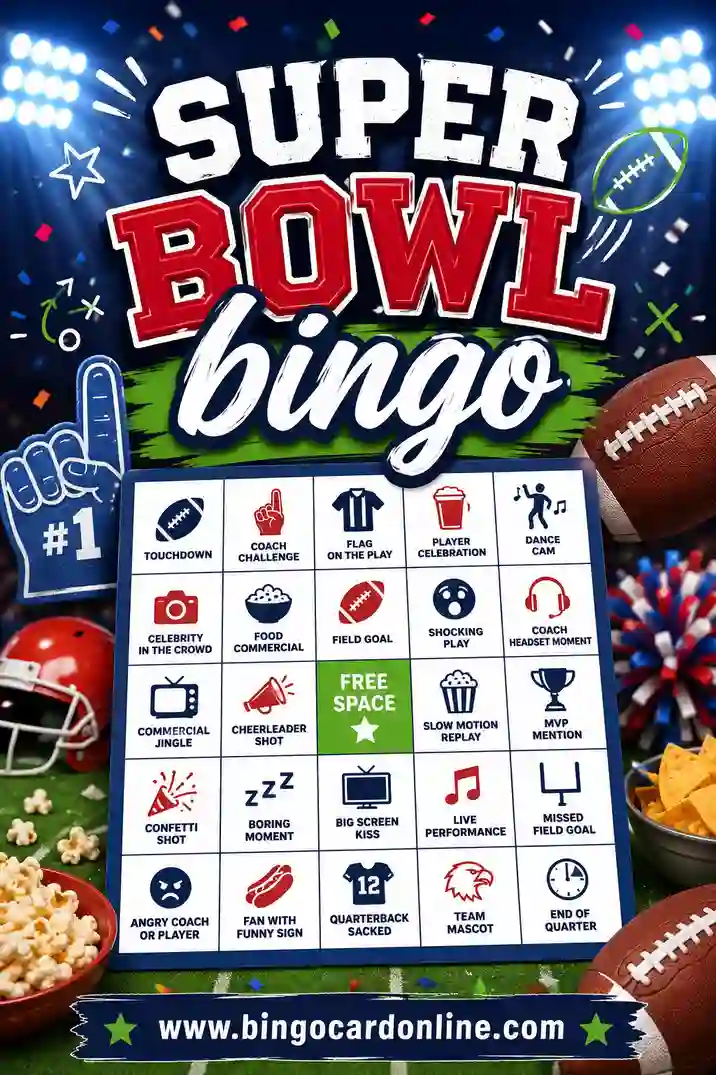
Here's a ready-to-use list of 30 game-day moments. Pick any 24 for a 5x5 card (the 25th square is your free space), or grab 9 for a quick 3x3. Copy a column straight into the generator.
| On the Field | Broadcast & Booth | Ads & Halftime |
|---|---|---|
| Touchdown | Instant replay | Funny beer commercial |
| Field goal | Slow-motion shot | Celebrity in an ad |
| Interception | Coach looks angry | Talking animal ad |
| Fumble | Penalty flag thrown | Tearjerker commercial |
| Two-point try | Stats on screen | Movie trailer airs |
| Quarterback sack | Aerial stadium shot | Halftime guest star |
| Gatorade shower | Coin toss | Pyrotechnics on stage |
| Player celebration | Booth disagrees | Wardrobe change |
| Fourth-down gamble | Crowd shot | Dancers fill the field |
| Goal-line stand | Celebrity in the crowd | Big-name singer |
Mix and match across columns for variety. If your crowd is more here for the ads and halftime than the football, weight your squares toward those two columns.
Writing Squares That Resolve in a Single Game
The most common mistake is filling the card with things that might not happen at all. Sort your ideas into three tiers and use some of each:
- Near-certain (about a third of the card). The coin toss, the opening kickoff, a punt, a penalty flag, an instant replay, the two-minute warning, a timeout, a crowd shot, the halftime show starting. These give everyone early marks and keep people engaged.
- Likely, timing unknown (about half). A touchdown, a field goal, a quarterback sack, a play reviewed by officials, a third-down conversion, a player celebration in the end zone, an ad with a celebrity, an ad with an animal.
- Long shots (three to five squares). A safety, a missed extra point, a fake punt, a defensive touchdown, a successful two-point conversion, overtime. These keep the blackout round alive into the fourth quarter.
Write every square so there's no argument about it. "Big play" will start a debate; "a play that gains 20 or more yards" won't, because the broadcast usually shows the yardage. "Funny ad" is a matter of taste; "an ad with a talking animal" isn't.
Be careful with squares tied to one named player. Starting quarterbacks are a safe bet, but injuries and game plans change, and a square that's dead by halftime is no fun for whoever has it. Squares about the matchup in general ("either team scores on its first drive") age better than squares about one receiver.
A quick football refresher for square writers
- A touchdown is worth 6 points. The scoring team then tries for 1 extra point with a kick or 2 points with a play from close range.
- A field goal is worth 3 points, and a safety is worth 2.
- The game has four 15-minute quarters, with a two-minute warning near the end of each half. Each team gets three timeouts per half.
- Coaches can throw a red challenge flag to ask for a review of certain plays. Scoring plays and turnovers are reviewed by officials automatically.
- If the score is tied after four quarters, the game goes to overtime.
Pacing the Card Quarter by Quarter
A championship broadcast is long: pregame coverage, four quarters, an extended halftime, and the trophy presentation. Energy dips are normal. Plan rounds around them instead of hoping one card carries the whole evening.
| Phase | What usually happens | Bingo idea |
|---|---|---|
| Pregame | Anthem, team introductions, coin toss | Hand out cards and markers. Mark coin-toss and anthem squares. |
| 1st quarter | Opening drives, first ad breaks | Single-line round. First line wins a small prize. |
| 2nd quarter | Two-minute warning, hurry-up drives before the half | Four corners on the same card. |
| Halftime | The show, guest performers, analysts | A separate 3x3 halftime card, so non-fans get their moment. |
| 3rd quarter | Often the quietest stretch | Hand out fresh second-half cards for everyone. |
| 4th quarter and postgame | Close finish, confetti, trophy, the cooler dump on the winning coach | Blackout race, with the final prize at the trophy presentation. |
If the game turns into a blowout, a fresh second-half card saves the party. Print two sets before guests arrive, one for each half, so you're not standing at the printer during the third quarter.
One Card for Fans and Non-Fans
Most watch parties are mixed. Some guests want real football on the card; others are there for the ads, the halftime show, or the company. Blend the squares to match the room. For a crowd of mostly fans, lean toward on-field plays. For a general party, a rough split of one third game action, one third broadcast moments, and one third ads and halftime gives everyone something to watch for.
- Use plain wording. "The defense recovers a fumble" is clearer to a newcomer than "takeaway."
- Add broadcast squares anyone can spot: a coach on the headset, an aerial shot of the stadium, a stat graphic, a slow-motion replay.
- Seat a fan next to a newcomer. Explaining why a flag was thrown is half the fun for the person who knows.
- Give kids a 3x3 card with moments they can see for themselves: a touchdown, a player spiking the ball, a referee signaling, confetti at the end.
Office Pool or Family Party?
The format works at work and at home, but the setup differs. In both cases, keep it about prizes and bragging rights, not money. No entry fees, no buy-ins, no cash pots. That keeps everyone included and keeps a party game from running into workplace policies or local rules.
At the office
- Hand out cards on the last workday before the game. People mark them at home and bring them back the next workday.
- The organizer checks claimed lines against the game recap or play-by-play the next morning.
- Prizes can be first pick of a breakfast spread, a silly desk trophy that rotates each year, or a reserved parking spot if the company allows it. Check with a manager before you start.
- Keep team rivalries friendly, and email a printable card to remote coworkers so they can play too.
At a family party
- Play live in the room, with rounds tied to the quarters.
- Give the youngest players a 3x3 card, or let them share a card with a grown-up.
- Small prizes per round work well: choosing dessert, picking the halftime snack, or a team-colored pencil.
- Use dry markers like pretzels or popcorn rather than anything sticky. Greasy fingers and paper cards don't mix.
Reusing the Format for Other Championships
Nothing about this method is specific to football. Keep the three tiers (near-certain, likely, long shot), swap in sport-specific moments, and adjust the rounds to how that sport is played.
- Baseball (World Series). Pitching change, mound visit, stolen base, double play, home run, full count, the seventh-inning stretch. Extra innings is your long shot. Baseball has no game clock, so plan rounds by innings.
- Soccer (a World Cup or league final). Yellow card, corner kick, offside flag, a video review, a header on goal, added time shown on the board. A penalty shootout is the long shot. Play one round per half.
- Basketball finals. Three-pointer, dunk, alley-oop, timeout, free throws, a reviewed call. Overtime is the long shot.
- Hockey finals. Power play, a big save, a puck over the glass, an empty-net goal near the end.
The prize-only rule and the referee rule carry over unchanged.
Watch-Party Bingo Questions
Do I need a caller?
No. Guests mark squares when the moment happens on the broadcast. You only need one referee to settle disputes and check winning cards.
What if nobody gets bingo by the end of the game?
Decide a tiebreaker before kickoff. The simplest is that the card with the most marked squares at the final whistle wins. A better fix for next year is adding more near-certain squares.
How many long-shot squares should a card have?
Three to five on a 5x5 card is plenty. Enough to keep a blackout round interesting, but not so many that lines never finish.
Can we play for money at the office?
Keep it to prizes and bragging rights. Cash pots raise workplace-policy and legal questions that a party game doesn't need, and prize-only games keep everyone comfortable joining.
How do I include kids and non-fans?
Give kids a 3x3 card of easy-to-spot moments and weight adult cards toward ads, halftime, and broadcast moments. A separate halftime card gives non-fans a round of their own.
Can I use these cards for other sports?
Yes. Replace the football squares with moments from baseball, soccer, basketball, or hockey, and plan rounds around innings, halves, or periods instead of quarters.
Copy the moment list above into the free bingo card generator, print a first-half and second-half set, and hand them out before kickoff. Every card comes out different, so the first "Bingo!" could come from anyone in the room.