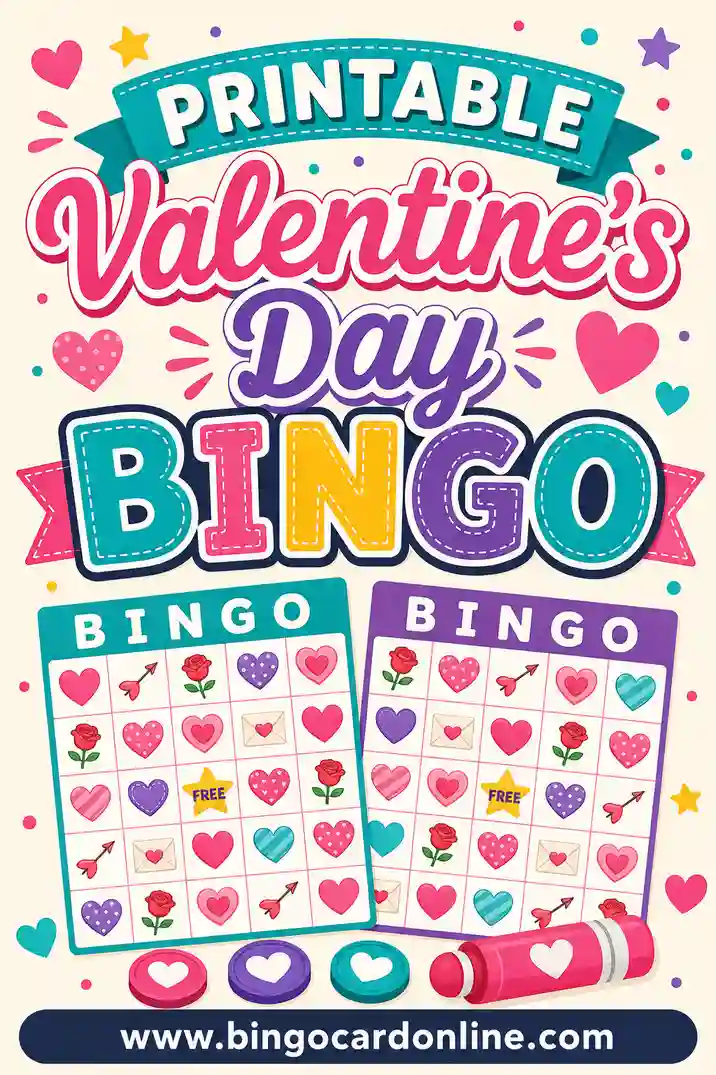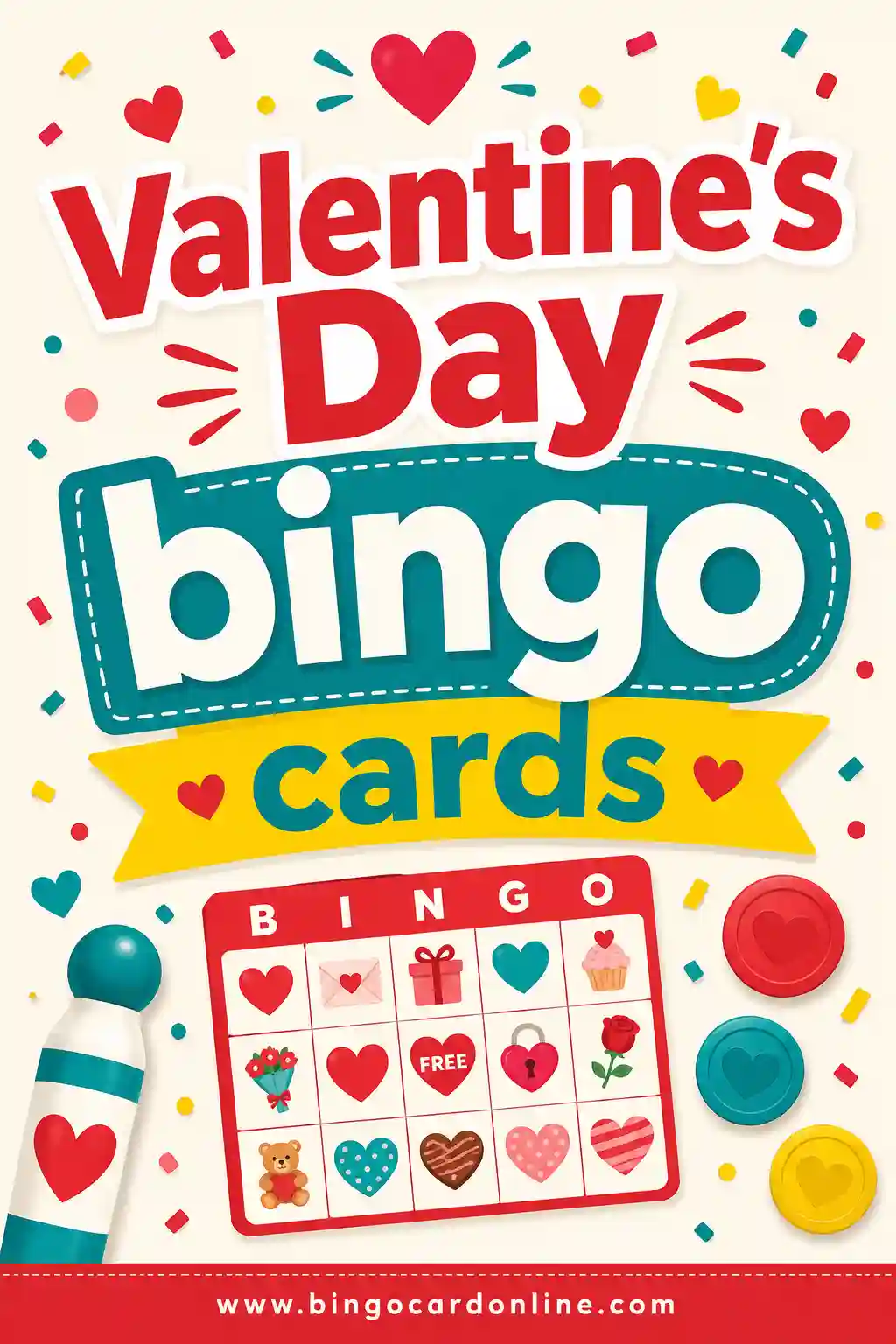
24 Valentine Bingo Cards Free Printable: Class Party Set
Need 24 valentine bingo cards, free printable, and preferably ready before the class party tomorrow? That's exactly what this page delivers. Twenty-four is the magic number because it's the typical class size — one card per student, every card unique so there's a real winner — and the free bingo card generator produces a set of 24 (or 28, or 30) in one go. Paste the word list below, type your card count, print. No sign-up, no watermark, no design work.
This guide is built for the person printing a class set: the teacher, the room parent, the aunt hosting eleven sugar-charged cousins. You'll get the word list, the print settings that save ink on 24 cards, and a party run-sheet that fills 30 minutes without chaos.
Why a Set of 24 Cards, Specifically?
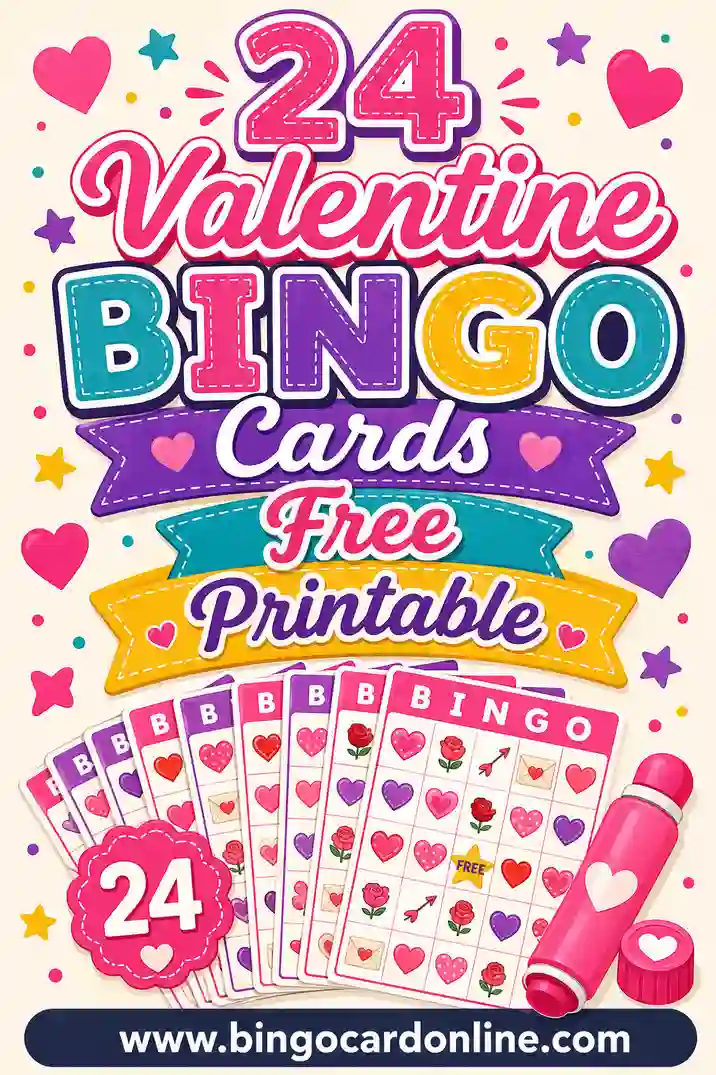
Because that's roughly how many kids are in a classroom — and because "24 unique cards" is exactly the thing you can't do with a photocopier. Copy one card 24 times and every child completes the same line on the same call: twenty-four simultaneous "BINGO!"s and zero satisfying winners. A real set needs 24 different layouts built from the same word list, which is precisely what the generator does automatically. It shuffles each card independently and checks it against the rest of the batch, so every student has a genuinely different grid.
One practical upgrade while you're at it: print 27 or 28, not exactly 24. A card will get ripped, decorated with marker, or claimed by a sibling. Spares cost two sheets of paper and save the day.
What Goes on a Valentine Bingo Card?
Hearts, obviously — but a good card mixes categories so calls stay interesting. Each square is a Valentine word or image; the caller announces them one at a time; kids mark matches with candy hearts or paper chips. First line wins, and with 24 unique cards you'll get one clean winner instead of a shouting match.
For little ones (pre-K to 1st grade), pick concrete squares they can picture instantly: heart, rose, teddy bear. For 2nd grade and up, the full 5x5 with wordier squares works — and doubles as sneaky reading practice.
Free Valentine Word List for a Class Set (Copy & Paste)
Here are 30 squares — paste all of them so the generator has enough variety to make 24 truly distinct cards. (24 words would technically fill a 5x5 card, but more words = more different cards.)
| Sweet Things | Symbols & Colors | Kind Words |
|---|---|---|
| Candy hearts | Heart | Best friend |
| Chocolate box | Cupid | Hug |
| Heart cookie | Arrow | Be mine |
| Pink cupcake | Red rose | XOXO |
| Lollipop | Love letter | Sweetheart |
| Cinnamon hearts | Pink balloon | Love bug |
| Strawberry | Ribbon | You rock |
| Heart cake pop | Bouquet | Super friend |
| Sprinkles | Teddy bear | Kind heart |
| Cherry | Valentine card | Big smile |
Teachers: swap the "Kind Words" column for this week's sight words or vocabulary and the party game quietly becomes a review session. Nobody will notice. More ideas like that live in our classroom bingo guide.
One more list decision worth two seconds of thought: skip anything that needs explaining. "Cupid's arrow" and "arrow" on the same card will trigger a twenty-hand debate about whether they're the same square. Keep each item clearly distinct and the game referees itself.
How to Print Your 24-Card Set in 4 Steps
- Open the free generator and choose the Words card type.
- Paste the word list above (or your own 30 squares).
- Set the number of cards to 28 — 24 players plus spares — and pick your grid: 5x5 for 2nd grade and up, 4x4 for K–1, 3x3 for preschool. Add a title like "Room 12 Valentine Bingo" and it prints on every card.
- Print. Choose 2 or 4 cards per page to keep the stack to 7–14 sheets, or Save as PDF and send it to the school copier. Print the master call sheet on one extra page — that's how you call the game and verify the winner.
Realistic total time: about five minutes, and most of that is the printer.
The 30-Minute Class Party Plan
Here's a run-sheet that room parents can execute without rehearsal:
- Minutes 0–5: setup. One card and a small cup of markers (candy hearts, cereal, or paper chips) per desk. Explain the win rule: one straight line, any direction, free space counts.
- Minutes 5–15: Round 1, single line. Call one word every 10–12 seconds. Kids need a beat to scan. First "Bingo!" gets verified against your call sheet, wins first pick from the prize basket — then keep calling until two or three more kids win, so it's not winner-takes-everything.
- Minutes 15–20: Round 2, four corners. Fast, easy, resets the energy.
- Minutes 20–30: Round 3, blackout. Fill the whole card. This round conveniently absorbs the end of the party, and everyone eats their markers when it's done.
Bonus job for a kid who'd rather run things than play: deputy caller. They draw the next word slip from the bowl and hand it to you to announce — a coveted position, and it keeps one more student invested. Rotate deputies each round and you've quietly created three more winners.
Want a hands-free version? Put the built-in caller on the smartboard: it draws words with no repeats, speaks each call out loud with voice on, and the auto-call timer paces the game every 10 or 15 seconds while you handle the "he took my candy hearts" arbitration.
Prizes That Work When 24 Kids Are Playing
The prize table matters more than the cards at a class party, because bingo is pure luck — which means any kid could go home empty-handed through no fault of their own. A structure that keeps 24 hearts unbroken:
- Plan for 5–6 winners minimum. Three rounds with one or two winners each gets you there. Keep calling after the first "Bingo!" in round one so second and third place win something too.
- Small, identical-ish prizes. Pencils, stickers, erasers, fun-size candy — a basket where every prize is roughly equal prevents the podium drama that one "big" prize creates.
- Everyone-wins finale. The blackout round ends with every card full eventually. Call it out: "If your whole card is marked, you win — eat your markers!" Twenty-four winners, zero tears, and the candy hearts were the prize all along.
- Non-candy classrooms: heart stickers, bookmarks, extra recess minutes, or "line leader for a day" coupons all work as currency. Second graders will trade kingdoms for line leader.
Beyond the Classroom: Other Groups of ~24
The 24-card set fits more than school parties:
- Church and scout groups. Same set, same rules; swap in a few kindness-themed squares.
- Family Valentine dinners. Print eight cards from the same list — the generator makes any quantity — and the toddler-to-grandma table plays together.
- Office February birthdays. Adult crowds enjoy it more than they admit. Add squares like "heart-shaped pizza" and "someone says 'Galentine's.'"
If you want the broader Valentine game with adult party variations and age tables, our printable Valentine's Day bingo guide covers all of it, and there's a full theme guide at Valentine's Day bingo cards.
Printing Tips for a 24-Card Batch
Printing one card is easy; printing 24 rewards a little strategy.
- Use 4-per-page for older kids. Quarter-page cards are plenty big for 3rd grade and up, and your 24-card set fits on 6 sheets.
- 1 or 2 per page for the littles. Small hands and chunky markers need real estate.
- Ink-saver mode is your friend. Twenty-four cards in full color drinks a cartridge; ink-saver keeps the theme without the drain. Black-and-white plus "color your card after" is a bonus activity, not a compromise.
- The school copier trick: Save as PDF, print one master run at school, done. The PDF keeps each card unique — it's not one card repeated.
- Cut with a paper cutter, not scissors. Twenty-four cards is 24 chances for a wobbly cut line.
Common Mistakes to Avoid
- Photocopying one card 24 times. Worth repeating: identical cards = everyone wins at once = tears. Generate the set instead.
- Exactly 24 words for 24 cards. Fill the list to 30+ so the layouts differ meaningfully.
- No spares. Print 10–15% extra. Valentine parties involve frosting.
- Skipping the call sheet. You need the record to verify a winner — and kids will audit each other.
- One prize for one winner. With 24 players, structure prizes so 4–6 kids win something. Bingo's luck-based, and February hearts bruise easily.
- Calling too fast. Ten seconds per call minimum for elementary kids. When in doubt, use the auto-call timer.
Frequently Asked Questions
Are the 24 valentine bingo cards really free to print?
Yes — completely. The generator has no sign-up, no watermark, and no card limit, so a 24-card class set (or a 30-card one) costs only your paper and ink.
Are all 24 cards actually different?
Yes. Each card is shuffled independently from your word list and checked against the others in the batch, so no two students share a layout — which is what makes a single, verifiable winner possible.
Can I print more than 24 cards?
Absolutely. The number is up to you — print 28 to cover spares, or 60 for a whole grade. Same word list, one print run.
What grid size should I use for a class party?
5x5 for 2nd grade and up, 4x4 for K–1 (shorter rounds, fewer squares to scan), 3x3 with picture-simple words for preschool. You can print two sizes from the same list for a split-age group.
What do kids use as markers?
Candy conversation hearts are the classic — cheap, thematic, and edible at the end. Cereal, paper chips, or heart stickers work too. The generator can even print a sheet of paper bingo chips alongside your cards.
How do I call the game?
Print the master call sheet and read words in any order, crossing each off as you go — or put the built-in caller on the classroom screen with voice and auto-call on, and it runs the whole game for you, no repeats guaranteed.
Print Your 24 Valentine Bingo Cards Now
Copy the word list, open the free bingo card generator, set the count to 28, and print your class set — every card unique, call sheet included, ready for February 14. Five minutes of prep for thirty minutes of happy chaos. That's a trade any room parent takes.