4th of July Bingo Cards: Free Printable & Fun
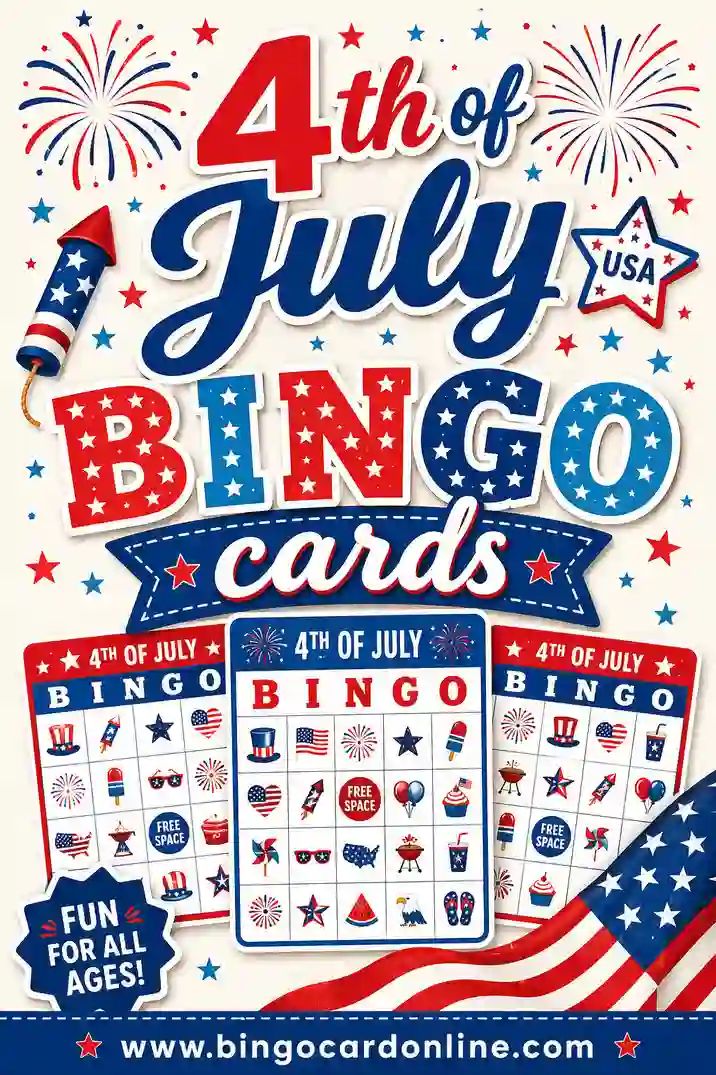
4th of July bingo cards are 5x5 grids filled with patriotic words and pictures instead of numbers, like "fireworks," "American flag," and "watermelon." You call out items, players mark the squares they have, and the first to finish a line shouts "Bingo!" The fastest way to get a full set is a free bingo card generator that shuffles your word list into unique cards everyone can print before the cookout.
Want to skip the prep? Open the free generator, paste in a 4th of July word list (there's one ready below), and print as many unique cards as you need. No sign-up, no cost, nothing to install.
Why the Fourth Suits Bingo: A Day Made of Waiting
Few holidays involve as much standing around as the Fourth of July. You wait for the parade to reach your corner, for the grill to come up to temperature, for the burgers, for the lake to warm up, and finally for the sky to get dark enough that the fireworks can start. Bingo fits into those gaps because it asks almost nothing of the players: a card, something to mark with, and a reason to look around.
That is also why the best Fourth of July cards are not really about numbers or even about calling. They work as a scavenger hunt on paper. A square that says "someone in a flag-print swimsuit" sends a bored eight-year-old scanning the whole beach, and a square that says "a dog wearing a bandana" will get a laugh from the adults too. The rest of this page covers the formats that suit each part of the day, how to keep paper alive in July weather, and how to build a history round that gets the facts right.
If you only want the cards, open the free generator, paste in the list below, and print. Everything after the list is optional.
The Free 4th of July Word List (30 Squares)
Here's a ready-to-use list of 30 squares. Pick any 24 for a 5x5 card (the 25th is your free space), or grab 9 for a toddler-friendly 3x3. Copy whichever column you like into the generator.
| Stars & Stripes | Cookout & Summer | Fun & Festive |
|---|---|---|
| Fireworks | Watermelon | Parade |
| American flag | Hot dogs | Marching band |
| Bald eagle | Hamburgers | Face paint |
| Liberty bell | Corn on the cob | Three-legged race |
| Statue of Liberty | Lemonade | Water balloons |
| Red, white, blue | BBQ grill | Cannonball |
| Sparklers | Apple pie | Sack race |
| Fireflies | Picnic basket | Patriotic hat |
| Star spangled | Ice cream | Bunting |
| Uncle Sam | Potato salad | Sunburn |
Match the Card to the Part of the Day
One card rarely covers a whole Fourth. Morning at the parade, afternoon at the grill, and nightfall at the fireworks each call for different squares, so it is worth printing a small set for each moment rather than one all-purpose stack.
Curbside parade bingo
Parade squares should be things that roll past at their own pace: a fire engine, a color guard, a veterans' group, a high school band, a float with a giant papier-mache anything, a convertible with a local official waving, a horse, a tractor, candy thrown into the crowd. Because you cannot control what shows up, make the free space something certain, like "the first siren." A 4x4 card suits this one, since people will be holding it in one hand with a paper cup of lemonade in the other.
Cookout bingo
This is the humor round. Squares can be the small dramas of every backyard barbecue: someone says "it needs five more minutes," a flipped burger lands on the ground, the cooler gets dragged to a new spot, an uncle starts a political argument and gets steered away from it, a toddler holds a hot dog like a microphone. Keep these affectionate and avoid naming individual guests unless they are in on the joke. Squares invented by the host, like "Grandma's potato salad gets seconds," are the entire point.
Road-trip bingo
The Fourth is one of the heaviest travel holidays of the year, and plenty of families spend part of it in a car. Build a window-watching card: a flag on a front porch, a billboard for fireworks, a roadside produce stand, a boat on a trailer, a minivan with a kayak on the roof, a rest stop with a long line, a license plate from another state. Give each seat its own card so the front passenger can referee. Print on letter-size paper and bring a clipboard or hardcover book so each card has a hard surface to rest on.
Lake and beach bingo
Shore squares: a cannonball, a pool noodle, a kid buried in sand, a dog that will not come out of the water, a kite, a floating cooler, a boat towing a tube, someone applying sunscreen for the third time. Because these cards live near water, laminate them or tuck them in a zip-top bag and have players mark through the bag with a dry-erase marker.
Fireworks-Watching Bingo, Including After Dark
The show is the one stretch of the day where the card has to work in the dark, and it should not compete with the actual fireworks. A few choices help.
- Use big squares and few of them. A 3x3 or 4x4 card is easy to read by dim light. Use bold, large type and keep each square to one or two words.
- Skip the phone screen. A bright display wrecks your night vision and bothers the people behind you. A small flashlight with a red filter, or a red-light headlamp, lets you read a card without losing your eyes' adjustment to the dark.
- Glow-friendly options. Glow sticks make quiet markers: snap one, set it in a cup, and drop a bead or a pebble when you spot a square. A glow bracelet on each player also helps parents keep track of kids in a crowd.
- Mark by touch. A chunky crayon or a bingo dauber makes a mark you can find later, and a binder clip on the corner tells you which edge is the top.
For squares, think of what you can see and hear rather than what you can name: the first firework, a gold shower, a loud boom you feel in your chest, a firework that crackles, an all-red burst, a finale that fills the sky, a round of applause, car horns in the distance, a child saying "again!" Have players mark as things happen and call "Bingo" quietly after the finale, so no one talks over the show.
A safety note: bingo is a spectator game. Leave the actual fireworks to the licensed professionals running the public display, and check your own local rules before anyone handles consumer fireworks. Sparklers appear on the list as a picture square, not as an invitation.
Running a Block-Party Round for a Mixed Crowd
A neighborhood party is the hardest audience, because people drift in and out and half of them have never met. A drop-in format works better than a single game with a fixed start.
- Put a card on every table or at a check-in spot. Let people grab one when they arrive instead of waiting for a call to begin.
- Make squares about the block. "Someone with a front-lawn flag," "a kid on a bike with streamers," "a neighbor you had not met before," "someone who brought a dish with a name tag." The meet-someone squares do the social work for you.
- Use spot-it play, not calling. Players mark squares as they find them, and the first to complete a line takes the card to the host.
- Set a closing time. Run the round until the first batch of burgers is done or the fireworks start, whichever comes first, then draw prizes from everyone with a finished line.
- Keep prizes small and shareable. A bag of ice, the first slice of pie, or a choice of the next yard game keeps things friendly.
If your block is large, give each card a slightly different set of squares so neighbors have to compare notes. The generator handles that by shuffling one list into unique cards.
Cards That Survive Heat, Wind, and Spills
Printed paper has a hard time at a July picnic. These habits help it last the afternoon.
- Laminate or sleeve. A damp cooler, a sweating drink, and a sunscreen-slick hand will all ruin plain copy paper. Laminate the cards or slide them into clear sleeves, then mark with dry-erase pens.
- Fight the wind. Light paper sails off a picnic table. Use clipboards, binder clips, or a strip of masking tape on the table edge, and keep a heavy cup of lemonade on the call sheet.
- Stay out of the sun. Glare makes pale ink hard to read. Print dark text on a light background and play in shade where you can.
- Do not leave stacks in a hot car. Heat curls paper and can make laminated sheets stick together. Carry the stack in a shaded bag.
- Bring spares. Print five or six extra for the guest who arrives late or the card that ends up in the dog's water bowl.
Patriotic History Bingo, Done Accurately
A history round is a good way to use the pause before dessert, and it works best as a question-and-answer game: the caller reads a clue, players mark the matching square. Here are well-documented facts you can turn into clues. Each answer is a square on the card.
| Clue the caller reads | Square answer |
|---|---|
| The Continental Congress approved the final text of the Declaration of Independence on this date in 1776. | July 4 |
| Congress voted in favor of independence two days earlier, on this date. | July 2 |
| This Virginian was the principal author of the Declaration. | Thomas Jefferson |
| Two founders who helped shape the document both died on July 4, 1826, the 50th anniversary. | John Adams and Thomas Jefferson |
| This bird has appeared on the Great Seal of the United States since 1782. | Bald eagle |
| The flag has had this many stars since Hawaii joined the Union; the current design became official on July 4, 1960. | 50 stars |
| The Flag Act of 1777 set the number of stripes at this. | 13 |
| This Philadelphia bell, which has a famous crack, was given its popular name by abolitionists in the 1830s. | Liberty Bell |
| This gift from France was dedicated in New York Harbor in 1886. | Statue of Liberty |
| Francis Scott Key wrote the words to this song after the 1814 bombardment of Fort McHenry. | The Star-Spangled Banner |
Two points are worth saying aloud, because they trip up even confident players. Independence was voted on July 2 and the wording was approved July 4, and most delegates signed the engrossed copy later, mainly in early August. The Statue of Liberty is a symbol of the country but was dedicated in October, not on a Fourth. Telling players this ahead of time turns a possible argument into a fun fact.
Looking for other seasons? Our summer bingo cards, Thanksgiving bingo cards, and Halloween bingo cards use the same generator with entirely different word lists.
Questions People Ask Before the Fourth
How many cards should I print for a cookout or block party?
Print one per expected guest, plus roughly a quarter more. People arrive late, cards get wet, and kids lose them. If a block party has a drop-in format, print extras and leave them at a check-in table.
Can we play bingo during the fireworks show?
Yes, with a few changes. Use a small 3x3 or 4x4 card with large print, mark with a dauber or crayon rather than a phone, and pick squares about what you see and hear, like the first burst or the finale. Call out "Bingo" after the show ends so you do not talk over it.
What is the best way to keep the cards from blowing away or getting soaked?
Laminate or sleeve them, clip them to a clipboard, and keep spares in a bag. A binder clip or a heavy cup holds a stack down on a picnic table, and a zip-top bag protects a card by the water.
Are the history facts on the trivia card reliable?
They are standard, well-documented facts: the July 2 vote, the July 4 approval, the 50-star flag becoming official on July 4, 1960, and the others in the table. If you add your own, check them against a reliable source such as the National Archives before printing, because Fourth of July trivia online often gets dates wrong.
Can I reuse the same cards next year?
Yes. If you laminate them, wipe them down with a damp cloth and store them flat. Change a few squares each year, such as this year's parade float or a joke from last summer's cookout, and the same stack will feel new.
Print the Stack, Then Go Outside
Pick the moment you want the game to cover, add a few squares only your crowd would recognize, and open the free bingo card generator to turn the list into unique cards. Then put the cards in a shaded bag, bring a clipboard, and let the day do the rest. Have a safe and happy Fourth.