Conversation Bingo: Free Printable Icebreaker Cards
Conversation bingo is an icebreaker where each square holds a "find someone who..." prompt, like "has traveled to another country" or "plays a musical instrument." Players move around the room, chat, and mark a square when they find a person who fits it. The first to complete a line wins, and everyone's met a few new people along the way. The quickest way to set it up is a free bingo card generator that shuffles your prompts into a unique card for each guest.
Want to make a set right now? Open the free generator, paste in a list of prompts (there's a ready-made one below), and print one card per person. No sign-up, no app, no cost.
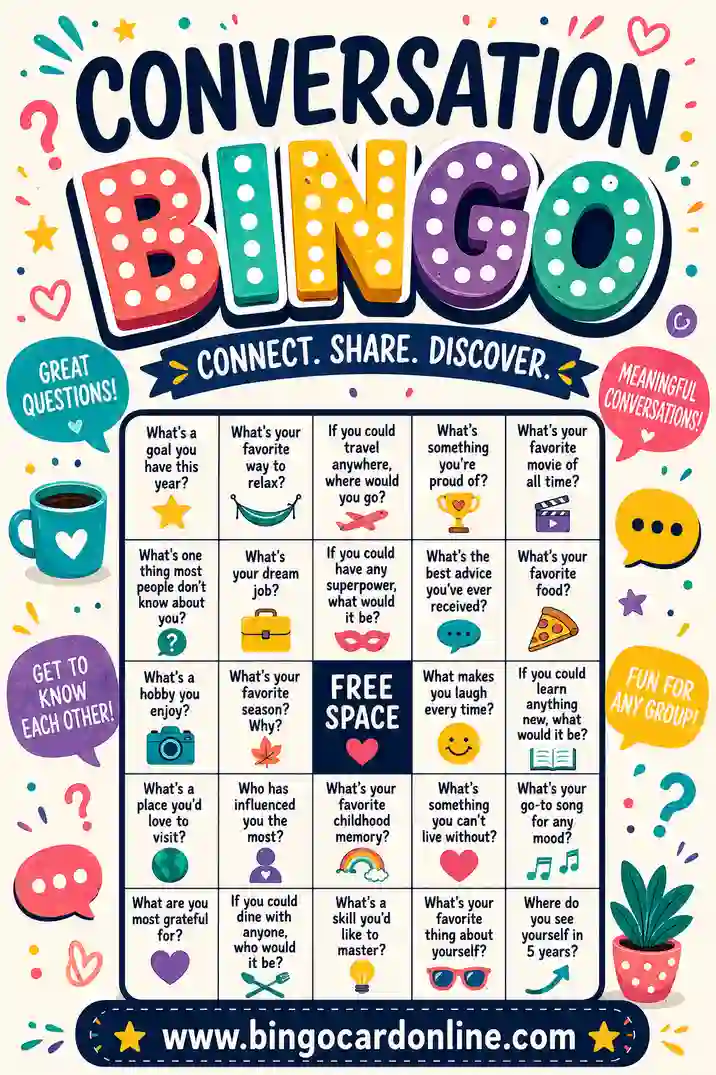
It's bingo built for talking instead of luck. Each card is a grid of "find someone who..." statements. Players walk around, ask questions, and when someone matches a square, they write that person's name in it (or just mark it). First to fill a line, or the whole card, wins.
The real prize isn't the win, though. It's that a room of strangers ends up actually talking. Conversation bingo gives shy people a script and a reason to approach others, which is exactly what makes icebreakers hard for most folks.
You can run it two ways:
- Find-someone-who bingo. Players mingle and collect names that match each prompt. The classic networking icebreaker.
- Discussion bingo. Squares are conversation topics or questions ("a place you'd love to visit," "your favorite meal"). Small groups talk through them and mark each one they cover. Great for seated settings like a dinner or a classroom circle.
Why Make Your Own Conversation Bingo Cards
You can find generic printables online, but making your own is better.
- It's free. Build and print a full set at no cost.
- You tailor the prompts. Match them to your group, new coworkers, a wedding crowd, a youth group, or a class.
- Every card is unique. Identical cards mean people chase the same squares. A generator gives each guest a different grid, so the room keeps mixing.
It's fast, too. Write a list of prompts, drop them into the generator, and you've got a printed icebreaker set in under ten minutes.
Free Conversation Bingo Prompt List (Copy & Paste)
Here's a ready-to-use list of 30 "find someone who..." prompts. Pick any 24 for a 5x5 card (the 25th is your free space), or grab 9 for a quick 3x3 round. Copy a column straight into the generator.
| Travel & Hobbies | Everyday Life | Fun Facts |
|---|---|---|
| Has been on a plane | Owns a pet | Can wiggle their ears |
| Speaks two languages | Has a sibling | Has met someone famous |
| Plays an instrument | Loves spicy food | Was born in another state |
| Has been camping | Drinks tea, not coffee | Has a twin |
| Likes hiking | Walks to work | Can do a cartwheel |
| Has visited the ocean | Has a garden | Knows a magic trick |
| Plays a team sport | Bakes their own bread | Has run a 5K |
| Reads every night | Has a big family | Can name all the planets |
| Paints or draws | Cooks dinner most nights | Has been on TV |
| Has been to a concert | Wakes up before 6am | Can solve a Rubik's cube |
Mix and match across columns for variety. Keep prompts easy enough that most people in your group can match a few, that keeps the room moving.
Theme variations to try
- Workplace bingo. Prompts fit a new-hire crowd: "works in a different department," "has been here over five years," "knows where the good coffee is."
- Wedding bingo. Help the two families mingle: "is on the groom's side," "has known the couple since school," "traveled the farthest to be here."
- Classroom bingo. A start-of-year favorite: "has the same favorite subject as you," "has a summer birthday," "rode the bus today."
How to Make Conversation Bingo Cards in 4 Steps
No design skills needed. Here's the whole thing.
- Pick your grid size. 5x5 for a big event, 4x4 for a medium group, 3x3 for a small or quick session.
- Add your prompts. Paste at least 24 prompts for a 5x5. More prompts means more variety between cards, so the room mixes better.
- Choose how many cards. One per guest, plus a few spares. The generator makes each card unique automatically.
- Print and hand out pens. Print the stack, give everyone a pen to write names, and turn them loose.
For a seated discussion version, you don't even need movement, just print and let small groups work through the squares together.
Who Conversation Bingo Is Great For
This game shines anywhere people need a nudge to start talking.
Workplaces and onboarding
New hires, team off-sites, all-hands mixers, conversation bingo melts the awkwardness fast. Instead of standing in a corner, people have a card-shaped excuse to introduce themselves. It's the gentlest networking tool there is, and it works on the quietest person in the room.
Classrooms and youth groups
Teachers use it on the first day of school to help kids learn each other's names and interests. Youth-group leaders use it to blend new members into the group. Keep the prompts age-appropriate and light, and the room warms up in minutes.
Weddings and parties
When two friend groups or two families meet for the first time, conversation bingo gives them a reason to mingle before the dancing starts. Tailor a few squares to the couple or the occasion for extra laughs.
Conferences and networking events
A printed card at each seat turns a stiff networking hour into a game. People collect names, find common ground, and leave having actually met someone, which is the whole point of the event.
Hosting Tips for a Lively Icebreaker
A few small choices make the game flow.
- Set a clear goal. "First to a full line wins" or "first to a blackout." Announce it up front so people know how hard to hustle.
- Add a one-name rule. A person can only fill one square on your card. This forces players to talk to many people, not just one chatty friend.
- Keep prompts inclusive. Avoid squares that only a few people could match, or some players will get stuck. Aim for prompts most of the room can answer.
- Give it a time limit. Ten to fifteen minutes keeps the energy up. Call time even if nobody's won, then award the fullest card.
- Have a small prize. A treat or a fun title ("Most Social") gives players a reason to push past the awkward first hello.
What to use as markers
For conversation bingo, people usually write names, but you can also:
- Have players write the matching person's name in each square
- Use a pen to check off squares for the discussion version
- Use stickers for younger kids
- Use dry-erase markers on laminated cards for reuse
Fun Ways to Change Up the Game
Once the basic version gets familiar, try these twists.
- Blackout round. Players must fill the entire card. Longer game, more mingling, perfect for a big mixer with plenty of time.
- Signature bingo. Each square needs an actual signature, not just a name. Adds a keepsake feel to weddings and reunions.
- Two-truths twist. Combine with "two truths and a lie", players have to guess which prompt is true before marking it.
- Team bingo. Small teams share a card and split up to fill it fastest. Good for very large events.
Conversation Bingo for Different Groups
The same game adapts from a classroom circle to a 200-person conference. Adjust the grid and the prompts to fit.
| Setting | Grid size | Tips |
|---|---|---|
| Small class (under 12) | 3x3 | Simple prompts. One name per square. |
| Classroom (12–30) | 4x4 | Age-appropriate prompts. Add a time limit. |
| Office mixer | 4x4 | Work-friendly prompts. One-name rule. |
| Wedding / party | 5x5 | Tailor a few squares to the occasion. |
| Conference (50+) | 5x5 | Networking prompts. Award the fullest card. |
Enjoy the social-game angle? You can build a whole event with our trivia bingo, bar / pub bingo, and office bingo cards.
Conversation Bingo vs. Other Icebreakers
If you've ever sat through a round of "two truths and a lie" while watching the clock, you know not all icebreakers are created equal. Conversation bingo earns its spot because it solves the two problems that sink most warm-up games: it doesn't put anyone on the spot, and it doesn't leave half the room standing around.
Here's how it stacks up against the usual options.
| Icebreaker | Best for | Why conversation bingo often wins |
|---|---|---|
| Two truths and a lie | Small seated groups | Everyone waits their turn; conversation bingo keeps the whole room active at once |
| Name games | Learning names fast | Names fade quickly; bingo builds an actual conversation around each person |
| Speed networking | Structured events | Rigid and timed; bingo feels like a game, not a drill |
| Trust falls / physical games | High-energy teams | Not everyone's comfortable; bingo stays low-pressure and inclusive |
The point isn't that other icebreakers are bad. It's that conversation bingo fits the widest range of groups. It works for the shy intern and the loud sales rep in the same room, and that flexibility is hard to beat.
That said, you can combine them. A quick round of conversation bingo to warm everyone up, then a deeper game like two truths and a lie once people are comfortable, makes a great one-two punch for a longer session.
Common Mistakes That Flatten the Game
Conversation bingo is hard to mess up, but a few small missteps can take the energy out of the room. Here's what to watch for.
- Prompts only a few people can match. If half your squares are "has run a marathon" or "speaks four languages," most cards stall. Lead with easy prompts and sprinkle in the rare ones.
- No time limit. Open-ended mingling drifts. People drift back to the friends they came with. A countdown keeps everyone hunting for new faces.
- Skipping the one-name rule. Without it, two friends can fill each other's whole card in a corner. Limit each person to signing one square so players have to circulate.
- Cards that are all the same. If every card has prompts in the same spots, players chase identical squares and the room clumps up. A generator shuffles each card so the crowd keeps mixing.
- Forgetting pens. It sounds obvious, but a stack of cards with nothing to write with stops the game cold. Hand out a pen with every card.
Avoid those five, and the game pretty much runs itself. The whole design is built to make talking easy, so your main job as host is just to set clear rules and start the clock.
Frequently Asked Questions
How do you play conversation bingo?
Print a card for each person, with a "find someone who..." prompt in every square. Players mingle, ask questions, and write down the name of anyone who matches a square. First to complete a line, or fill the whole card, wins.
How many conversation bingo cards do I need?
One per guest, plus a few spares. For an event of 40, print around 45. The generator lets you make as many unique cards as you want at once.
What prompts should go on a conversation bingo card?
Easy "find someone who..." statements most people can match, like "has a pet," "speaks two languages," or "has been camping." The list above gives you 30 ready to copy. Aim for at least 24 so a 5x5 card fills completely.
Is conversation bingo good for shy people?
Yes, that's its whole strength. The card gives shy players an exact thing to say and a built-in reason to approach others, which removes the hardest part of any icebreaker.
Are these conversation bingo cards really free to print?
Yes. You make and print them yourself at no cost. There's no sign-up and no watermark, so a whole conference or classroom can play on one free prompt list.
How do I make every card different?
Use a generator that shuffles your prompt list. It rearranges the same prompts into a new layout for each card, so guests chase different squares and the room keeps mixing. Doing it by hand is slow, which is why the tool exists.
How long should a conversation bingo game run?
Ten to fifteen minutes is the sweet spot for most groups. Set a timer and call time even if nobody's finished, then award the fullest card. A clear deadline keeps the energy up; open-ended play tends to fizzle as people drift back to their friends.
What's the difference between conversation bingo and human bingo?
They're essentially the same game with different names. Both use "find someone who..." prompts and have players mingle to fill their cards. "Human bingo" is the name you'll hear more often at corporate events, while "conversation bingo" leans toward the talking-and-mixing angle. Use whichever name fits your crowd.
Ready to Print Your Conversation Bingo Cards?
Grab the prompt list above, open the free bingo card generator, and you'll have a stack of unique, printable conversation bingo cards in minutes. It's free, there's no sign-up, and every card comes out different, so your mixer, class, or wedding is set to break the ice. Have fun, and watch the quiet corner of the room come alive.