Trivia Bingo: Free Printable Cards That Mix Quiz & Bingo
Trivia bingo is a game where each square holds an answer instead of a number, and the caller reads a trivia question instead of just calling out a word. Players mark the square that matches the correct answer, and the first to complete a line wins. The fastest way to set it up is a free bingo card generator that shuffles your list of answers into unique cards for every player.
Want to make a set right now? Open the free generator, paste in a list of answers (there's a ready-made one below), and print one card per person. No sign-up, no software, no cost.
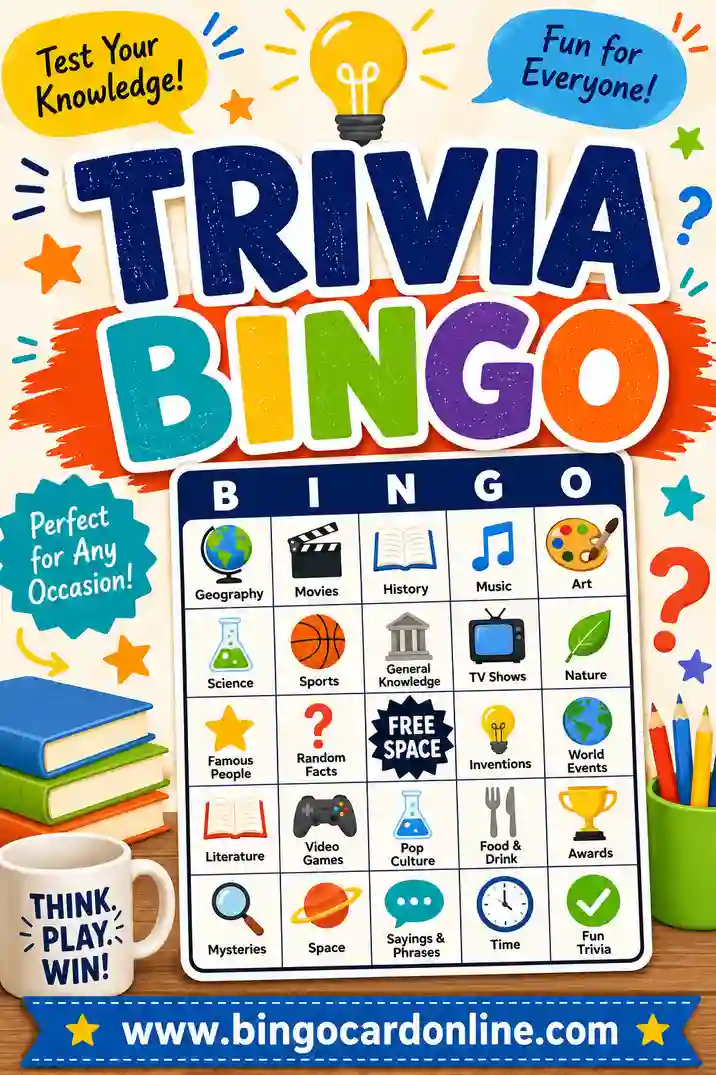
Picture a normal bingo card, but every square is a possible answer to a quiz question. The caller doesn't shout "B-7." Instead, they read a question like "What's the tallest mountain on Earth?" Players who have "Mount Everest" on their card mark it. First to a full line yells "Bingo!"
It's a clever combo. You get the steady, anyone-can-play rhythm of bingo, plus the brain-tickle of trivia. Nobody has to be a quiz champion, since the answers are right there on the card. Players just have to spot the match.
You can run it two ways:
- Answer bingo. Squares are answers. The caller reads questions, and players mark the answer they think is correct. This is the classic trivia bingo format.
- Topic bingo. Squares are categories ("a country in Africa," "a 90s movie"), and the caller reads clues that fit. A looser, more forgiving version for casual groups.
Why Make Your Own Trivia Bingo Cards
You can buy quiz bingo kits, but making your own beats it for a few reasons.
- It's free. Build and print a whole set without spending anything.
- You control the difficulty. Match the questions to your crowd, easy for a family night, tougher for a pub quiz league.
- Every card is unique. Pre-printed kits repeat layouts, so multiple people win at once. A generator gives each player a one-of-a-kind grid.
It's quick, too. Write your questions, drop the answers into the generator, and you've got a printed quiz-bingo set in well under fifteen minutes.
Free Trivia Bingo Answer List (Copy & Paste)
Here's a ready-to-use list of 30 general-knowledge answers. Pick any 24 for a 5x5 card (the 25th is your free space), or grab 9 for a quick 3x3 round. Copy a column straight into the generator, then write a matching question for each answer.
| Geography & Nature | History & Arts | Science & Pop Culture |
|---|---|---|
| Mount Everest | Shakespeare | Photosynthesis |
| Pacific Ocean | Cleopatra | The Sun |
| Sahara Desert | Mozart | DNA |
| Amazon River | Leonardo da Vinci | Gravity |
| Mount Fuji | The Great Wall | Oxygen |
| Antarctica | Albert Einstein | Jupiter |
| The Nile | Vincent van Gogh | The heart |
| Niagara Falls | Pyramids of Giza | Penicillin |
| Iceland | Roman Empire | Helium |
| Grand Canyon | The Renaissance | Saturn's rings |
Write one trivia question per answer, then read them in a shuffled order on game night. Aim for at least 24 different answers so a 5x5 card fills completely.
Theme variations to try
- Movie trivia bingo. Answers are film titles or actors. Questions describe a famous scene, a tagline, or a year. Perfect for a movie-buff crowd.
- Decade bingo. Pick one era, say the 80s, and fill squares with songs, gadgets, and events from that decade.
- Subject bingo. Great for classrooms: a card of science terms, vocabulary words, or historical dates, with the teacher reading clues.
How to Make Trivia Bingo Cards in 4 Steps
You don't need any tech skills. Here's the full process.
- Pick your grid size. 5x5 for adults and teens, 4x4 for a faster game, 3x3 for younger kids or a quick warm-up.
- Add your answers. Paste at least 24 answers for a 5x5. The more you add, the more variety between cards.
- Choose how many cards. One per player, plus a few spares. The generator makes each card unique automatically.
- Print and write your questions. Print the stack, jot a question for each answer, and you're ready to host.
Keep a master sheet that pairs every question with its answer. You'll use it to read clues and to verify the winner.
Who Trivia Bingo Is Great For
This game works for nearly any group that likes a little friendly competition.
Classrooms
Teachers love trivia bingo as a review game. Fill cards with vocabulary, dates, or science terms, then read questions that test the material. Kids stay engaged because they're playing bingo, but they're really studying. Print a class set, hand out paper markers, and you've got a review session that runs itself.
Pub quiz nights
Bars and pubs use trivia bingo to mix up their regular quiz. It's faster-paced than a traditional quiz and easier for casual players, since the answers sit right on the card. Award a small prize per winning card and you've got a packed, lively room.
Family game night
It's the rare game where a grandparent and a ten-year-old can compete fairly. Mix easy questions with a few harder ones, and the answers on the card keep everyone in the running.
Office team-building
Trivia bingo makes a low-pressure icebreaker for work events. Split into tables, read questions, and let teams mark a shared card. It's friendly competition without the spotlight on any one person.
Hosting Tips for a Smooth Game
A few small moves make your quiz bingo flow.
- Read each question twice. Once to introduce it, once for players who missed it. A loud room swallows clues fast.
- Pause after every question. Give players a beat to scan their cards before you move on.
- Keep an answer key. Cross off each answer as you call it, so you can verify the winning card later.
- Mix easy and hard. Front-load a few gimmes so casual players stay in it, then sprinkle in harder ones to keep experts honest.
- Decide the win condition first. One line, four corners, or a full blackout. Announce it before you start.
What to use as markers
No special supplies needed:
- Dried beans, buttons, or coins
- A pen or highlighter to cross answers off
- Bingo daubers, if you have them
- Dry-erase markers on laminated cards for reuse
Fun Ways to Change Up the Game
Once the basic round gets familiar, try these twists.
- Blackout round. Players race to mark every square. A longer game that suits a longer question list.
- Four corners. First to mark all four corners wins. Quick and great for a short attention span.
- Speed round. Read questions faster, with shorter pauses. Raises the energy and rewards quick thinkers.
- Team bingo. Tables share a card and confer on answers. Good for big groups and quieter players.
How to Write Good Trivia Questions
The cards are only half the game. The questions make or break the night, so a few simple rules help.
- One clear answer per question. Avoid questions where two answers could both be right. "What's the largest planet?" is clean. "What's a big planet?" invites arguments.
- Match the answer on the card exactly. If the square says "Mount Everest," don't phrase the answer as "Everest" in a way that confuses players. Keep wording consistent.
- Keep them short. A loud room loses long, winding questions. Aim for one sentence each.
- Spread the difficulty. A mix of easy, medium, and hard keeps everyone in it. If every question is brutal, casual players check out fast.
- Avoid trick questions. Trivia bingo is meant to be fun, not a trap. Save the brain-benders for a dedicated quiz league.
A handy habit: write each question and its answer side by side on one master sheet. When someone shouts "Bingo!", you read their marked squares back against that sheet to confirm the win. It also doubles as your call-tracking record, so cross off each answer as you go.
Where to find question ideas
Stuck for material? Pull from these easy sources:
- A theme you already love, your favorite decade, sport, or movie series
- A school subject, for classroom review games
- Current events from the past year, for a fresh, topical round
- Local trivia about your town, which always gets a laugh from a hometown crowd
Trivia Bingo for Different Ages
The same game stretches from kids to grandparents if you adjust the questions and grid.
| Age group | Grid size | Tips |
|---|---|---|
| Kids (6–9) | 3x3 | Easy, picture-friendly answers. Read slowly. |
| Tweens (10–13) | 4x4 | School-subject or pop-culture questions. |
| Teens | 5x5 | Mix general knowledge with current trends. |
| Adults | 5x5 | Full general knowledge. Try a speed round. |
| Seniors | 4x4 | Larger print, classic-era questions, slower pace. |
Like the quiz-game angle? You can build a whole social game night with our bar / pub bingo, conversation bingo, and classroom bingo cards.
Frequently Asked Questions
How is trivia bingo different from regular bingo?
In regular bingo the caller reads numbers. In trivia bingo the caller reads questions, and players mark the answer on their card that matches. It mixes the easy rhythm of bingo with the fun of a quiz.
How many trivia bingo cards do I need?
One card per player, plus a few spares. For a class of 25, print around 30. The generator lets you make as many unique cards as you want at once.
What should I put on a trivia bingo card?
Answers, one per square. Then write a matching question for each. The list above gives you 30 general-knowledge answers ready to copy. Aim for at least 24 so a 5x5 card fills completely.
Can I make trivia bingo for a classroom?
Yes, it's a great review game. Fill the cards with vocabulary, dates, or science terms, then read clues that test the material. Kids learn while they play.
Are these trivia bingo cards really free to print?
Yes. You make and print them yourself at no cost. There's no sign-up and no watermark, so a whole class or pub quiz can run on one free answer list.
How do I make every card different?
Use a generator that shuffles your answer list. It rearranges the same answers into a new layout for each card, so no two players share a grid. Doing it by hand is slow and mistake-prone, which is why the tool exists.
Ready to Print Your Trivia Bingo Cards?
Grab the answer list above, open the free bingo card generator, write a question for each square, and you'll have a stack of unique, printable trivia bingo cards in minutes. It's free, there's no sign-up, and every card comes out different, so your classroom, quiz night, or family table is set to play. Good luck, and may the smartest "Bingo!" win.