Family Reunion Bingo: Free Printable & Customizable
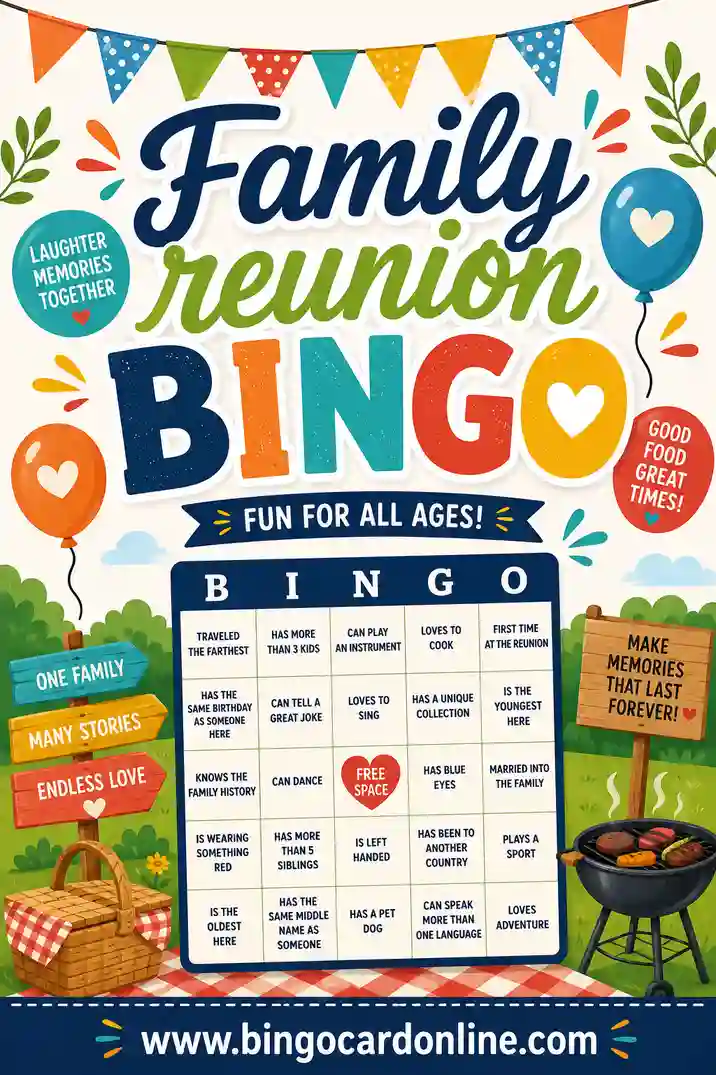
Family reunion bingo swaps numbers for "find a relative who..." prompts. To mark a square, you have to track down a cousin, aunt, or grandparent who fits it, such as "drove more than an hour to get here" or "remembers the old family house," and write their name in the box. This guide covers writing prompts that work across generations, adding family-history squares, playing in teams by family branch, running the game outdoors with a big group, and saving the finished cards as a family record.
Have your prompts ready? Open the free bingo card generator, paste them in, and print a different card for every relative. It's free and needs no account.
"Find a Relative Who" Prompts That Span Generations
A reunion card has a harder job than most bingo cards. The same grid has to make sense to a ten-year-old, their parents, and a great-aunt who remembers the family before any of them were born. The goal is a card where every generation can mark some squares on its own, and fill the rest only by talking to someone from a different one.
A good way to get there is to write prompts in three groups:
- Squares anyone can find quickly. "Is wearing a hat," "has a pet," "has the same birthday month as you." These get people moving and give younger players early wins.
- Squares that point at a generation. "Has a great-grandchild," "is in high school," "learned to drive on a stick shift," "has never used a landline." Most of these can only be marked by finding someone much older or younger than you.
- Squares that need a real conversation. "Has lived in more than three states," "served in the military," "can name all of Grandma's siblings." You can't guess these. You have to ask.
Mix all three on every card. All easy squares and the game is over in minutes; all hard ones and kids give up. A shuffled mix also means one card might lean toward the grandparents' table while the next sends its player to the teenagers.
One house rule keeps the game honest: a player has to write the relative's name in the square, and each relative can only fill one square on a given card. That stops everyone from marking their whole card after one chat with the most talkative uncle.
Squares That Bring Out Family History and Memories
The squares people remember are usually the ones only your family could have written. These turn the game into a way of passing stories down, because the person who can fill the square is usually the one who knows the story.
Before the reunion, ask a few older relatives what they remember, or look through the family photo albums, and turn what you find into prompts:
- "Was at the reunion held at the lake"
- "Knows where the family's first home was"
- "Can tell you how the grandparents met"
- "Has a recipe handed down from a great-grandparent"
- "Remembers the family's first car"
- "Knows the story behind a family nickname"
Ask players to write one detail along with the name, such as the street name or the year, not just a checkmark. Those small notes are what make the finished cards worth saving, which is covered further down.
Be careful with history squares that touch hard memories. A relative who has passed away, a divorce, or an old family rift doesn't belong on a game card. Stick to places, traditions, food, and stories the family tells happily.
Free Family Reunion Bingo Word List (Copy & Paste)
Here's a ready-to-use list of 30 prompts. Pick any 24 for a 5x5 card (the 25th is your free space), or grab 9 for a kid-friendly 3x3. Copy the column you like straight into the generator.
| About a Person | Travel & Family | Hobbies & Quirks |
|---|---|---|
| Has a new baby | Traveled the farthest | Plays an instrument |
| Wears glasses | Lives out of state | Loves to cook |
| Has the same name as you | Born in another country | Grew a garden |
| Tallest in the room | Same birthday month | Tells the best stories |
| Has twins | Drove over an hour | Bakes the pies |
| Got married this year | Has grandkids | Loves fishing |
| Has a pet | Just moved | Plays sports |
| Born in summer | Visited 5 states | Speaks two languages |
| Youngest cousin here | Flew to get here | Knits or sews |
| Oldest person here | Camps every year | Sings in a choir |
Swap in your own family's details to make it personal. Names, hometowns, and shared traditions make the best squares, because nobody else's card would ever match yours.
Playing in Teams by Family Branch
At a large reunion, individual cards can leave people sticking to the relatives they already know. Teams fix that, and the family tree gives you ready-made teams: the descendants of each sibling in the oldest generation, or each line of the family that's attending.
There are two ways to use branches:
- Branches as teams. Each branch shares one large card, printed big or taped to a poster board. Team members spread out, fill squares, and report back. This works well when some branches are much bigger than others, since everyone contributes to one card.
- Branches as a rule. Everyone plays their own card, but a square only counts if the relative is from a different branch than the player. This is the stronger mixer, because it sends people straight to the cousins they know least.
Color-coding helps either way. Print each branch's cards on a different color of paper, or give each branch a colored name tag, so players can tell at a glance who is "other side of the family." Name tags that list the relative's parent or grandparent ("Sam, Ruth's grandson") also make introductions easier for people meeting for the first time.
Keep it friendly: going first in the food line is plenty of prize for the winning branch.
Running the Game at a Big Outdoor Gathering
Many reunions happen at a park pavilion, a backyard, or a campground, and paper games outdoors come with their own problems. A few preparations go a long way.
- Set up a card station. A table near the check-in or food area with cards, pencils, a sign explaining the rules, and a box for finished cards. Late arrivals can pick up a card on their own.
- Plan for wind. Clipboards, or cards printed on cardstock, keep cards from blowing away. A few rocks or weights for the station table help, too.
- Use pencils, not pens. Pens can skip on damp paper and dry out in the sun. Pencils also let players erase a square they marked by mistake.
- Give the game a time frame. Outdoor reunions spread out across hours. Announce a set window, such as "cards due by the time dessert comes out," so the game has an end and people know when winners will be named.
- Keep a rain plan. If you move under a pavilion or indoors, the game moves too. It doesn't need open space to work.
For a reunion that runs across a weekend, let one card carry through every event: the Friday cookout, Saturday's picnic, and the group photo. Players keep the card with them and fill squares as they meet relatives over the weekend.
Making Room for Every Age and Ability
A reunion might include toddlers, grandparents who use a walker, relatives who don't read English well, and people who are hard of hearing. The game should have a way in for each of them.
- Bring the game to seated relatives. Add squares that can only be filled by visiting someone at the shade table, like "is the oldest person here" or "knows the family's original hometown." Relatives who'd rather stay seated become a destination instead of being left out.
- Print a large-type version. A 4x4 card with bigger text is easier for older eyes and for anyone who needs reading glasses but forgot them.
- Make a picture card for small children. A 3x3 grid with simple images (a grandma, a dog, a hat, someone in red) lets non-readers play. Pair them with an older cousin who can help write names.
- Offer a seated version. For relatives who can't walk around much, a caller can read prompts out loud, and players mark the ones that apply to themselves.
- Translate a few cards if part of the family speaks another language at home. A bilingual card is a nice nod to where the family comes from.
Turning Finished Cards into a Family Keepsake
Unlike most bingo games, finished reunion cards are full of information: names, connections, places, and small facts about who was there. Collect them all, not just the winners.
- Collect every card. Ask players to drop cards in the box at the card station, whether they won or not. Have someone gather any left on tables before cleanup.
- Photograph or scan them. A phone photo of each card is enough. Share them in the family group chat or a shared photo album.
- Pull out the stories. Go through the cards and type up the details people wrote next to the history squares. A one-page "what we learned this year" sheet makes a good follow-up email or newsletter.
- Update the family tree. Cards often turn up a new baby, a marriage, or a move. Pass those along to whoever keeps the family records.
- Reuse the best prompts. Note which squares started good conversations and keep them for the next reunion. Add new ones from the stories you collected.
Over a few reunions, the stack of cards becomes a small record of the family: who came, who met whom, and what they talked about. If there's a family wedding coming up, the wedding bingo guide covers a reception version built around the evening's events.
Family Reunion Bingo Questions
Can one relative fill more than one square on my card?
It's best to set a rule that each relative can sign only one square per card. That way players have to talk to many different family members instead of filling the whole card with one person.
How do I write prompts if I don't know the family history well?
Ask two or three older relatives a few questions before the reunion: where the family lived, how the grandparents met, what traditions they remember. Each answer can become a square, and those relatives will enjoy being the ones who can fill it.
How should we split into teams at a big reunion?
Family branches make natural teams, such as the descendants of each sibling in the oldest generation. Another option is a rule that a square only counts if the relative is from a different branch than the player.
How do we include relatives who can't walk around much?
Add squares that can only be filled by visiting them, so other players come to their table. You can also print a large-type 4x4 card or run a seated version with a caller reading prompts out loud.
What's the best way to handle cards at an outdoor reunion?
Print on cardstock or hand out clipboards so cards don't blow away, use pencils instead of pens, and set up one card station with a sign, spare cards, and a box for finished cards.
What should we do with the cards afterward?
Collect every card, not just the winners, and photograph or scan them. Type up the stories and details people wrote down, share them with the family, and pass any news along to whoever keeps the family tree.
Before Everyone Arrives
Write a mix of quick, generational, and family-history prompts, add your favorites from the list above, and open the free bingo card generator to print a unique card for every relative, plus a few large-type and picture cards. Set up the card station, and save the finished cards for next time.