Graduation Bingo: Free Printable & Customizable
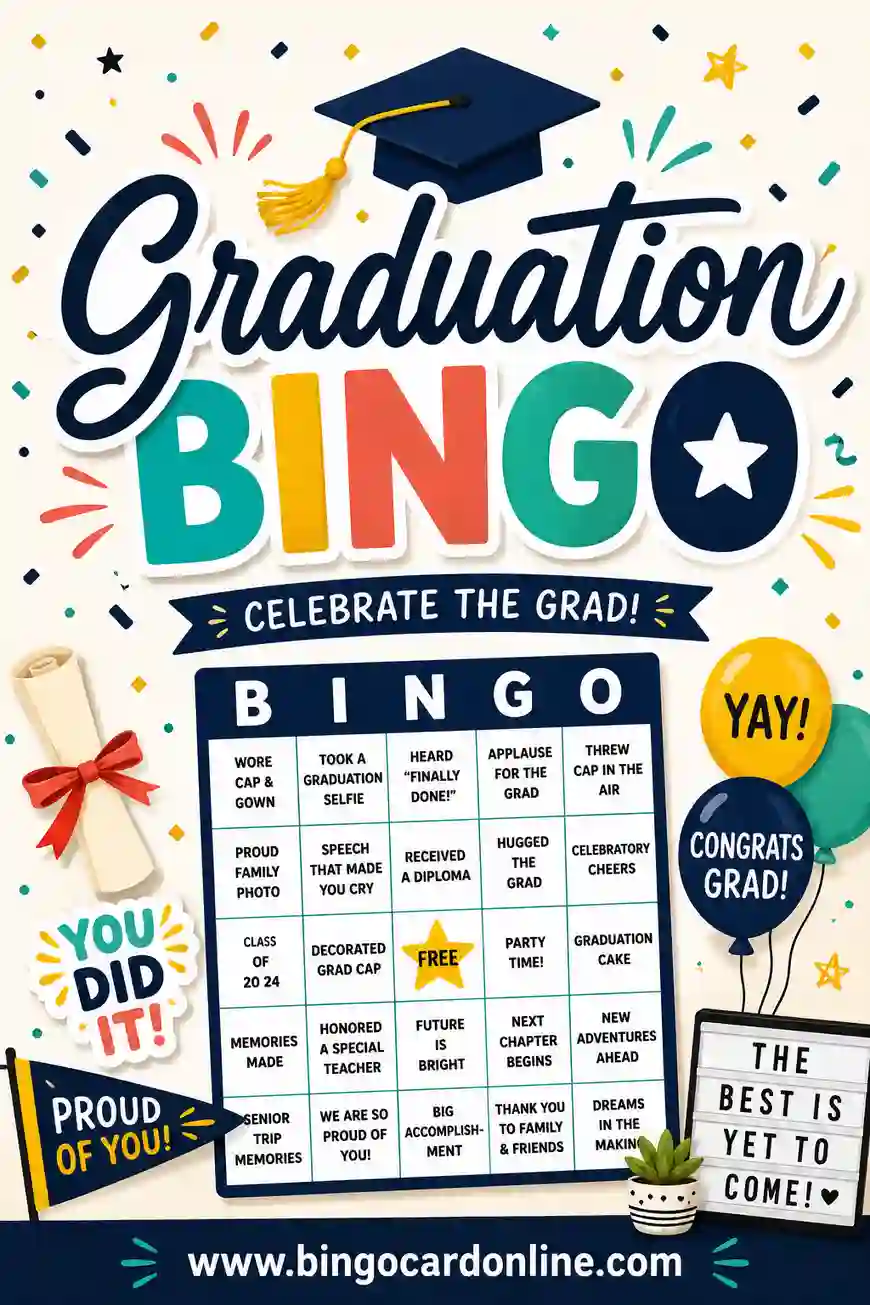
Graduation bingo gives family and friends something to do during the part of the day nobody warns you about: the hour or more spent waiting for one name in a list of hundreds. Each player gets a grid of grad-day squares, such as "cap and gown," "tassel turn," or "someone yells a nickname," and marks them as they happen or as a caller reads them out. The same cards can come back out later at the open house, where they work as an easy icebreaker for relatives, neighbors, and classmates who have never met.
To make a set, paste your squares into the free bingo card generator on our homepage and print one shuffled card per guest. Below you'll find a word list, ideas for squares that fit a long ceremony, ways to write class-memory squares, and notes on adjusting the game for a kindergarten promotion, a high school commencement, or a college graduation.
Bingo for the Long Name Reading
Most commencements follow the same shape: a processional, a few speeches, the reading of names, the tassel turn, and a recessional. The speeches are short compared to the name reading, which can run a long time at a large school. That stretch is where a quiet bingo card earns its place. Instead of scrolling on a phone, younger siblings and grandparents have a reason to watch the stage, and they tend to notice more of what happens.
A ceremony card works best when the squares are things you can see or hear from the seats without anyone calling them. Good choices include:
- A graduate waves to the crowd from the stage
- Someone in the audience shouts a nickname
- A graduate does a small dance or fist pump
- Two graduates with the same last name walk back to back
- A cap falls off on the stairs
- A decorated cap with a message you can read from your seat
- The announcer asks the audience to hold applause
- A baby or toddler joins the applause anyway
- The school band or choir performs
- Your graduate's row stands up
You can also build squares from the printed program. If the program lists a valedictorian speech, an alma mater, or a special award, each of those becomes a square. Families who receive the program in advance can fill the card in at home; otherwise, print the cards with general squares and leave a few blank ones for people to write in after they open the program.
Keeping it respectful in the seats
A graduation is a formal event for every family in the room, not just yours. Play silently, mark squares with a pencil instead of a dauber, and keep the cards small enough to hold on your lap. Avoid squares that poke fun at how a particular name is pronounced or at a graduate who stumbles; everyone in that row has a family watching too. The goal is to keep people paying attention, not to keep score on other people's kids. Some venues have rules about what you can bring in, so check the school's guest information before you hand out clipboards.
When your own graduate crosses the stage, put the cards down. No square is worth missing that moment or the photo that goes with it.
Free Graduation Bingo Word List (Copy & Paste)
Here's a ready-to-use list of 30 graduation squares. Pick any 24 for a 5x5 card (the 25th square is your free space), or grab 16 for a 4x4. Copy the column you like straight into the generator.
| Cap & Gown | Ceremony Moments | Party & Photos |
|---|---|---|
| Cap and gown | Walk the stage | Selfie |
| Diploma | Tassel turn | Group photo |
| Honor cords | Handshake | Graduation cake |
| Cap decoration | Long speech | Confetti |
| School colors | Name called | Bouquet |
| Class ring | Standing ovation | Proud parents |
| Mortarboard | Cap toss | Yearbook signing |
| Class of... | Air horn in crowd | Open a card |
| Stole | Mascot appears | Future plans |
| Gown wrinkles | Pomp and Circumstance | Money in a card |
Mix and match across columns for variety. The "Ceremony Moments" column is where you should add jokes that fit your specific school.
Writing Class-Memory Squares
The word list covers what happens at nearly every graduation. Class-memory squares are what make the card belong to one particular class. They come from the years leading up to the ceremony: the field trip, the teacher everyone quotes, the school play, the season the team made the playoffs, the cafeteria food students still talk about.
The best source is usually the graduate. Ask them for ten or fifteen things their class would recognize immediately. Their yearbook is another good source, since it already sorts the year into clubs, sports, events, and superlatives. If you're planning a joint party for several friends, have each grad contribute a few squares so the card reflects the whole group, not just one family's version of events.
A few guidelines keep these squares fun for everyone:
- Make them about shared moments. "The fire drill during finals" includes the whole class. A square about one student's embarrassing moment singles someone out.
- Keep them short. Bingo squares are small. "Senior trip bus" fits; a full sentence explaining the story does not.
- Mix them with general squares. If every square is an inside joke, older relatives won't know what to listen for. A card that is roughly one third class memories and two thirds general grad squares lets everyone play.
- Check them with the grad. Something that was funny in tenth grade may not be something they want printed on cards their grandparents are holding.
Class-memory squares are most natural in caller bingo, where someone reads them aloud and can add a sentence of context. Reading "the snow day in May" and then asking the grad to explain it turns each call into a short story, which is half the fun at a party.
Adjusting the Card for Each School Level
A kindergarten promotion and a university commencement are very different events, and the card should change with them.
Kindergarten and preschool
Here the graduates are often the players. Use a 3x3 grid with a picture next to each word: a cap, a diploma, a star, a balloon, a teacher, a song. Keep the game short and let every child end up with a full card, because at this age the point is the celebration, not the winning. A teacher can call squares between songs or during snack time after the ceremony, and stickers make easier markers than pens for small hands.
Middle school and eighth-grade promotion
These ceremonies are usually shorter and held at the school. A 4x4 card with a mix of ceremony squares and moving-up squares ("new locker combination," "high school orientation," "last day of middle school") suits the age, and students often enjoy playing it with their friends at a class party.
High school
This is where ceremony bingo gets the most use, since high school commencements tend to be large and the audience includes a wide range of ages. A 5x5 card can hold ceremony squares, class memories, and a few plans-for-next-year squares like "college sweatshirt," "first job," or "gap year." Keep the plans squares general so no graduate feels judged for their choice.
College and graduate school
University ceremonies are often split by school or department, so the reading of names may be shorter, but the day itself can be long. Swap class memories for campus ones: the library, the dorm, the dining hall, finals week, the thesis or capstone, the major. For graduate degrees, squares like "hooding," "advisor in the front row," and "the defense is over" fit the occasion.
Graduation Bingo at the Open House
Many families host a graduation open house rather than a sit-down party. Guests drop in over several hours, stay for a plate of food and a conversation, and move on. That flow does not suit classic caller bingo, because there is never a moment when everyone is in the room at once.
A self-serve format works better. Put a stack of cards and pens near the guest book or photo board. Each card is filled with squares guests can complete on their own as they walk around:
- Find the grad's baby picture on the photo board
- Sign the guest book
- Meet someone from the grad's team or club
- Ask the grad about their plans for next year
- Try the cake
- Find a photo from the first day of school
- Take a picture with the grad
Guests who complete a line can drop their card in a bowl. At the end of the open house, or at a set time announced on a small sign, the grad draws a card from the bowl for a prize. That way someone who visited at noon has the same chance as someone who arrived at four.
If your party is a single evening event where everyone is present together, switch back to caller bingo for a round or two. A relative or friend of the grad makes a good caller, and the grad can explain any class-memory square that gets called. Short rounds work better than one long game, since guests will also want to eat, talk, and take photos.
Saving a Card for the Memory Box
After the party, set aside one card and keep it with the program, a tassel, and a few photos. A filled-in card from the ceremony is a small but specific record of the day, noting which moments people actually saw from the seats. If you used class-memory squares, the card also preserves those inside jokes in a form the grad will enjoy finding years later. Printing on cardstock in the school colors helps the saved card hold up.
Planning another celebration soon? The retirement party bingo guide covers a very different crowd, with tips for workplace send-offs and a card signed by colleagues.
Graduation Bingo Questions
Is it rude to play bingo during a graduation ceremony?
It doesn't have to be. Play silently, use small cards and pencils, and stick to squares about things that happen on stage rather than jokes about individual graduates. Put the cards away when your own grad walks, and follow any rules the venue posts for guests.
What squares work for a ceremony with hundreds of names?
Choose moments that repeat across a long reading, such as a graduate waving, a nickname shouted from the crowd, a decorated cap, or two people with the same last name in a row. Add items from the printed program, like the alma mater or a special award, so there are squares that happen once and squares that happen often.
How do I play bingo at an open house where guests come and go?
Use self-serve cards with squares guests complete on their own, like finding a baby photo or signing the guest book. Have people drop finished cards in a bowl and draw a winner at a set time, so early and late visitors have the same chance.
Can kindergarten graduates play graduation bingo?
Yes. Use a 3x3 card with a picture beside each word, let a teacher or parent call the squares, and use stickers as markers. Keep the round short and let every child finish the card.
Where do I find class-memory squares?
Ask the graduate for things their class would recognize right away, and look through their yearbook for events, clubs, and teams. Keep each square short, make it about a shared moment rather than one person, and check the final list with the grad before printing.
How many squares do I need for unique cards?
A 5x5 card needs 24 squares plus the free space, but a list of 30 or more gives the generator enough to shuffle so cards look clearly different from one another. For a 3x3 kindergarten card, 12 to 15 picture squares is plenty.