Retirement Party Bingo: Free Printable & Customizable
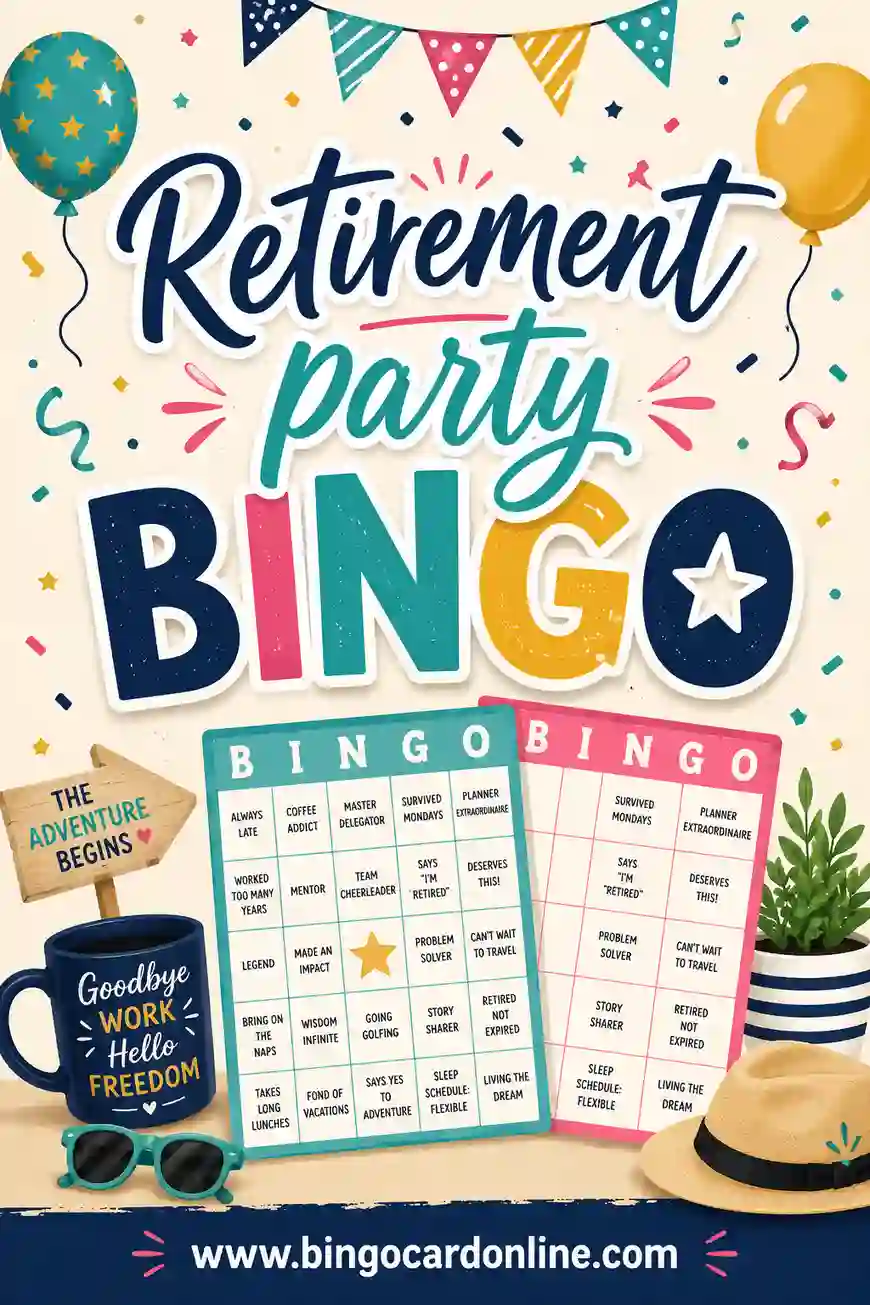
Retirement party bingo is a card game built around one person's working life. The squares mix the classic send-off details, like "gold watch" and "no more alarms," with the specifics your team knows: the project that took three years, the mug nobody else was allowed to use, the plans the retiree keeps mentioning for the first free Monday. Guests mark squares as a caller reads them or as moments happen during the party, and the first full line wins.
You can build the cards in a few minutes with the free bingo card generator, which shuffles one word list into a different card for each guest. This guide focuses on what makes a workplace send-off different from other parties: tight timing, a guest list that spans departments and generations, and a retiree who should enjoy the game rather than become the target of it.
Planning the Game Around the Send-Off
Workplace retirement parties usually happen on company time and in company space: a conference room, the break room, a reserved section of a nearby restaurant, or a video call for distributed teams. That shapes how bingo fits in. Before you print anything, settle a few details with whoever is organizing the event.
- How long is the party? A lunch or late-afternoon gathering might run an hour, and much of that goes to food and speeches. Plan on one or two short rounds rather than a long game.
- Where do the speeches fall? Pause the game while managers and colleagues speak. Running bingo during the tributes makes it look like people aren't listening.
- Who is calling? Pick an organizer or a coworker who enjoys a microphone. The retiree should be a player or a guest of honor, not the person running the game.
- Who is attending remotely? If some colleagues are joining by video, email their cards ahead of time and have the caller read squares clearly into the microphone or post them in the chat.
- Is it a surprise? If so, collect squares quietly and keep the printed cards out of sight until the party starts.
A simple sequence works for most office send-offs. Hand out cards as people arrive and let them read the squares while food is served. Play one round once most guests are seated. Break for speeches, the card or gift presentation, and any toast with coffee or punch. Then play a final round while people finish dessert, and award the prize just before the room clears. That way the game fills the gaps without crowding out the parts of the event that matter most to the retiree.
Prizes can be small and work-friendly: first choice of leftover cake, a plant from the retiree's desk if they offer one, or a card the retiree signs for the winner. If your workplace has rules about gifts or gambling-style games, a no-stakes prize keeps everyone comfortable.
Free Retirement Party Bingo Word List (Copy & Paste)
Here's a ready-to-use list of 30 retirement squares. Pick any 24 for a 5x5 card (the 25th square is your free space), or grab 16 for a 4x4. Copy the column you like straight into the generator.
| Freedom & Fun | Career Memories | Party Moments |
|---|---|---|
| No more alarms | Gold watch | Farewell card |
| Sleeping in | Pension | Office cake |
| Golf clubs | Last commute | Speeches |
| RV trip | Empty inbox | Tears of joy |
| Travel plans | Cleaned-out desk | Group photo |
| Hammock | Years of service | Toast |
| Fishing rod | Old badge | Plaque |
| Grandkids | The big project | Gag gift |
| Hobby time | Final meeting | Hugs |
| Bucket list | Mentor moments | Memory slideshow |
Mix and match across columns for variety. The "Career Memories" column is where you should add your own inside jokes for the biggest reaction.
Career-Memory Squares and "What's Next" Squares
A strong retirement card looks backward and forward at the same time. Think of it as two halves: squares about the career that is ending and squares about the life that is starting.
Looking back
Career-memory squares come from the people who worked alongside the retiree. Send a short, private message to a handful of longtime colleagues asking for things the whole team would recognize: a phrase the retiree always used in meetings, a system they helped launch, an office move they survived, a client they were known for, the desk plant that outlived three reorganizations. Turn each answer into a short square, a few words at most.
Some topics belong off the card no matter how well known they are. Skip anything about layoffs, health, pay, performance reviews, or conflicts with specific people. Leave out jokes about age, too; the retiree has likely heard plenty already, and they can make other older employees in the room uncomfortable. A good test is whether the retiree's family would enjoy reading the square.
Looking ahead
"What's next" squares are about the plans the retiree has shared: a long trip, more time with grandchildren, a garden, a workshop in the garage, volunteering, a sport they never had time for. If you aren't sure what those plans are, ask a close colleague or a family member rather than guessing. Squares that assume someone will golf or fish when they have no interest in either land flat.
About half and half is a good balance. Career squares give longtime coworkers something to laugh about, while the forward-looking squares let newer staff and family members join in, since they may know the retiree's plans better than their history at the company.
Coworker-Guessing Formats
Standard caller bingo works, but a retirement party is a good place to try a version where guests have to know something about the retiree, or about each other, to mark a square.
Clue calling
Instead of reading the square itself, the caller reads a clue, and players work out which square it matches. The clue "the year Dana joined the company" might match a square showing that year. "The software Dana fought with every Monday" matches the name of the system. Longtime colleagues will spot answers quickly, and newer staff learn a bit of the retiree's history as the game goes on. Keep a written answer key so the caller can confirm wins.
Who said it?
Fill the card with names of people in the room: the retiree, their manager, teammates, and a few longtime friends from other departments. The caller reads a familiar saying or habit, and players mark the person they think it belongs to. Only use sayings each person is happy to have shared, and ask them first.
Find a coworker who
This version turns bingo into a mixer. Each square describes a person rather than a word: "has worked with the retiree for more than ten years," "shared an office with them," "was trained by them," "joined this year," "works in a different building," "has a story about the holiday party." Players find someone who fits each square and write that person's name in it. It is especially useful when the guest list spans several departments that rarely talk to one another.
Keeping a Mixed-Age Office Crowd Comfortable
A retirement party may bring together interns, mid-career staff, executives, former colleagues who retired years ago, and the retiree's spouse or adult children. A card that works for that range needs a little extra care.
- Make the print readable. Use a 4x4 card or a 5x5 with large text, and print on plain white paper with dark ink. Avoid decorative fonts that are hard to read in dim restaurant lighting.
- Skip slang and acronyms. Internal jargon that only one team uses can leave guests from other departments guessing. If a square needs explaining, rewrite it.
- Offer partners. Let guests play in pairs, so someone new can team up with a longtime coworker who knows the history.
- Keep the pace gentle. Read each square twice and leave a pause before the next one, especially if some guests are joining by video.
- Bring pens and extras. Former colleagues and family members often arrive without anything to write with, and late arrivals are common at workplace events.
A Keepsake Card Signed by Colleagues
The game cards are for playing. A separate, larger card can become the gift. Print one oversized bingo grid on heavy cardstock, ideally at least letter size or larger if your printer allows, using the same squares as the game. Leave a little white space in each square.
During the party, pass the big card around and ask each guest to sign a square that means something to them, with a short note if there is room: the colleague who worked on that project signs the project square, the person who shared an office signs the coffee-mug square, and so on. Remote colleagues can send a short message ahead of time for an organizer to copy in, or you can mail the card around the office in the days before the party.
Give the finished card to the retiree at the end, or present it alongside the main gift. Many people like to frame something like this, so a simple frame sized to your print makes a thoughtful addition. Unlike a standard greeting card, it records both the inside jokes and who shared them.
Celebrating a different milestone? Our graduation bingo guide covers ceremony games, open houses, and class-memory squares.
Questions Organizers Ask
When should we play bingo during a retirement party?
Play one short round after people have their food and another after the speeches and gift presentation. Pause the game completely while colleagues are giving tributes, so the retiree has everyone's attention for that part.
Should the retiree play or call the game?
Let the retiree play or simply watch. Ask an organizer or an outgoing coworker to be the caller, so the guest of honor can relax and enjoy hearing the squares read aloud.
What topics should stay off a retirement bingo card?
Leave out age jokes, health, pay, layoffs, performance issues, and conflicts with specific people. Stick to shared memories, well-known habits the retiree enjoys being teased about, and their plans for life after work.
How do I collect career memories without spoiling a surprise?
Message a few longtime colleagues privately and ask each for three or four things the team would recognize. If the retiree's plans are part of the card, check with a family member or close friend instead of asking the retiree.
How can remote coworkers join in?
Email each remote guest a unique card before the party, have the caller read each square clearly into the microphone, and post the called squares in the chat. Remote colleagues can also send a note ahead of time for the signed keepsake card.
What is the easiest way to make a keepsake card?
Print one large copy of the bingo grid on cardstock and pass it around for colleagues to sign the squares that mean the most to them. Use the generator to print the oversized card along with the regular game cards.