The Bingo Free Space: Why It's There and How to Use It
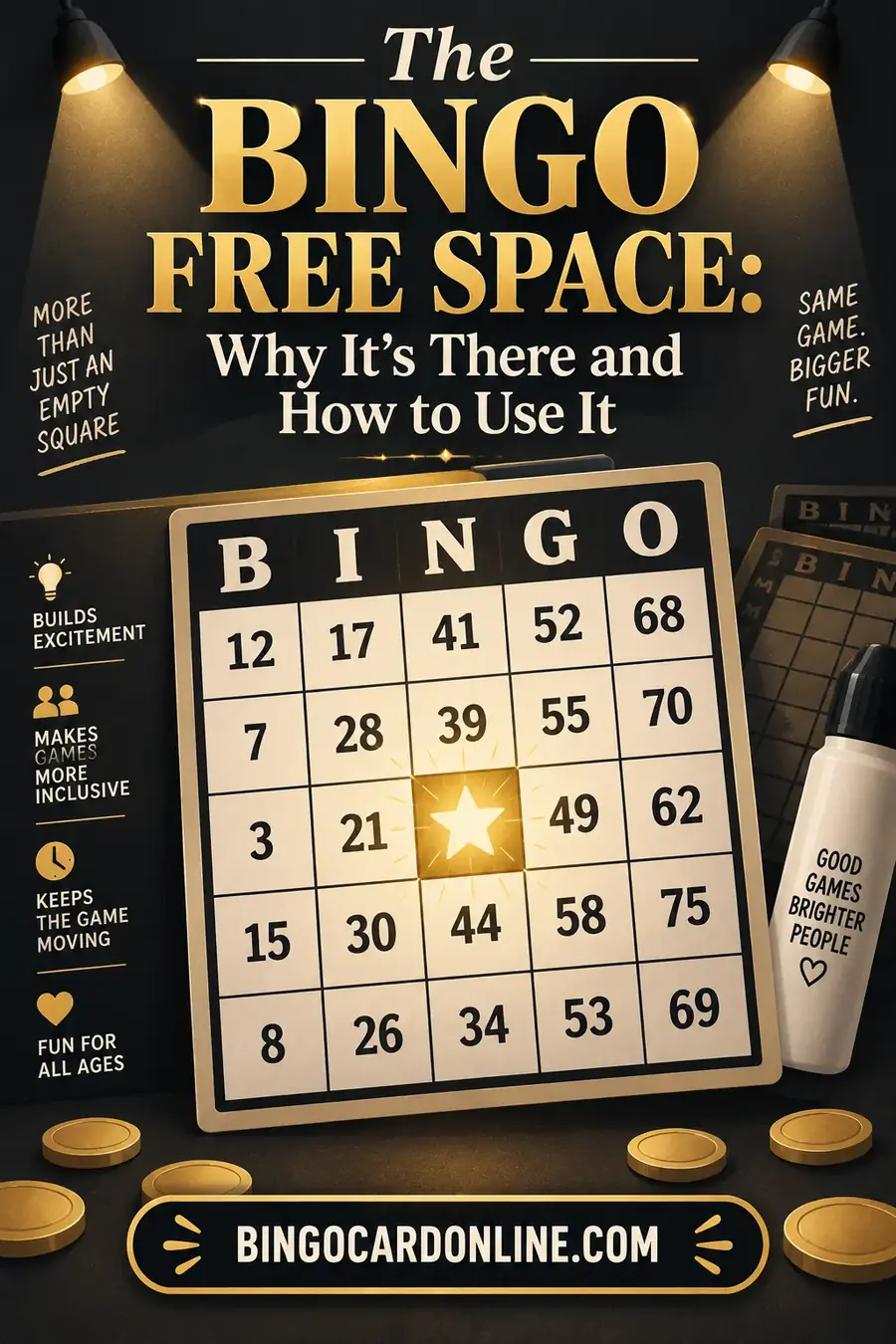
The free space is the center square of a standard 5x5 bingo card, marked before the game starts and counting toward any line that passes through it. It's not decoration and it isn't arbitrary — it exists because a 5x5 grid needs 25 squares, and the standard bingo number pool divides much more neatly into 24.
Why It Exists
In traditional 75-ball bingo, each of the five columns draws from its own range: B from 1-15, I from 16-30, N from 31-45, G from 46-60, O from 61-75. Fifteen numbers per column, five squares per column.
The free space sits in the N column, which means that column only needs four numbers instead of five. The practical effects:
It shortens the game. Every player starts with one square already marked, and four of the twelve possible winning lines run through the center. Without it, games run measurably longer — which mattered a great deal when bingo halls needed to fit many games into an evening.
It reduces the numbers in play. 24 marked squares rather than 25 across the card means slightly fewer calls needed overall.
It guarantees everyone starts equal. Nobody is behind at the first call, which matters for the social feel of the game more than for the odds.
The origin story usually told is that Edwin Lowe, who commercialised modern bingo in the 1930s, adopted the free space partly to speed play and partly because it made card design simpler. The number-pool arithmetic is the reason it stuck.
What It Does to the Odds
The free space affects the game in a specific, limited way: it makes the four lines through the center easier than the eight that don't.
| Line type | Lines | Squares needed |
|---|---|---|
| Through the center (middle row, middle column, both diagonals) | 4 | 4 |
| Not through the center | 8 | 5 |
So a quarter of the possible wins need one fewer call than the rest. Over a long session this pulls wins slightly toward center lines — worth knowing if you're choosing which near-complete line to hope for, and essentially irrelevant to any strategy, since you don't control which numbers get called.
It does not affect who wins. Every player has the same free space, so it's an equal advantage. It changes the pace of the game, not its fairness.
When to Play Without One
Removing the free space is a real variant, usually called hardway bingo when applied to lines specifically. Reasons to do it:
To lengthen the game. If your event needs to fill more time with fewer games, no-free-space is the simplest lever.
For higher-value prizes. A harder win justifies a bigger prize, and a no-free-space blackout is a substantial challenge.
For educational bingo. This is the important one. On a math, sight-word or vocabulary card, the free space is a square where no learning happens. Removing it means every square requires an answer — worth doing when the game is the lesson rather than entertainment.
For non-standard grids. A 4x4 or 3x3 card has no true center square, so the free space either doesn't apply or has to be placed off-center, which looks odd and creates asymmetric line difficulty.
Free Space Variations
Multiple free spaces. Some novelty cards mark all four corners, or a diagonal, as free. Speeds the game up dramatically and is mostly used for very young children or very short rounds.
Wild free space. The center counts as any called number rather than being pre-marked — functionally identical for line-based play, but different for pattern play.
Earned free space. The center starts unmarked and becomes free once a player completes some other condition. Rare, and mostly seen in themed or fundraiser events.
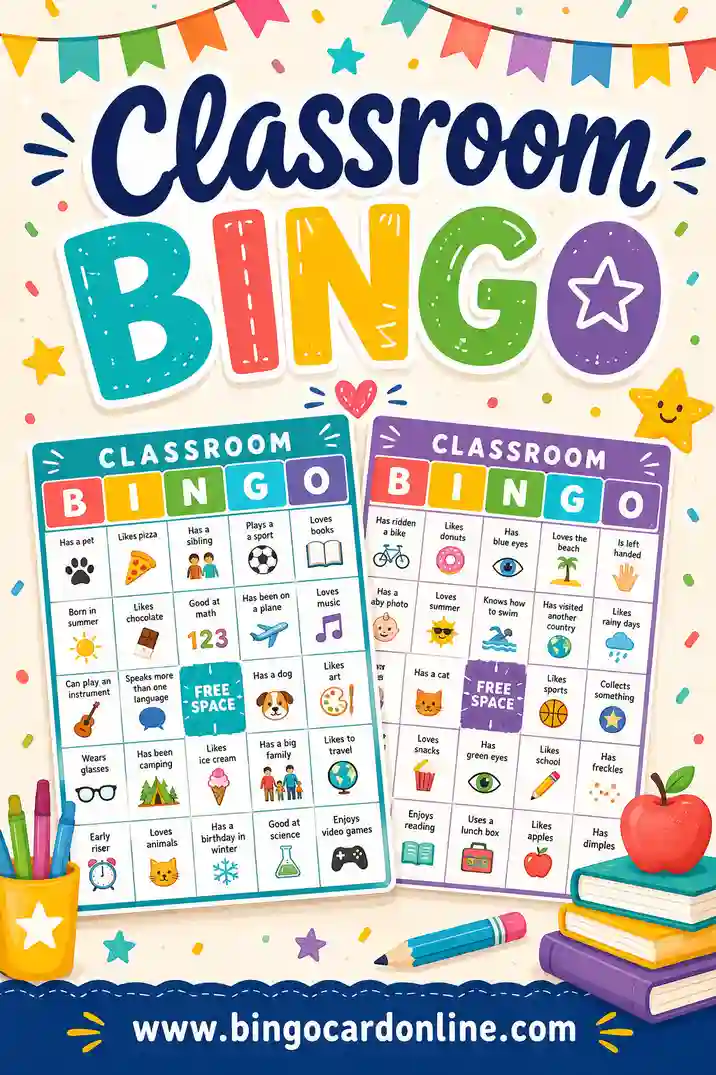
Themed free space. Rather than the word FREE, the center holds a logo, a photo or an event name. Purely cosmetic, and a nice touch for weddings, showers and company events — the square still functions normally.
Pattern Play and the Center
Once you move beyond simple lines into pattern bingo — letters, shapes, blackout — the free space becomes genuinely strategic in how patterns are designed.
Patterns that include the center (X, plus sign, diamond, small square) are meaningfully easier than patterns that avoid it (the four corners, outer frame, postage stamp). If you're running several rounds and want them to take similar amounts of time, alternate rather than stacking all the center-inclusive patterns together.
For a blackout round, the free space simply removes one required call from an otherwise long game — which is why blackout rounds are usually the last game of a session even with it.
Building Cards With or Without
Whether to include a free space is a decision to make before printing, since retrofitting it means reprinting the set. Most generators default to including it on 5x5 cards and omitting it on other sizes, which matches convention.
A bingo card generator lets you toggle it, which matters most for classroom sets where you usually want it off, and for themed events where you want a custom image in the center instead.
The Column Ranges, and Why They Exist
The free space only makes sense alongside the column structure it belongs to, which is worth spelling out.
| Column | Letter | Number range |
|---|---|---|
| 1 | B | 1-15 |
| 2 | I | 16-30 |
| 3 | N | 31-45 |
| 4 | G | 46-60 |
| 5 | O | 61-75 |
Each column draws from its own fifteen numbers, and five numbers are chosen per column — except N, which takes four because of the free space.
This structure does two useful things. It guarantees an even spread, so no card can be loaded with low numbers while another holds only high ones. And it makes calling faster, because "B-7" tells a player which column to look at before they even process the number.
It also explains why the free space couldn't sit anywhere else. Removing a square from B or O would break the visual symmetry; the center of N is the only position that keeps the card balanced while shedding exactly one number.
Patterns and the Center Square
Once you move beyond straight lines into pattern play, the free space becomes a genuine design consideration.
Patterns that include the center are easier by exactly one call: the X, the plus sign, the diamond, the small square, the letter T, the arrow.
Patterns that avoid the center need their full complement: the four corners, the outer frame, the postage stamp, the letter L, the checkmark, the letter U.
If you're running a session of several pattern rounds and want them to take comparable time, alternate rather than stacking all the center-inclusive patterns together. A run of easy patterns followed by a run of hard ones makes the session feel badly paced even when the total time is the same.
For a blackout round, the free space simply removes one required call from a long game. It's why blackout is almost always the final game of a session — even with the free space, it takes the longest.
Diamond bingo is the one that catches people out. A diamond bingo pattern runs through the center, so it needs one fewer call than the four-corners round that usually precedes it. Announce it as an easier, faster game rather than a step up, or the room will settle in for a stretch that ends much sooner than they expect.
Themed and Custom Centers
The free space is the one square on a bingo card that carries no number, which makes it the natural place for branding or personalization.
Events. A couple's names and wedding date, a company logo, a charity name, a birthday age. Purely cosmetic, and it makes a generic card feel made for the occasion.
Classrooms. A school crest, a class name, or a small illustration relevant to the topic being taught.
Fundraisers. A sponsor's logo, which is a genuinely useful thing to be able to offer a sponsor.
Seasonal sets. A pumpkin, a snowflake, a heart — matching the theme of the rest of the card.
The square still functions exactly as normal; it's marked from the start and counts toward any line through the center. Only the printed content changes.
The Free Space in Non-Standard Formats
90-ball bingo, common in the UK and much of Europe, uses a completely different card — three rows of nine columns, with only five numbers per row and four blanks. There is no free space, because the format already has blanks built into every row.
80-ball bingo uses a 4x4 grid with four colored columns. No free space, since there's no true center square on an even grid.
30-ball or speed bingo uses a 3x3 grid. Some versions include a free center, which makes the game extremely short — a line needs only two called numbers. Most drop it.
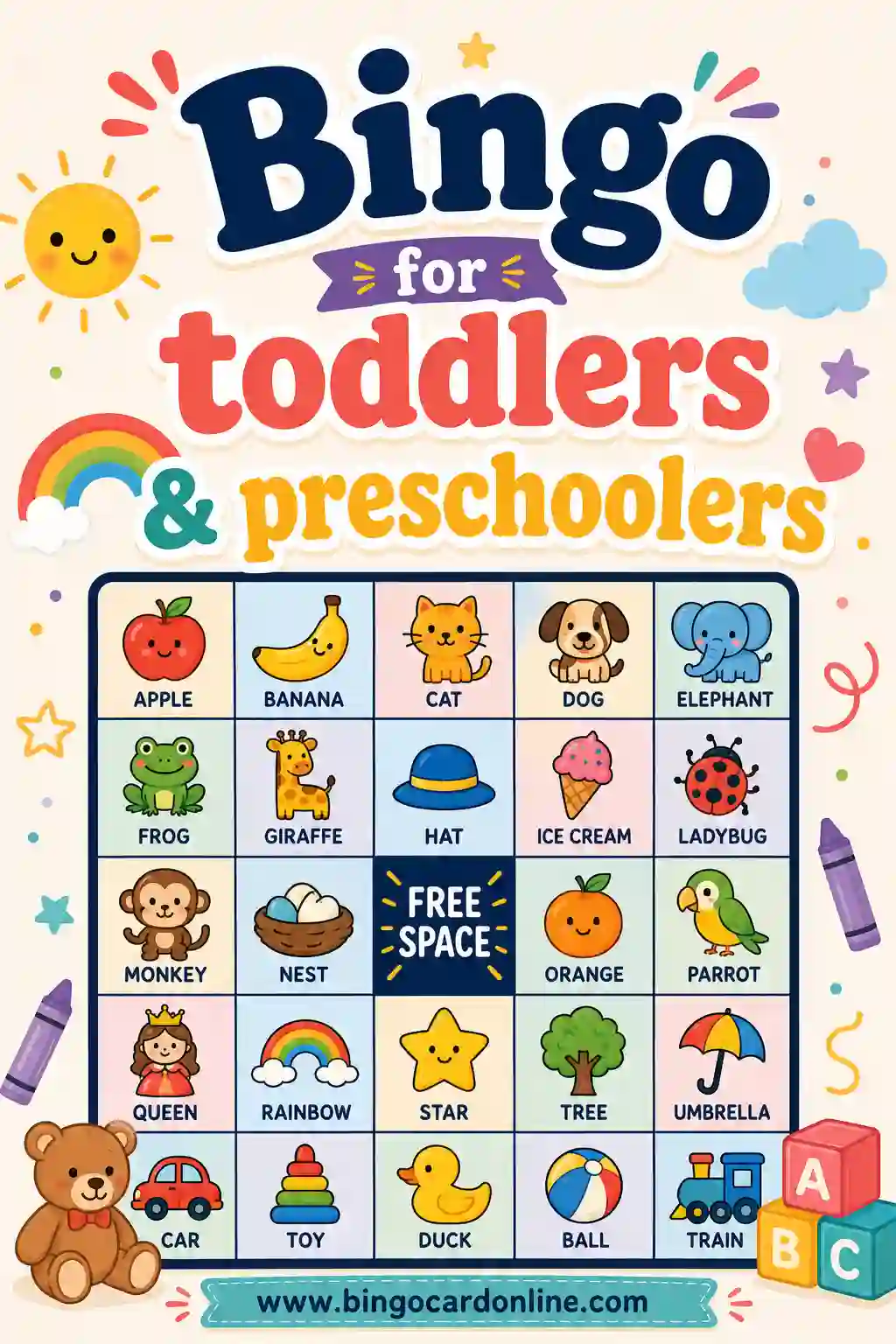
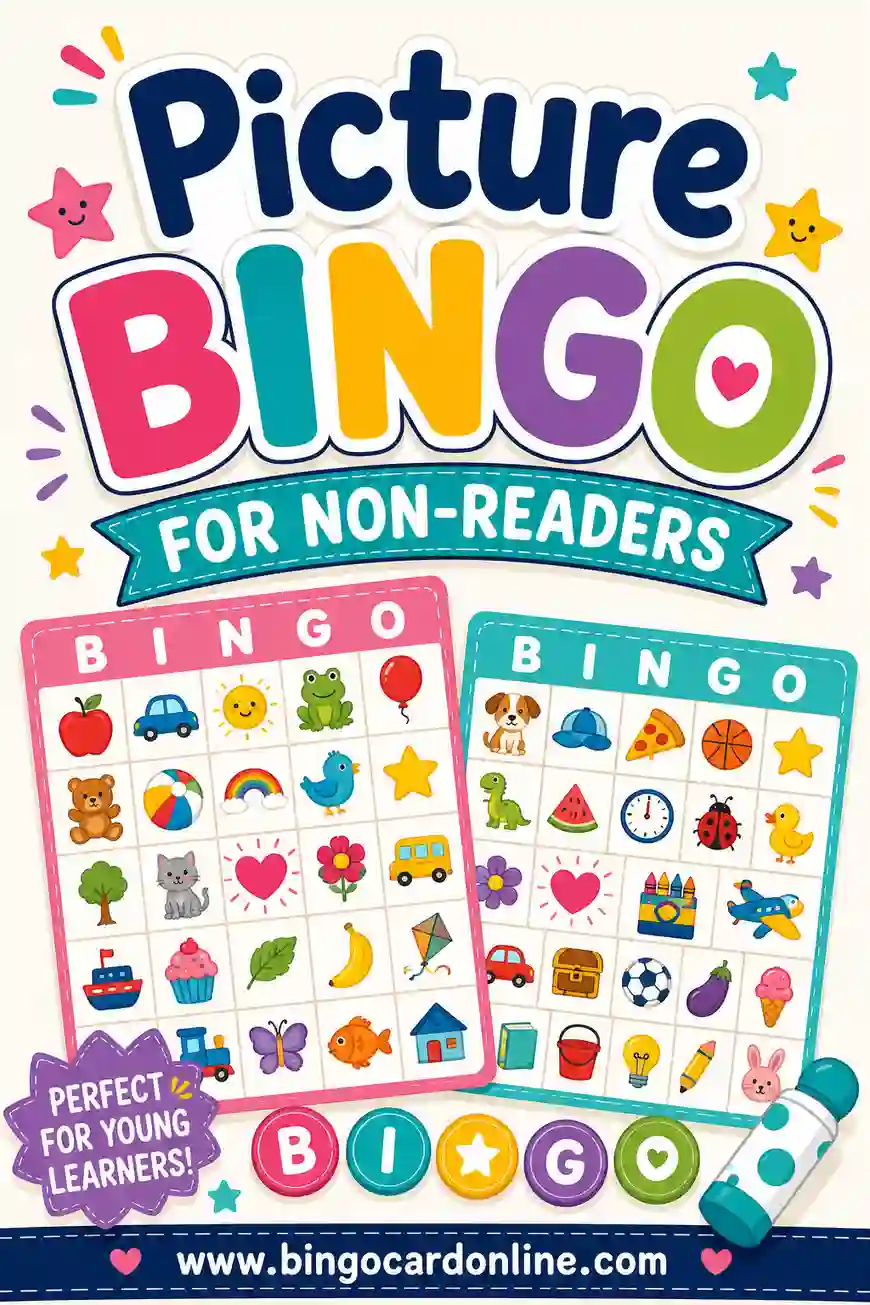
Themed and educational cards frequently use 4x4 or 5x5 grids with words or images rather than numbers. Whether to include a free space is purely a design choice, and for teaching purposes it's usually better without, since a free square is a square where no learning happens.
The general principle: the free space belongs to the 75-ball 5x5 format specifically. Carrying it into other grid sizes usually creates more problems than it solves.
Should Your Cards Have One?
A short decision guide:
Include it if: you're running a traditional 75-ball game, you want games to move quickly, you're playing with children who need an early sense of progress, or you want a branded center square for an event.
Skip it if: the game is educational and every square should require an answer, you want longer games, you're using a non-5x5 grid, or you're running a high-value prize round where a harder win is appropriate.
Decide before printing. Adding or removing a free space after the fact means reprinting the whole set, and mixed sets — some cards with, some without — create a genuine fairness problem.
History and Origin
Modern bingo descends from a carnival game called "beano," played with dried beans as markers and numbers drawn from a cigar box. The story generally told is that a toy salesman named Edwin Lowe encountered it at a carnival in the late 1920s, saw its commercial potential, and developed it into the game sold as bingo.
Lowe's contribution was largely standardization — fixing the card format, the column ranges and the calling conventions. The free space belongs to that standardization. With five columns of fifteen numbers each and five rows to fill, a card needs twenty-five squares and the arithmetic works more cleanly at twenty-four numbers with a free center.
The other frequently cited motivation is speed. Bingo halls in the 1930s and 40s ran many games per session, and shaving even a few calls off each game across an evening was commercially meaningful. A free space removes one required call from four of the twelve possible lines.
Both explanations are probably true and neither is fully documented — the history of the game's early commercialisation is thinly recorded and much of what circulates is repeated rather than sourced. What is clear is that the free space was a design decision rather than an accident, and that it has been standard in 75-ball bingo ever since.
Blank Boards, Column Calls and the One Setting to Decide
A few practical points that sit alongside the free space once you're actually producing cards.
Starting from an empty bingo board. A blank 5x5 grid with the B-I-N-G-O header and nothing else is the most useful printable in the set. Hand an empty bingo board to a class and they fill it themselves with vocabulary, sight words or their own numbers, which does considerably more teaching than a pre-filled card ever will. Leave the center blank too and let them argue about whether it should be free.
The one bingo setting to decide before printing. Free space on or off is the single bingo setting that can't be changed after the fact. Every other choice — grid size, number range, font, wording — is visible on the page and can be worked around. A mixed set where some cards have a free center and some don't is genuinely unfair, and it's the mistake people make when they print a second batch weeks later without checking what the first batch did.
Reading a call like I-21. A player who looks up I 21 bingo notation is really asking one thing: which column does that number belong to? The letter answers it. I covers 16 through 30, so 21 sits in the second column and can be found without scanning the whole card. That is the entire reason the letters get called at all, and it's the same structure the free space depends on.
Lucky Numbers, Lucky Seats and the Odds
The free space is the only square on a bingo card a player is guaranteed. Everything else is drawn, which is why so much folklore attaches to a game containing no decisions.
Lucky bingo rituals are real and harmless. Regular players have a seat they prefer, a dauber color they trust and numbers they feel warmly about. None of it changes anything — the balls have no memory and every card faces the same draw — but a lucky bingo routine is a large part of why people enjoy a hall session, and a caller who mocks it has misread the room.
Card choice does nothing. Every card is a random selection from the same pool, so no card is better than another. What does move your odds is how many cards you play relative to everyone else in the room, which is arithmetic rather than luck.
The free space is the only edge, and everyone has it. Four of the twelve lines need one fewer call. That advantage is identical for every player in the room, which is precisely why it isn't an advantage.
Frequently Asked Questions
Why do bingo cards have a free space? Because a 5x5 grid needs 25 squares while the traditional 75-ball number pool divides evenly into columns of 15, giving 24 numbers across five columns of five minus one. The free space fills the gap, speeds up games, and starts every player equal.
Does the free space count toward a win? Yes. It counts as a marked square for any line, pattern or blackout that includes the center — which is why the middle row, middle column and both diagonals need only four called numbers instead of five.
Should educational bingo cards have a free space? Usually not. On a math or vocabulary card, the free space is a square where no practice happens. Removing it means every square requires an actual answer.
Do 4x4 or 3x3 bingo cards have a free space? Generally no. Even-sided grids have no true center square, and on a 3x3 a free center makes the game extremely short. The convention is that the free space belongs to the 5x5 format.