Bingo Was His Name-O: The Song, the Spelling, and What "Bingo" Really Means
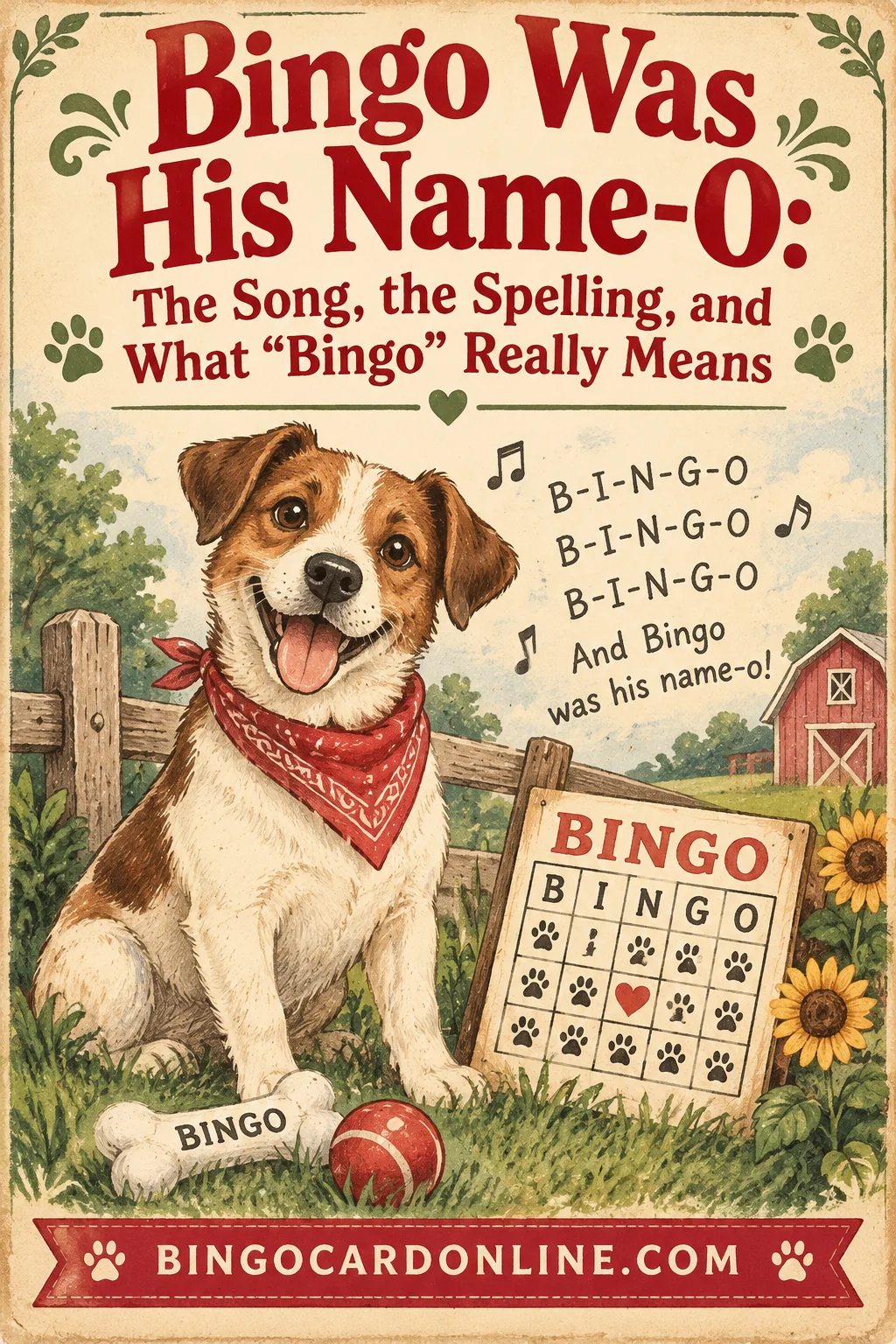
"Bingo" carries three separate meanings that people run together: it's a number game played on a grid, it's an exclamation you shout when something suddenly works out, and it's the name of a farmer's dog in a children's song that has been sung in some form for roughly three hundred years. None of the three caused the others in a straight line, which is why the word feels so slippery when you try to pin it down.
If you landed here after singing the song with a toddler, or after hearing someone yell "bingo!" in a meeting, this page covers both. We'll go through the dictionary meaning, the murky etymology, the song's long history and its regional lyric variants, how the clapping game actually works with a group of kids, why the rhyme scheme is doing more teaching work than it looks like, and how to spell the word when the plural or the possessive trips you up.
The dictionary meaning of bingo
In standard American and British dictionaries, bingo has two main entries.
As a noun, bingo is a game of chance. Players hold cards printed with a grid of numbers, a caller draws numbers at random, and players mark the matching squares. The first player to complete a required pattern — a line, four corners, a full card — wins. The word covers both the game itself and, informally, the venue where it's played ("she's at bingo tonight").
As an interjection, bingo means roughly "there it is" or "that's exactly right." You say it at the moment a search ends: the missing key turns up behind the sofa, a diagnosis finally fits the symptoms, a spreadsheet formula finally returns a sane number. Bingo. The interjection sense is now so common in ordinary speech that plenty of people use it without ever having played the game.
There's a third, narrower sense worth knowing because it surprises people: in aviation radio usage, "bingo fuel" means the fuel level at which a pilot must break off and return to base. The logic is the same as the interjection — a threshold has been hit, and the moment is announced.
| Sense | Part of speech | Example |
|---|---|---|
| The number game | Noun | "They run bingo at the church hall on Thursdays." |
| The venue or session | Noun (informal) | "Grandma's gone to bingo." |
| Sudden success or recognition | Interjection | "Third drawer down — bingo." |
| A decision threshold | Adjective (aviation) | "We're at bingo fuel, turning back." |
Where the word came from
The honest answer is that nobody has a documented origin everyone agrees on, and any page that tells you otherwise is overselling its sources.
What's reasonably well established is the sequence. A grid-and-counters game of the same family circulated in Europe for a long time under other names, descended from Italian lottery games. In the United States in the 1920s, a carnival version was widely known as beano, because players marked their cards with dried beans as the numbers were called. Winners shouted "beano!"
The commonly repeated account of the switch is that a toy salesman named Edwin S. Lowe saw the game at a traveling carnival near Atlanta around 1929, heard an excited player shout "bingo" instead of "beano," liked the sound of it, and used that name when he began producing sets commercially. Lowe's company did popularize the game in the US, and the name did stick. Treat the exact "slip of the tongue" detail as the traditional story rather than something anyone can now verify.
Separately, "bingo" existed in British English as an exclamation before the game took the name — a punchy, percussive noise word in the same family as bang, bing, and bingo-bango, used the way you might say "presto." That older interjection may well have fed the game name rather than the other way around. It also explains why the exclamation feels so natural to people who have never marked a card in their lives.
Why "bingo!" became an exclamation
The word does something phonetically that few English words do as neatly. It opens on a hard b, snaps through a nasal -ing-, and lands on an open -o that you can hold as long as you like. That shape makes it a natural shout: the beginning is sharp enough to cut through noise and the ending is loud enough to carry across a hall.
Add the game's structure and the meaning follows. In bingo, the whole session is a slow accumulation of near-misses followed by one instantaneous resolution. The word marks a threshold being crossed — not "I'm doing well" but "it's done, right now." When people borrowed it for everyday speech, they borrowed that precise timing. "Bingo" is never a comment on progress. It's always a comment on arrival.
How to spell bingo
Bingo is spelled B-I-N-G-O — five letters, no double consonants, no silent letters. That's it, and the song exists partly to make sure children never forget it.
The parts that actually cause trouble:
- Plural. Both bingos and bingoes appear in print. Bingos is more common in American English and is the safer choice. You'll mostly need it for phrases like "she had two bingos in one session."
- Capitalization. Lowercase for the game and the exclamation. Capitalize only when it's a proper name — the dog in the song, a brand, or a hall's name.
- Hyphenation in the song title. The refrain line is usually written "Bingo was his name-o," with a hyphen before the o, because the o is a sung syllable rather than part of the name. You'll also see "name-oh," "nameo," and "name o" with no hyphen. None of these are wrong exactly; the hyphenated form is simply the most common in printed songbooks.
- Not "bing-o" as a word. The game is one word. The only place a hyphen belongs is in that sung "name-o."
If you spell bingo often — on classroom cards, prize signs, or headers — it's worth noting that the five letters are also the five column headings on a standard 75-ball card. That's a useful memory hook for children: one letter per column, left to right.
The song: a farmer, a dog, and three centuries
The children's song usually printed as "Bingo" or "Bingo Was His Name-O" is far older than the game it shares a name with. Versions of a song about a farmer and a dog called Bingo appear in English printed sources in the eighteenth century, well before anyone was marking numbered cards. Early printed versions treat it as a drinking or catch song for adults, with the spelled-out name used as a party trick — the point was to get through the spelling without fumbling, and to trip up whoever did.
The children's version we know now is much simpler. It has a fixed three-part shape:
- A setup couplet. Two lines establishing that a farmer owned a dog, ending with the assertion that the dog's name was Bingo.
- The spelled refrain. The name is spelled out letter by letter, repeated three times, with a strong rhythmic pulse on each letter.
- The closing line. A restatement that Bingo was the dog's name, with that trailing sung "-o."
That's the entire song. Its power is structural, not lyrical: five letters, three repetitions, and a shape a three-year-old can predict after one hearing.
"Bingo was his name-o" vs "bingo was its name o"
Both are sung, and the split is mostly regional and generational rather than a matter of one being correct.
| Variant line | Where you'll hear it | Note |
|---|---|---|
| "and Bingo was his name-o" | Most common in the US and UK | The traditional and most-printed form |
| "and Bingo was its name-o" | Heard in some classroom and songbook versions | Often a deliberate edit to avoid assigning the dog a gender |
| "There was a farmer who had a dog" | Common in the US | Interchangeable with the had form |
| "There was a farmer had a dog" | Older printed versions | Keeps the original meter more cleanly |
If you've been searching for bingo was its name o and finding only the his version, that's why — the its variant is a real, widely sung alternative rather than a mistake, but the his form dominates in print. Some versions also swap the farmer for a family, a grandmother, or a school, which lets a teacher name the dog after something in the classroom.
The phrase bingo was his on its own is simply the truncated beginning of that closing line; it turns up constantly in searches because people remember the tune and the first three words and not much else.
How the clapping game is played
The song's real function is a memory-and-coordination game, and it's the reason the song has survived. Here's how it runs with a group of children:
Round one. Sing the whole song straight through, spelling all five letters out loud. This sets the rhythm and makes sure everyone knows the tune.
Round two. Sing it again, but replace the B with a clap. Everyone claps once in the exact spot where the B would have gone, then sings the remaining four letters. The clap has to land on the beat — that's the challenge.
Round three. Replace B and I with two claps, sing the last three letters.
Round four. Three claps, then two letters.
Round five. Four claps, then just the O.
Round six. All five letters replaced with claps. The refrain becomes pure rhythm, and the only sung words left are the setup and closing lines.
The whole cycle takes about four minutes with a group and gets faster and funnier as it goes, because the failure mode is always the same: somebody sings a letter they were supposed to clap. Nobody is out, nobody wins, and that's the point — the game is cooperative, so it works with mixed ages and with children who are shy about performing alone.
Common variations:
- Stomps instead of claps for a group that's been sitting too long.
- Silence instead of claps for a much harder version — the beat has to be held internally.
- Substitute the name. Any five-letter word works. Teachers often use a classroom pet's name, a five-letter sight word, or a child's name so the game doubles as spelling practice.
- Split the room. Half the group claps, half sings the letters, then swap.
Bingo rhyming: what the song is actually teaching
The rhyme scheme in "Bingo" is looser than people assume, and the looseness is doing real work.
The setup lines rhyme conventionally, usually pairing an end word with o-sounding words like so or know, depending on the version. But the memorable part isn't the end rhyme at all — it's the assonance running through the whole song. Every stressed syllable in the refrain lands on a vowel sound that resolves into the long o: the letters themselves have their own vowel colors, and the sung "-o" at the end of every phrase pulls them all toward the same place.
That's why the song sticks. A child doesn't have to hold five arbitrary letters in memory. They hold a rhythm with a fixed landing point, and the letters ride on it. This is the same mechanism behind alphabet songs generally, and it's why bingo rhyming games are used deliberately in early literacy work rather than just for fun. The specific skills it builds:
- Phonemic awareness — hearing individual letter sounds as separate units inside a word.
- Sequencing — the letters only work in one order, and the rhythm punishes you for getting it wrong.
- Working memory — each clapping round removes one letter but you still have to track the whole word.
- Beat competency — clapping on a specific beat is a genuine developmental skill and a good predictor of later reading fluency.
If you want to extend the rhyming side, ask children for words that rhyme with Bingo — lingo, dingo, jingle nearly does it, flamingo almost — and then sing a round with the substitute name. Half of them will be near-rhymes rather than perfect ones, which is a useful conversation in itself.
Does the song have anything to do with the game?
Almost certainly not, beyond the shared name. The song predates the American game by roughly two centuries, and the game's name is best explained by the beano lineage plus the existing British exclamation. Bingo was a common enough dog name in England that a song using it needed no special explanation.
The overlap does have one happy side effect for teachers: because the song drills the spelling of the word, children who sing it arrive at a real card already knowing what the five column letters say. If you're running a session with a class, you can print a grid from a bingo card generator and sing the song as the warm-up, then use the same five letters to explain how the columns work. The lesson lands in about thirty seconds because the spelling is already in their heads.
Frequently Asked Questions
What does bingo mean as a word? It has two everyday senses: a number-matching game played on a printed grid, and an exclamation meaning "that's it" or "found it," said at the moment something suddenly works. A narrower aviation sense, "bingo fuel," means the point at which an aircraft must turn back.
Is it "Bingo was his name-o" or "Bingo was its name o"? Both are sung. The his version is older and far more common in printed songbooks; the its version circulates in classrooms and some modern collections, often to avoid assigning the dog a gender. Neither is a mistake.
How do you spell bingo, and what's the plural? B-I-N-G-O. The plural is usually written bingos in American English, though bingoes also appears. Keep the word lowercase for the game and the exclamation, and capitalize it only as a name.
How old is the Bingo song? Versions of a song about a farmer and a dog named Bingo appear in English printed sources in the eighteenth century, which makes it far older than the American card game that took the same name in the 1920s. The two share a word and nothing else.