Bowling Bingo: Game Rules, Scoring, and Free Printable Cards for League Night
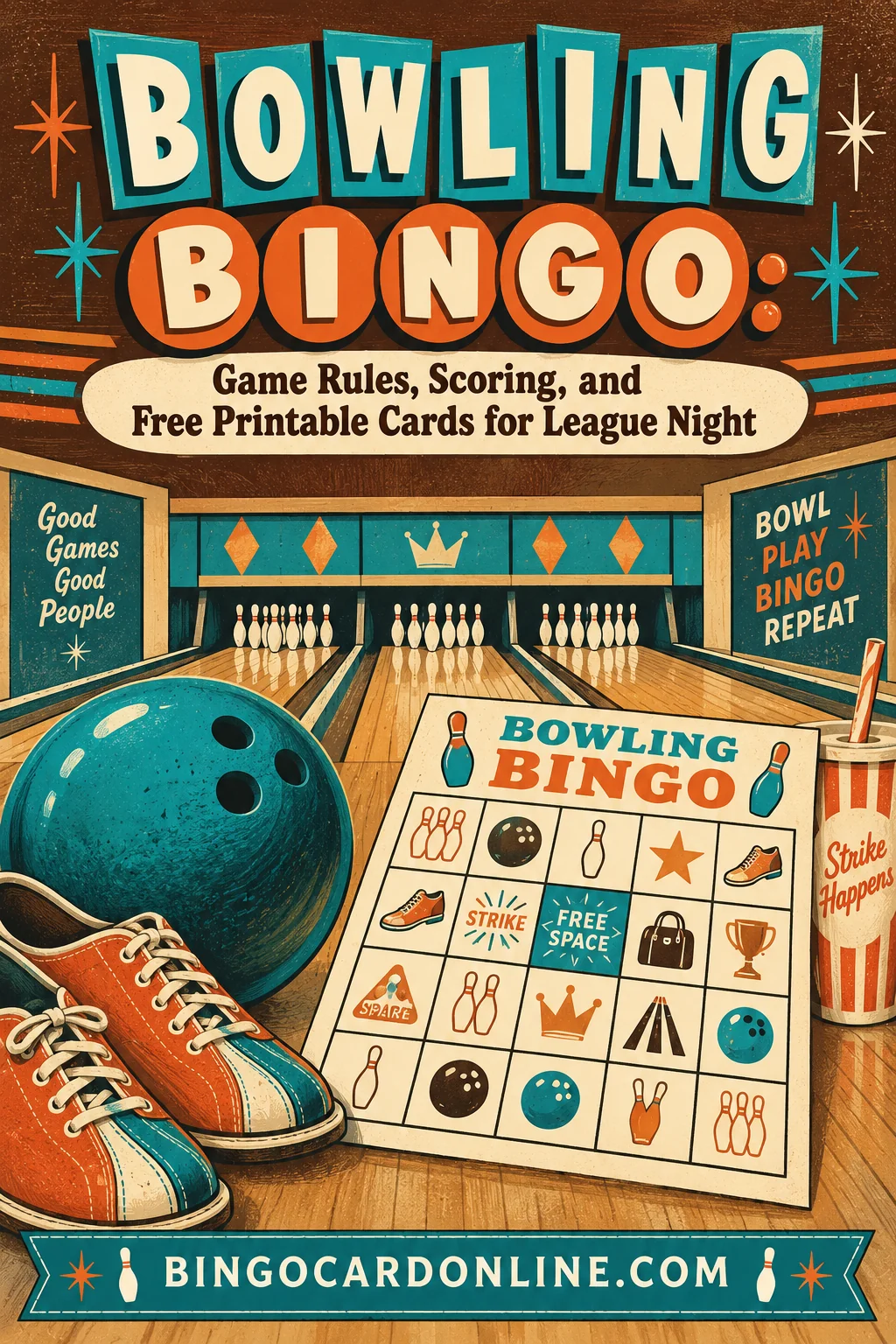
Bowling bingo is a side game played while you bowl: each square names something that can happen on the lanes — a strike, a gutter ball, a spare after an open frame, someone's ball drifting into the next lane — and you mark it off when it actually happens. It runs alongside the real game without changing it, which is the whole reason it works for league nights, birthday parties, and corporate outings where half the room can't bowl.
This is a different animal from watch-party bingo. You're not sitting in front of a screen marking things a broadcaster says. You're on the approach, and the squares are describing your own group's behavior — which means everyone at the pair of lanes is generating the marks, including the people whose average is 78.
How bowling bingo works
The mechanics are simple enough to explain in the time it takes for the pinsetter to reset.
- Everyone gets a card before the first frame. Cards should be different from one another — that's the point, otherwise everyone marks the same square at the same moment.
- Squares are events, not numbers. "Someone bowls a strike," "a ball goes in the gutter on the first ball," "somebody blames the shoes."
- Anyone's action counts. Unless you're playing the solo variant below, a square marks when anybody in your group does the thing. That's what keeps weak bowlers involved.
- Mark it when it happens, out loud. Calling it prevents arguments later.
- First to a line wins in a short session. First to a full card wins in a two-hour league night.
You need a pen per person and enough cards for the group. Bring clipboards if you can — bowling tables are sticky and there's nowhere flat to write. A phone camera works as backup: photograph each card at the start so nobody can quietly "remember" a square differently at the end.
The best squares for a lanes session
Good bowling bingo squares are specific, observable, and likely-but-not-guaranteed. A square that hits every frame is dead weight. A square that can't possibly hit is worse.
Ball and pin events
- Strike on the first ball of a frame
- Gutter ball on the first ball
- Gutter ball on the second ball
- Spare picked up after leaving four or more pins
- A split (any)
- The 7-10 split (rare enough to be a free bragging right)
- Solid single-pin leave: the 7, the 10, or the dreaded 5-pin
- Two strikes in a row by the same person
- Turkey — three strikes in a row
- Ball goes in the gutter and comes back with pins knocked down by the neighbor's ball
- Somebody's ball drifts into the next lane's approach area
- A pin left standing wobbles and falls late
- Someone knocks down exactly one pin
- All ten pins standing after the first ball (a whiff)
People events
- Someone does a victory dance
- Someone falls over or slides too far past the foul line
- Foul line light or buzzer goes off
- Someone bowls out of turn
- A player changes ball mid-game
- Somebody uses a bumper "by accident"
- Someone throws granny-style (two hands, between the legs)
- Player complains the lane is oily
- Player blames the rental shoes
- Someone drops the ball behind them on the backswing
- A phone comes out mid-frame
- Somebody says "I'm just warming up" after frame six
Alley events
- The pinsetter jams
- A ball gets stuck in the return
- The scoring screen shows the wrong name
- Someone from another lane cheers for your group
- Nachos or fries arrive at the table
- A birthday announcement over the loudspeaker
- The lights or music change for glow bowling
- Somebody puts a bumper up for the kids' lane next door
Score-based squares
- Anyone breaks 100
- Anyone breaks 150
- Anyone finishes with a score lower than their frame count
- Two players tie at the end of a game
- Someone improves by 20 points between game one and game two
- A frame scores zero for two people in a row
Aim for a mix: roughly half ball-and-pin events, a quarter people events, and a quarter alley or score events. An all-technical card is dull for spectators; an all-jokes card gets ignored by serious bowlers.
Card formats and which one to pick
| Format | Grid | Free space | Best for | Typical length |
|---|---|---|---|---|
| Quick card | 3x3 | No | One game, kids, short attention spans | 20-30 minutes |
| Standard | 5x5 | Yes, center | Most groups, one to two games | 45-75 minutes |
| League night | 5x5, blackout | No | Full three-game league set | 2 hours+ |
| Team card | 5x5, one per lane | Yes | Corporate outings, big groups | Whole session |
| Solo card | 4x4 | No | Serious bowlers marking only their own throws | Three games |
The 3x3 quick card is the one people underuse. Nine squares fills fast, which means you can run three or four complete rounds across a single game and hand out something small each time. For kids under ten, this is the only format that holds up.
The 5x5 with a free center square is the default for a reason. Twenty-four real squares over two games gives a line win somewhere around frame twelve to fifteen, which is a good pace.
A blackout card — you must fill all 25 — is the right call for a three-game league night, because a line win in the first twenty minutes leaves ninety minutes of nothing.
League night rules
League bowling has a rhythm bingo has to respect: people are keeping real score, there's a standings sheet, and nobody wants a side game slowing down the lanes.
Set it up before practice balls. Hand out cards during the warm-up frames so nothing interrupts the actual games.
Ban squares that change how people bowl. This is the rule that matters most. A square reading "throw a granny ball" turns into someone tanking a frame to mark it, and in a league with standings that's a real problem. Every square should describe something that happens naturally, not something a player can choose to do. If you want stunt squares, keep them for a fun night, not a scored one.
Decide the scope up front: does a square mark when anyone on your pair of lanes does it, or only your own team? Pair-of-lanes scope is more fun and fills faster. Team-only scope makes it more competitive.
Use the whole three-game set. League nights run long enough that a blackout card is realistic, and a card that survives all three games gives late-arriving bowlers a chance.
Run a prize that isn't money. League treasuries have rules. Pick something like choosing the music, skipping the lane cleanup, or a free game voucher from the front desk.
Keep one neutral scorekeeper. Somebody who isn't playing — a partner, a kid, the person sitting out a game — settles disputes about whether that leave was really a split.
A league-friendly square set
For a scored league night, the safest squares are ones the bowler cannot manufacture:
- Any split
- Any turkey
- A strike in the tenth frame
- Two open frames in a row
- The pinsetter jams
- Anyone breaks their season average
- A 200 game on any lane in sight
- A late-falling pin
- A ball returns with someone else's ball right behind it
- Anyone finishes a game with an all-spares frame run of three
Kids' birthday parties
Bowling parties have a structural problem: two hours, twelve kids, two lanes, and roughly four minutes of bowling per child. Bingo fills the gap between turns, which is where birthday parties usually fall apart.
Use a 3x3 or 4x4 card. Twenty-five squares is too many for a seven-year-old to track between turns.
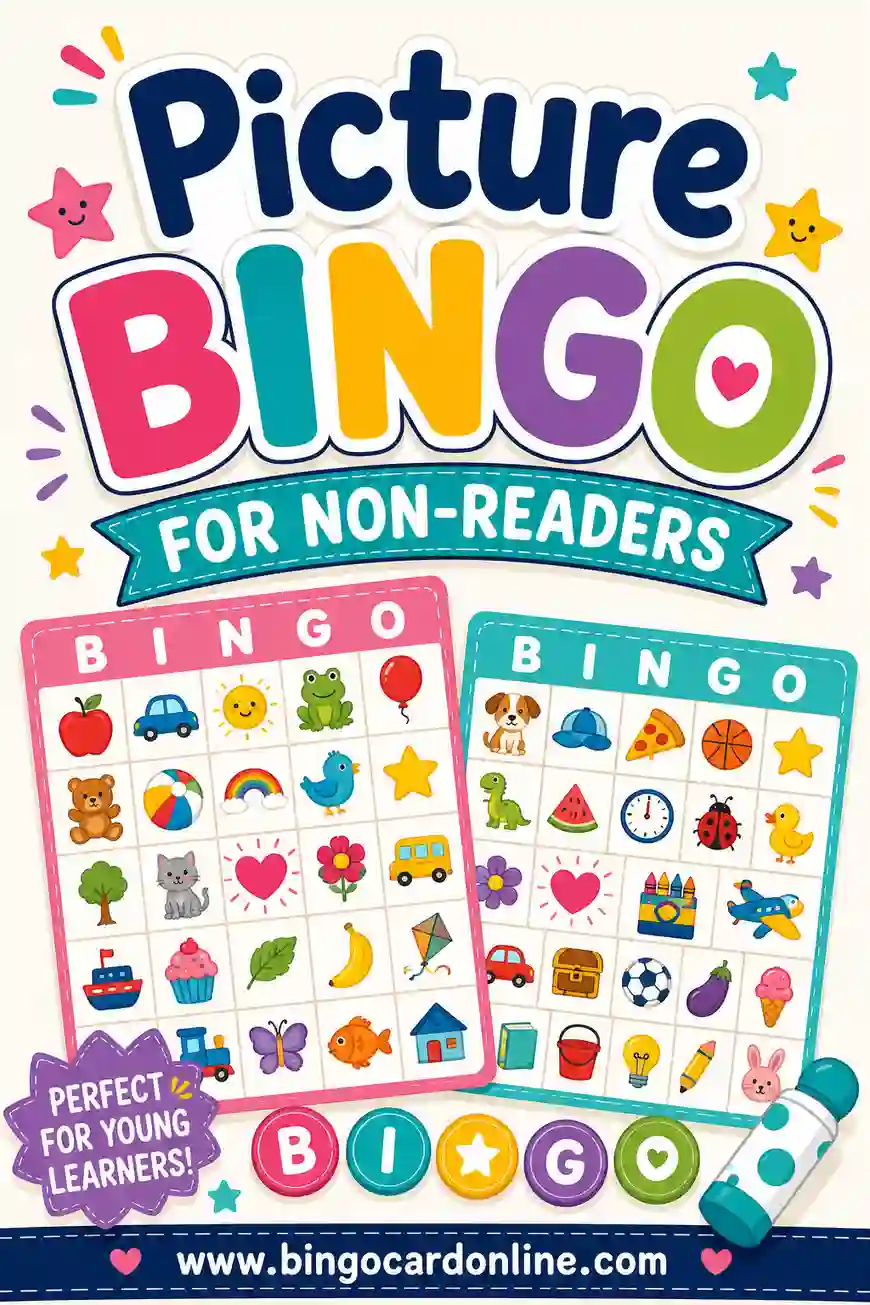
Use pictures or very short phrases. "Gutter ball," "strike," "bumper hit," "high five," "someone falls down." A child who reads slowly should be able to scan the card in five seconds.
Bumper-specific squares work well: the ball bounces off both bumpers, the ball bounces off a bumper and still gets a strike, a ball rolls so slowly the kids start counting.
Give everyone something. Run it so that every child completes a line eventually — with nine or sixteen easy squares over two hours, they will. Small prizes at the moment of the win beat one grand prize at the end.
Sticker markers instead of pens. Pens on a bowling table end up on shirts. Dot stickers or a bingo dauber are cleaner and kids prefer them.
One card for the birthday kid that's rigged in their favor is a perfectly acceptable use of a generator. Nobody has to know.
You can build the whole set — one different card per child, matching the party's colors — in a couple of minutes with a bingo card generator and print the sheets the night before.
Scoring variants
Straight bingo (first to a line) is fine, but the lanes give you a scoreboard to play with, and these variants use it.
Points per square
Instead of racing for a line, every marked square is worth points, and the highest total at the end of the session wins. Weight the squares by difficulty:
| Event | Points |
|---|---|
| Gutter ball, blame the shoes, phone out | 1 |
| Strike, spare after a big leave, victory dance | 2 |
| Any split, turkey, pinsetter jam | 3 |
| 7-10 split, a 200 game, someone breaks 150 for the first time | 5 |
This variant is better than plain bingo for wildly mixed groups, because a beginner marking eight one-pointers finishes level with a good bowler marking two turkeys.
Frame lock
Each square must be marked in a different frame. You can't mark three squares off one dramatic tenth frame. This slows the game down substantially and is the right variant when you've only got one game to fill.
Bingo handicap
Borrow the league idea directly. A player whose average is under 100 needs a line; a player over 150 needs two lines; a player over 180 needs the four corners plus a line. It sounds fussy but it takes ten seconds to assign and it stops the same person winning every week.
Blackout with a burn
Blackout rules, but each player may "burn" — cross out and forfeit — two squares they judge impossible for their group. A card with "7-10 split" on it isn't dead weight anymore, it's a decision.
Team relay
On a pair of lanes, each team shares one card, but only the player currently up may mark a square. If your teammate throws a strike while you're bowling, tough — nobody marks it. This produces genuine shouting.
Lane trade
Halfway through the session, swap cards with the person on your left. Every mark already made stays. This wrecks anyone who was one square from a line and is extremely funny for everyone else.
Common mistakes when running it
Squares that are too rare. A card full of 7-10 splits and 300 games is a card nobody marks. If a square hasn't hit in three sessions, replace it.
Squares that are too common. "Someone bowls a gutter ball" hits in the first two frames with most groups. Make it "someone bowls two gutter balls in the same frame."
Identical cards. If everyone has the same grid in the same order, everyone wins at the same moment. Shuffle the square order per card — a generator does this automatically, and it's the single biggest quality difference between a good bowling bingo night and a flat one.
No time cap. Announce when the game ends: "end of game two" or "when the lane clock hits zero." Otherwise it drifts and nobody claims a win.
Forgetting the non-bowlers. Parents, partners, and people sitting out are the most attentive markers in the building. Give them cards. They'll spot the pinsetter jam before anyone on the approach does.
Frequently Asked Questions
How many squares should a bowling bingo card have? Nine for kids and short sessions, twenty-five for a normal one-to-two-game night. Use a 5x5 blackout card only if you're bowling a full three-game league set, since a blackout in one game is close to impossible.
Can bowling bingo be played during a scored league game? Yes, as long as every square describes something that happens naturally rather than something a bowler can choose to do. Ban stunt squares like "throw the ball backwards," because in a league with real standings someone will tank a frame to mark it.
What should the prize be? Something small and immediate: a free game voucher, control of the music, the last of the nachos, or a token that lets the winner pick lanes next week. Cash prizes complicate league treasuries and turn a filler game into a dispute.
Does everyone need a different card? Yes, if you want the game to last. Identical cards mean every player marks the same square at the same moment and everyone hits a line simultaneously. Randomizing the square order across cards is the one setup step that genuinely matters.