Christmas Bingo for Kids: Word Lists, Age Guide, and Free Printable Cards
Christmas bingo for kids is the party game that actually works. It takes two minutes to explain, every child plays at once, nobody sits out waiting for a turn, and the room stays (mostly) at indoor volume because everyone is busy scanning their card. If you have ever tried to run a relay race in a classroom the last day before winter break, you already know why that matters.
This page gives you everything you need to run it well: a 40-word kid-friendly Christmas list sorted into three themes, a 30-word picture list for pre-readers, an age guide that tells you which grid size and calling pace fits which kids, and a four-step method for printing a whole class set of unique cards. There are round ideas, prize ideas that are privileges rather than purchases, and the mistakes that turn a fun game into a meltdown.
You do not need to hand-draw a single card. Paste any list from this page into the free bingo card generator, choose a grid size, and it prints as many unique cards as you need plus a master call sheet for the caller. No sign-up, no watermark, and it checks that no two cards match.
Why Bingo Works for Kids at Christmas
December is a hard month to hold a child's attention. Kids are tired, overexcited, and counting down the hours. Bingo fits that mood better than almost any other group game because it asks for short bursts of focus instead of one long stretch of it. A round lasts five to ten minutes, then the cards get cleared and the excitement resets.
It is also one of the few games where every child plays the whole time. There is no elimination, no waiting for your turn, and no team that is clearly losing by the third minute. A five-year-old who has never heard of bingo can be marking squares within one round. The kid who is shy in front of a group does not have to perform anything; they just look for a snowman on their card.
Teachers love it for a quieter reason. When thirty kids are each hunting their own card for the word you just called, the room goes still for a few seconds. Then someone yells bingo, everyone groans or cheers, and it goes still again. That rhythm of quiet-burst-quiet is about as calm as a Christmas party gets.
- Short rounds: a full game on a 4x4 grid usually ends in six to ten calls, which is perfect for small attention spans.
- Everyone plays at once: no lines, no turns, no benches.
- Zero skill gap: a kindergartner and a fifth-grader have the same odds of winning.
- Built-in vocabulary practice: reading, listening, and matching without feeling like a lesson.
- Scales to any group: the same word list works for six cousins in a living room or ninety kids in a gym.
40 Kid-Friendly Christmas Bingo Words
This is the main list. Every word is something a child can recognize and picture, and none of them lean on a trademarked character. They are sorted into three themed columns so you can build a smaller list quickly: a 3x3 card only needs nine squares, so a preschool round might use just the Santa & Friends column, while a 5x5 card for older kids can pull from all three.
Copy the words you want into the generator one per line. It shuffles them into a different layout on every card, so two kids sitting next to each other will never have the same card even though they share the same 40 words.
| Santa & Friends | Decorations | Treats & Fun |
|---|---|---|
| Santa Claus | Christmas tree | Candy cane |
| Reindeer | Star on top | Gingerbread man |
| Elf | Ornament | Hot cocoa |
| Sleigh | Twinkle lights | Sugar cookie |
| Snowman | Wreath | Chocolate coins |
| Polar bear | Stocking | Peppermint |
| Penguin | Tinsel | Fruitcake |
| Mrs. Claus | Snow globe | Marshmallows |
| North Pole | Bells | Caroling |
| Rudolph | Mistletoe | Snowball fight |
| Nutcracker | Garland | Sledding |
| Angel | Candle | Ice skating |
| Snowflake | Gift bow | Pajamas |
| Chimney | Wrapping paper | Christmas movie |
A quick note on that last row: Chimney, Wrapping paper, and Christmas movie are the abstract-ish ones in the set, so keep them for kids who are reading confidently. Two words from the list, Rudolph and Nutcracker, are fine as single squares but should not be the theme of the whole game. If you want the full holiday set with more grown-up squares mixed in, the general Christmas bingo cards page has a longer list.
30 Picture Words for Pre-Readers
Three- to five-year-olds cannot read mistletoe, but they can absolutely spot a picture of a snowman. The fix is a picture card. You have two ways to get there, and both work with the same list below.
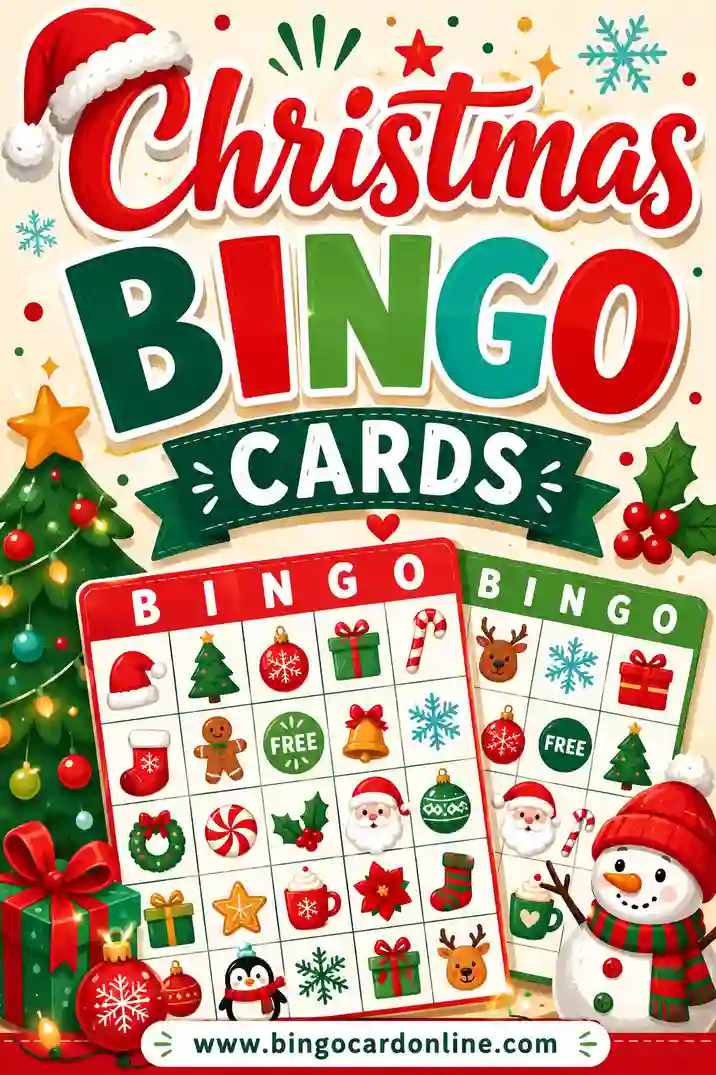
The fast way is to switch the generator to the emoji or picture card type. The free bingo card generator swaps each word for a matching little picture, so a card shows a tree, a bell, a star, and so on instead of the words. The caller reads the word out loud and holds up the picture on the screen, and the child matches it by sight.
The old-school way is to print Words cards on a 3x3 grid, then draw a tiny doodle in the corner of each square before the party. A dome with a few brick lines is an igloo. A triangle is a tree. Nobody expects art. Kids under five honestly prefer the wobbly hand-drawn version, and it takes about a minute per card.
| 30 Picture Words for Pre-Readers | ||
|---|---|---|
| Tree | Star | Bell |
| Igloo | Santa | Antlers |
| Gift | Gift bag | Lollipop |
| Cookie | Ice skate | Mitten |
| Hat | Sled | Lantern |
| Cocoa mug | Holly leaf | Elf hat |
| Owl | Fox | Moon |
| Cloud | Scarf | Boot |
| Drum | Teddy bear | Train |
| Rocking horse | Carrot nose | Bow |
Notice the list leans on shapes that are easy to tell apart at a glance: a mitten does not look like a boot, a star does not look like a bell. That matters more than you would think. With a 3x3 grid and nine of these, a preschool round usually ends in four or five calls, which is exactly right for that age.
Age Guide: Grid Size, Round Length, and Calling Pace
The single biggest difference between a great kids' bingo game and a frustrating one is matching the card to the age. A 5x5 blackout round is a wonderful challenge for a ten-year-old and a small tragedy for a four-year-old. Use this table as your starting point and adjust after the first round if the room feels too slow or too fast.
| Age | Grid size | Card type | Round length | Calling pace | Best win pattern |
|---|---|---|---|---|---|
| 3 to 5 | 3x3 (9 squares) | Pictures or emoji | 4 to 6 calls, about 3 minutes | Slow: say the word, show the picture, wait, say it again | Any single line, or 'first to find three' |
| 6 to 8 | 4x4 (16 squares) | Words with a picture hint, or plain words for strong readers | 8 to 12 calls, about 6 minutes | Medium: 10-second auto-call timer works well | Single line, then four corners |
| 9 to 12 | 5x5 (25 squares) | Words | 12 to 20 calls, about 10 minutes | Brisk: 5-second timer or a live caller who keeps moving | Line, X, picture frame, blackout |
For mixed-age groups, like a family party with cousins from three to twelve, do not try to find one perfect grid. Print 3x3 picture cards for the little ones and 5x5 word cards for the big kids from the same word list. The caller reads the same words for everyone, the small kids simply finish faster, and that is a feature. Let them win early, hand out a sticker, and start their next card while the older ones are still hunting.
A word on pace. Little kids need to hear the word, look at their card, find it, and mark it, and that takes longer than you expect. If you are using the on-screen caller, set the auto-call timer to 15 seconds for preschoolers, 10 for early elementary, and 5 for confident readers who want a fast round.
How to Make and Print a Class Set in 4 Steps
Hand-making thirty unique bingo cards is an evening you will never get back, and duplicated cards are how you end up with three kids shouting bingo at once. The generator handles all of that. Here is the whole process, start to finish.
- Paste your word list. Open the free bingo card generator and paste your words one per line. For a 4x4 card you need at least 16 words, but 30 to 40 gives every card a genuinely different mix. The three-column list above is already the right size.
- Pick the grid and card type. Choose 3x3, 4x4, or 5x5 to match the age guide. Choose Words for readers or the emoji picture card type for pre-readers. Turn on the ink-saver option if you are printing a big batch on the school printer.
- Set the number of cards and cards per page. Type the number of kids plus a few spares. Set 4 cards per page for a class set: 32 cards fit on eight sheets, and you cut them into quarters. Use 1 or 2 per page if you want bigger squares for younger hands.
- Print the cards and the master call sheet. The generator checks that no two cards match, then prints the set along with a master call sheet listing every word. Cut, stack, and you are done. Keep the call sheet for the caller, or skip paper entirely and use the on-screen caller.
One practical tip: print one extra card per five kids. Someone will spill cocoa on theirs, someone will mark the wrong squares and want a fresh start, and a spare card fixes both without a fuss.
For markers, anything works. Dot markers, crayons, small candies if the kids are not going to eat their markers mid-game, or dried beans if you want cards that survive to the next round. Crossing out with a pencil is the most reliable for a classroom because the marks cannot slide off when a card gets bumped.
Running Christmas Bingo in the Classroom
The last day before winter break is the classic slot. The kids are not going to absorb a math lesson, you know it, they know it, and bingo gives that afternoon a shape. Plan on three or four rounds, about twenty-five minutes total, and have something calm ready for afterward like a read-aloud or a coloring page.
Set up the caller on the projector
This is the part that makes classroom bingo easy. Put the on-screen caller up on the projector or smartboard and turn on voice. It reads each word aloud in a clear voice, shows it large on the screen, and keeps a call history on the side so any child who missed a word can look up and check. You are free to walk the room and help the kid who cannot find tinsel instead of being stuck at the front reading a list.
The auto-call timer is your pacing control. Set it to 10 seconds for a second-grade class, and the game runs itself. Pause it when a child calls bingo, verify their card against the call history, and start it again. A teacher can run a whole round without saying a word, which after a week of December is a gift.
Party stations
If your class party runs as stations, bingo makes a strong table. Six to eight kids, one adult helper with a phone or tablet running the caller, and 3x3 or 4x4 cards so a round finishes inside the ten-minute rotation. Because the generator makes unlimited unique cards, every group gets fresh cards and there is no reset between rotations. The classroom bingo page has more on stations and vocabulary variations.
Big groups and assemblies
For a whole-grade party or a holiday assembly, the same setup scales. Print a 5x5 set for everyone, put the caller with voice on the big screen, and have a few helpers walk the rows to verify bingos. See bingo for large groups for how to handle multiple winners and keep 100 kids from all standing up at once.
Round Ideas That Keep It Fresh
Playing the same single-line round four times in a row gets old. Announce a different win pattern for each round and the same cards feel like a new game. Show the pattern on the board so nobody has to remember it.
- Single line: the classic. Any full row, column, or diagonal wins. Start here for every age group, it is the round that teaches the game.
- Four corners: mark all four corner squares. Fast, easy to verify at a glance, and it usually crowns a different winner than the line round.
- Christmas tree: on a 5x5 card, mark the top center square, the three middle squares of row two, all five of row three, and the center square of the bottom row as the trunk. Draw it on the board first. Kids love this one because the winning card looks like a tree.
- Letter T: full top row plus the full middle column. Good for 4x4 and 5x5.
- Blackout: cover every square. Only for ages nine and up, and only as the last round because it uses most of the word list.
- Speed round: set the timer to 5 seconds and play single line. Older kids find the pressure hilarious.
- Whisper round: the caller whispers, kids mark silently, winners raise a hand instead of shouting. Use this when the room needs to come down a notch before dismissal.
A movie tie-in works too. If you are showing a holiday movie in class, swap the word list for scene and character types (a snowball fight, a candy cane, somebody falls off a roof) and play along with the film. The Christmas movie bingo page has a ready-made list for that.
Prize Ideas That Are Not Purchases
You do not need to bring a bag of prizes. The best prizes for kids are privileges, and they ask nothing of the teacher but a little imagination. They also avoid the tears when the prize bag runs out before the fourth round. Write five or six of these on slips, let the winner draw one, and every prize becomes its own little event.
- Line leader for the rest of the day
- Choose the next carol or holiday song for the class to sing
- A sticker from the teacher's drawer (every teacher has that drawer)
- Pick the next read-aloud book
- Sit in the teacher's chair for one round
- Be the caller for the next round, with the microphone if you have one
- First in line for the party snacks
- Choose the win pattern for the next round
- Hand out the papers or feed the class pet tomorrow
- Wear the Santa hat until the next winner
- Pick a song for cleanup time
- Five extra minutes of free-choice time for the whole table
- A paper crown that says Bingo Champion, made by the class the day before
For a family party, the same idea translates: winner picks the movie, winner gets the first cookie off the tray, winner decides who has to wear the reindeer antlers. Kids remember the antlers long after they would have forgotten a plastic trinket.
Quiet-Time and Family-Night Variations
Bingo does not have to be loud. A few small changes make it work for the calm end of a party, a rainy December afternoon, or the hour after Christmas dinner when the adults want to sit down.
Quiet-time bingo
Give each child a card and a pencil, and instead of a live caller, put the on-screen caller on with voice at a low volume and a slow 15-second timer. Kids play at their own desks. A winner walks up quietly and shows the teacher instead of shouting. It feels almost like a listening exercise, and it can fill a calm fifteen minutes on the day everyone is waiting for the bell.
Family Christmas Eve bingo
Print cards for the whole family from the main list, mixing 3x3 picture cards for the smallest kids and 5x5 word cards for older kids and adults. Let a grandparent be the caller from a tablet. Play three rounds, and make the final round blackout so it runs long enough for the little ones to drift off. Prizes: first to pick a stocking in the morning, first to open a gift, or the right to choose the breakfast.
Winter break at home
If you want something that lasts past the holiday itself, switch the words to a snow-and-winter theme and play it again in January. The winter bingo cards page has a full list. And if a Christmas-week birthday party is on the calendar, the bingo for kids' birthday parties guide covers running it with party favors instead of holiday themes.
Car and travel bingo
Print 3x3 or 4x4 cards from the picture list, and instead of a caller, kids mark squares as they spot things through the window on the drive to grandma's: a wreath on a door, a lit tree, a snowman, a reindeer decoration. First to a line picks the next song in the car. No caller, no screen, no arguments.
Mistakes to Avoid
Most of what goes wrong with kids' Christmas bingo is avoidable. These are the ones that come up again and again.
- Duplicate cards. If two children have the same card, they win at the same moment and someone cries. The generator checks that no two cards match; a hand-made or copied set does not. Never photocopy one card thirty times.
- Words that are too abstract. Joy, peace, and tradition are lovely words and useless bingo squares for a six-year-old. Every square should be a thing you could draw.
- Too many rounds for little ones. Three-year-olds get two rounds, maybe three. Stop while they still want more.
- A word list that is too short. With exactly 16 words on a 4x4 card, every card contains every word and the game turns into a race to hear the last one. Use at least twice the number of squares.
- Calling too fast. Kids need time to scan. If half the room is saying 'wait, what was it?' slow the timer down.
- No way to verify a bingo. Keep the master call sheet or the call history on screen so you can check a winning card in ten seconds instead of taking their word for it.
- Skipping the practice round. Play one throwaway round with no prize so the youngest kids understand marking and calling before anything is at stake.
- Prizes that run out. Privileges never run out. Trinkets do.
- Cards too small for small hands. Four-per-page is fine for ages eight and up. For preschool, print 1 or 2 per page so the squares are big enough to mark with a crayon.
And one last thing: if you are running the game for kids and grown-ups together, keep the word list on the kid side. Adults are happy with a snowman square. Kids are not happy with an 'awkward family photo' square. When the grown-ups want their own game, send them to Christmas bingo for adults after the kids are in bed.
Frequently Asked Questions
What age is Christmas bingo good for?
Christmas bingo works from about age three up. Preschoolers play on a 3x3 picture card with the caller showing a picture for each word, six- to eight-year-olds handle a 4x4 word card with a slow pace, and nine- to twelve-year-olds enjoy a full 5x5 card with patterns like blackout or a Christmas tree shape. The same word list serves every age; only the grid size and calling speed change.
How many words do I need for kids' Christmas bingo?
Use at least twice as many words as there are squares on the card. A 3x3 card needs 18 or more, a 4x4 card needs 32 or more, and a 5x5 card is best with 40 to 50 words. That spread is what makes every card different and keeps the game from ending on the same call for everyone. The 40-word list on this page covers a 4x4 or 5x5 game comfortably.
How do I make Christmas bingo cards for a whole class?
Paste your word list into the free bingo card generator, choose the grid size and the Words or picture card type, enter the number of students plus a few spares, and set 4 cards per page. It generates unique cards, checks that no two match, and prints them with a master call sheet. A class of 30 prints on eight sheets, and the whole job takes under five minutes.
Can pre-readers play Christmas bingo?
Yes. Use the picture or emoji card type in the generator so each square shows a small picture instead of a word, or print word cards on a 3x3 grid and doodle a tiny picture in each square. The caller says the word and shows the matching picture on screen, and the child matches by sight. Stick to clearly different shapes like a tree, a star, a mitten, and an igloo.
How long does a round of Christmas bingo take with kids?
A 3x3 round for preschoolers ends in about four to six calls, roughly three minutes. A 4x4 single-line round takes eight to twelve calls, around six minutes. A 5x5 blackout for older kids can run fifteen to twenty minutes. Plan on three or four rounds for a classroom party, about twenty-five minutes in total, and stop while the youngest kids still want to play.
What can I use as prizes for kids' Christmas bingo?
Privileges beat things. Let the winner be line leader, choose the next carol, pick the read-aloud book, sit in the teacher's chair, be the caller for the next round, or wear the Santa hat until someone else wins. At home, the winner can pick the movie or open the first gift. Privileges never run out mid-party and avoid the disappointment of an empty prize bag.
How do you play Christmas bingo in a classroom?
Give each student a unique card, put the on-screen caller on the projector with voice turned on, and set the auto-call timer to about 10 seconds. Students mark each word they hear. The first to complete the announced pattern calls bingo, and you verify their card against the call history on screen. Change the win pattern every round, from single line to four corners to a Christmas tree shape, to keep it fresh.
Are the Christmas bingo cards really free to print?
Yes. The bingo card generator on this site is free, needs no sign-up, and adds no watermark. You can print unlimited unique cards, choose 1, 2, or 4 cards per page, use the ink-saver option, and print the master call sheet for the caller. You provide the word list, or use the ones on this page, and the paper and printer are the only things you supply.
Print Your Kids' Christmas Bingo Cards Now
Pick a list from this page, match the grid to the ages in the room, and decide on your first two win patterns before the kids arrive. That is honestly all the planning it takes. The rest is a few sheets of paper and a caller with a good voice, which the generator will handle for you.
Paste your words into the free bingo card generator, print a unique card for every child plus a master call sheet, and let the on-screen caller do the reading while you enjoy the party.