Funny Bingo Calls: The Classic Rhymes and How to Use Them
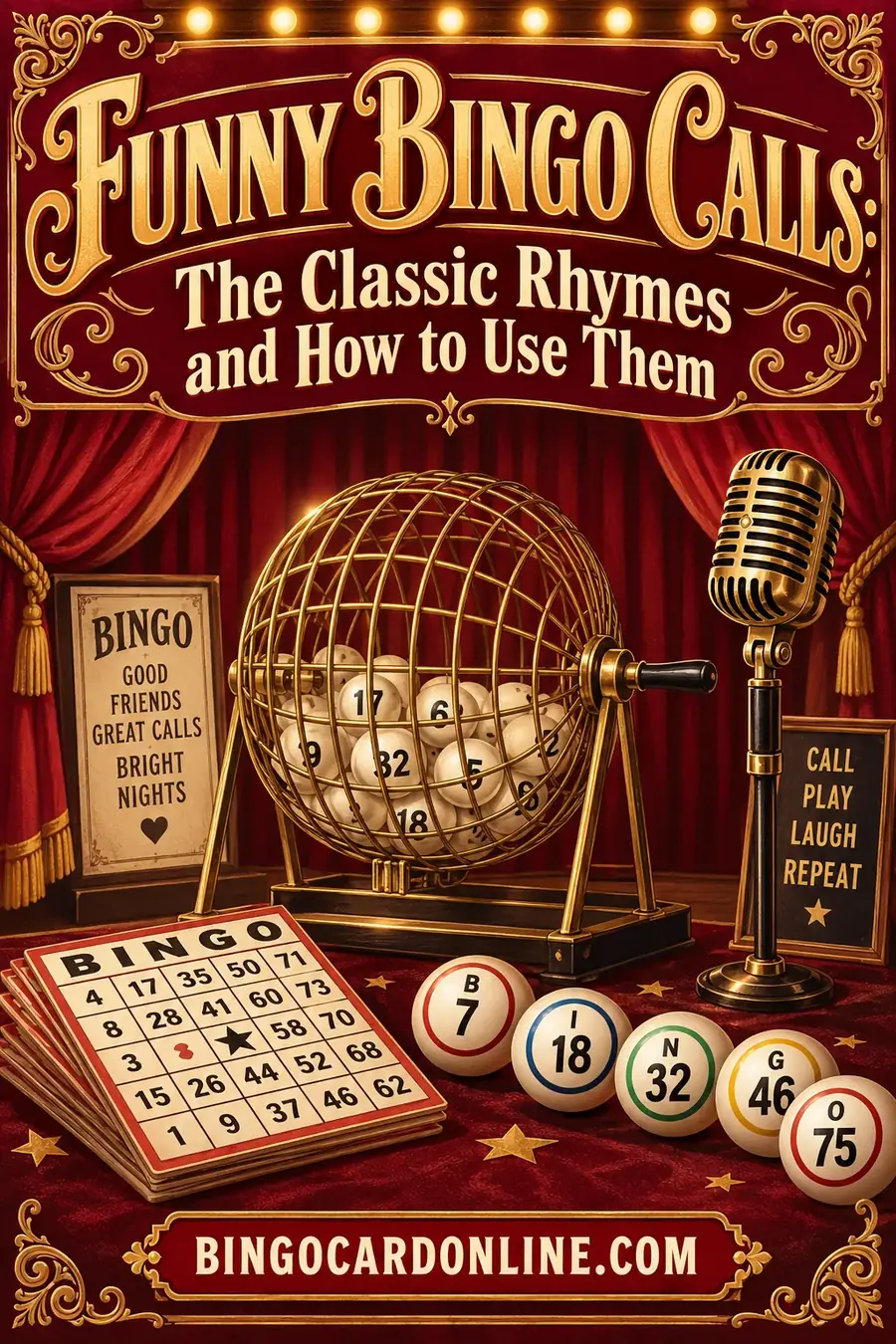
Traditional bingo calls are rhyming nicknames for numbers — "two little ducks" for 22, "legs eleven" for 11 — and they exist for a practical reason before a comic one: they make numbers distinguishable when a room is loud. "Sixteen" and "sixty" sound nearly identical across a noisy hall. "Sweet sixteen" and "three score" do not.
The humor came later, and it's now most of the appeal.
The Classic Calls
1 — Kelly's eye 2 — One little duck 3 — Cup of tea 4 — Knock at the door 5 — Man alive 7 — Lucky seven 8 — Garden gate 9 — Doctor's orders 10 — Uncle Ben 11 — Legs eleven 13 — Unlucky for some 16 — Sweet sixteen 21 — Key of the door 22 — Two little ducks 25 — Duck and dive 26 — Half a crown 30 — Dirty Gertie 33 — All the threes 39 — Steps 44 — Droopy drawers 45 — Halfway there 50 — Half a century 55 — All the fives 57 — Heinz varieties 59 — Brighton line 60 — Five dozen 66 — Clickety click 76 — Trombones 77 — Sunset strip 80 — Gandhi's breakfast 83 — Time for tea 88 — Two fat ladies 90 — Top of the shop
Where They Come From
The calls are a mix of rhyme, shape, and cultural reference — which is why some land instantly and others need explaining.
Rhyme: "Garden gate" for 8, "man alive" for 5, "key of the door" for 21 (the traditional age of majority).
Shape: "Two little ducks" for 22, because a 2 looks like a duck. "Clickety click" for 66 imitates the sound and the mirrored shape. "Legs eleven" for the two upright strokes.
Cultural reference: "Heinz varieties" for 57 (the company's long-running slogan). "76 trombones" from The Music Man. "Sunset strip" from the TV series 77 Sunset Strip. "Gandhi's breakfast" for 80 is a pun on "ate nothing."
Superstition: "Unlucky for some" for 13, which some halls skip entirely.
That mix is also why the tradition is uneven — a caller today explaining a 1950s American TV reference to a room of twenty-year-olds is the awkward part of using the full list.
Using Them Without Killing the Pace
The main risk is that calls slow the game badly. A hall running eighty calls in a game cannot afford three seconds of patter each.
Call the nickname, then the number. "Two little ducks — twenty-two." The nickname is flavor, the number is the information. Never the nickname alone.
Use the response calls. Several have traditional audience replies — the room shouts "quack quack" after two little ducks. These are the ones worth keeping because they involve everyone rather than performing at them.
Don't use all of them. Pick eight or ten that suit your crowd and use those consistently. A caller reciting every traditional call from a printed sheet reads as a recitation, not a game.
Skip the ones that need explaining. If half the room won't get "Brighton line," it produces a pause rather than a laugh.
Speed up as the game gets tense. When cards are close to full, drop the nicknames entirely and call numbers cleanly. The room's attention is on the card by then.
Building Your Own
Traditional calls are heavily British and heavily mid-century. For a modern group, an event-specific set often works better than the inherited one.
Office event: 9 — "doctor's orders" becomes "back-to-back meetings." Rework references to the workplace.
Wedding or shower: number the calls to the couple — 14 for the date they met, and so on. Gets a genuine reaction because it's about the people in the room.
Kids' party: shapes work better than references. "Snake" for 8, "sail boat" for 4, "flagpole" for 1.
Holiday event: seasonal substitutions land easily and need no explanation.
The rule for a home-made call is the same as for the traditional ones: it must be shorter than the pause it creates, and it must not require an explanation to work.
The Caller's Job
The calls are the visible part, but the actual skill is elsewhere:
Consistent pace. Roughly one call every five to eight seconds for a casual game. Faster once players are experienced.
Clear enunciation over volume. Shouting distorts; enunciating carries.
Keep the record. Every called number written down, no exceptions. Every disputed win comes back to this.
Read the room's speed, not your own. Older players and children both need more time than a caller who knows every number by heart expects.
Verify wins fully before declaring. Read the numbers back from the card against your record, out loud. It takes fifteen seconds and prevents the one thing that genuinely sours an event.
More on running the calling side well is in the online bingo caller guide.
Calls With Audience Responses
A handful of traditional calls have a response the room shouts back. These are the ones most worth keeping, because they turn calling from a performance into something the room participates in.
- 22, two little ducks — the room answers "quack quack"
- 11, legs eleven — traditionally answered with a wolf whistle
- 66, clickety click — often echoed back
- 90, top of the shop — a general cheer, since it's the highest number
- 1, Kelly's eye — sometimes answered with a shout of "one"
If you use only a handful of traditional calls, make it these. A call that produces a response from forty people does something that a clever call delivered into silence never will.
Introduce them explicitly at the start if the room is unfamiliar. "When I say two little ducks, you say quack quack." Thirty seconds of setup, and it pays back all night.
Building a Modern Set
The traditional list is heavily British and heavily mid-twentieth-century, which means a meaningful share of it needs explaining to a modern room. Building your own is usually better.
Rules for a call that works:
- Shorter than the pause it creates. If it takes longer to say than it saves in clarity, cut it.
- No explanation required. A call that gets a blank look has failed.
- Distinct from the number it precedes. The point is disambiguation, so a call that sounds like another number is worse than none.
- Repeatable all night. You'll say it ten times. It has to survive that.
Sources that work for a modern set: local landmarks and in-jokes, the event itself (a company's products, a couple's history, a school's traditions), current shared references the whole room definitely knows, and simple visual descriptions of the numeral shape.
Sources that don't: anything requiring cultural knowledge some of the room lacks, anything referencing a person in the room, and anything that dates within a year.
Calling Speed and Rhythm
The calls are the visible part; pacing is what actually determines whether a game feels good.
Five to eight seconds between calls for a casual game with a mixed group. Faster for experienced players, slower for children or older players.
Slow down when cards fill. Once several players are one or two numbers from a win, the tension is doing the work and rushing dissipates it.
Speed up in the middle. The stretch between the first ten calls and the first near-miss is where games sag. Tightening the pace there keeps energy up.
Repeat every number once. "Two little ducks, twenty-two. Twenty-two." The repeat catches anyone who missed it and costs two seconds.
Never call over noise. Wait for the room. A number called into a laugh is a number half the room didn't hear, and it produces a disputed win twenty calls later.
Keep a visible board if you can. A displayed list of called numbers removes most disputes and lets latecomers catch up without stopping the game.
Regional Variation
The traditional list is not universal, and assuming it is causes confusion.
British halls use the classic list most fully, and it's where nearly all the well-known calls originate. Several reference mid-century British culture, which is why some now need explaining even there.
American halls historically used far fewer nicknames, generally calling numbers plainly with the column letter — "B-7," "O-64." The letter-number format does the disambiguation work that nicknames do elsewhere, which is why the tradition never took hold in the same way.
Australian venues use a partly overlapping set with local additions.
Online platforms increasingly include the traditional calls as an audio option, which has kept the tradition alive with players who have never been in a hall.
If you're calling for a mixed or international group, use the letter-number format as the base and add a handful of nicknames as flavor. It's the version everyone can follow.
Practical Calling Kit
What a caller actually needs, beyond the numbers:
A record sheet. Every number called, ticked off. Non-negotiable for verifying a win.
A visible board or screen. Displays called numbers so players can catch up. Removes most disputes before they start.
A clear rule statement for the current game. Written where players can see it, not just announced.
A backup list of calls. If you're using nicknames, having them printed prevents the mid-game blank where you can't remember what 57 is.
Water. Calling for two hours is more demanding on the voice than people expect.
A decision on disputes made in advance. What happens if two people call at once, or if a player calls late? Deciding during the dispute is how a good evening turns bad.
Adapting Calls for Different Audiences
Children's games. Skip the traditional list almost entirely — most of it references culture from decades before their parents were born. Shape descriptions work far better: "a snake" for 2, "a sailboat" for 4, "two circles" for 8. Children join in with these immediately, which is the whole point.
Care homes and senior groups. This is the audience the traditional list was built for, and it lands properly. Many players will know the responses without prompting and enjoy that they do.
Corporate events. Build a bespoke set referencing the company — products, offices, in-jokes that everyone genuinely shares. Avoid anything referencing individuals.
Weddings and family events. Number the calls to the family's own history where you can. It takes twenty minutes to prepare and gets a far better reaction than any inherited list.
Charity fundraisers. A mix works well — a handful of traditional calls for familiarity, plus a few referencing the cause or the venue.
Mixed international groups. Letter-number format as the base, minimal nicknames. The traditional list assumes cultural knowledge that won't be shared.
Teenagers. The hardest room in the building. Teenager bingo works when the prize is genuinely worth having and the calls reference something the group actually shares — a school in-joke, a teacher's catchphrase, the local name for a place. Anything that reads as an adult performing youth culture fails within two calls, which is why it usually goes better with a student calling and an adult keeping the record.
What Makes a Caller Good
The nicknames are the surface. What players actually respond to is different.
Audibility above all. A caller who can be heard clearly at the back, without shouting, is doing the most important part of the job.
Consistent rhythm. Players settle into a pace. A caller who speeds up and slows down unpredictably makes the room tense in a way they can't identify.
Reading the room. Noticing that people are still marking and holding the next call for two seconds. Noticing that energy has dropped and picking up the pace.
Fairness that's visible. Verifying wins properly and out loud, even when it's obviously correct. Players need to see the process, not just trust it.
Warmth without performance. The best callers sound like they're enjoying themselves and are not doing a routine. A caller working too hard for laughs is more tiring than one simply calling well.
"That's a Bingo" and the Jokes Around the Word
The word itself does more comic work than any individual call.
"That's a bingo." The line comes from Inglourious Basterds, where a character who has just learned the expression says "That's a bingo" and is told that you simply say "bingo." It has since become the standard way to acknowledge that somebody has guessed correctly about anything at all, and plenty of callers now use it deliberately when confirming a win. Written without the apostrophe as thats a bingo, it is one of the most searched phrases attached to the game and has almost nothing to do with playing it.
Bingo as an exclamation. Outside the hall, the word is a bingo synonym for "exactly right." It entered general English that way in the 1930s and is now said far more often about a correct guess than about a completed card.
Bingo jokes. The dependable ones are about the conventions rather than the game: the player who shouts "house" at a fire drill, the seven-year-old who yells bingo on the second call every single time, the caller who says "two fat ladies" to a table of exactly two. Bingo jokes land in rooms that already know the calls and die at events where nobody does.
Callouts versus delivery. Worth separating. Funny bingo callouts are the scripted nicknames themselves, and they can be written down in advance. Bingo calling funny enough to carry a room is timing rather than material — the same call gets a laugh at the right moment and silence thirty seconds later. Keep a short list of bingo funny sayings by the microphone for the gaps, not for every number.
The Equipment Behind the Calls
Traditional calling assumes a physical setup, and knowing what each piece actually does makes it easier to decide what you need.
Bingo balls. Numbered 1 to 75 or 1 to 90, usually plastic and about an inch across, printed on more than one face so the number reads however the ball lands. A set of bingo balls is the piece worth buying rather than improvising, since handwritten tokens smudge, stick together and eventually produce a disputed call.
The bingo cage. A wire drum on a crank that tumbles the balls and releases one at a time. A bingo cage is theater as much as mechanism — the sound of it turning is a large part of what a hall feels like — but it also solves a real problem, which is demonstrating to the room that the draw was fair.
Bingo paper. Halls play on bingo paper rather than reusable cards: thin newsprint sheets, often several cards to a page, marked with a dauber and thrown away at the end of the game. Bingo paper sheets are sold in fixed series so that every player in a session holds a different combination, and the color of the sheet tells the room which game is currently in play.
The bingo flashboard. The lit display showing every number called so far. A bingo flashboard removes most disputes before they start and lets latecomers catch up without stopping the game. A whiteboard or a projected screen does the same job at a small event.
Free Bingo Caller Tools
Most events now run the draw from a screen rather than a cage, and the software is generally free.
What a free bingo caller does. Draws numbers without repeats, keeps and displays the full call history, speaks the number aloud, and lets you set the pace. That covers everything a caller needs except the personality, and it removes the most common source of disputes — a lost record of what was actually called.
Bingo caller freeware versus browser tools. Downloadable bingo caller freeware still exists and runs offline, which matters in a hall with poor signal or a school network that blocks things. A browser-based tool needs no install and stays current, which suits a one-off party. Either way, check it can put a called-numbers board on a second screen before the event rather than during it.
Free bingo calling with the traditional nicknames. Several tools include recorded calls, so "two little ducks, twenty-two" plays automatically. That's useful when nobody in the room can call confidently, though free bingo calling from a speaker never gets a room to shout back the way a live voice does.
Keep a human in the loop. Someone still has to verify wins, settle disputes and read the room's pace. The software handles the draw. It does not handle the game.
Themed Calling Nights
A theme hands the caller a ready-made set of substitutions and gives the room a reason to turn up.
Musical bingo. Cards hold song titles or artists, and the "call" is a clip played for fifteen or twenty seconds. Musical bingo is now the most common variant in bars, because it needs no numbers, no nicknames and no caller with a good voice — just a playlist and a speaker. Build the card from songs the room will place inside two bars, not from deep cuts.
Mixtape bingo. A tighter version built around one era, one genre or one decade — a mixtape bingo night themed to the nineties, say. Narrower recognition means faster marking and considerably more shouting, which is the point.
Hillbilly bingo. A country-and-western night: the calls get swapped for barn-dance references, the prizes are jars of preserves, and the caller works a drawl. Hillbilly bingo is a fundraiser standard for the same reason any costume theme is — people commit harder when there's a dress code.
Holiday and seasonal nights. The easiest of all, because the substitutions need no explanation and the decorations do half the work.
Whatever the theme, the calling rules don't change. The flavor goes first, the information goes second, and the pace stays steady.
Frequently Asked Questions
Why does bingo have funny names for numbers? Originally for clarity — similar-sounding numbers like sixteen and sixty are hard to distinguish in a noisy hall, while their nicknames are not. The humor and tradition grew around a practical solution.
Do I have to use the traditional calls? No. They're a convention, not a rule, and many modern games skip them entirely. Picking eight or ten that suit your group works better than reciting all ninety.
What are the most well-known bingo calls? "Two little ducks" (22), "legs eleven" (11), "clickety click" (66), "two fat ladies" (88) and "top of the shop" (90) are the most widely recognized, and several have traditional audience responses.
Are the calls the same everywhere? No. The classic list is strongly British, and many calls reference mid-twentieth-century culture. American, Australian and other halls use overlapping but different sets, and plenty of venues invent their own.
Where can I buy bingo cards? Party shops, stationers and hall suppliers all sell them, and bingo paper in bulk is worth buying if you run regular sessions for a large room. For anything smaller — a classroom, an office event, a family game — printing your own is cheaper and lets you set the grid size, the number range and the wording to suit the group.