The History of Bingo: From an Italian Lottery to Church Halls
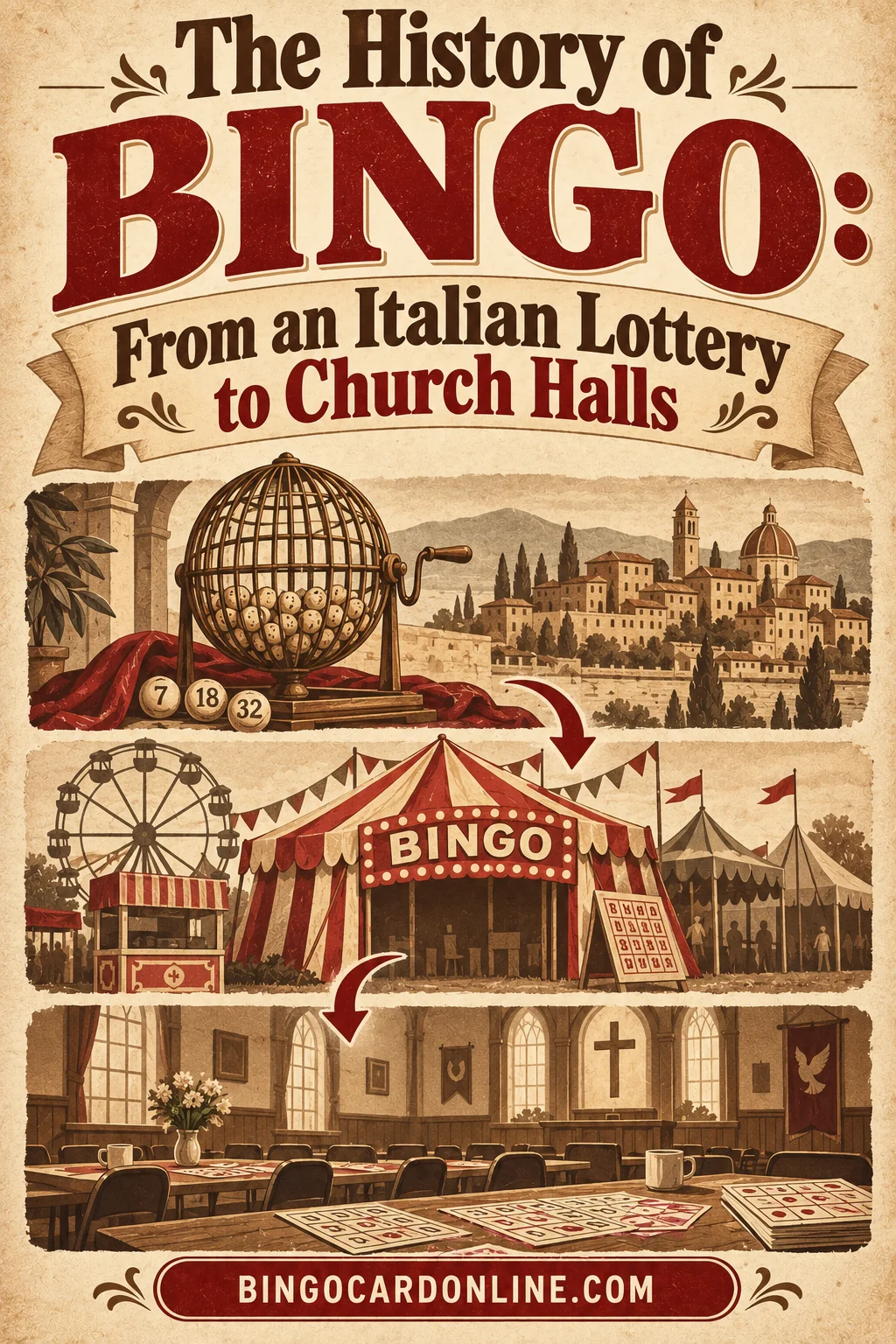
The history of bingo begins with an Italian state lottery traditionally dated to 1530, travels to France as a parlor game in the 1770s, becomes a school teaching aid in nineteenth-century Germany, and arrives in the United States as a carnival game called beano — which acquired its modern name in 1929 when a player at one of Edwin Lowe's games got excited and shouted the wrong word. Nobody invented bingo in the sense of sitting down and designing it; it was assembled over four centuries by lottery officials, French socialites, German schoolteachers and one American toy salesman who understood a good accident when he heard one.
That is the short version. The long version is better, because almost every feature of the game you play now — the five-by-five grid, the ninety-number ticket, the free center square, the shouted call — was added by a specific person for a specific reason. Here is where each piece came from.
What Is Bingo, and What Came Before It
Before the history, the definition. What is bingo? It is a game of chance in which every player holds a card of numbers drawn from a fixed pool, a caller announces numbers pulled at random, and players mark the ones they hold. The first person to complete an agreed shape — a line, a set of corners, the whole card — calls out and wins. Nothing in that description requires skill, and nothing in it has changed in four hundred years.
What did change is the machinery. The direct ancestor is the lottery, and specifically the kind of lottery in which numbers are drawn from a fixed set rather than tickets being matched to a single winning number. That distinction matters, because it is what allows many people to be partly right at once, which is the entire experience of playing.
Il Gioco del Lotto d'Italia, 1530
The line traditionally starts with Il Gioco del Lotto d'Italia, the Italian national lottery, usually dated to 1530 in the Republic of Genoa and later run as a state institution. It has been drawn on a regular weekly schedule for most of the centuries since, which makes it one of the longest continuously operating games of any kind in Europe.
The Genoese version grew out of something genuinely odd: a civic election. Names of candidates for public office were drawn from a pool, and people began betting on which names would come out. When the names were eventually replaced by numbers, the modern number lottery existed. That substitution — names to numbers — is the single most important step in the whole story, because numbers can be printed on a card in advance.
Two features of the Italian game carried forward into everything that followed. First, the draw was public and sequential, one number at a time, which creates suspense that a single announcement cannot. Second, the numbers ran from 1 to 90, and that ninety-number pool is still the standard across most of Europe, Latin America and Australia today.
Le Lotto Arrives in France, 1770s
By the 1770s the game had crossed into France, where it was played as Le Lotto among the wealthy and educated. This is the point at which the card takes its modern shape.
The French lotto ticket was ruled into three horizontal rows and nine vertical columns, giving twenty-seven spaces. Only some of those spaces carried numbers; the rest were blank. The columns held numbers by range — the first column held numbers in the ones, the second the tens, and so on up to ninety. A caller drew wooden tokens from a bag and read them out, and players covered the matching numbers.
Anyone who has played 90-ball bingo in a British or Australian hall has held that exact ticket. The three-by-nine grid, the column ranges, the blanks between numbers: all of it is French parlor equipment from the reign of Louis XVI, essentially unaltered. The only substantive change in two hundred and fifty years is that the tokens are now plastic or air-blown balls.
German Classrooms, 1800s
In the nineteenth century the game took a detour that most histories skip, and it is the reason bingo is still standard equipment in elementary schools.
German educators adapted lotto as a teaching device. Instead of numbers, cards carried multiplication problems, spelling words, historical dates or animal names, and the caller read out the prompt rather than the answer. A child had to work out that seven times eight belonged on the square marked 56 before covering it. The game supplied the motivation; the teacher supplied the content.
That single idea — swap the numbers for anything you want learned — is why classrooms still run sight-word bingo, times-table bingo and vocabulary bingo. It also explains the entire modern category of picture and word cards, from holiday games to office icebreakers. The German teachers were not making a party game. They were making a drill that children would volunteer for.
Beano on the American Carnival Circuit
The game reached North America in the early twentieth century and settled onto the traveling carnival circuit under the name beano, sometimes also called keno or lotto depending on the region.
The setup was simple and portable. A caller sat at a table with numbered wooden discs in a cigar box, drew one at a time, and read it out. Players sat at long benches with printed cards and a pile of dried beans, placing a bean on each number they held. The winner shouted "Beano!" The beans gave the game its name and its marking system in one stroke, and they are the direct ancestor of the modern dauber.
This is the version that Edwin S. Lowe walked into.
Who Invented Bingo? Edwin Lowe and the Night the Name Changed
Who invented bingo is a question with an honest answer and a popular one, and they are not the same. The honest answer is that nobody did — the game arrived in America substantially complete. The popular answer is Edwin S. Lowe, and while he did not invent the game, he named it, standardized it and turned it into a national pastime, which is arguably a larger contribution.
Lowe was a New York toy salesman. In December 1929, traveling near Jacksonville, Georgia, he came across a carnival tent where a beano game was running late into the night. By his own account the players were so absorbed that the operator could not get them to leave. Lowe went home, bought numbered discs, cardboard and dried beans, and ran games for friends in his apartment.
At one of those games a player who was one square from winning got ahead of herself and, instead of "Beano," shouted "Bingo!" Lowe recognized immediately that the accidental word was better than the real one, and he kept it. He was right for reasons that are worth stating plainly: bingo has a hard stop consonant at the front and a bright vowel at the end, it carries across a noisy room, and it is impossible to mumble. The name is a piece of design, even if it was designed by mistake.
Lowe began producing sets commercially in 1930.
Carl Leffler and the Card Problem
The commercial game immediately ran into a mathematical wall, and the story of how it was solved is the strangest chapter in the history of bingo.
A Catholic priest from Wilkes-Barre, Pennsylvania approached Lowe about using the game to raise money for his parish. The idea worked in principle and failed in practice: with only a couple of dozen distinct cards in circulation, a single call produced five or six simultaneous winners, and a fundraiser cannot function when every round ends in a six-way split.
The fix required a large set of cards with no repeated number combinations — cards that could be sold by the hundred and still produce one winner at a time. That is a genuine combinatorial problem, not a printing problem. Lowe hired Carl Leffler, a mathematics professor at Columbia University, to generate them. Leffler worked through the arrangements by hand, and by 1930 he had produced roughly six thousand distinct cards.
The story usually ends with the claim that the work drove Leffler insane. It is repeated everywhere, and it is folklore: no contemporary record supports it, and it appears to have grown out of retellings of how tedious the job was. What is documented is the size of the set and the fact that it made commercial and charitable bingo workable overnight. Every modern card generator is doing Leffler's job, several thousand times faster.
The Church Hall Era
With a usable card set, bingo became the default fundraising engine of American parish life through the middle of the twentieth century, and it stayed there for decades.
The fit was close to perfect. The equipment was minimal. The rules needed no explanation. Volunteers could run it. It filled a hall that was otherwise empty six nights a week. And crucially, the legal status of charitable gaming was carved out separately from commercial gambling in most jurisdictions, so a parish could run a game legally where a business could not. State laws varied enormously and changed repeatedly, which is why the game's fortunes rose and fell on different schedules in different places.
The social effect outlasted the fundraising. For a great many people through the 1940s, 1950s and 1960s, the weekly game was the standing appointment in the calendar, and the hall was where you saw your neighbors. That is the era most people picture when they picture bingo, and it is the reason the game still reads as communal rather than solitary.
Britain, Housey-Housey and the 1960 Act
Britain took a different path to the same place. The 90-ball French ticket had been in use for a long time, and the game was played extensively in the armed forces under the name housey-housey, along with tombola and several regional variants.
The turning point was the Betting and Gaming Act of 1960, which legalized commercial bingo clubs. Operators moved into buildings that were emptying out for an unrelated reason — cinemas losing their audiences to television — and a large number of the classic British bingo halls of the 1960s and 1970s were former picture houses. The architecture was already right: raked seating, a stage for the caller, and room for hundreds.
This is why the British and American games look different. Britain inherited the French ticket and kept ninety numbers and three-row strips. America inherited the carnival version and settled on a five-by-five grid of seventy-five numbers with a free center square and the letters B-I-N-G-O across the top.
A Timeline of the Game
| Date | What happened |
|---|---|
| 1530 | Il Gioco del Lotto d'Italia traditionally dated to this year |
| 1770s | Le Lotto played in France on a three-by-nine ticket |
| 1800s | German educators adapt lotto for classroom drilling |
| Early 1900s | Beano runs on American carnival circuits with dried beans |
| Dec 1929 | Edwin Lowe sees a beano game near Jacksonville, Georgia |
| 1929-30 | A player shouts "bingo" by accident; Lowe keeps the name |
| 1930 | Carl Leffler produces around 6,000 non-repeating cards |
| 1930s-60s | Parish fundraising makes the game a fixture of American life |
| 1960 | Britain's Betting and Gaming Act legalizes commercial clubs |
| Late 1990s | The first bingo online sites appear |
From the Hall to the Screen
The last chapter is the shortest and the fastest. Bingo online arrived in the late 1990s, and it changed the social shape of the game more than the rules. A caller became a random number generator, marking became automatic, and the chat window replaced the row of neighbors. The core loop — draw, mark, complete a pattern, call — survived untouched, because there was nothing in it to improve.
What the internet genuinely added was free bingo. For four hundred years, playing meant physically being somewhere with a ticket in your hand. Now anyone can run a game for a classroom, a party or a family evening using nothing but a browser and a printer, which is a category that simply did not exist before. Search behavior reflects it: people type free online bingo, bingo online free and bingo free online interchangeably, and the word order changes nothing at all. All three phrasings are looking for the same thing, which is a game you can start immediately without buying equipment.
That is also where the German schoolteachers turn out to have won the argument. The most-used cards today are not numbered at all. They carry sight words, vocabulary, holiday pictures, office phrases and party prompts, exactly as the nineteenth-century teaching sets did. If you want to make your own set for any of those, this free bingo card generator produces unique cards and the master call list that goes with them, which is the same problem Leffler solved by hand in 1930.
Why the Story Matters When You Run a Game
Three practical things fall out of the history, and each of them explains a rule people otherwise find arbitrary.
Why the free space exists. The American five-by-five grid needs an odd center for the diagonal patterns to intersect cleanly, and a free square makes a line achievable in four calls instead of five. It is a pacing decision, made when the game had to fit into a carnival's schedule.
Why cards must be unique. The Wilkes-Barre problem has not gone away. Duplicate cards produce simultaneous winners, and simultaneous winners ruin the ending. This is the single most common failure in a homemade game, and it is why generating a proper set matters more than the artwork on it.
Why the caller says the letter. B-7 rather than 7 exists because the letter tells you which column to search, cutting the scan from twenty-five squares to five. That convention came in with the American grid and it is the reason a 75-ball game can be called much faster than a 90-ball one.
Frequently Asked Questions
When was bingo invented? There is no single invention date, because the game accumulated over centuries. The lottery ancestor is traditionally dated to 1530 in Italy, the modern card shape dates to the French lotto of the 1770s, and the name bingo dates to 1929, when Edwin Lowe adopted a player's mistaken shout at one of his own games. If you need one year for the game as we know it, 1929 is the defensible answer.
Who invented bingo? Nobody invented it outright. Edwin S. Lowe is the person most often credited, and what he actually did was name it, produce it commercially from 1930, and commission Carl Leffler to build the large set of non-repeating cards that made organized play possible. The game itself he found already running in a carnival tent in Georgia.
Why is it called bingo and not beano? Because a player at one of Lowe's early games shouted the wrong word. The game had been called beano after the dried beans used to mark the cards, and the accidental substitution stuck. Lowe kept it deliberately: the word is short, it ends on a bright open vowel, and it carries across a crowded room far better than beano does.
Is bingo the same game as lotto? They share a direct ancestor and they are close relatives rather than the same thing. Lotto in the French and Italian sense used a three-by-nine ticket and ninety numbers, and that version survives as 90-ball bingo. American bingo took the same idea onto a five-by-five grid with seventy-five numbers and added the free space and the column letters. Both are drawn-number games with no element of skill.