St. Patrick's Day Bingo Cards: Free Printable & Fun
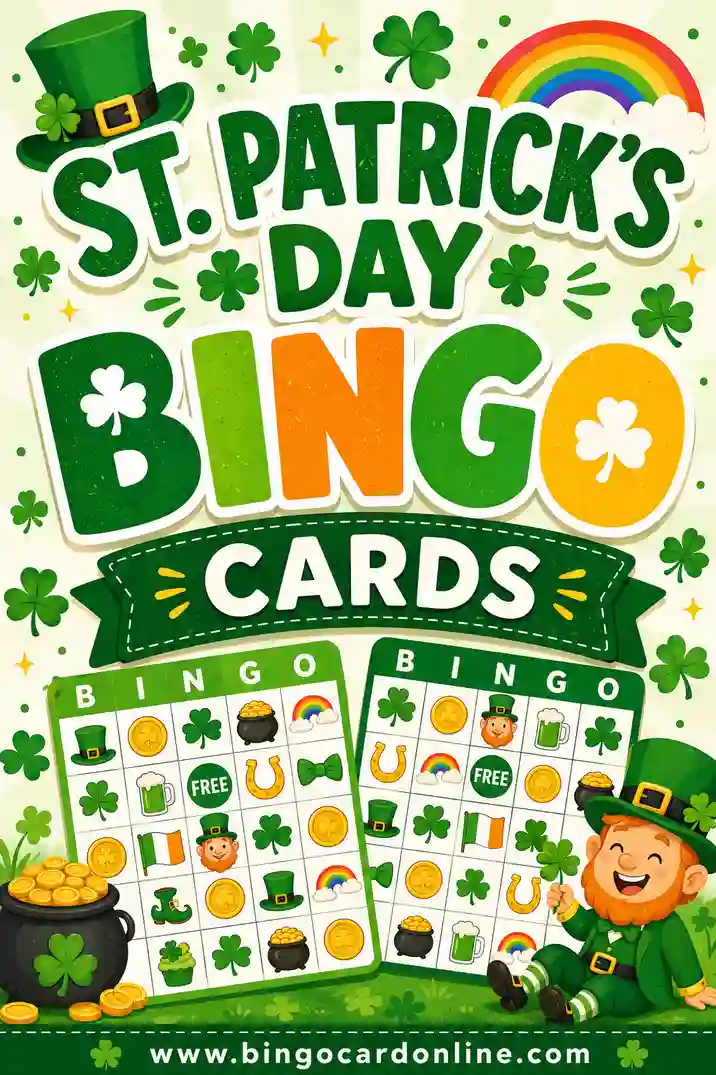
A St. Patrick's Day bingo card swaps numbers for green things: shamrocks, rainbows, gold coins, fiddles, a parade float. Someone calls the items, players mark what they find, and the first full line wins. March 17 comes with plenty of built-in imagery, so a themed card is easy to fill and easy for kids to read at a glance.
The fastest way to a full stack is the free bingo card generator. Paste in the word list further down this page, choose a grid size, and print a different card for every player. No sign-up and nothing to install.
Why March 17 Suits a Bingo Card
Most holidays give you a handful of symbols. St. Patrick's Day gives you a color. Green is on the clothes, the decorations, the baked goods and the parade route, so almost any room on March 17 doubles as a bingo board. That is why this holiday works well for both of the ways people play:
- Called bingo. One person draws an item from a bowl and reads it out. Players mark matching squares. It suits a classroom carpet or a library table.
- Spotted bingo. Nobody calls anything. Players mark a square only when they actually see the item, whether that is a shamrock sticker on a door or a marching band on the sidewalk.
The tool above builds either style. The rest of this page covers what to put on the cards, how to run them in a few real settings, and how to keep the theme respectful.
Facts Worth Calling Out Loud
If you are the caller, you can turn each draw into a thirty-second story. These are well documented and safe to share with a mixed-age group.
| Square | What you can say when you call it |
|---|---|
| Shamrock | A three-leaf clover, the plant most associated with Ireland. Tradition says St. Patrick used it to explain the Trinity, though that story comes from later folklore and not from his own writings. |
| Harp | The harp, not the shamrock, is Ireland's official state emblem. It appears on Irish euro coins. |
| Leprechaun | A figure from Irish folklore, usually described as a small, solitary shoemaker who guards treasure. The bright green cartoon version most Americans know is far newer than the old tales. |
| Parade float | Some of the earliest recorded St. Patrick's Day parades took place in North America. Boston held one in 1737 and New York City in 1762. Dublin's big festival came much later. |
| Green river | Chicago has dyed its river green every March since 1962. |
| Celtic knot | Interlaced patterns that appear in early medieval Irish art, including carved crosses and illuminated manuscripts such as the Book of Kells. |
| Blarney Stone | A stone set in Blarney Castle in County Cork. Legend says kissing it gives you the gift of persuasive talk. |
| Soda bread | A quick bread leavened with baking soda instead of yeast, a staple of Irish home baking. |
The man behind the holiday is worth a mention too. Patrick was born in Roman Britain and, by his own account, was taken to Ireland as a teenager and held as a slave. He escaped, and later returned to Ireland as a Christian missionary. March 17 is the day traditionally observed as his death. In Ireland it became an official public holiday in 1903.
Free St. Patrick's Day Bingo Word List (Copy & Paste)
Here's a ready-to-use list of 30 St. Patrick's Day squares. Pick any 24 for a 5x5 card (the 25th is your free space), or grab 9 for a toddler-friendly 3x3. Copy whichever column you like straight into the generator.
| Lucky & Green | Pots & Parades | Fun & Festive |
|---|---|---|
| Shamrock | Pot of gold | Step dancing |
| Leprechaun | Rainbow | Bagpipes |
| Four-leaf clover | Gold coins | Parade float |
| Lucky horseshoe | Green hat | Fiddle |
| Harp | Green beer | Celtic knot |
| Rolling hills | Top hat | Irish flag |
| Toadstool | Green beads | Jig |
| Wishing well | Face paint | Marching band |
| Sheep | Green river | Pinch you |
| Castle | Soda bread | Blarney Stone |
Mix words across the columns for more variety. If you're playing with very young kids, lean on easy-to-picture squares like shamrock, rainbow, and green hat.
Playing at a school or library? Drop "Green beer" and "Pinch you" from the list before you paste it in, and swap in "Green crayon" or "Clover pin." That leaves plenty of words to build unique cards.
Find the Green: A Scavenger-Style Version
This version needs no caller and almost no preparation. Print cards whose squares are things to find, and let players hunt for them in a classroom, library, backyard or hallway. Every square should be a concrete object that can be spotted in a few seconds.
- Green-only board. Squares such as green marker, green book spine, green sweater, green leaf, green sticker, something green that is not a plant.
- Shape hunt. Triangle, heart, three-leaf shape, circle that looks like a coin, rainbow arc.
- Gold hunt. Gold coin, yellow button, gold ribbon, anything shiny, a yellow crayon.
Set a time limit, such as ten minutes, and announce the win condition first: one line, four corners, or the whole board. A fair rule is that each square must be seen, not carried over. Players with bingo can point out where they found each item, which settles any dispute.
A March 17 Classroom Plan
Teachers often have one tight window on or near the holiday. This outline fits a 30-minute block and can be trimmed to 20.
- Five minutes: a quick story. Tell the short version of who Patrick was and why March 17 is celebrated. Use the table above as your script.
- Five minutes: build the card. Older students can write their own squares from a shared board. Younger ones can use the generator's printed cards and match them with picture words.
- Fifteen minutes: play. Run two or three short rounds. Make round one a single line, round two four corners, and round three a full card.
- Five minutes: wrap-up. Ask students to name one thing they learned about Ireland that was not on the board.
Some ways to adapt it by subject:
- Early reading. Use short words with pictures: hat, gold, clover, harp. Call letters or sounds instead of whole words for a phonics round.
- Geography. Use Irish counties, cities or landmarks such as Dublin, Cork, Galway and the Cliffs of Moher, then locate each on a map as you call it.
- Music. Cards with fiddle, harp, tin whistle and uilleann pipes, played from a short recording of each.
Library, Party and Parade Formats
At a library
A drop-in table works well. Print cards in a mix of 3x3 and 5x5 so families can choose. Pair them with a display of picture books on Irish folktales and let players mark a square each time they find a matching book cover. Let winners choose a bookmark instead of candy.
At a school or community party
Run bingo at one station among several, since a full-room game can drag. Use team cards for big groups: each table shares one card and a runner brings back the call sheet. Keep the rounds under ten minutes.
On the parade route
Spotted bingo is ideal here. Print small cards that fit on a clipboard or in a pocket. Good squares are a marching band, a green banner, a piper, a step dancer, a float with a harp, someone waving an Irish flag. Because every parade is different, give the group a card with several free spaces so nobody is stuck waiting for something that never shows up.
Rainbow, Gold and Leprechaun-Lore Card Ideas
Once your group has played the standard shamrock card, a few specialty boards keep the second round fresh.
- Rainbow board. Each row is one color of the rainbow, and squares are objects of that color. Players need to find or hear an item for each stripe.
- Leprechaun tales. Squares come from the folklore: shoemaker, buckle shoes, hidden gold, a trick, three wishes, the end of the rainbow. Call each one with a line from a story you tell aloud.
- Pot-of-gold blackout. A full-card game where the winner "finds the pot." It makes a good last round.
- Luck board. Squares that stand for good luck: horseshoe, clover, wishing well, coin, ladybug, penny.
Pot-of-Gold Prizes Without the Sugar Overload
The gold-at-the-end-of-the-rainbow idea gives you a simple prize theme. Some low-fuss options:
- Chocolate gold coins, only if you have checked allergies. Foil coins often contain milk, and some brands contain nuts or soy.
- Gold-colored stickers, pencils or erasers for classrooms that do not allow candy.
- A "pot" of green pencils or bookmarks that winners draw from.
- Privileges: first in line, pick the next read-aloud, or wear the paper top hat for the rest of the period.
Use a black cooking pot or a painted bucket as the "pot," and have winners reach in for a surprise.
Keeping the Theme Respectful
St. Patrick's Day is both a national holiday in Ireland and a celebration of Irish heritage around the world. A few habits keep a bingo game friendly to everyone.
- Stick to culture, not caricature. Avoid squares or costumes that make fun of accents, poverty or the Irish famine. Music, dance, landscape, language, baking and folklore are all good ground.
- Skip drinking themes at any all-ages event. Squares about alcohol do not belong on a card handed to children, and even with adults the holiday has plenty of other things to celebrate.
- Add real Irish words. Lá Fhéile Pádraig is the Irish name for St. Patrick's Day. Sláinte means "health" and is used as a toast. Céad míle fáilte means "a hundred thousand welcomes." Print them in a corner and invite players to try saying them.
- Invite stories. If someone in your group has Irish family, let them tell a short story or name a favorite tradition between rounds.
Printing and Reusing Green Cards
Print one test page first, since some green inks look dull on plain paper. Black and white works fine for big stacks, and kids can color the clovers in. Green paper squares or pom-poms make good markers. Sleeves plus dry-erase pens let you wipe the set clean and reuse it next March.
Frequently Asked Questions
When is St. Patrick's Day, and when should I play?
The holiday is March 17 each year. If it falls on a weekend, schools and libraries usually hold their activity on the Friday before or the Monday after. Spotted bingo works at a parade or a community event on the day itself.
What size card is best for a classroom party?
A 4x4 grid suits most elementary classes, with 3x3 for kindergarten and pre-K. A 5x5 card is better for upper grades, since it lasts longer and holds more vocabulary. Print one size per group so rounds finish together.
Can I play without a caller?
Yes. The scavenger-style version, where players mark squares as they find things, needs no caller. Set a timer and a clear win condition, and add a rule that every square needs to be actually seen.
How do I keep the game from feeling like a stereotype?
Mix folklore squares like leprechaun and pot of gold with real cultural ones such as harp, fiddle, Celtic knot and soda bread. Add a few Irish phrases and facts, and leave out jokes about accents, drinking or poverty.
What can I give as prizes if candy isn't allowed?
Green pencils, shamrock stickers, bookmarks, erasers, or classroom privileges like picking the next story all fit the pot-of-gold theme. Chocolate coins are fine in many settings, but check for allergies first.
Your Checklist Before March 17
Choose where you will play: a classroom, a library, a parade, or a dinner table. Pick called or spotted bingo, copy the word list above (swapping out anything that does not fit your group), and open the free bingo card generator to print unique cards for every player. If you are planning a spring series, an Easter bingo set uses the same steps. Happy March 17, and may your first line come early.