Addition Bingo: Math Fact Practice That Kids Will Actually Do
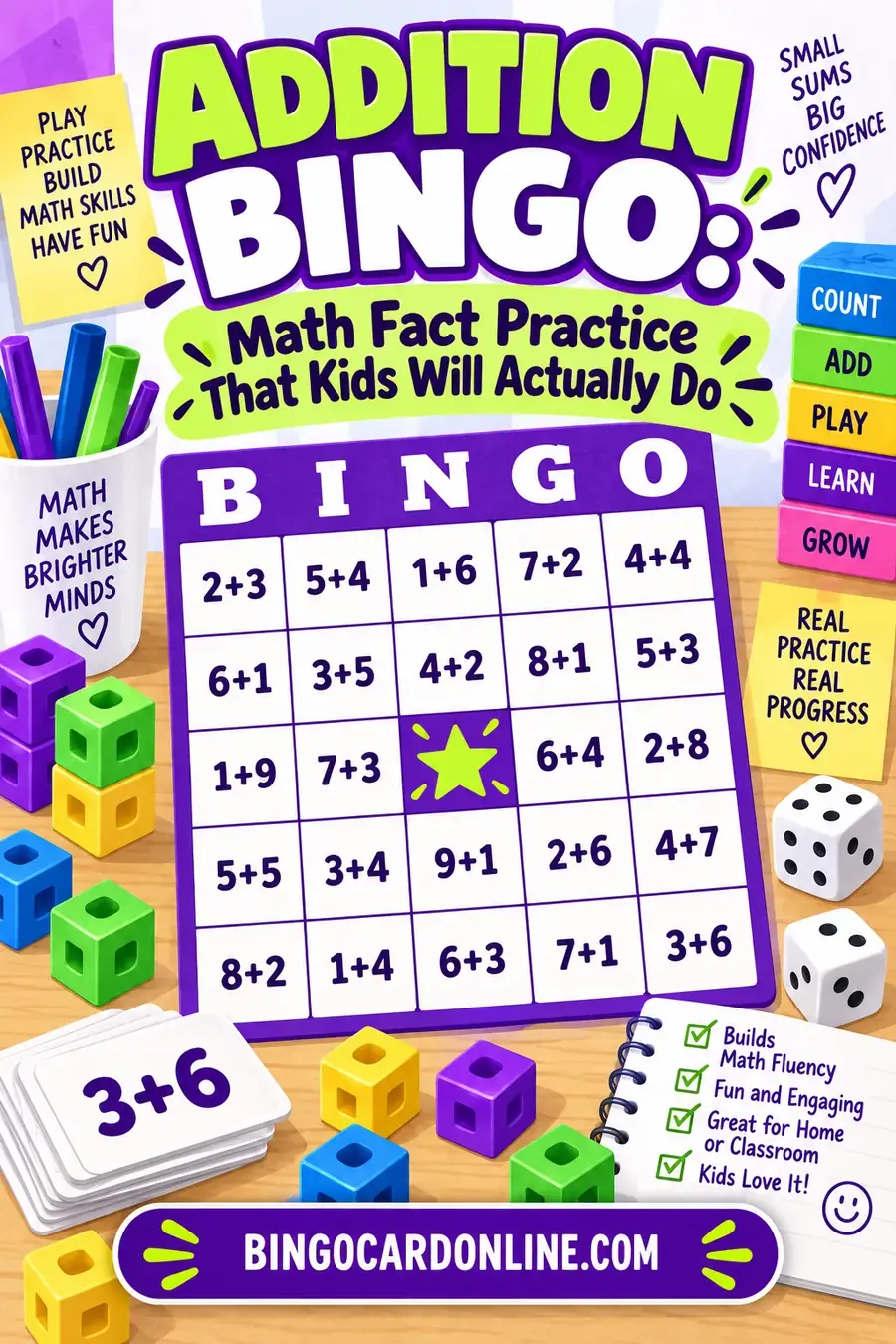
Addition bingo works because it disguises repetition as a game — a single round can present forty addition facts, which no child would sit through as a worksheet. The mechanic is simple: cards hold answers, the caller reads problems, and children have to compute before they can mark.
That inversion is the whole trick. The child isn't matching a symbol to a symbol; they're solving to find the match.
Fact Ranges by Grade
| Grade | Fact range | Card numbers | Grid |
|---|---|---|---|
| K | Sums to 5 | 0-5 | 3x3 |
| 1st | Sums to 10 | 0-10 | 3x3 or 4x4 |
| 1st-2nd | Sums to 20 | 0-20 | 4x4 |
| 2nd | Two-digit + one-digit | 10-99 | 4x4 or 5x5 |
| 3rd | Two-digit + two-digit | 20-199 | 5x5 |
Match the range tightly to what's being taught. A card spanning 0-20 when the class is working on sums to 10 means most calls are unmarkable, and children disengage fast. Narrow ranges produce more marks per call, which keeps everyone in the game.
The Duplicate-Answer Problem
This is the one design detail that decides whether the game works.
Multiple problems produce the same answer — 7+3, 6+4, 5+5 and 8+2 all make 10. If a card holds 10 only once, a child marks it on the first call and then has nothing to do for the other three.
Two ways to handle it:
Allow repeated numbers on a card. A card might hold 10 twice, in different squares. Children mark one instance per call. This keeps engagement high and is the simpler fix.
Use a wide enough answer range that duplicates are rare. Works for higher grades where the range is 20-199, but not for sums to 10 where there are only eleven possible answers.
For kindergarten and first grade, allowing duplicates is almost always the better choice.
Running the Game
- Read the problem twice, slowly. "Six plus four. Six plus four."
- Give genuine thinking time. Ten to fifteen seconds for early learners. The computation is the point; rushing it defeats the exercise.
- Say the answer after marking time — "That's ten." Children who got it wrong self-correct immediately, and children who couldn't compute it still hear the fact.
- Keep a record of what you called. Essential for verifying a win, and easy to forget.
- Verify wins by re-reading the problems, not the answers. "Show me where you marked six plus four" makes the winner demonstrate the reasoning.
Variations
Subtraction bingo. Identical structure — cards hold differences, calls are subtraction problems. Worth running as its own game before mixing.
Mixed operations. Cards hold answers; calls mix addition and subtraction. Genuinely harder, because the child must identify the operation before computing. Appropriate once both are individually solid.
Doubles focus. Every call is a doubles fact (4+4, 7+7). Doubles are a foundational fluency target and worth a dedicated round.
Make-ten focus. Every call sums to exactly 10. Builds the make-ten strategy that underpins most mental addition.
Missing addend. The call is "six plus what makes ten?" and cards hold the missing number. Much harder, and excellent preparation for algebraic thinking.
Word problems. The call is a short scenario rather than a bare equation. Slower, and connects the arithmetic to meaning.
Why It Beats a Worksheet
Volume without visible drudgery. Forty facts in fifteen minutes, and children ask to play again.
No public failure. A child who computes slowly isn't exposed the way they are when called on individually. They simply mark a moment later, or miss one call and stay in the game.
Automatic differentiation. Give different cards to different children — a struggling child gets a card with sums to 10, a confident one gets sums to 20 — and everyone plays the same game at the same time. Nobody can tell from across the room.
Listening plus computing together. The child has to hold a spoken problem in working memory while solving it, which is closer to real mental arithmetic than reading equations off a page.
Common Problems
"They just wait for someone else to react." Real, and the fix is to say the answer only after marking time has passed, so watching a neighbor doesn't help.
Calls that don't match any card. Frustrating in volume. Build the call list from the answers actually present across your card set, rather than calling random problems.
Winners on the third call. Usually means the answer range is too narrow for the grid size — too many cards share too many numbers. Widen the range or shrink the grid.
Arguments over marked squares. Reusable cards with loose markers (chips, counters) instead of pens make corrections painless.
Building the Cards
Each card needs a different arrangement of answers, drawn from the range you've chosen — and for early grades, with deliberate duplicates allowed. Doing that by hand for a class of twenty-five is genuinely tedious, and hand-built sets tend to accidentally repeat cards, which produces simultaneous winners.
A bingo card generator lets you set the number range and print a set where every card is distinct. Print on cardstock, laminate for repeated use, and keep a printed call list with the set — the call list is the piece people lose.
Building the Call List Properly
The call list matters as much as the cards, and it's the piece most people improvise badly.
Build calls from the answers actually on your cards. If your cards hold numbers 0-10, every call must produce an answer in that range. Calling "eight plus seven" when no card holds 15 wastes everyone's time and breaks the rhythm.
Cover every answer at least twice. A number appearing on cards but never called might as well not be there. Work through your answer range and make sure each value has at least two problems that produce it.
Weight toward the facts you're teaching. If the class is working on make-ten strategies, load the list with pairs summing to 10. The game should reinforce this week's instruction rather than sampling randomly across everything.
Write the list down before you start. Improvised calling drifts toward the facts the caller finds easiest to generate, which is usually doubles and plus-ones. A written list guarantees coverage and gives you the record needed to verify a win.
Mark off calls as you make them. Essential for checking a winning card, and easy to forget in the moment.
Differentiating Without Anyone Noticing
This is the strongest practical argument for bingo over worksheets, and it's worth setting up deliberately.
Print three card sets with different answer ranges — sums to 10, sums to 20, and two-digit answers — using the same visual design. Hand them out according to where each child actually is.
Every child then plays the same game, hears the same calls, and marks at roughly the same rate, because the calls that suit their range come up regularly. A child working on sums to 10 marks when "six plus three" is called; a child on two-digit addition marks when "twenty-four plus eight" is called.
Nobody can tell from across the room which card anyone else has. That's the whole point — differentiation that doesn't announce itself is differentiation children will accept.
One caution: make sure each range gets a fair share of calls. A list weighted 80% toward easy facts leaves the advanced group idle.
Common Problems and Fixes
Winners on the third call. Answer range too narrow for the grid size. Widen the range or shrink the grid to 3x3.
Nobody wins after thirty calls. Range too wide, or cards holding numbers that rarely come up. Check that your call list actually covers the numbers you printed.
Children waiting for someone else to react. Announce the answer only after marking time has elapsed, so watching a neighbor gains nothing.
Arguments over a marked square. Use loose counters rather than pens so corrections cost nothing.
One child always finishing last. Check their card's range against their actual level — usually it's a mismatch rather than a speed problem.
The game running too long. Switch from full card to a line for the last round of the session.
Beyond Addition
The same card structure carries most of early arithmetic, which makes a single set unusually versatile.
Subtraction. Cards hold differences; calls are subtraction problems. Run it separately before mixing.
Mixed operations. Cards hold answers; calls mix addition and subtraction. Genuinely harder, because the child must identify the operation before computing.
Missing addend. "Six plus what makes ten?" Cards hold the missing number. Excellent preparation for algebraic thinking and considerably harder than it looks.
Multiplication. For third grade and up. Same structure, products on the cards.
Doubles and halves. A focused round where every call is a doubles fact. Doubles are a foundational fluency target worth isolating.
Number bonds to 10 or 20. Every call sums to the same total. Builds the make-ten strategy that underpins most mental arithmetic.
Word problems. The call is a one-sentence scenario rather than an equation. Slower, and it connects the arithmetic to meaning in a way bare facts don't.
A single set of number cards covering 0-20 supports most of these without reprinting, which is worth knowing before you build one.
Running It as a Station
Addition bingo works as a small-group station rather than a whole-class activity, which suits a rotating classroom structure.
Four to six children per station. Enough for the game to have energy, few enough that everyone marks regularly.
Pre-record the calls. A short audio recording of the problem list, played on a tablet, lets the station run without an adult. Children mark as they hear each problem.
Use a printed call list with a checkbox if a child is calling. Gives them a clear job and produces the record needed to verify a win.
Set a fixed round length rather than playing to a winner, so the station rotation stays on schedule.
Keep answer cards face down at the station for self-checking after the round.
Why Bingo Beats a Worksheet for Fact Fluency
Fact fluency requires volume, and volume is exactly what children resist. Bingo solves the resistance problem without reducing the volume.
The repetition is hidden. A fifteen-minute game presents thirty to forty addition facts. A worksheet with forty problems on it looks like forty problems and gets treated accordingly.
Failure is private. A child who can't compute 8+5 in time simply doesn't mark that square. Nobody notices, the game continues, and they hear the answer a moment later. Compare that with being called on in front of the class.
The pace is externally set. Left alone with a worksheet, a struggling child slows down and finishes fewer problems. In bingo, the calls keep coming, so they attempt every fact whether or not they get each one.
Hearing the answer is built in. Announcing the answer after marking time means even the children who couldn't compute it get the fact reinforced, which a self-marked worksheet doesn't do.
It's genuinely social. Fluency practice is solitary by default. A game makes it a shared activity, which for many children is the difference between compliance and engagement.
None of this means bingo replaces written practice — children still need to write and show working. It means the drilling portion of fluency work can be considerably more pleasant than it usually is.
Using the Same Card Format Across Other Subjects
Addition bingo is one case of mathematical bingo — the general format where the cards hold answers and the calls hold problems. Once that structure is in place it carries almost anything with a single right answer.
Addition subtraction bingo. The most common next step. Cards hold a number range that serves both operations, and the call list mixes "seven plus five" with "twenty minus eight." Addition subtraction bingo is genuinely harder than either operation alone, because the child has to identify the operation before computing. Run each separately until both are solid.
Doubling bingo. Every call is a doubles fact — 4+4, 7+7, 9+9 — and the cards hold only the even answers. A doubling bingo round is worth isolating because doubles are a foundational fluency target that near doubles and mental addition both get built on.
Multiplication and division. Same structure, products or quotients on the cards. Third grade and up.
CVC bingo. Outside math, the same mechanic drives early reading. In cvc bingo the caller says a word — "cat," "pin," "mud" — and the cards hold the written word or the missing vowel. The child decodes rather than computes, but the game is structurally identical.
Parts of speech bingo. For older students. Cards hold the labels — noun, verb, adjective, adverb — and the caller reads a short sentence with one word emphasized. Parts of speech bingo works well as a five-minute warm-up because a single printed set lasts the whole year.
What makes all of them work is the same inversion that makes addition bingo work: the answer sits on the card and the question stays in the air, so nobody marks anything without doing the thinking first.
Frequently Asked Questions
What goes on the cards — problems or answers? Answers. The caller reads the problem and children compute to find the matching answer on their card. Putting problems on the cards turns it into a reading exercise instead of a computation one.
How do I handle two problems having the same answer? Either allow a number to appear more than once on a card (children mark one instance per call), or use an answer range wide enough that duplicates are uncommon. For sums to 10, allowing duplicates is the practical option.
What grade is addition bingo for? Kindergarten through about third grade, adjusting the fact range — sums to 5 for the youngest, two-digit addition for third graders. The format works at any level as long as the range matches current instruction.
Can the same cards be used for subtraction? Yes, if the answer range overlaps. A card of numbers 0-20 works for both "seven plus five" and "twenty minus eight," which makes mixed-operation rounds easy to run with a single set.