Bingo Board Printable
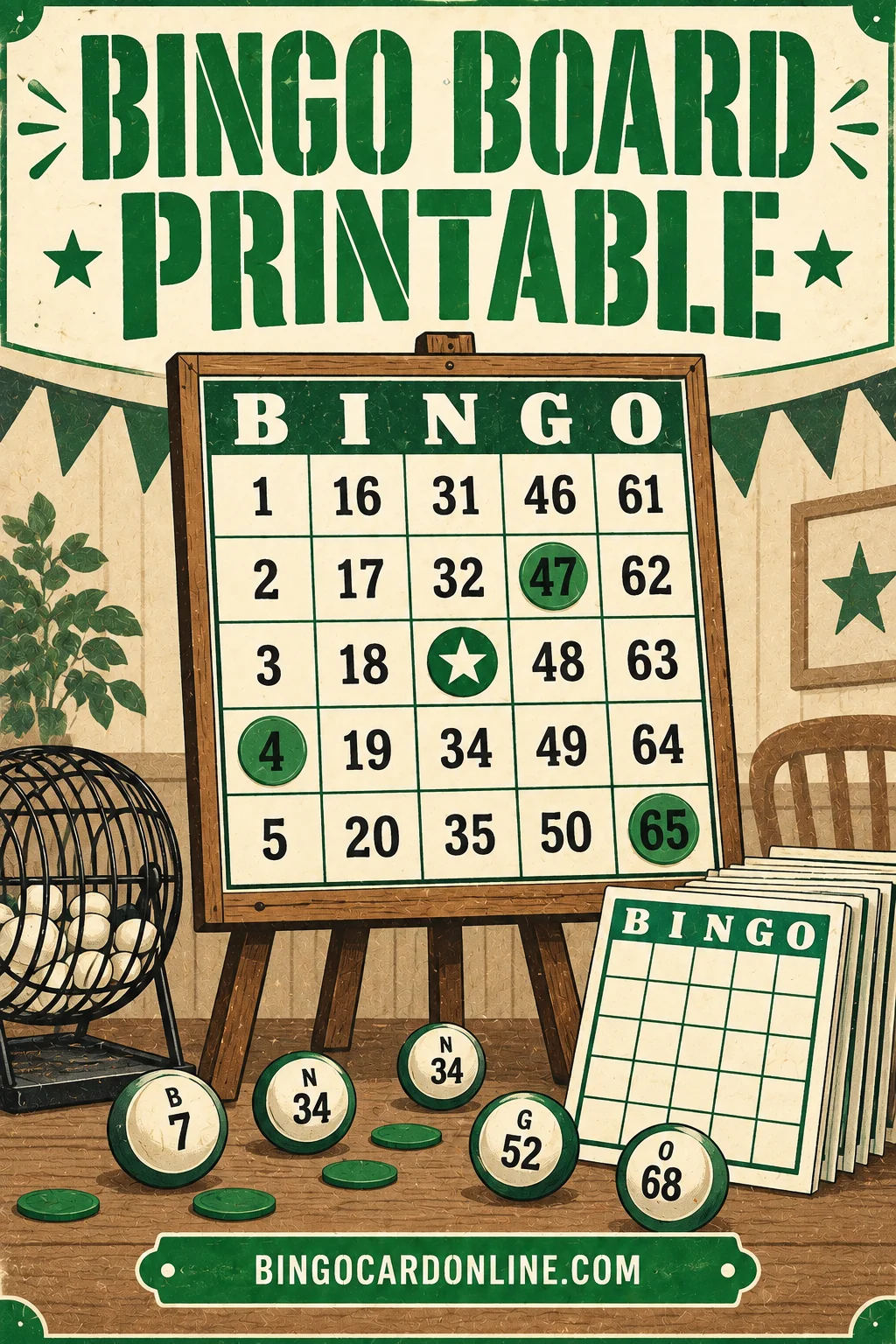
A bingo board printable is the one big grid everybody in the room looks at: the caller's master board that tracks every number or item already called, and the oversized group board a class, team, or family marks together on a single sheet. It is a different document from the stack of player cards, and printing the wrong one is the most common reason a game stalls in the middle.
The two are easy to confuse because both are grids and both say bingo across the top. The difference is who reads them. A card is private and disposable, one per person, marked and thrown away. A board is public and durable, one per room, and it usually gets used again. Once you know which of the two you are printing, every other decision, from paper size to font size to whether you laminate, follows from it.
Board or Card: Decide This Before You Print Anything
A card is per player. A board is per room. Everything else follows from that one line.
| Player card | Printable bingo board | |
|---|---|---|
| How many you print | One per person | One for the whole group |
| Who marks it | The player, privately | The caller, or the group together |
| Contents | A random selection from the pool | The complete pool, or a shared challenge list |
| Grid | Usually 5x5 or 3x3 | 5x5, or a 5-column reference grid of every number |
| Lifespan | One game | A whole party, term, or season |
| Paper | Light, plain, cuttable | Heavy, often laminated |
| Read from | Arm's length | Across the room |
If you need twenty different randomized grids so that twenty players do not all shout at once, you need cards, and a bingo card generator will build and randomize them faster than you can lay out one by hand. If you need a single sheet that the caller checks off or that the whole room fills in together, you need a board, which is what the rest of this guide is about.
There is one more overlap worth naming. A single player card blown up to poster size becomes a board the moment more than one person is marking it. That is exactly what a preschool teacher is doing with a wall-sized grid of nine pictures, and it is why the words get used interchangeably even though the documents behave differently.
The Caller's Master Board
The master board is the caller's reference sheet: every number or item in the pool, printed once, checked off as it is called. It is the least glamorous printout in the game and the one that prevents almost every argument.
In classic 75-ball play, the master board is a grid of five columns and fifteen rows, B holding 1 through 15, I holding 16 through 30, N holding 31 through 45, G holding 46 through 60, and O holding 61 through 75. Seventy-five cells, laid out in the same column order as the cards, so the caller's eye lands in the right place without hunting. In 90-ball play the same idea runs as nine columns of ten.
The master board does four jobs at once, and each one is a failure you avoid:
It stops repeat calls. Pull a chip, call it, mark it. Without a marked board, a caller who is also refilling drinks will absolutely call the same number twice, and the room will notice.
It settles verification. When someone calls bingo, you read their marked squares back against the board. If a number is not checked off on the board, it was not called, and the claim is dead. This takes fifteen seconds and ends the dispute cleanly, because the board is neutral and everyone can see it.
It tells you where the game is. A board that is half-marked tells you a full-house round is going to run long, which is useful when you need to decide whether to call a line win instead.
It survives an interruption. Someone knocks the bowl of chips over. With a marked master board, you know exactly which numbers are still live and you can refill from it. Without one, the round is over.
For themed bingo, where the squares hold words, pictures, or phrases instead of numbers, the master board is even more useful. It is the complete item pool in one place, so the caller is not shuffling loose slips and hoping none fell under the table. Print two copies, cut one into calling slips, keep the other whole as the board, and check off each slip as it comes out.
The Group Board: One Grid, Many Players
A group board is a single large grid that a whole class, team, or household fills in together over time, and it has no caller at all. Nothing is drawn at random. The squares are things to do, and the game is the doing.
This is the format behind almost every board you have seen taped to a wall or a refrigerator:
- Summer or break bingo. Twenty-five activities, one household, one sheet on the fridge, marked as each one gets done.
- Reading challenge boards. A book with a blue cover, a book set somewhere you have never been, a book someone recommended. One board per class, or one per student pinned to a shared wall.
- Classroom behavior and station boards. Squares are stations or tasks; the class fills the grid across a week.
- Team and office boards. A quarter's worth of small goals, marked publicly, which is most of the motivation.
- Icebreaker boards. The room works one big grid together instead of everybody holding a card, which suits a smaller group where individual cards would finish in a minute.
- Habit and chore boards. A row a week, marked with a dry-erase pen and wiped clean at the end.
Group boards want different content from called bingo. Every square has to be achievable by whoever is looking at it, because unlike a random card, nobody gets a different set. One impossible square in the corner poisons the whole board, since it blocks the blackout that most people are actually chasing. Write the twenty-five squares, then reread them asking a single question of each one: can the person standing in front of this board actually do this in the time available? Cut anything that fails.
The other rule is that a group board needs a stated win condition written on the sheet itself. A line, a corner, a blackout, or simply as many as you can by the end of the month. Boards left ambiguous get abandoned around the eleventh square.
Sizes and Formats That Actually Get Used
| Board type | Grid | Best paper | Typical use |
|---|---|---|---|
| Caller's master board, 75-ball | 5 columns x 15 rows | Letter, portrait | Number bingo verification |
| Caller's master board, 90-ball | 9 columns x 10 rows | Letter, landscape | Ticket-style play |
| Themed calling board | Item pool, any shape | Letter | Picture, word, and party bingo |
| Small group board | 3x3 | Letter | Toddlers, waiting rooms, quick rounds |
| Standard group board | 5x5 | Letter or tabloid | Fridge boards, reading challenges |
| Wall board | 5x5 tiled over 4 sheets | 4 x letter, taped | Classrooms, large rooms |
A 5x5 group board on letter paper gives squares a little under an inch and a half across, which is enough for a short phrase and a check mark, and not enough for a child's handwriting. If people are writing inside the squares rather than checking them, go up to tabloid or drop to a 4x4 or 3x3 grid. This is the single adjustment that makes the difference between a board people fill in and a board people give up on.
How to Create a Bingo Board Step by Step
To create a bingo board, pick the board type first, then the pool, then the grid, and print a single test copy before you commit. In that order, because each choice constrains the next.
1. Decide caller's board or group board. If numbers get drawn, you are building a master reference. If squares get completed, you are building a challenge grid. They share nothing but the word bingo.
2. Write the pool in a plain list first. Not in the grid. A list is easy to edit, reorder, and cut, and a grid is not. For a group board, write about a third more items than you have squares so you can drop the weak ones.
3. Read the list for balance. A good 5x5 group board has roughly five easy squares, fifteen ordinary ones, and five that take real effort. All-easy is boring by the second row. All-hard is abandoned.
4. Check that no two squares mean the same thing. Duplicates are invisible in a list and glaring on a printed board, where two nearly identical squares make the whole thing look careless.
5. Choose the grid, then place the hardest square off center. Nobody wants the difficult item sitting in the middle of every possible line.
6. Print one copy and look at it from where people will stand. Not on screen. Across the room, under the actual lighting.
7. Then print the real thing on heavier paper, and laminate it if it will be marked more than once.
Printing a Board People Can Read From Across the Room
Print at 100 percent, not fit to page, and check the first copy from the back of the room before you print the rest. Scaling is where most printable boards quietly go wrong.
The scaling trap. Print dialogs default to shrinking a page slightly to fit an unprintable margin. On a card that is invisible. On a board with hand-drawn grid lines it produces uneven cell widths and a border that is thicker on one side, and it will also shrink your text below the size you designed. Set scaling to 100 percent, actual size, or none, whichever your driver calls it.
Paper weight. A group board that lives on a wall for a month wants cardstock or at least a heavier text weight. Standard copy paper curls at the corners within a week and tears at the tape line. A caller's master board used once can be plain paper, since it is going in the recycling anyway.
Going bigger than letter. Two easy routes. Print tabloid if you have access to a printer that takes it, or tile a single page across four letter sheets using the poster or multi-page option in your print dialog, then trim the overlap and tape the back. Tiling looks improvised close up and reads perfectly from six feet away, which is the only distance that matters for a wall board.
Contrast. Black text on white, thin gray grid lines, and no background image behind the squares. Decorative boards photograph well and read badly. If you want color, put it in the header band and the free space, not underneath the text.
Text size. For a wall board, the rule of thumb that holds up is that anything you want read from across a classroom needs to be about as tall as the top joint of your thumb on the printed page. Print one square at the size you are planning and walk away from it.
Landscape for wide boards. A 90-ball master board with nine columns is much more comfortable in landscape. A 5x5 group board is happier in portrait.
Making One Board Last a Season
A board is worth protecting in a way a card never is.
- Laminate it, or slide it into a clear sheet protector. Either surface takes a dry-erase marker and wipes clean, so the same board runs weekly.
- Use dot stickers for permanent marks. Better than pen for a board that fills over a month, because a sticker reads from farther away and never smudges.
- Magnets on a metal door. Chips or magnet dots turn a fridge board into something a small child can operate without a pen.
- Painter's tape, not clear tape, on painted walls. It comes off without taking paint with it.
- Write the win condition and the end date on the board itself, in the header. Boards without a deadline stop being played.
Free Bingo, Free Online Bingo, and What Those Searches Return
It is worth naming the ambiguity plainly, because people looking for a board to print keep landing somewhere else entirely.
Searching for free bingo, free online bingo, online bingo, or bingo online free returns two very different kinds of result. One is generators and printables of the kind this article is about: build a grid, fill it, print it, play in a room with people. The other is commercial bingo rooms where the game is played for stakes, which is a regulated activity in many places and has nothing to do with printing a board for a classroom.
The word bingo online does most of the confusing, since it reads as a place to play rather than a tool to make something. If what you want is a sheet in your hand, the useful search terms are the physical ones: bingo board printable, blank grid, master board, calling sheet. If you want a virtual caller so you do not need chips and a bowl, that is a third thing again, an online caller that draws and displays numbers while everyone still plays on printed cards.
None of these three is a substitute for the others. A free bingo generator will not call numbers for you. An online caller will not print a board. And bingo online free, as a phrase, mostly returns the commercial rooms rather than either.
Mistakes Worth Avoiding
- Printing one board and expecting it to work as cards. Twenty-five people looking at identical squares all win at the same moment. That is fine for a group challenge and fatal for a called game.
- No master board at all. The caller relies on memory, calls a number twice, and the game loses its authority.
- Squares too small to write in. The most common board failure, and it is decided at layout, not at printing.
- Fit to page scaling. Uneven cells and text one size smaller than you designed.
- A background image behind the grid. Looks good on screen, unreadable on paper, and heavy on ink.
- No stated win condition. People fill four squares and drift.
- Laminating before proofreading. Read every square out loud before the sheet goes through the machine.
Frequently Asked Questions
What is the difference between a bingo board and a bingo card? A card is one player's randomized grid, printed in a stack so that no two people hold the same squares. A board is the shared sheet the room reads: either the caller's master list of the whole number pool, or a single large challenge grid a group fills in together.
How do I create a bingo board without any software? Rule a grid on paper with a straightedge, write your item list separately first, then copy the items in. Photocopy the blank grid before you fill it so you have spares. The list-first order matters more than the tool, because editing a list is easy and editing a filled grid is not.
What size should a printable bingo board be? Letter paper handles a 3x3 or 4x4 board comfortably and a 5x5 board adequately if people are only checking squares rather than writing in them. For a wall board, tile one page across four letter sheets and tape them together, which reads clearly from across a room.
Do I need a master board if I am using a virtual caller? Not for tracking calls, since the caller keeps its own history on screen. You will still want a printed pool list if the game is themed rather than numbered, so you can verify a winning card against the exact wording of each item you called.