Bingo for ESL Learners: A Fun Way to Build Vocabulary
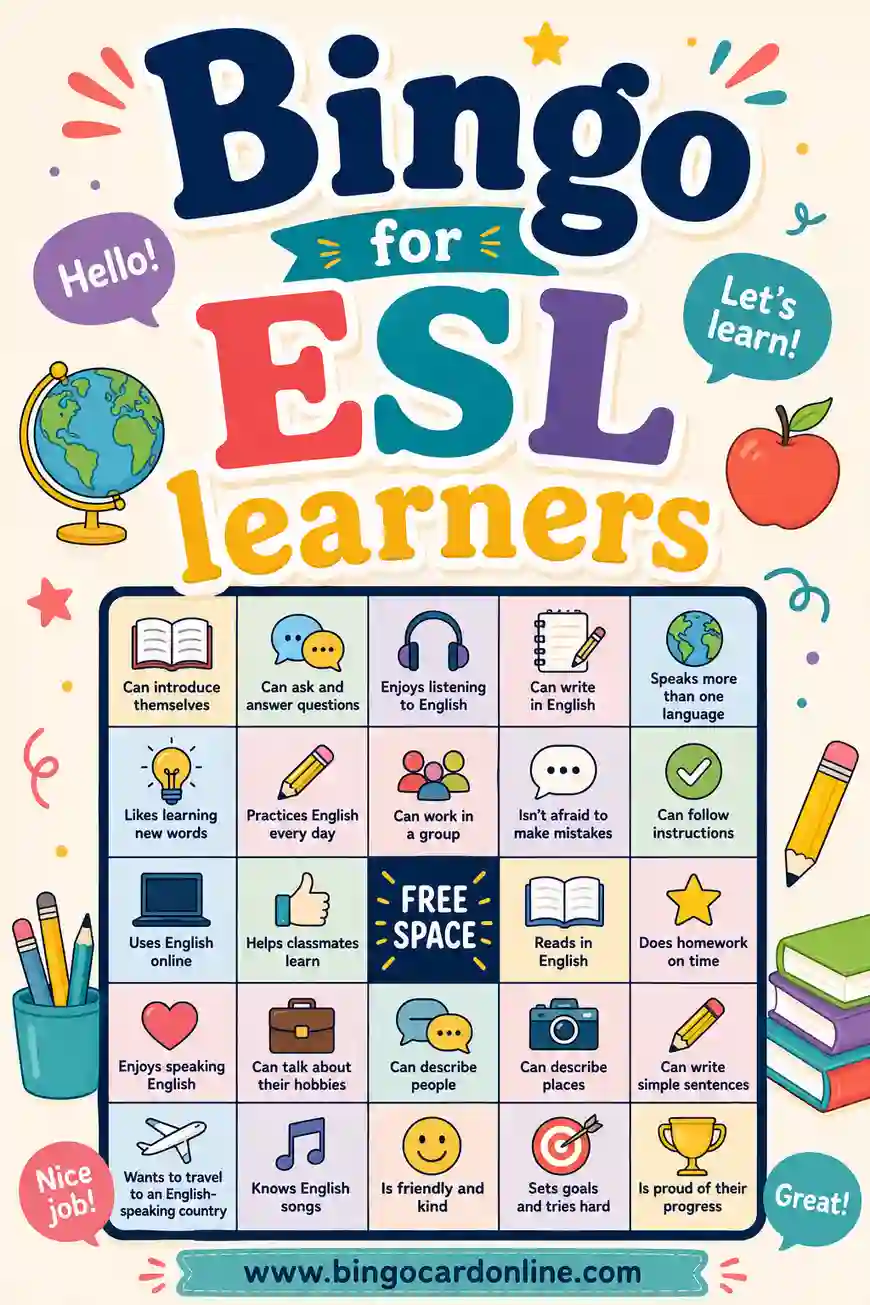
Bingo for ESL learners turns vocabulary practice into a game: you put English words or pictures on the cards, call out the word (or its definition, or a sentence), and students mark the match. It builds listening, reading, and word recognition all at once, and it lowers the pressure that makes language learners freeze up. The quickest way to set it up is a free bingo card generator that scrambles your word list into a different card for every student.
Want to play in your next lesson? Open the free generator, paste in the word list below, and print a unique card for each learner in minutes. No sign-up, no cost, nothing to install.
Learning a language means hearing a word, recognizing it, and connecting it to meaning, fast. Bingo drills exactly that. When you call "umbrella" and students scan their cards for it, they're practicing real-time listening and word recognition without even thinking about it.
It also takes the fear out of speaking too soon. A student who's nervous to talk can still win at bingo by listening and marking. That early success builds confidence, and confident learners speak up sooner.
And because it's a game, students repeat the same words many times without getting bored. Repetition is the whole point in language learning. Bingo just makes it feel fun instead of like a worksheet.
ESL Bingo Variations Worth Trying
You can run bingo in several ways depending on what skill you want to push.
Listening and recognition
- Word bingo. Words on the cards, you call them aloud. Best for beginners building basic vocabulary.
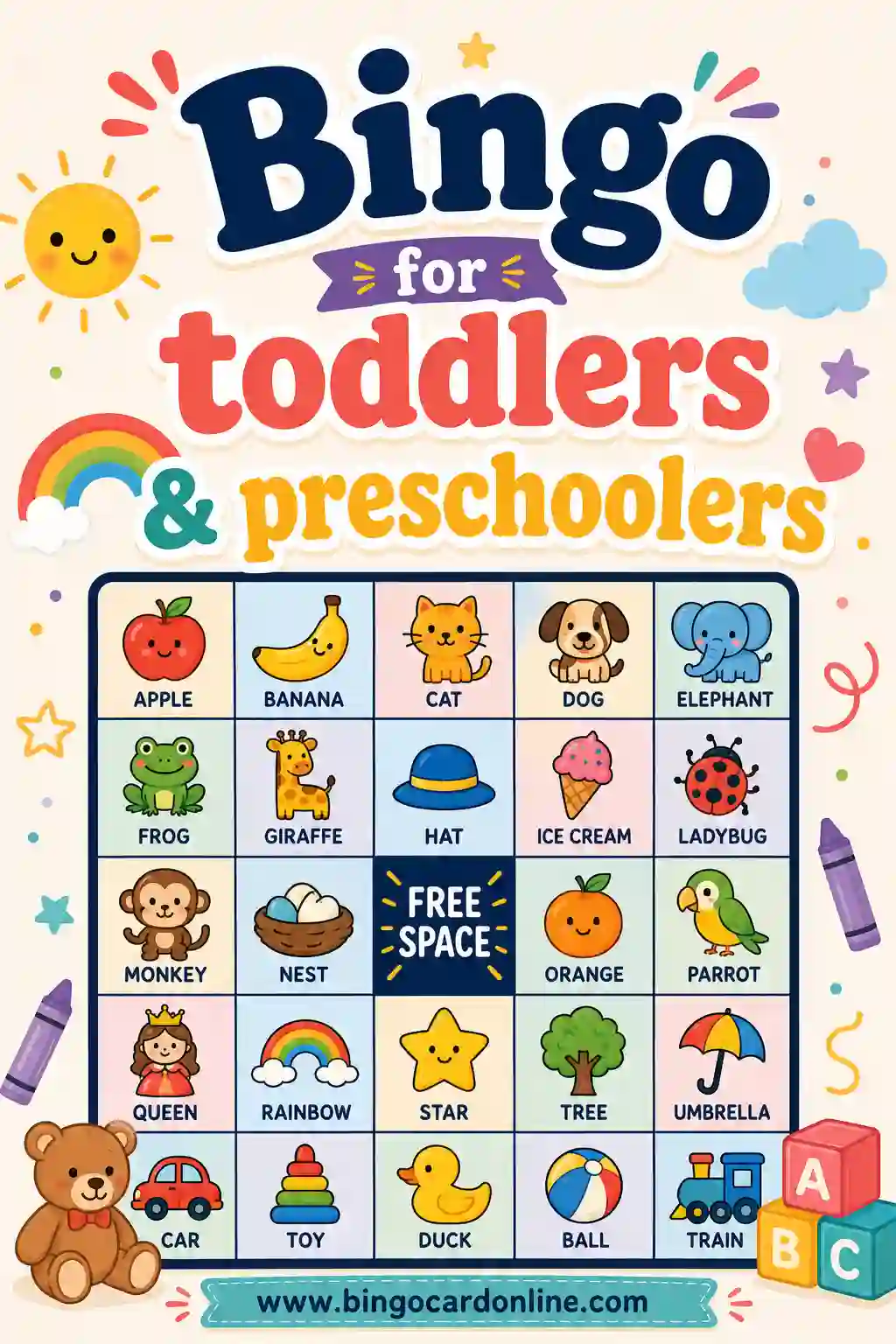
- Picture bingo. Pictures on the cards, you call the word. Perfect for true beginners and non-readers.
Comprehension
- Definition bingo. Words on the cards, you read a simple definition. Students match meaning to word.
- Sentence bingo. You say a sentence with a blank: "I open my ___ when it rains." Students mark "umbrella."
Production and speaking
- Question bingo. Squares hold answers. You ask "What do you eat for breakfast?" and students mark a food they have.
- Synonym or antonym bingo. Call a word; students mark a square that means the same or the opposite.
These last two nudge students from passive recognition toward producing language, which is exactly where you want them heading.
Free ESL Bingo Word List (Copy & Paste)
Here's a ready-to-use list of 30 common, everyday English words, the kind beginners and lower-intermediate learners meet first. Copy any column straight into the generator. Pick 24 for a 5x5 card or 9 for a beginner-friendly 3x3.
| Around the Home | Food & Drink | Out & About |
|---|---|---|
| Window | Apple | Bus |
| Kitchen | Bread | Street |
| Chair | Water | Park |
| Bed | Cheese | Store |
| Door | Coffee | School |
| Lamp | Rice | Hospital |
| Mirror | Egg | Library |
| Towel | Banana | Train |
| Clock | Soup | Market |
| Blanket | Milk | Bridge |
Stick to concrete, picturable words for beginners, things they can see and touch. Save abstract words like "freedom" or "patience" for higher levels, where students can handle them.
Theme ideas by topic
- Weather bingo. Sunny, rainy, windy, snowy. Pair it with a unit on small talk.
- Job bingo. Doctor, teacher, driver, cook. Great for adult learners.
- Action bingo. Run, eat, sleep, read. Call the verb and act it out for extra clarity.
How to Make ESL Bingo Cards in 4 Steps
No tech skills needed. Here's the whole thing.
- Choose a grid size. 3x3 for true beginners, 4x4 for a quick round, 5x5 for intermediate learners.
- Add your words. Paste at least 24 for a 5x5. More words means more variety between cards.
- Pick how many cards. One per learner, plus a couple spares.
- Print. The generator makes each card unique, so no two students share a layout.
For beginner classes, add pictures next to words by hand, or use a picture-only set. Visual support helps learners connect the English word to its meaning faster.
Bingo by English Level
Match the game to your students' level and they'll stay engaged instead of overwhelmed.
| Level | Grid size | What to put on the squares |
|---|---|---|
| Absolute beginner | 3x3 | Pictures or single words. Call slowly and repeat. |
| Beginner | 4x4 | Concrete everyday words. Add pictures for support. |
| Lower-intermediate | 4x4 or 5x5 | Definitions or simple sentences as clues. |
| Intermediate | 5x5 | Synonyms, antonyms, or fill-in-the-blank sentences. |
| Advanced | 5x5 | Idioms, phrasal verbs, or topic-specific vocabulary. |
The lower the level, the more you support with pictures and slow, clear speech. The higher the level, the more you can hide the word behind a clue so students have to think.
Running a Smooth ESL Bingo Game
Here's how to run a clean round, even with mixed levels in the room.
- Hand out cards and markers. One card each, a small pile of counters within reach.
- Pre-teach the words. Quickly review each word with a picture or gesture before you start. Bingo reinforces, it shouldn't introduce brand-new words cold.
- Explain the win condition. A line, four corners, or a blackout. Show it on the board so there's no confusion across languages.
- Call clearly and slowly. Say each word, then pause. Repeat it once for beginners.
- Check the winner. When a student calls "Bingo!", have them say the marked words aloud. Now they're speaking, too.
A slow, steady pace beats a fast one with language learners. One call every 15 to 20 seconds gives everyone time to scan and process.
Markers that work anywhere
- Dried beans, buttons, or coins
- Small counters or pom-poms
- A pencil to cross squares off
- Torn paper if you have nothing else
Tips to Get the Most Learning Out of Each Game
A few small moves turn a fun game into real language practice.
- Make the winner speak. Before awarding the prize, ask the student to read their marked words or use one in a sentence. Instant speaking practice.
- Pre-teach, then play. Review the words first so bingo reinforces rather than confuses.
- Use gestures and pictures. Pair "jump" with a little jump. The visual locks the meaning in.
- Mix in review words. Slip in words from last week so students keep recycling old vocabulary.
- Slow down. Language learners need processing time. A slower call pace helps everyone keep up.
If you teach beginners, lean on a 3x3 or 4x4 grid with bigger squares and pictures. Less on the card means less to scan and more success early on.
Adapting Bingo for Adult ESL Classes
Adult learners need bingo too, but with a grown-up twist. Skip the cartoon clip art and use vocabulary they'll actually use: job words, banking terms, doctor's-office phrases, words for filling out forms.
Adults also appreciate knowing why they're playing. A quick "this helps you recognize these words when you hear them at work" goes a long way. Keep the competition light and the prizes optional, since some adults find games childish until they see the payoff.
Topic-based sets work especially well here. A "going to the doctor" bingo round, with words like prescription, appointment, and symptom, prepares adults for a real situation they'll face. That relevance is what keeps adult learners coming back.
Building Bingo Around What You're Teaching
The biggest mistake teachers make with vocabulary bingo is treating it as a standalone game. It works far better as the back end of a lesson you've already taught. Bingo is review and reinforcement, not the first time a student meets a word.
So start from your current unit. If this week is "food and cooking," your card words come straight from that list: onion, boil, fry, recipe, slice. The students have already seen these words, so bingo gives them three or four more exposures in a low-stress setting. That spaced repetition is exactly what moves a word from "I sort of recognize that" to "I know that."
You can also use bingo to bridge two units. Put half last week's words and half this week's on the same card. Students recycle the old vocabulary while practicing the new, and you get a quick read on what's stuck and what hasn't. If half the class freezes on a word you taught a week ago, that's useful information.
A quick template for tying bingo to a lesson
- Teach the words first. Introduce them with pictures, gestures, and example sentences, the way you normally would.
- Practice once. A matching exercise, a quick drill, anything that gets students using the words.
- Play bingo as the reinforcement. Now the words are familiar, so the game feels like a reward and a review at the same time.
- Close with production. Have winners use a marked word in a sentence, so the lesson ends with students making language, not just recognizing it.
That four-step shape turns a fun filler into a deliberate part of your lesson plan.
Handling Mixed-Level Classes
Real classrooms are rarely one neat level. You'll have a couple of fast learners, a big middle, and one or two students still finding their feet. Bingo can flex to hold all of them at once, which is part of why it's such a workhorse activity.
The simplest trick is to differentiate the clue, not the card. Everyone gets the same words on their grid, but you adjust how you call. For a beginner, you say the word plainly: "apple." For a stronger student listening to the same call, the word is still there, but you can occasionally swap in a definition or a sentence with a gap, and the advanced students will get it from context while the beginners catch the plain word. One game, several levels of challenge.
You can also pair students up. Put a stronger learner with a weaker one on a shared card. The stronger student helps scan and explains the words, which is great practice for them, while the weaker student stays in the game instead of falling behind. Peer teaching like this often lands harder than anything you say from the front.
Finally, keep the pace humane. In a mixed room, the slowest processor sets your speed. Call, pause, repeat, and watch faces. If three students are still scanning, wait. Bingo only teaches when everyone can keep up, so a slow, kind pace beats a fast, frustrating one every time.
Common Pitfalls and How to Dodge Them
A few avoidable mistakes can turn a great bingo activity into a confusing one. Watch for these.
- Brand-new words on the card. If students meet a word for the first time during bingo, they can't match it, and the game stalls. Always pre-teach.
- Too many words at once. A 5x5 card with 30 unfamiliar words overwhelms beginners. For lower levels, drop to a 3x3 or 4x4 with words they already half-know.
- Calling too fast. Native pace is a wall for learners. Slow down, pause, and repeat each call once.
- Abstract words too early. "Honesty" or "progress" are hard to picture and hard to match. Save them for advanced classes and stick to concrete nouns and verbs at lower levels.
- No speaking payoff. If the game ends the moment someone wins, you've missed the best part. Make the winner say their words aloud or use one in a sentence.
Sidestep those five and bingo earns its place in your lesson every single time.
Frequently Asked Questions
How does bingo help ESL students learn English?
It drills listening, reading, and word recognition at the same time, with lots of low-pressure repetition. Students hear a word, scan for it, and connect it to meaning, the core skills of early language learning, all inside a game they enjoy.
What words should I put on an ESL bingo card?
Start with concrete, everyday words students can picture: home objects, food, places, common verbs. The list above gives you 30. Save abstract words and idioms for higher levels who can handle them.
How do I make every student's card different?
Use a generator that shuffles your word list into a new layout per card. Doing it by hand is slow and easy to mess up, which is why the tool exists. Every learner gets a unique grid.
Is this bingo card generator free to use?
Yes. You make and print the cards yourself at no cost. There's no login and no watermark, so a whole class can play on one free word list.
Can I use bingo with absolute beginners?
Absolutely. Use a small 3x3 grid with pictures instead of words, and call slowly. Picture bingo lets non-readers and brand-new learners join in and succeed from day one.
Does ESL bingo work for adult learners too?
Yes. Use practical, real-world vocabulary, job terms, medical words, form-filling phrases, and explain the purpose. Adults engage well once they see the words connect to situations they actually face.
How do I use bingo with a mixed-level class?
Give everyone the same card words but vary how you call them. Say the plain word for beginners and occasionally swap in a definition or a gapped sentence that stronger students decode from context. Pairing a stronger learner with a weaker one on a shared card also keeps everyone in the game.
Should bingo introduce new vocabulary or review it?
Review. Bingo works best as reinforcement after you've already taught the words. If students meet a word for the first time on the card, they can't match it and the game stalls. Pre-teach with pictures and sentences, then use bingo to lock the words in.
Ready to Print Your ESL Bingo Cards?
Grab the word list above, open the free bingo card generator, and you'll have a unique, printable card for every learner in minutes. It's free, there's no sign-up, and every card is different. Want more ideas? See our guides to bingo for teachers, bingo for toddlers and preschoolers, and bingo for large groups. Now go turn vocabulary practice into a game your students will ask to play again.