Coworker Bingo: Office Prompts That Stay Friendly
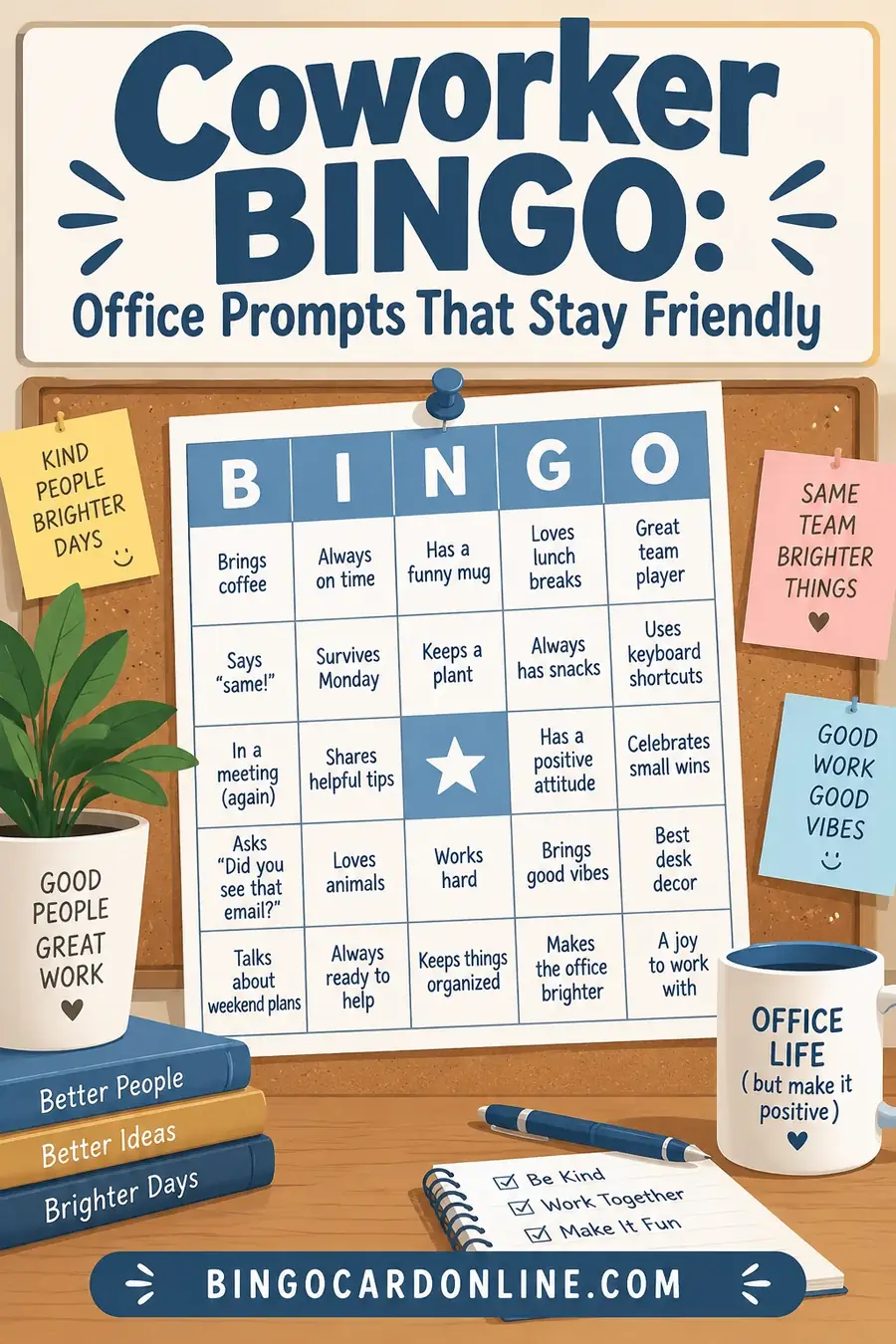
The difference between coworker bingo that a team enjoys and one that quietly damages morale is whether the squares describe situations or people. "Someone's dog barks on a call" is a situation everyone has been in. "Someone talks too much in meetings" is a specific colleague, and everyone in the room knows which one.
Same format, opposite outcome. Here's how to build the first kind.
Two Different Games
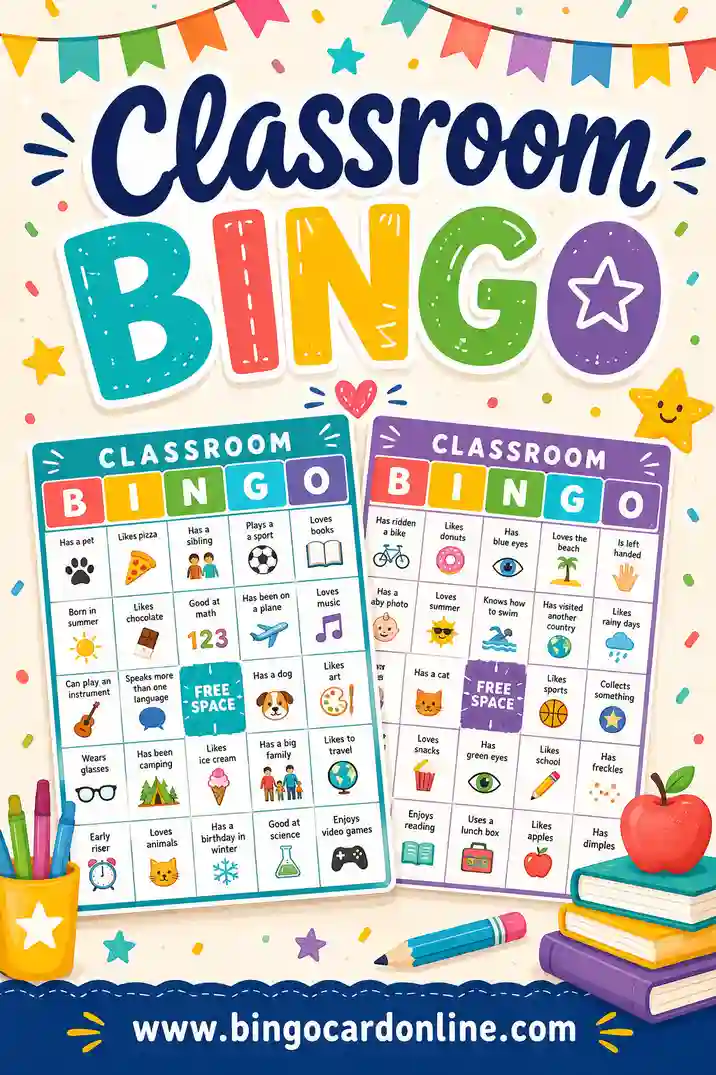
Icebreaker bingo (find someone who). Squares describe people — "has run a marathon," "speaks three languages" — and players circulate to find a colleague who matches, writing their name in the square. This is for onboarding, offsites and new teams.
Meeting bingo. Squares describe things that happen during a call or meeting, marked as they occur. This is for regular teams and works as a shared joke rather than a mixing exercise.
They need different prompt lists, and mixing them produces a card that does neither job well.
Icebreaker Prompts
Aim for a mix that gives everyone at least a few hits:
- Has lived in another country
- Plays a musical instrument
- Has a pet with an unusual name
- Can cook one dish really well
- Has run a 5K
- Speaks more than one language
- Has been to a concert this year
- Prefers tea over coffee
- Has a hidden talent
- Grew up somewhere rural
- Has read a book in the last month
- Can drive a manual transmission
- Has met someone mildly famous
- Does something creative outside work
- Has a sibling
- Watches a show everyone else has finished
- Has a favorite houseplant
- Has done a job completely unrelated to this one
- Can whistle properly
- Has been at the company longer than five years
The design rule: every square should be something a reasonable person is comfortable volunteering. Nothing about relationship status, health, income, family plans, religion or politics. A square someone has to decline creates exactly the awkwardness the game is meant to dissolve.
Meeting Prompts (Remote)
- "Can everyone see my screen?"
- Someone joins late and apologises
- Audio cuts out mid-sentence
- A dog or doorbell in the background
- "Sorry, you go ahead" — twice
- Someone forgets they're muted
- "Let's take that offline"
- A calendar invite is questioned
- Someone's camera is off the whole time
- The meeting could have been an email (thought, not said)
- Screen share shows an unexpected tab
- "I'll follow up on that"
- Someone eats on camera
- The wrong document gets shared first
- A child or housemate walks through
- "Can you hear me now?"
- Meeting runs over by five minutes
- Someone says "circle back"
Meeting Prompts (In Person)
- The projector doesn't connect first try
- Someone brings coffee for the room
- The room is booked by someone else
- Whiteboard marker is dry
- Someone stands up to present and sits back down
- A phone buzzes on the table
- Someone arrives with a laptop and never opens it
- "Does that make sense?"
- The agenda is abandoned by item two
- Someone volunteers to take notes
Squares to Avoid
Worth being explicit, because these are the ones that get a game shut down:
Anything identifying one person. If a square describes a habit only one colleague has, it's a card about them, whatever the intention.
Performance and competence. "Someone missed a deadline," "someone doesn't know the answer." Never funny to the person it lands on.
Appearance, age, accent, background. Obvious, and it still happens.
Anything a manager could read as a complaint. "Meeting with no clear purpose" is a fair critique and a bad bingo square — it puts the person who organized the meeting in the room with a joke about it.
Anything relating to protected characteristics. Non-negotiable.
The test: would you be comfortable if the person the square best describes read the card and knew you wrote it? If not, cut it.
Running It Well
Distribute cards before the meeting, not during. Handing out cards as a meeting starts signals that nobody intends to pay attention.
Keep it to appropriate occasions. A team retro, an all-hands, an offsite — yes. A performance conversation, a client call, a meeting about layoffs — obviously not. This judgment is the whole thing.
Give it a low-key prize. Coffee, first pick of lunch, an actual sticker. Cash prizes make it feel like a scheme rather than a joke.
Cap the time. One meeting, or one hour of an offsite. A game that runs for a week stops being funny and starts being a distraction people feel obliged to maintain.
Let people opt out without explaining. Someone having a bad week shouldn't need a reason.
Icebreaker Logistics
For the "find someone who" version specifically:
Set a real time limit. Ten to fifteen minutes. Open-ended mixing drifts.
One name per square, and a person can only appear once or twice on a single card. Without that rule, two friends fill each other's cards and nobody meets anyone.
Don't require a full card. A line is plenty for a fifteen-minute mixer; requiring a blackout means most people finish nothing.
Debrief briefly. Ask two or three people to share the most surprising thing they learned. That's where the actual connection happens — the card is just the mechanism.
Each card needs a different arrangement so the room isn't marking in unison. A bingo card generator takes your prompt list and produces a distinct card per person, which is the tedious part of building an office set by hand.
Onboarding and New-Team Use
The icebreaker version earns its keep most in the first week of a new team, a new hire's first day, or the opening hour of an offsite — situations where people genuinely don't know each other and small talk is effortful.
Why it works better than a round of introductions. Standard introductions put one person on the spot while everyone else waits. Bingo has everyone moving and talking simultaneously, which means no performance, no waiting, and roughly ten times as many one-to-one conversations in the same fifteen minutes.
Seed it with a few things you know. If you're running it for a team you know reasonably well, include two or three squares you're confident someone matches. It guarantees early wins and gets the room moving.
Include the new person's likely matches. For an onboarding session, a couple of squares that fit the new hire ensures people approach them rather than gravitating to colleagues they already know.
Debrief for two minutes. Ask three people for the most surprising thing they learned. That's where the connection consolidates — without it the game is just fifteen minutes of milling about.
Don't run it twice with the same group. The second time, everyone already knows the answers and it becomes an exercise in remembering rather than discovering.
Remote and Hybrid Adaptations
The meeting version translates directly to video calls; the icebreaker version needs restructuring.
For remote icebreaker bingo, replace circulation with breakout rooms — three or four rounds of four minutes each, with different groupings. Players collect names within each room. It's slower than in-person mixing but it works, and it's considerably better than a full-group round-robin.
For hybrid meetings, be careful with meeting-bingo prompts. Squares about audio problems and muting are funny to remote attendees and invisible to people in the room, which produces a card half the group can't fill. Write prompts that work from both positions, or run two card variants.
Share cards as images, not documents. A card everyone can edit gets accidentally overwritten. An image in the chat is simplest.
Set a clear end time. Remote games drift more than in-person ones because there's no visible signal that people have stopped.
Prizes, Stakes and Tone
Keep prizes small and non-monetary. Coffee, first pick of lunch, a genuinely silly trophy, an actual sticker. Cash or anything of real value shifts the tone from a joke to a competition and invites people to take it more seriously than the game can bear.
Consider no prize at all. For meeting bingo especially, the game works fine as a shared joke with no reward attached.
Never make participation compulsory. A game people are required to play stops being a game. Announce it as optional and mean it.
Read the week. A team that's just had bad news, missed a deadline or lost a colleague is not the room for meeting bingo, however good the prompts are. This is a judgment call and getting it wrong is worse than not running the game.
Building a Prompt List for Your Own Team
The generic lists above work. A list built from your actual team works considerably better, and it takes about fifteen minutes.
Collect from the team, anonymously. Ask everyone to submit three things that happen in every meeting. You'll get better material than you'd write alone, and it removes the question of who chose the prompts.
Filter hard. Cut anything naming a person, anything about performance, and anything that reads as a complaint about how the team runs. Expect to cut a third of submissions.
Test each one against the room. For each surviving prompt, ask whether the person it best describes would be comfortable. If you hesitate, cut it.
Keep twenty-five to thirty finalists for a 5x5 card, which gives enough variation between cards that nobody marks in unison.
Have one other person review the list before printing. A second reader catches the prompt you're too close to see.
When Not to Run It
Worth stating plainly, because the format's failure mode is a morale problem rather than a boring game.
Meetings with difficult content. Restructures, budget cuts, performance issues, anything involving bad news. Obvious, and it still happens.
Client or external meetings. A card visible on a shared screen during a client call is a genuine professional problem.
When the team is under real pressure. A game about meeting habits during a week when everyone is behind reads as mockery rather than levity.
When someone new is joining. Meeting bingo assumes shared context. A person on day one doesn't have it and will feel outside the joke.
When you're the most senior person and haven't asked. A manager introducing a game about meeting behavior puts the team in the position of having to enjoy it. Ask first, or let someone else propose it.
Alternatives Worth Considering
Coworker bingo isn't always the right tool, and a few adjacent formats do specific jobs better.
Two truths and a lie works better for a small group that will be together for a while, since it produces longer conversations about fewer facts.
Question cards on tables suit a seated group who won't be circulating — a dinner, a long meeting, a workshop with fixed seating.
Photo scavenger hunt works better for a group that needs to move around a venue and is more physical than bingo.
Skill or interest mapping — everyone adds themselves to a wall chart by interest — produces a lasting artifact rather than a fifteen-minute activity, which suits onboarding better.
Bingo's specific advantage is simultaneous participation with no performance requirement. If the group's problem is that some people won't speak up in a round-robin, bingo solves it. If the group's problem is that they need to go deep rather than broad, something else does the job better.
Measuring Whether It Worked
Worth thinking about if you're running it as part of a structured session.
Did people talk to someone new? The actual goal. A quick show of hands afterwards tells you.
Did the energy in the room change? Icebreakers are largely about state change. A room that's louder and more mobile afterwards has worked, whatever the cards say.
Did anyone opt out uncomfortably? If someone stood aside looking awkward, the prompts or the framing need adjusting.
Would you run it again with this group? If the answer is no, it's usually the prompt list rather than the format.
Jargon Cards and Their Relatives
Meeting bingo has older names, and knowing them helps when you're explaining the idea to a team.
Buzzword bingo. The original. Squares hold corporate jargon — "synergy," "circle back," "low-hanging fruit," "at the end of the day" — and players mark them as they're said. Buzzword bingo dates to the mid-nineties and spread through offices as a photocopied sheet long before anyone printed proper cards. It's still the sharpest version and also the one that most needs the situation test, because a card of jargon is a joke about how people talk, which is fine right up until the jargon belongs to one identifiable person.
Work bingo. The broader term, covering anything played at the office: meeting cards, onboarding icebreakers, a card for a conference or an all-day training. If someone asks you for work bingo, ask which of the two games they mean before you write a single prompt.
Break bingo. A quieter format — a card pinned in the break room or dropped into the team channel, marked over one afternoon rather than during a meeting. Break bingo suits teams who would find a card on the table during a call distracting, and it keeps the game outside the meeting itself, which is frequently the better outcome anyway.
Person and Career Card Variants
The icebreaker version has several named variants, and what separates them is simply what the squares are about.
Person bingo. The generic name for "find someone who" — squares describe people, and players collect names. Person bingo is the version to reach for with a group that genuinely doesn't know each other, because every square forces a conversation with somebody new rather than a mark on a card.
Career bingo. Squares about working life rather than personal life: "has worked in another industry," "has managed a team," "has been on a project that got canceled," "joined in the last year." Career bingo suits a professional-development day or a cross-department mixer, where the point is finding out what skills are actually in the room. It also sidesteps the privacy problem entirely, since every square is about work.
Childhood bingo. Squares about growing up — "had a paper route," "learned an instrument," "moved schools at least once." Childhood bingo produces the warmest conversations of the three and needs the most care, because family circumstances vary widely and a square about a childhood some people didn't have lands badly. Keep the prompts about activities rather than circumstances.
All three run on the same logistics: a real time limit, one name per square, a line rather than a full card, and a two-minute debrief at the end.
Frequently Asked Questions
Is coworker bingo appropriate for a work meeting? For team retros, offsites, all-hands and onboarding, generally yes. Not for performance discussions, client calls, or any meeting with difficult news. The occasion matters as much as the prompts.
What's the difference between icebreaker bingo and meeting bingo? Icebreaker bingo has squares describing people, and players circulate to find colleagues who match. Meeting bingo has squares describing events, marked as they happen during a call. They need separate prompt lists.
How do I keep the prompts from targeting someone? Write squares about situations rather than habits, and apply one test: would you be comfortable if the colleague the square best describes knew you wrote it? Anything that fails that test comes off the card.
How long should an icebreaker bingo run? Ten to fifteen minutes, with a line rather than a full card as the win condition. Longer than that and the energy drops well before people finish.