Bingo Patterns Explained (With Examples)
A bingo pattern is the shape of marked squares a player must complete to win. The most common is a single line, five in a row across, down, or diagonally, but you can also play for four corners, a full blackout, a picture frame, and dozens of fun shapes. The group simply agrees on the pattern before the game starts, and the first to complete it wins.
Want to try a few patterns yourself? Open the free bingo card generator, print a set of unique cards, and call a game. No sign-up, no software, and you can play any pattern you like.
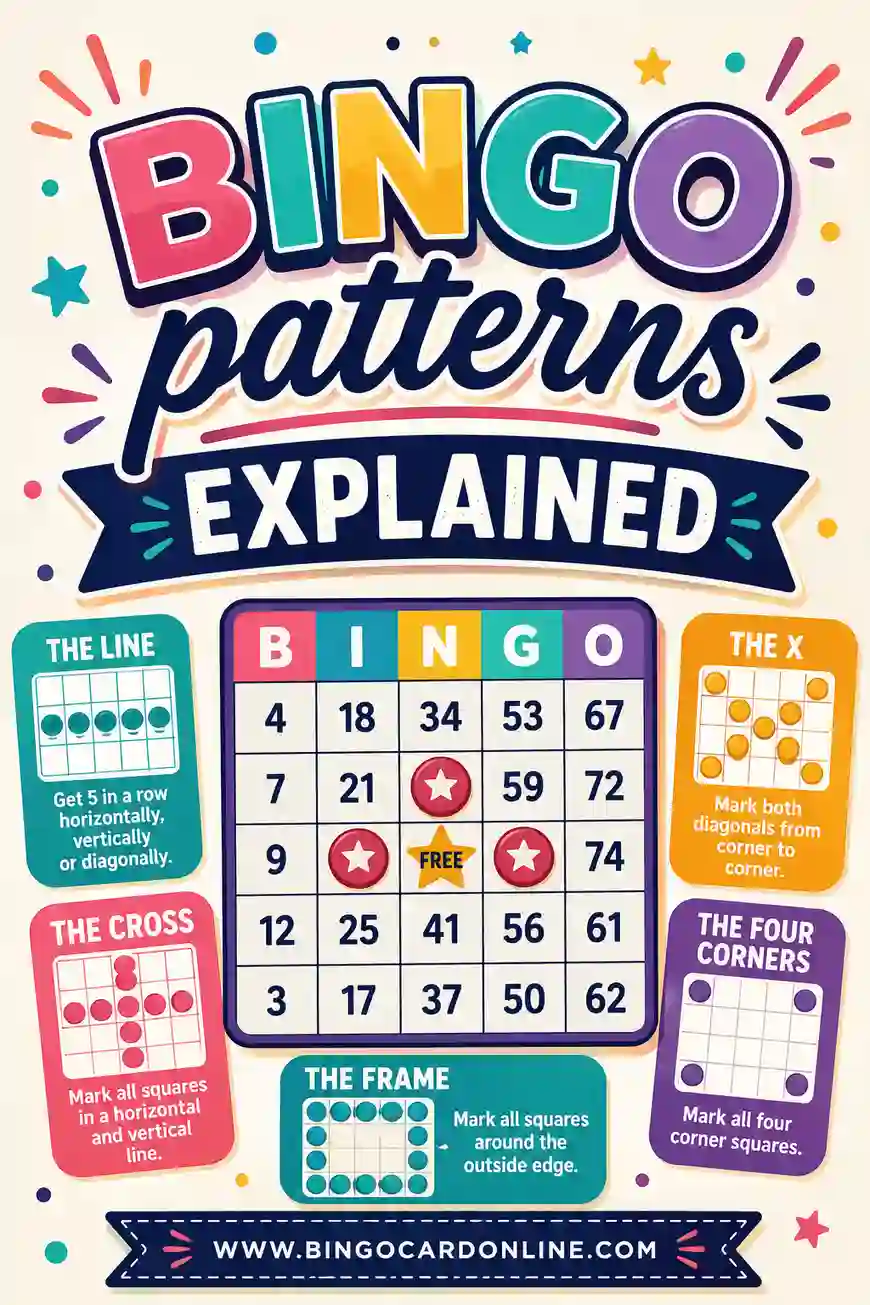
In bingo, you don't just mark random squares and hope. You're racing to fill a specific shape. That shape is the pattern. When your marked squares match it, you call "Bingo!" and win.
Every game picks one pattern before it starts. Beginners usually go with a single line because it's the fastest to understand. As your group gets comfortable, you can switch to trickier shapes to change the pace and keep things interesting.
Patterns matter for two reasons:
- They set how long the game runs. A single line is quick; a blackout takes a while.
- They keep things fresh. Swapping patterns between rounds stops the game from feeling repetitive.
Let's walk through them, from simplest to most involved.
The Classic: Single Line
The single line is the original bingo win. You complete any one row, column, or diagonal of five squares in a row.
There are three ways to make a line on a 5x5 card:
- Horizontal: five across in one row
- Vertical: five down in one column
- Diagonal: five corner-to-corner
This is the friendliest pattern for beginners and kids. It's fast, easy to spot, and almost everyone already knows it. If you're teaching someone bingo for the first time, start here. New to the whole thing? See how to play bingo: rules for beginners.
Four Corners
Four corners is exactly what it sounds like: mark all four corner squares of your card to win. No lines, no center, just the four outer corners.
It's one of the quickest patterns out there, which makes it great for:
- Short attention spans
- Young kids who want a fast win
- A speedy warm-up round before a longer game
Because only four squares matter, four corners games end fast. Run a few in a row to build excitement before switching to a tougher pattern.
Blackout (Coverall)
Blackout, also called coverall, is the marathon of bingo patterns. To win, you cover every single square on your card.
On a standard 5x5 grid, that's all 25 squares (the free space counts as one you start with). It's the longest pattern and usually carries the biggest prize, since it takes the most calls to finish.
Blackout works best when you:
- Want one long, suspenseful game instead of several short ones
- Have a bigger prize on the line
- Are playing with adults or older kids who'll stay engaged
Just know it runs longer than a line game, so plan your time. Curious how many squares that is for different grids? See how many squares are on a bingo card.
Picture Frame (Outside Edge)
The picture frame, sometimes called the "outside edge" or "border," asks you to mark every square around the outer edge of the card.
On a 5x5, that's the 16 squares forming the border, leaving the inner 3x3 untouched. It's a nice middle ground:
- Longer than a single line
- Shorter than a full blackout
- Visually satisfying when it fills in
It's a crowd favorite for groups that find a line too quick but a blackout too long.
Letter and Number Shapes
Once your group knows the basics, shape patterns add real fun. These trace a letter or number across the grid using marked squares.
Popular ones include:
- Letter X: both diagonals, crossing in the center
- Letter T: the top row plus the center column
- Letter L: the left column plus the bottom row
- Letter O: the outside edge (same as the picture frame)
- Number 7: the top row plus a diagonal down to the bottom-left
These take a sharp eye and a bit more time, so save them for players who've mastered the simpler patterns. They're a hit at themed parties where you can match the shape to the occasion.
A Pattern Cheat Sheet
Here's a quick reference so you can pick a pattern at a glance based on how much time you've got.
| Pattern | Squares to mark | Game length | Best for |
|---|---|---|---|
| Single line | 5 | Short | Beginners, kids |
| Four corners | 4 | Very short | Quick warm-ups |
| Picture frame | 16 | Medium | Mixed groups |
| Letter X | 9 | Medium | Intermediate players |
| Letter T | 9 | Medium | Themed games |
| Blackout | 25 | Long | Big prizes, adults |
Pick the row that fits your time and crowd, announce it before you start, and you're good to go.
A Themed Word List to Practice With
Patterns are easier to learn when you're actually playing. Here's a ready-to-use list of 30 general squares you can copy straight into the generator to make practice cards.
| Group 1 | Group 2 | Group 3 |
|---|---|---|
| Sun | Wave | Map |
| Moon | Shell | Key |
| Cloud | Crab | Lock |
| Star | Fish | Gear |
| Rainbow | Boat | Bolt |
| Kite | Sail | Hook |
| Storm | Net | Chain |
| Breeze | Buoy | Spring |
| Frost | Reef | Lever |
| Mist | Tide | Pulley |
Print a stack of unique cards, pick a pattern from the cheat sheet, and run a few rounds. You'll have the patterns memorized in no time.
Progressive Patterns: One Card, Multiple Rounds
Here's a trick that stretches a single set of cards into a whole evening. Instead of printing fresh cards for each game, play a series of patterns on the same cards, building from quick to long.
A classic progression looks like this:
- Round one: four corners. Fast, gets everyone marking, ends in a minute or two.
- Round two: single line. A touch longer, and players keep their already-marked squares.
- Round three: picture frame. Now the edges fill in, building tension.
- Final round: blackout. The whole card, with the biggest prize.
Because players keep their marks from round to round, each game feels like it's racing toward something. It's a favorite at fundraisers and family game nights because you only print one card per person yet get four distinct games out of it.
You can also run "double bingo," where the first line earns a small prize but the game keeps going until someone gets a second line on the same card. It's an easy way to reward more than one player without printing more cards.
How Pattern Choice Changes the Odds
Patterns aren't just about time. They quietly change how likely a quick win is, which is worth knowing when you're planning prizes.
A few rules of thumb:
- Fewer squares, faster win. Four corners needs only four marks, so someone usually wins early. Don't put your grand prize on it.
- Patterns through the center are easier. Any shape that includes the free space, like a diagonal or the letter X, gives every player a head start, so those games end a little sooner.
- Edge-only patterns feel slow. The picture frame skips the center entirely, so the free space doesn't help. That's why it runs longer than its square count suggests.
- Blackout is the great equalizer. Since everyone has to fill every square, luck evens out over the long game. It's the fairest pattern for a big prize.
Match the prize to the pattern and your game feels fair. A big reward on a four-corners round will feel like a coin flip; the same reward on a blackout feels earned.
How to Choose a Pattern for Your Game
Not sure which pattern to use? A few quick questions point you to the right one.
- How much time do you have? Short on time? Single line or four corners. Got a while? Blackout.
- Who's playing? Young kids do best with single line or four corners. Adults enjoy the challenge of shapes and blackout.
- How many rounds? For several quick rounds, use fast patterns. For one big game, go blackout.
- Is there a prize? Bigger prizes pair well with longer patterns like blackout or picture frame.
When in doubt, start with a single line to warm everyone up, then escalate to trickier patterns as the group gets into it.
Tips for Calling a Pattern Game
If you're running the game, a few habits keep pattern play smooth. (For the full rundown, see how to call a bingo game.)
- Announce the pattern loudly before you start. Show an example card if you can, so nobody marks the wrong shape.
- Remind players mid-game. A quick "remember, we're playing four corners" prevents false calls.
- Verify against the pattern. When someone calls "Bingo!", check that their marked squares actually match the agreed shape, not just any line.
- Switch it up between rounds. Rotating patterns keeps a long session lively.
Clear communication is the whole trick. As long as everyone knows the target shape, pattern games run themselves.
Frequently Asked Questions
What are the most common bingo patterns?
The most common bingo patterns are the single line (five in a row across, down, or diagonal), four corners, blackout (covering every square), and the picture frame (the outside edge). Single line is the classic and the easiest for beginners.
What is a blackout in bingo?
A blackout, also called a coverall, is when you mark every square on your card to win. On a standard 5x5 card that's all 25 squares. It's the longest pattern and usually carries the biggest prize.
How do you win four corners in bingo?
To win four corners, you mark all four corner squares of your card, the top-left, top-right, bottom-left, and bottom-right. It's one of the fastest patterns, so it's great for quick rounds and young players.
Can you make up your own bingo patterns?
Absolutely. As long as everyone agrees on the shape before the game starts, you can invent any pattern you like, letters, numbers, hearts, or themed shapes for a party. Just show players an example so they know the target.
Does the free space count toward a pattern?
Yes. The center free space counts as a marked square for any pattern that includes it, like a diagonal line, the letter X, or a blackout. Since it's marked from the start, it gives every player a small head start.
How do I pick the right pattern for my group?
Match the pattern to your time and crowd. Use single line or four corners for kids and quick games, picture frame for a medium-length round, and blackout for a long game with a bigger prize. Start simple and build up.
Can you play more than one pattern on the same card?
Yes, and it's a great way to stretch one set of cards. Play four corners first, then a single line, then a blackout, all on the same cards, with players keeping their earlier marks. Each round feels like it's building toward something, and you only print one card per player.
Which bingo pattern is the fastest to win?
Four corners is the quickest standard pattern, since it needs only four marked squares. A single line is next. If you want a game that ends fast, pick one of those; if you want a long, suspenseful round, go with the picture frame or a full blackout.
Ready to Play Your Favorite Pattern?
Now that you know the patterns, all you need are the cards. Open the free bingo card generator, print a unique card for every player, and pick a shape from the cheat sheet above. It's free, there's no sign-up, and every card comes out different. New to bingo? Brush up with how to play bingo: rules for beginners and how to call a bingo game. Now go pick a pattern and may the first "Bingo!" be yours.