How to Make a Bingo Card (Free & Easy)
To make a bingo card, you draw a grid (usually 5x5), drop a different word, number, or picture into each square, and leave the center as a free space. Then you shuffle those same items into a fresh layout for every player so no two cards match. The fastest way to do it is a free bingo card generator that takes one word list and spits out a whole stack of unique, printable cards.
Want to skip the busywork? Open the free generator, paste in your list (there's a ready-made one below), pick how many cards you need, and print. No sign-up, no software, no design skills required.
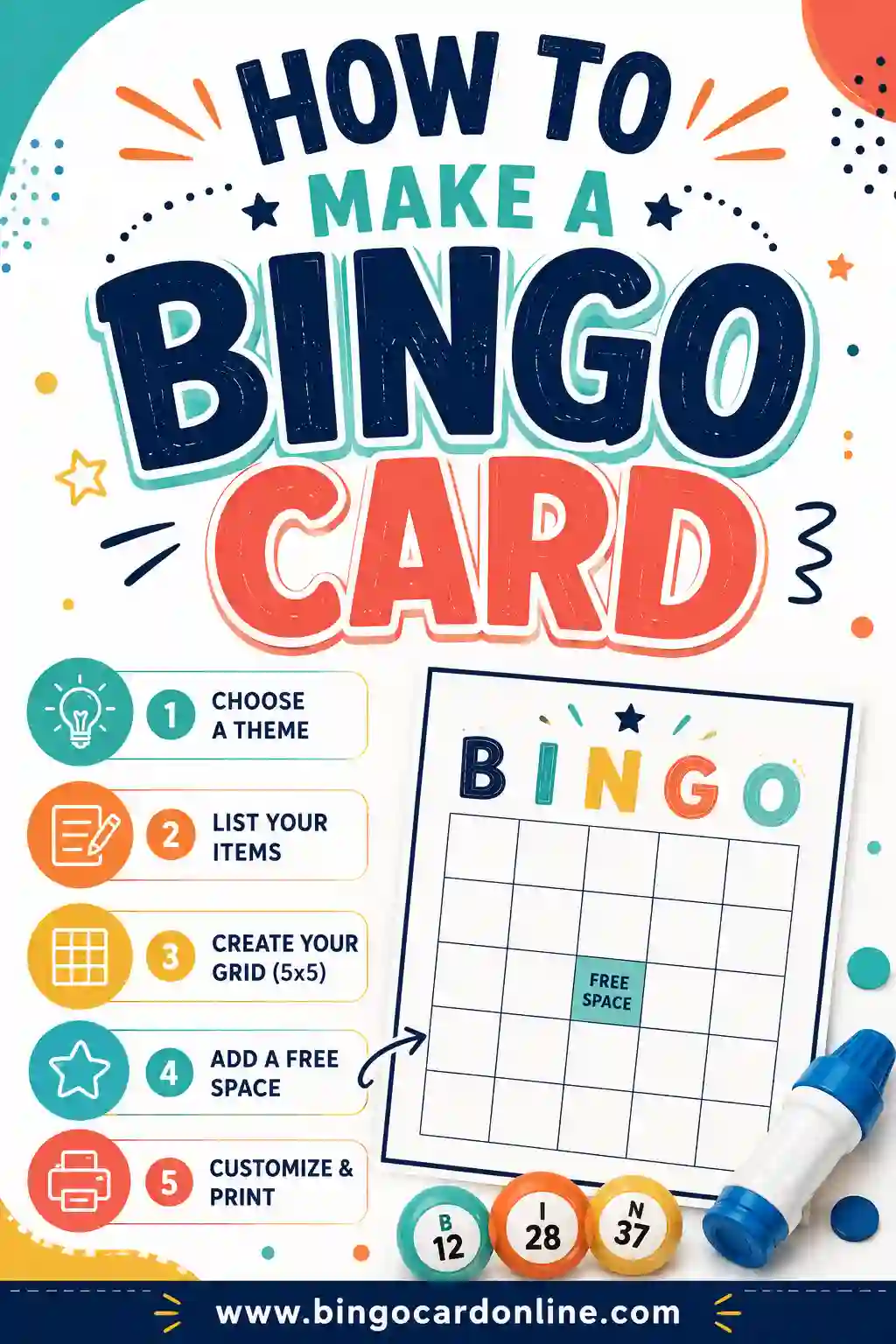
A bingo card is just a grid of squares. Each square holds one item: a number, a word, or a small picture. The classic version is a 5x5 grid with a free space in the middle, which gives you 24 filled squares plus that automatic center mark.
You're not stuck with numbers, though. People make bingo cards out of almost anything:
- Words for themed games (holidays, parties, classroom units)
- Numbers for the traditional 1-to-75 style
- Pictures for kids who can't read yet
- Phrases for "spot it" games, like movie bingo or road-trip bingo
The only real rule is that each square is different, and each card in your stack is laid out differently. That second part is what trips people up when they try to make cards by hand.
The One Thing That Makes Bingo Work
Here's the catch nobody mentions: every card needs a unique layout. If two players have the same arrangement, they'll both hit "Bingo!" at the exact same second, and the game falls flat.
That's why drawing cards by hand is such a pain. To make ten different cards, you'd have to reshuffle the same words ten times and copy them out square by square without making a mistake. It's slow, and it's easy to accidentally repeat a layout.
A generator solves this in one click. You give it a single word list, tell it how many cards you want, and it scrambles the words into a brand-new grid for each one. Ten cards, thirty cards, a hundred cards, all unique, all in a couple of seconds.
How to Make a Bingo Card in 5 Steps
You don't need to be crafty or tech-savvy. Here's the whole process from blank page to printed stack.
- Pick your grid size. 5x5 is standard. Go 4x4 for a quicker game, or 3x3 for little kids.
- Build your word list. You need at least one item per square. For a 5x5, that's 24 words minimum, but 30 or more is better (it makes the cards more varied).
- Drop in a free space. The center square is usually a freebie that every player gets for free. Some games skip it; that's your call.
- Make each card unique. Shuffle your list into a different layout for every player. This is the step a generator handles for you.
- Print and play. Print one card per player plus a few spares, hand out markers, and you're ready.
That's the entire thing. Most people go from "I need bingo cards" to a finished stack in under ten minutes.
Building a Good Word List
Your word list is the heart of the card. A strong list makes the game fun; a weak one makes it confusing. Here's a ready-to-use list of 30 general bingo squares you can copy straight into the generator.
| Easy & Common | Mid-Range | Fun Extras |
|---|---|---|
| Apple | Rainbow | Treasure |
| House | Bicycle | Lightning |
| Star | Umbrella | Volcano |
| Dog | Mountain | Robot |
| Tree | Anchor | Dragon |
| Flower | Compass | Rocket |
| Sun | Lantern | Castle |
| Fish | Feather | Comet |
| Boat | Mushroom | Skeleton |
| Heart | Snowflake | Telescope |
Mix and match across columns for variety. A few tips for picking words:
- Keep them concrete. "Apple" beats "happiness" because players can recognize it at a glance.
- Match your audience. Simple, picture-friendly words for kids; trickier ones for adults.
- Have extras. More words than squares means the generator can make every card feel distinct.
If you're building a themed game instead, swap this generic list for your topic. Holiday words, party moments, classroom vocabulary, song titles, whatever fits.
Picking the Right Grid Size
Bigger isn't always better. The grid you choose changes how long the game runs and who can keep up.
| Grid | Squares to fill | Best for |
|---|---|---|
| 3x3 | 8 (+ free space) | Toddlers and very short games |
| 4x4 | 15 (+ free space) | Kids and quick rounds |
| 5x5 | 24 (+ free space) | The classic, works for most groups |
A 5x5 is the default for a reason: it's long enough to build suspense without dragging. Drop to 4x4 when you want a faster game, or 3x3 when you're playing with preschoolers who'd get lost in a bigger grid.
Should you include a free space?
The center free space is a long-standing tradition, and it helps the game move faster since everyone starts with one square already marked. For a casual game, keep it. For a tougher challenge or a "spot it" game, you can drop it and make players earn every square.
Making Bingo Cards by Hand vs. Using a Generator
Both work. Here's the honest comparison so you can pick.
By hand is fine if you only need one or two cards, or you want a craft project with kids. Grab graph paper, draw a 5x5 grid, and fill it in. The downside: making many unique cards is tedious and error-prone.
A generator wins the moment you need more than a couple of cards. You enter your list once, and it produces a full set of unique cards instantly. You also get clean grids, consistent sizing, and a tidy printout. For a classroom, a party, or any group, it's the obvious choice.
A few things a good generator does for you automatically:
- Shuffles words into a different layout per card
- Adds the free center space
- Sizes squares evenly so the print looks neat
- Lets you pick 3x3, 4x4, or 5x5 without redrawing anything
Printing Tips for Cards That Last
Once your cards are made, a few small choices make them look sharp and survive game night.
- Use cardstock if you can. It holds up to repeated use and feels nicer than thin paper.
- Print a test card first. Check the margins so you don't end up with cut-off squares on a full stack.
- Black and white saves ink. The cards read clearly without color, and kids can color them in as a bonus.
- Laminate or use sleeves for reuse. Players mark with dry-erase markers, then you wipe the cards clean.
- Go bigger for little hands. A 3x3 or 4x4 grid leaves more room per square, which helps young kids.
What to use as markers
No special supplies needed. Any of these work:
- Dried beans, buttons, or coins
- Candy pieces (a hit with kids)
- A pen or crayon to cross squares off
- Bingo daubers, if you've got them
Common Mistakes to Avoid
A few easy slip-ups can flatten an otherwise fun game.
- Too few words. With exactly 24 words for a 5x5, every card ends up nearly identical. Aim for 30 or more.
- Identical layouts. If you reuse the same arrangement, multiple players win at once. Always vary the layout.
- Hard-to-read words. Abstract terms like "joy" are tough to spot. Stick to concrete things.
- One size for all. A 5x5 overwhelms toddlers. Run a smaller grid for the youngest players.
- No master list. As the caller, keep a record of what you've called so you can verify the winner.
Avoid those five, and your game will run smoothly from the first call to the final "Bingo!"
Frequently Asked Questions
How do I make a bingo card for free?
Use a free bingo card generator. Enter your word list, pick a grid size, choose how many cards you want, and print. There's no cost, no sign-up, and no software to install. You can also draw one by hand on graph paper if you only need a single card.
How many words do I need to make a bingo card?
For a 5x5 card you need at least 24 words (the center is a free space). For 4x4 you need 15, and for 3x3 you need 8. Always aim for a few more words than the minimum so each card in your stack comes out different.
What size should a bingo card be?
The classic bingo card is a 5x5 grid with a free center space. Use 4x4 for a faster game or 3x3 for young children. Print at standard letter size so the squares stay big enough to read and mark easily.
Can I make bingo cards with pictures instead of words?
Yes. Picture cards are perfect for kids who can't read yet. Use simple, recognizable images, one per square, and keep the grid small (3x3 or 4x4) so non-readers can follow along.
How do I make every bingo card different?
Shuffle your word list into a new layout for each card. A generator does this automatically: it rearranges the same words into a fresh grid for every player, so no two cards match. Doing it by hand is slow and easy to mess up.
Do bingo cards need a free space in the middle?
No, but it's a common tradition. The free center space speeds up the game since everyone starts with one square marked. For a tougher game, you can leave it out and make players fill every square.
Ready to Make Your Bingo Cards?
Grab the word list above, open the free bingo card generator, and you'll have a stack of unique, printable cards in minutes. It's free, there's no sign-up, and every card comes out different. Once you've got the hang of it, try a themed set like birthday party bingo, music bingo, or baby shower bingo. Happy playing, and may the first "Bingo!" be yours.