Division Bingo: Free Printable Cards for Division Facts
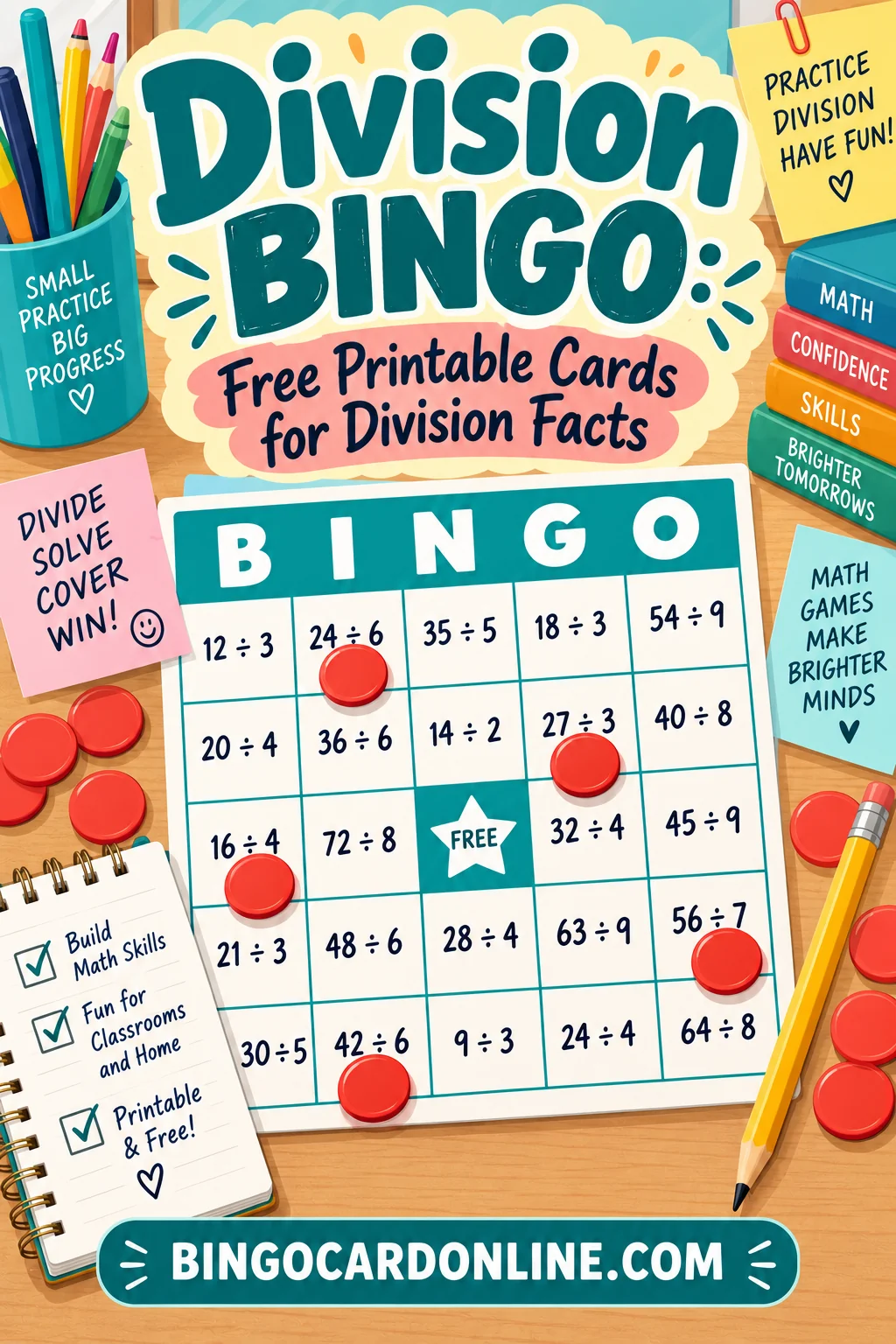
Division bingo works exactly like the multiplication version until you sit down to build the cards, and then it falls apart, because every basic division fact has an answer between 1 and 12 and there are only twelve of those. Twelve possible squares will not fill a 5x5 card, and a card built carelessly hands one player three wins off a single square.
Below is the full fact bank sorted by difficulty, the repeated-quotient trap and how to design around it, and the three ideas students get wrong: remainders, dividing by zero, and the inverse link to multiplication.
The Answer Pool Problem
In the standard fact table, dividends run up to 144 and divisors run 1 through 12, and every quotient is a whole number from 1 to 12. That is the entire answer pool: twelve values. A 4x4 card needs sixteen squares and a 5x5 needs twenty-four, so neither fills without repeating.
Division has three escapes.
Widen the dividends. Allow dividends past 144 and quotients climb well past 12. Dividing 174 by 6 gives 29. A pool running into the twenties and thirties fills a 5x5 card comfortably.
Use remainders as part of the answer. The answer "7 r3" is a different square from "7 r1" and from plain 7. Remainders turn a pool of twelve into a pool of hundreds, and they are the most useful expansion here.
Put the problem on the card and call the answer. Squares read 56 ÷ 7 rather than 8, giving as many distinct squares as there are facts. It has its own trap, covered below.
The Fact Bank, Grouped by Difficulty
Use these as your call lists. Every quotient here is exact.
Easy: divisors 2, 5, and 10
These come from skip counting the child already knows, and they are where a first division bingo game should start. Read a row as a fact: 4 ÷ 2 = 2, and 90 ÷ 10 = 9.
| Answer | ÷ 2 | ÷ 5 | ÷ 10 |
|---|---|---|---|
| 2 | 4 | 10 | 20 |
| 3 | 6 | 15 | 30 |
| 4 | 8 | 20 | 40 |
| 5 | 10 | 25 | 50 |
| 6 | 12 | 30 | 60 |
| 7 | 14 | 35 | 70 |
| 8 | 16 | 40 | 80 |
| 9 | 18 | 45 | 90 |
| 10 | 20 | 50 | 100 |
| 12 | 24 | 60 | 120 |
Medium: divisors 3, 4, and 6
The 4s follow from halving twice and the 6s from doubling the 3s. Say that out loud during the game and half the class picks it up.
| Answer | ÷ 3 | ÷ 4 | ÷ 6 |
|---|---|---|---|
| 2 | 6 | 8 | 12 |
| 3 | 9 | 12 | 18 |
| 4 | 12 | 16 | 24 |
| 5 | 15 | 20 | 30 |
| 6 | 18 | 24 | 36 |
| 7 | 21 | 28 | 42 |
| 8 | 24 | 32 | 48 |
| 9 | 27 | 36 | 54 |
| 10 | 30 | 40 | 60 |
| 12 | 36 | 48 | 72 |
Hard: divisors 7, 8, 9, and 12
These decide whether a student is fluent. They have no easy skip-counting pattern, their dividends are unfamiliar, and 7 and 8 are the two divisors most children guess at.
| Answer | ÷ 7 | ÷ 8 | ÷ 9 | ÷ 12 |
|---|---|---|---|---|
| 2 | 14 | 16 | 18 | 24 |
| 3 | 21 | 24 | 27 | 36 |
| 4 | 28 | 32 | 36 | 48 |
| 5 | 35 | 40 | 45 | 60 |
| 6 | 42 | 48 | 54 | 72 |
| 7 | 49 | 56 | 63 | 84 |
| 8 | 56 | 64 | 72 | 96 |
| 9 | 63 | 72 | 81 | 108 |
| 10 | 70 | 80 | 90 | 120 |
| 12 | 84 | 96 | 108 | 144 |
If you only have time to drill one column, drill the 7s. Seven has the fewest patterns to lean on and it shows up constantly in later work with fractions.
Challenge: division with remainders
Write the answer as quotient and remainder together on the card: 3 r2, not 3.
| Problem | Answer | Problem | Answer |
|---|---|---|---|
| 17 ÷ 5 | 3 r2 | 29 ÷ 3 | 9 r2 |
| 19 ÷ 4 | 4 r3 | 38 ÷ 9 | 4 r2 |
| 23 ÷ 4 | 5 r3 | 45 ÷ 6 | 7 r3 |
| 30 ÷ 7 | 4 r2 | 47 ÷ 6 | 7 r5 |
| 50 ÷ 8 | 6 r2 | 61 ÷ 7 | 8 r5 |
| 75 ÷ 8 | 9 r3 | 100 ÷ 9 | 11 r1 |
Challenge: two-digit divisors
For students who have the tables and need the long-division procedure instead.
| Problem | Answer | Problem | Answer |
|---|---|---|---|
| 176 ÷ 11 | 16 | 240 ÷ 15 | 16 |
| 195 ÷ 13 | 15 | 252 ÷ 18 | 14 |
| 168 ÷ 14 | 12 | 285 ÷ 19 | 15 |
| 224 ÷ 16 | 14 | 306 ÷ 17 | 18 |
Repeated Quotients, and the Square That Wins Three Times
This is the design trap that ruins a division bingo game, and almost nobody sees it coming.
Every quotient from 1 to 12 is produced by twelve different facts, one per divisor. The answer 6 alone comes from 6 ÷ 1, 12 ÷ 2, 18 ÷ 3, 24 ÷ 4, 30 ÷ 5, 36 ÷ 6, 42 ÷ 7, 48 ÷ 8, 54 ÷ 9, 60 ÷ 10, 66 ÷ 11 and 72 ÷ 12.
Now picture a call list containing 12 ÷ 2, then 42 ÷ 7, then 60 ÷ 10. All three land on the same square: the first marks it and the next two do nothing. Three calls burned on one square, and the student whose card is thick with 6s wins on a fraction of the work.
Three rules keep it clean.
One quotient per call list. If the card holds answers, your forty calls should contain each answer value at most once.
If answers repeat on the card, say what a call marks. A small pool forces repeats. Decide before the first call whether "six" marks every 6 on the card or one of the player's choosing. Marking every copy is faster and more fun; marking one is fairer in a prize game.
Never let a repeated square sit in two win lines. If a 6 appears twice on a 4x4 card and both copies sit in the same row, that row is half finished on one call. Scatter duplicates across rows, columns and diagonals, which a randomizing generator does for you and hand-drawing rarely does.
Building a Card That Fits the Pool
Match the card to the answer range.
| What you are practicing | Distinct answers | Card size | Win condition |
|---|---|---|---|
| Divisors 2, 5, 10 only | 12 or fewer | 3x3 | Blackout |
| Whole 1-12 table, answers on the card | 12 | 3x3, or 4x4 with repeats | Line |
| Whole table, problems on the card | 100+ | 5x5 | Line |
| Division with remainders | Very large | 4x4 or 5x5 | Line |
| Two-digit divisors | Large | 4x4 | Line |
| Dividends past 144 | 30 or more | 5x5 | Line, then blackout |
The middle row is the interesting one. Putting the problem on the card and calling the answer gives a hundred distinct squares immediately, the cleanest way to reach a 5x5. The catch mirrors the repeated-quotient problem: calling "eight" marks every square whose problem equals 8, possibly four at once. Build those cards so no card holds more than two problems with the same answer.
Zero, One, and the Rules Students Get Wrong
Put these in the game deliberately, because a game is a better place to meet them than a test.
Zero divided by anything is zero. 0 ÷ 7 = 0. There are no groups to make, so the answer is nothing.
Anything divided by zero is undefined. Not zero, not one, and not "you can't do it because it's too hard." No number multiplies by 0 to give 6, which is why the question has no answer. For a memorable round, put a square reading "undefined" on the card and call 6 ÷ 0 once. The argument that follows is the lesson.
Anything divided by itself is one, so 9 ÷ 9 = 1, and anything divided by one is itself, so 9 ÷ 1 = 9. Those two make the answer 1 unusually crowded, since all twelve self-division facts produce it. One square holding 1 is fine; two on the same card is a mistake.
The Inverse Relationship, Played as a Round
Division is multiplication run backward, and the fastest way to fix a shaky division fact is to attack it from the multiplication side. Run a round where each square holds a three-number family written as a trio, like 6, 7, 42. The caller reads any of the four facts that family generates, and students mark the family rather than an answer:
6 × 7 = 42 | 7 × 6 = 42 | 42 ÷ 6 = 7 | 42 ÷ 7 = 6
A student who freezes on 42 ÷ 7 but knows 6 × 7 has to notice they are the same fact. The trio format also solves the pool problem, because there are far more families than quotients. A ready set of twelve for a 3x3 or 4x4 card: 3-4-12, 4-6-24, 3-9-27, 5-7-35, 6-6-36, 4-9-36, 6-7-42, 7-7-49, 7-8-56, 8-8-64, 8-9-72, 9-9-81.
A harder variation is the missing-divisor call: "Fifty-six divided by what makes eight?" Students mark 7-8-56. Those are noticeably harder than plain division and worth two or three calls a round.
Which Dividends Do the Most Work
A few dividends carry a lot of the table. Within the 1-12 facts, 24 divides evenly by 2, 3, 4, 6, 8 and 12; 36 by 3, 4, 6, 9 and 12; and 48, 60 and 72 carry four facts apiece. Those are your most efficient calls and your most confusing squares, since a student who hears "seventy-two divided by" has four answers waiting. A two-minute "what can we divide 72 by?" warm-up pays for itself, and it shows the class without a speech that the divisor decides the answer.
Running the Game
Division takes longer to compute than addition, so pace it slower than you think.
| Task | Grade | Seconds per call |
|---|---|---|
| Divisors 2, 5, 10 | 3 | 15-20 |
| Divisors 3, 4, 6 | 3 | 20-25 |
| Divisors 7, 8, 9, 12 | 4 | 25-35 |
| Division with remainders | 4 | 35-45 |
| Two-digit divisors | 5-6 | 60-90 |
Two habits matter more than the timing. Write each problem on the board as you say it and leave the last five visible, so a student still working on call ten can catch up rather than quit. And verify every win by asking the winner to state one full fact behind a marked square, which stops a fast marker beating a strong mathematician.
Paste any of the fact banks above into the free bingo card generator to print a class set in 3x3, 4x4 or 5x5, with every card different, repeated entries allowed for small pools, and a matching call sheet for checking wins.
Variations Worth Running
- Word problem round. "Thirty-two cookies shared among eight children." Same fact, but it forces students to decide which number is the divisor, which is where division word problems go wrong.
- Remainder-only bingo. Cards hold just the remainders, 0 through 8. A tiny pool, so use a 3x3 card and blackout. It drills the part of long division students rush.
- Fact-family blackout. Trio cards, and a family is marked only once all four of its facts have been called. Nothing teaches the inverse relationship harder.
- Estimate first. The caller reads 174 ÷ 6 and students mark the nearest answer on their card before working it out exactly.
Frequently Asked Questions
What should go in the squares, the problems or the answers? Answers, for younger students, because a card of problems means solving sixteen expressions while scanning and the fastest reader wins. Switch to problems in the squares once you need a 5x5, since an answer pool of 1 through 12 cannot fill one.
How do I stop one square being marked by three different calls? Include each answer value only once in your call list. The answer 6 can be reached by twelve different facts, so a list containing 12 ÷ 2, 42 ÷ 7 and 60 ÷ 10 spends three calls on a single square while the rest of the card sits untouched.
Which division facts are hardest? The 7s and 8s, followed by the 12s. They have no simple skip-counting pattern, and dividends like 56, 63, 72 and 96 are unfamiliar enough that students guess rather than recall. Give those divisors their own round.
How do I handle dividing by zero if a student asks? Say it has no answer, and show why: division asks what number times the divisor gives the dividend, and no number times 0 gives 6. Zero divided by a number is fine and equals zero, which is the distinction worth drawing on the board.