Hardway Bingo: The No-Free-Space Rule Explained
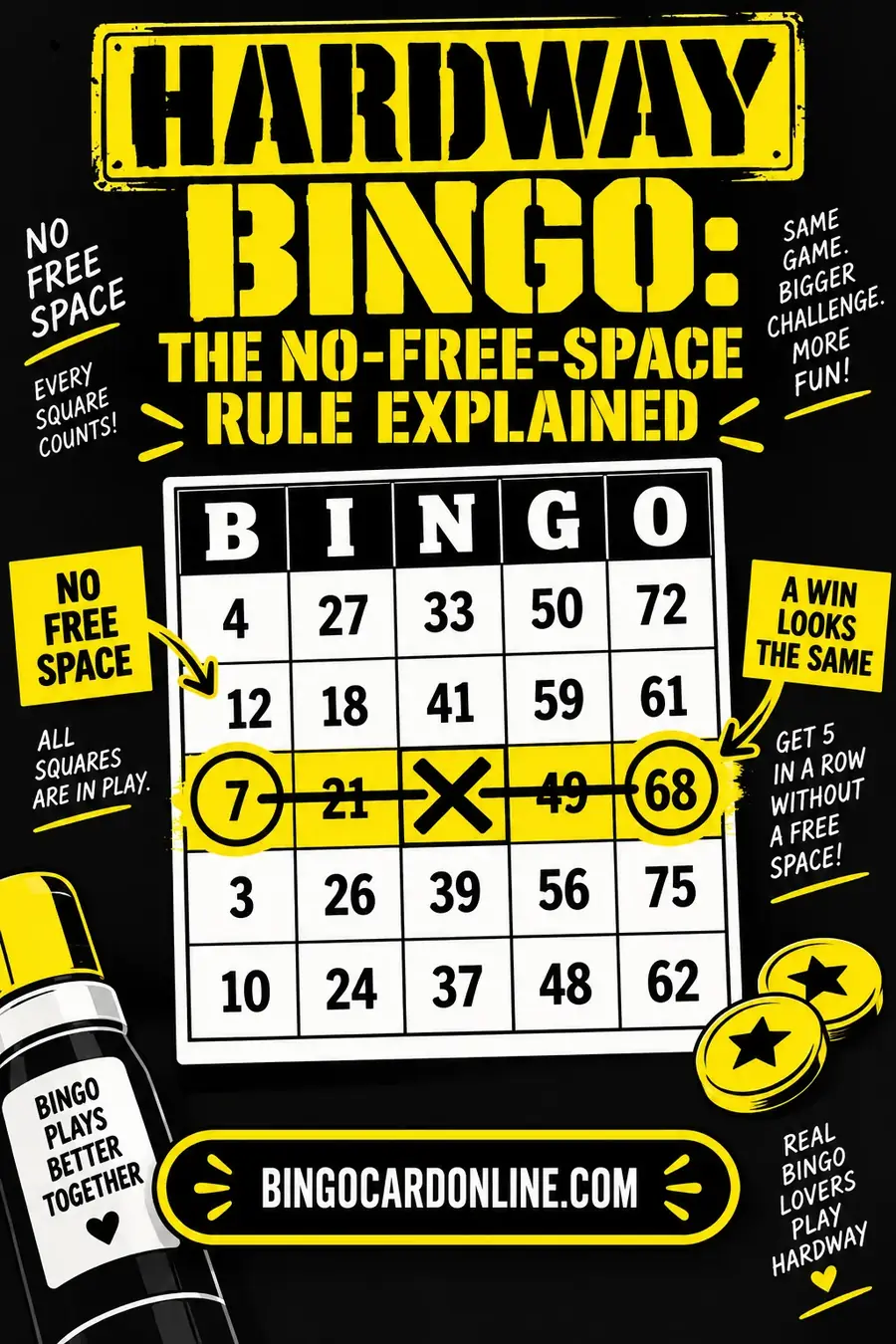
A "hardway" bingo is a straight line of five called numbers with no free space involved. In standard play, the middle row, middle column and both diagonals pass through the free center square, so they only need four actual calls. A hardway win requires all five squares to have been genuinely called — which means it can only be one of the eight lines that avoid the center.
The rule exists to make a line worth more, and it's a staple of bingo halls that want a harder mid-session game without changing anything about the cards.
The Rule in One Line
Any of the eight lines that don't pass through the center. That's the four outer rows (top, second, fourth, bottom) and the four outer columns. The middle row, middle column and both diagonals are excluded, because they'd use the free space.
Some halls state it as "five numbers, no free space." Same thing.
Why It's Harder
| Standard line | Hardway line | |
|---|---|---|
| Eligible lines | 12 | 8 |
| Called numbers needed | 4 or 5 | Always 5 |
| Free space helps | On 4 of 12 lines | Never |
Two effects stack: you have fewer lines available to win on, and each of them needs the full five calls. In practice a hardway game runs noticeably longer than a standard line game on the same cards — which is exactly the point when a hall wants to stretch a session or justify a larger prize.
When to Call It
As a mid-session escalation. A common structure is standard lines early, hardway in the middle, blackout to finish. The difficulty ramps and the prizes ramp with it.
When prizes are larger. A harder win makes a bigger payout feel earned rather than arbitrary.
When a game is running too short. If your cards or number pool are producing wins in eight calls, hardway is the quickest correction that doesn't require reprinting anything.
When you have experienced players. Hardway is a poor fit for a first game with a new group, because the extra rule needs explaining and the longer game tests patience before anyone's invested.
How to Announce It
Say it clearly before the first call, and say what's excluded:
"This game is hardway bingo. Five in a row, no diagonals, no middle row, no middle column — the free space doesn't count. Outer rows and outer columns only."
Then repeat it at least once mid-game. The single most common dispute in hardway play is a player calling bingo on a diagonal out of habit, having genuinely forgotten. Repeating the rule prevents an awkward moment rather than resolving one.
Have the winning lines visible. A small diagram at the front showing the eight valid lines shaded and the four invalid ones crossed out settles almost every question without a conversation.
Related Variations
Hardway blackout. Every square except the free space. Barely different from a standard blackout, since a blackout needs everything anyway — mostly a naming quirk.
No-free-space cards. Rather than restricting which lines count, print cards with a real number in the center. Every line then needs five calls and all twelve lines stay eligible. This is a cleaner design if you're printing fresh cards, and it's what most educational sets do — see the bingo free space for why classroom cards usually skip it.
Hardway with a wild number. Some halls soften it by declaring one number wild after a set number of calls. Keeps the difficulty but caps the game length.
Prize Structure That Fits
If you're running an event, hardway pairs naturally with a tiered structure:
| Game | Win condition | Relative prize |
|---|---|---|
| 1-2 | Any line | Small |
| 3 | Four corners | Small-medium |
| 4 | Hardway line | Medium |
| 5 | Postage stamp or letter pattern | Medium |
| 6 | Blackout | Largest |
The point is that the escalation is visible to players. A hardway game announced as harder, with a visibly better prize, feels like a step up. The same game announced without explanation just feels slow.
Running It Smoothly
Keep a called-number record. Non-negotiable for verifying a hardway win, since you're checking five specific squares against the call list.
Verify by reading back the numbers, not by glancing at the card. "Read me your five" catches both honest mistakes and miscounts.
Expect a longer game and plan the session around it. A hardway game can take half again as long as a standard line game. If you have a fixed room booking, that matters.
Consider a consolation line prize. Because hardway games run long, a small prize for the first standard line — announced as not ending the game — keeps energy up while the hardway win is still out there.
If you're printing a set for an event, a bingo card generator can produce cards with or without a free center, which is worth deciding before you print rather than working around afterwards.
The Eight Valid Lines, Precisely
Worth listing explicitly, because "no lines through the center" is easy to state and easy to misapply in the moment.
Valid (eight): - Row 1 (top), Row 2, Row 4, Row 5 (bottom) - Column B, Column I, Column G, Column O
Not valid (four): - Row 3 (middle) — passes through the center - Column N (middle) — passes through the center - Both diagonals — both pass through the center
The pattern to hold: the middle row, the middle column, and both diagonals are out. Everything on the outside is in.
A small diagram at the front of the room showing the eight valid lines shaded and the four invalid ones crossed through resolves nearly every question without a conversation. Producing one takes two minutes and saves the argument that otherwise arrives around call forty.
Running a Session That Escalates
Hardway works best as one step in a structured session rather than as a standalone game.
| Game | Win condition | Difficulty | Prize weight |
|---|---|---|---|
| 1 | Any line | Easy | Small |
| 2 | Any line | Easy | Small |
| 3 | Four corners | Medium | Small-medium |
| 4 | Hardway line | Harder | Medium |
| 5 | Letter or shape pattern | Medium-hard | Medium |
| 6 | Blackout | Hardest | Largest |
The escalation needs to be visible to players to work. A hardway game announced as harder, with an obviously better prize, feels like a step up and generates real tension. The same game announced without explanation just feels slow, and players who don't understand why nobody is winning get restless.
Say the difficulty out loud when you announce it: "This one's harder — hardway, no free space, and the prize is bigger to match."
Managing the Longer Game
Expect roughly half again the length of a standard line game on the same cards. If your session has a fixed end time, budget for it rather than discovering it.
Add a consolation line prize. Announce that the first standard line wins a small prize but does not end the game. It gives the room a moment of energy partway through a long stretch, and it costs almost nothing.
Keep the call pace up. Long games sag if the caller slows down. If anything, speed up slightly during the middle stretch and slow again when cards get close.
Watch for near-misses aloud. "Someone's close" is a legitimate energy tool during a long game, and it's true often enough to be honest.
Have a hard stop rule. If a hardway game is genuinely running past reasonable — say sixty calls with no winner — most halls will convert it to any-line and award the next winner. Decide this before you need it.
Where the Term Comes From
"Hardway" is borrowed from dice gaming, where rolling a pair — two threes for a six, rather than a four and a two — is called making the number "the hard way." The sense carried over into bingo halls to describe a win achieved without the assistance the free space provides.
The term is used inconsistently across venues. Some halls use it strictly for straight lines avoiding the center; others use it loosely for any pattern that doesn't use the free space, including corners and shapes. A few use it for any game where the free space is declared void entirely.
Because of that variation, always state the rule rather than relying on the label. Saying "hardway" to a room that knows a different definition than yours produces exactly the dispute you were trying to avoid.
Other Ways to Make a Game Harder
Hardway is one lever among several, and it's worth knowing the alternatives.
No free space on the card. Print a real number in the center. All twelve lines stay valid but each needs five calls. Cleaner than hardway and requires a reprint.
Pattern play. Four corners, postage stamp, letters, shapes. Difficulty varies widely by pattern and it's more visually interesting than a straight line.
Blackout. Every square. The standard hardest game and usually the session finale.
Double bingo. Two lines on the same card. Roughly doubles the length and is easy to explain.
Number restriction. Only numbers in specific columns count toward a win. Unusual and genuinely confusing for most rooms.
Speed variations. Faster calling rather than harder win conditions. Different kind of difficulty, and it suits experienced players.
Of these, pattern play is usually the better choice than hardway for a casual room, because it's visual and self-explanatory. Hardway earns its place in halls where players already know the conventions.
Verifying a Hardway Win
The verification step matters more here than in a standard game, because the win condition is restrictive and mistakes are common.
Ask which line they're claiming before looking at the card. A player who says "the middle row" has misunderstood the rule, and you've established that in one question rather than after a two-minute check.
Read the five numbers back aloud against your called-number record. Not glance at the card — read each number and confirm it against the list.
Check the line is one of the eight valid ones. Top, second, fourth or bottom row; B, I, G or O column. If it involves the center square in any way, it isn't a hardway.
Confirm the free space isn't part of the claim. Players occasionally count the free space toward an outer line by miscounting rows.
Announce the verification result clearly either way. A quiet "no, sorry" mid-room produces confusion; a clear "that's the middle row, which doesn't count in this game — we're still playing" keeps everyone informed.
If two players call simultaneously, verify both fully before awarding anything. Deciding a tie after announcing one winner is considerably worse than taking an extra minute.
Hardway and the American Bingo Tradition
Hardway belongs to american bingo specifically — the 75-ball, 5x5, letter-and-number format played in US halls. It does not exist in the 90-ball game common in the UK and much of Europe, because a 90-ball ticket has no free space and no center square to avoid. Every line there already needs its full complement of numbers, so there is nothing for the rule to restrict.
That matters if you're calling for a mixed or international group. Players who learned on 90-ball tickets have never heard the term, and announcing "hardway" communicates nothing to them. State the rule instead: five called numbers in a straight line, no diagonals, no middle row, no middle column.
It is the oldest bingo with a twist still in regular use. Most variations change the card, the pattern or the calling. Hardway changes none of those — same cards, same numbers, same caller — and only restricts which completed line you're allowed to claim. That's why halls keep reaching for it. Any bingo with a twist that requires reprinting a set costs money and preparation time; this one costs a single sentence before the first call.
Frequently Asked Questions
What does hardway mean in bingo? A hardway bingo is a straight line of five numbers that were all actually called, without using the free space. That restricts wins to the eight rows and columns that don't pass through the center square.
Do diagonals count in hardway bingo? No. Both diagonals pass through the center free space, so they're excluded. Only the four outer rows and four outer columns are eligible.
Is hardway bingo the same as playing without a free space? Similar in effect but not identical. Hardway keeps the free space printed on the card and simply disallows lines that use it, leaving eight eligible lines. Cards printed without a free space have a real number in the center, so all twelve lines stay eligible but each needs five calls.
How much longer does a hardway game take? Meaningfully longer — fewer eligible lines and no four-call shortcut. Plan for roughly half again the length of a standard line game on the same cards, though it varies with the size of the group.