Mini Bingo
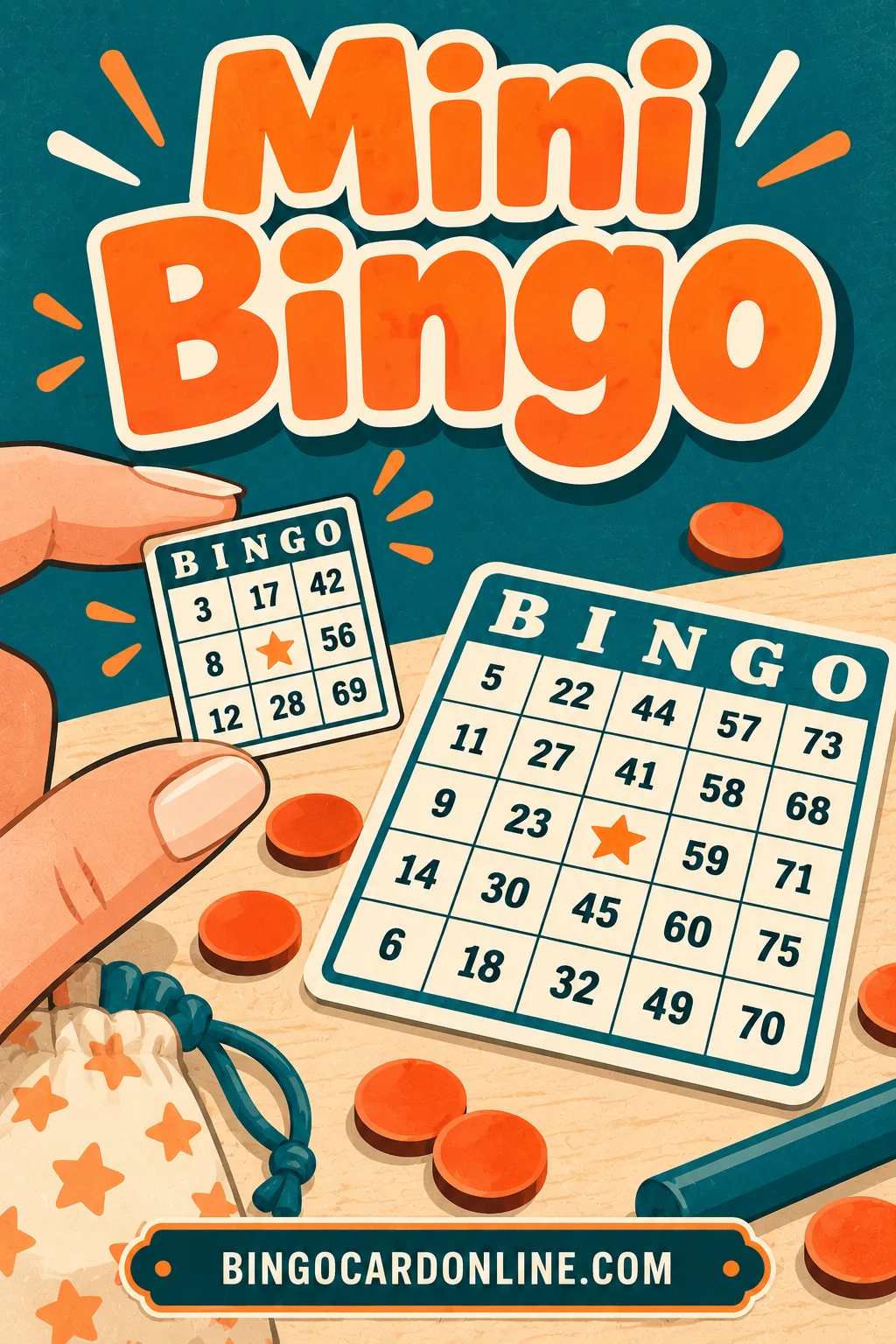
Mini bingo is a short round played on a small grid, usually nine squares, that produces a winner in a few minutes instead of the twenty or thirty a full card takes. It is the version you reach for when the time is borrowed rather than scheduled: the last stretch of a class, a table waiting on food, the back seat on a long drive, or a party where nobody is going to sit still for a full house.
The change is not really about the grid. It is about what the game feels like to play. On a full card, a player marks a few squares, settles in, and waits. On a mini card, every single call is live, because with nine squares any call can be the one that finishes a line. That difference is the whole reason mini bingo exists, and it is why the format works for some groups and falls flat for others.
What Is Bingo, and What Makes a Round Mini
Bingo is a matching game. Every player holds a grid of items. A caller draws items one at a time from a pool and announces them, players mark any square that matches, and the first player whose marked squares complete an agreed pattern calls out and wins. The pattern is usually a line, sometimes the four corners, sometimes the whole card.
That is the entire game, and nothing in it specifies a size. The 5x5 card most people picture is a convention of hall bingo, not a rule. Shrink the grid and the same game becomes a different experience: fewer squares to track, fewer calls to a win, and a much shorter attention span required from everyone at the table.
Three things get shorter at once when a game goes mini, and they compound:
Fewer squares to fill. Nine instead of twenty-four means a line is three marks, not five.
A smaller pool to draw from. A mini game usually pulls from a smaller item list too, so the odds of any single call matching a given card go up sharply.
Less verification. Reading back three marked squares takes seconds. Checking a full house on a 5x5 card in a noisy room takes considerably longer, and it happens in front of an audience that has stopped playing.
Stack those together and a mini round finishes in the time it takes a standard game to warm up.
What a Mini Round Actually Feels Like
The tension arrives immediately and never lets go, which is the opposite of a standard game.
In a normal round the first several calls are dead air. Nobody is close, nobody is watching anybody else, and the room is quietly chatting. The game becomes interesting somewhere in the middle, when a few players get within one square.
A mini round has no middle. The third call can put someone on the edge of a win. By the fifth, several players are one square away and everyone knows it, because on a nine-square card you can see your own position at a glance without counting. Players start leaning over to look at each other's cards, which almost never happens in a full game.
That has consequences worth planning for. Mini bingo is loud, it is fast, and it produces near-misses constantly, which is where the fun lives. It also produces ties, which is where the trouble lives, and the next section is about that.
Duplicate Winners: The One Thing to Plan For
With nine squares and a small item pool, two people can genuinely hold very similar cards, and simultaneous wins stop being rare.
This is not a flaw to be engineered away. It is arithmetic. The number of meaningfully different nine-square cards you can build from a small pool is limited, and the smaller the pool, the more overlap there is between any two cards. Pull twelve items for nine squares and every card in the room shares most of its content with every other card.
| Item pool | Grid | What happens |
|---|---|---|
| 12 items | 3x3 | Heavy overlap, frequent ties, very fast rounds |
| 20 items | 3x3 | Comfortable variety, occasional ties |
| 30 items | 3x3 | Good spread, ties uncommon, slightly longer rounds |
| 20 items | 4x4 | Tight, ties likely |
| 40 items | 4x4 | Balanced mid-length game |
The practical fix is to write at least twice as many items as you have squares, and ideally three times. Twenty to thirty items for a nine-square card gives real variety without making the round long. Under about fifteen, accept that ties are part of the game and decide in advance how you will handle them.
Three ways to handle a tie, all fine as long as you say which one before you start:
Everybody wins. Simplest, and correct for children and for classroom play, where the point is participation rather than a single prize.
First voice wins. Standard in a competitive room. It rewards attention, which is arguably the skill the game tests.
Play on to the next pattern. Tied players keep going, first to a second line or a blackout takes it. This is the most satisfying option when there is a single prize, and it takes about a minute.
When a Mini Game Is the Right Call
Any time you have fewer than fifteen minutes, or a group that will not hold still for longer.
The last ten minutes of a class. Long enough to run two full rounds, short enough that it does not eat into the lesson. Vocabulary, sight words, math facts, and country flags all fit nine squares comfortably.
Restaurants and waiting rooms. A nine-square card fits on a small piece of paper and does not need a table cleared for it. Squares are things to spot, which turns waiting into looking.
Car trips. Road-trip bingo works far better small than large. Nine things to spot out the window is achievable in an hour of driving. Twenty-four is a card that never gets finished and gets abandoned somewhere on the second day.
Young children. This is the strongest case for mini bingo. A three-by-three grid is about the limit of what a four-year-old can scan and track. Give the same child a full card and they will lose their place, mark the wrong square, and stop enjoying it well before anybody wins.
Warm-ups and icebreakers. Nine squares of find-someone-who gets a room mingling in five minutes. A full card of the same thing takes half an hour and people give up at square fifteen.
Party filler. Between courses, while people arrive, or after a main activity has wound down. A round that takes four minutes can be dropped into a gap without restructuring the evening.
Repeat play. Because a round is short, you can run six of them with different themes and it still takes less time than one full game. Variety beats length for most groups.
When It Is the Wrong Call
Mini bingo is a poor fit in three situations, and it is worth being honest about them.
A big room with one prize. Fifty people on nine-square cards will produce several simultaneous winners in the first two minutes. A prize round needs a longer game precisely because length is what separates the field.
A fundraiser or headline event. People who came for bingo came to play bingo. A four-minute round feels like a rehearsal.
When the calling itself is the entertainment. If the caller has jokes, themed calls, and a rhythm going, a short round cuts them off before the routine gets going.
In all three cases the answer is a standard grid, and if you want the middle ground, a 4x4 card gives a game that runs meaningfully longer than nine squares without the commitment of a full house on twenty-four.
Travel-Size Mini Bingo
A travel card has to survive a bag, work on a knee, and be markable without a table. That rules out a few things and suggests a few others.
- Card stock, not copy paper. A card being held rather than laid flat needs to hold its shape.
- Small enough to fit a pocket, big enough to write in. A quarter-sheet with nine squares is roughly the sweet spot.
- Laminate and use a dry-erase pen for anything that will be replayed. One card per child, wiped between rounds, no reprinting.
- Or use a sheet protector if laminating is not available. Same effect, less permanent.
- Skip loose chips in a car. They end up under the seat. Crossing off, a dry-erase mark, or a sticker sheet all work better.
- Print two per page, back to back with different themes. One card, two games.
For spot-it games played out a window, write the squares as categories rather than exact objects. A red truck is findable. A specific model of red truck is not, and one impossible square on a nine-square card blocks two of the three possible lines through it.
Item Pools That Suit Nine Squares
Small grids reward concrete, evenly likely items. On a full card you can carry a couple of unlikely squares without harm, because there are plenty of other routes to a line. On a nine-square card, every square sits on at least two lines, so one dud square does real damage.
Themes that work well small:
- Sight words or a spelling list. Nine words the class is working on this week.
- Number facts. The caller reads the problem, players mark the answer.
- Colors and shapes for the youngest players.
- Things you see on a walk. A bird, something yellow, a mailbox, a dog.
- Sounds in a movie or a game. Works surprisingly well as a quiet-room activity.
- Find someone who, with nine achievable prompts rather than twenty-four increasingly desperate ones.
- Holiday and seasonal items, where the small pool is a feature rather than a limit.
Whatever the theme, read the nine squares out loud before you print. If any square makes you hesitate about whether it will actually come up, replace it.
Running the Round Well
Call slower than you think, mark visibly, and verify out loud. A fast game gets faster if the caller rushes, and then half the table is a call behind and the round is spoiled.
Pace. Leave a real beat between calls. Players on a nine-square card look down, scan, and look up quickly, but small children do not, and neither does anyone holding two cards.
Repeat every call once. In a short game there is no time to recover from a missed call, because there may only be eight calls in total.
Say the pattern before you start, and say it in full: a line across, down, or diagonally, or all nine for a blackout. On a small grid the diagonal question comes up immediately, so answer it before it is asked.
Verify by reading the card back. Player reads their marked squares, caller confirms each against the called list. Fifteen seconds, no argument.
Have the next round ready. The entire advantage of a short game is lost if there is a three-minute pause between rounds while you shuffle papers.
Mini Bingo Variants Worth Knowing
- Blackout only. All nine squares. Removes the line question entirely, runs a bit longer, and every call still matters.
- Two cards each. Doubles the attention required without lengthening the round much. Good for adults who find a single small card too easy.
- Speed round. Caller does not pause. Deliberately chaotic, best with older children who find the normal pace too gentle.
- Team mini bingo. Pairs share one card and have to agree before marking. Turns a solo scan into a conversation.
- Progressive rounds. Round one is a line, round two is a blackout, round three is a blackout with a smaller pool. Each round takes a little longer than the last.
- Player-filled cards. Give out blank nine-square grids and a list of fifteen items, and let each player choose which nine to write. Every card is different, players are invested before the first call, and you skip the randomizing entirely.
That last one is the best trick in small-format bingo. It takes three minutes at the start and it solves the duplicate-card problem without any generating at all.
Free Bingo, Free Online Bingo, and What Those Phrases Return
Searches in this area come in variants that mean different things, and the words are close enough to be confusing. Free bingo, free online bingo, bingo online free, and bingo free online mostly return commercial bingo rooms where the game is played against the house. Those are a different activity from printing nine-square cards for a classroom, and in many places they are regulated as gambling.
The word bingo online has the same split. Sometimes it means a place to play against strangers. Sometimes it means a browser-based caller that draws items for a room full of people holding printed cards. And sometimes it just means a tool for making cards, which is the sense that matters here. A bingo card generator sits in that third category: you supply the item list, it builds the grids, and the actual game happens in front of you with people in it.
If what you want is a small printable card for a group, search the physical words rather than the play words. Mini bingo, 3x3 card, blank grid, and printable template all point at making something. Online bingo points at joining something.
Frequently Asked Questions
How many squares does a mini bingo card have? Nine, in a three-by-three grid, is the usual definition. Some people count a 4x4 card of sixteen squares as mini too, since it is still well short of the standard twenty-five, but nine is what most templates and most printed sets mean by the term.
Should a mini bingo card have a free space? Usually not. On nine squares a free center square sits on four of the eight possible lines, which shortens the game dramatically and makes the diagonals almost automatic. Keep the free space for larger grids where it does not distort the odds so heavily.
How long does a mini round take? Typically three to six minutes from first call to verified winner, depending on how large the item pool is and how fast the caller works. Two full rounds fit comfortably into the last ten minutes of a class, including handing out cards.
How do I stop everyone winning at once? Write two to three times as many items as there are squares, so the cards genuinely differ, and decide your tie rule before the first call. For a single prize, the cleanest option is to let tied players keep going to a second pattern rather than splitting or redrawing.