Picture Frame Bingo: How the Frame Pattern Works
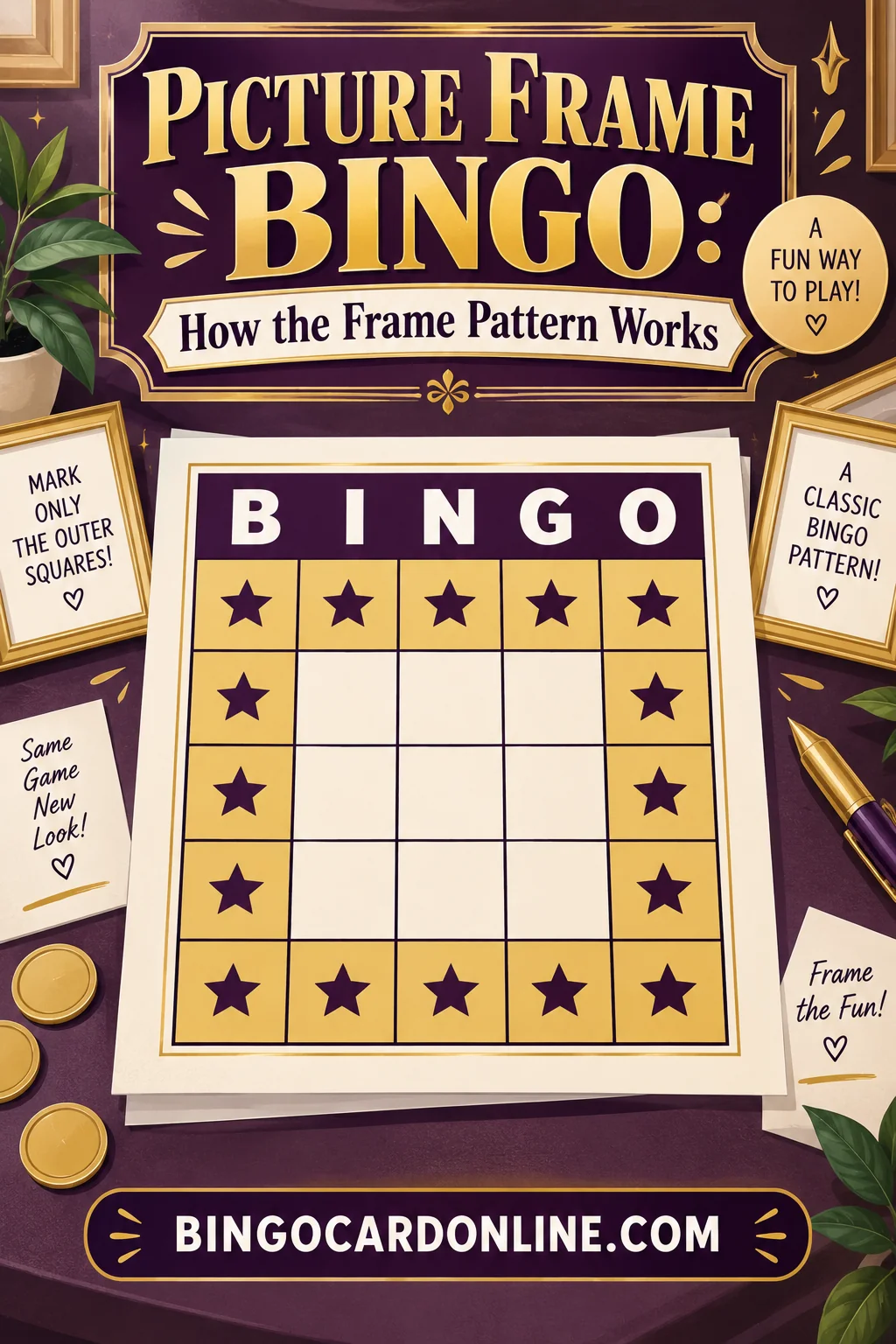
Picture frame bingo is won by covering a ring of squares that surrounds an empty middle, like the frame around a photograph. The catch is that two completely different patterns go by that name, and a caller who does not say which one is in play will end the round arguing.
The big picture frame is the outer border of the card: sixteen squares running all the way around the edge. The small picture frame is the tight ring of eight squares immediately around the free space. Both look like frames, and one takes twice as many squares as the other.
The Big Picture Frame: The Outer Border
The big frame, sometimes just called the outer frame or the border, is every square that touches an edge of the card:
B    I    N    G    O
[X]  [X]  [X]  [X]  [X]
[X]  [ ]  [ ]  [ ]  [X]
[X]  [ ]  FREE [ ]  [X]
[X]  [ ]  [ ]  [ ]  [X]
[X]  [X]  [X]  [X]  [X]
That is sixteen squares. Listed in full:
| Part of the frame | Squares |
|---|---|
| Full B column (left edge) | B1, B2, B3, B4, B5 |
| Full O column (right edge) | O1, O2, O3, O4, O5 |
| Top edge, middle three | I1, N1, G1 |
| Bottom edge, middle three | I5, N5, G5 |
Five plus five plus three plus three is sixteen. The nine squares in the middle, I2 through G4, are not part of the pattern, and neither is the free space sitting in the center of the hole.
The top and bottom edges only contribute three squares each because the corners are already counted in the B and O columns. Callers who list the pattern as "five, five, five, five" and get twenty are making exactly that mistake.
Small Picture Frame Bingo: The Ring Around the Free Space
The small frame is the eight squares that touch the free space, forming a 3x3 block with a hole in the middle:
B    I    N    G    O
[ ]  [ ]  [ ]  [ ]  [ ]
[ ]  [X]  [X]  [X]  [ ]
[ ]  [X]  FREE [X]  [ ]
[ ]  [X]  [X]  [X]  [ ]
[ ]  [ ]  [ ]  [ ]  [ ]
Eight squares, and here they are by name:
| Part of the small frame | Squares |
|---|---|
| Left side of the ring | I2, I3, I4 |
| Right side of the ring | G2, G3, G4 |
| Top and bottom of the ring | N2, N4 |
Note what the N column contributes: only N2 and N4. N3 is the free space in the middle of the ring, and N1 and N5 sit two squares from the center, so they are not in the pattern at all. That is the single most common marking error in small picture frame bingo. Players see "the N column" and daub the whole thing.
The B and O columns contribute nothing. A player holding a card with the entire B column marked has a straight line, not a small frame.
Big Frame or Small Frame: Which One Are You Playing?
Announce it before the first ball. The two patterns share a name and differ by eight squares.
| Big picture frame | Small picture frame | |
|---|---|---|
| Squares needed | 16 | 8 |
| Columns used | B, I, N, G, O | I, N, G only |
| Free space involved | No, it sits in the hole | No, it sits in the hole |
| Corners needed | Yes, all four | No |
| Full columns needed | B and O | None |
| Typical use | Big-prize round late in a session | Mid-session round |
A wording nobody misreads: "Big frame tonight. The whole outside edge of your card, all four corners, all the way around. The middle nine squares do not count." Or: "Small frame. The eight squares that touch the free space, and nothing else."
If you have a board or a projector, put the shape up and leave it up. A diagram is the only thing that reliably stops a player from daubing the wrong ring.
Verifying a Frame Win, Square by Square
Frame patterns are pleasant to verify because the squares sit in a predictable order. Do not read them at random, and do not let the winning player read them to you. Work a fixed route so you never miss one.
Verifying a big picture frame. Read the two full columns first, then the two edge rows:
- B1, B2, B3, B4, B5
- O1, O2, O3, O4, O5
- I1, N1, G1
- I5, N5, G5
Four short bursts, sixteen numbers, checked against your master call sheet. Reading the columns first matters because your call sheet is grouped by letter, so all five B numbers sit in one place on the page.
Verifying a small picture frame. Same idea, three bursts:
- I2, I3, I4
- N2, N4
- G2, G3, G4
Say the letter with every number: "I-24, I-19, I-30. N-38, N-44. G-52, G-47, G-60." A frame verified silently is a frame somebody will argue about.
Two things void a claimed frame: a missing square anywhere in the ring, usually a corner on the big frame or N2 on the small one, and a marked square that was never called. Say "not quite yet" and restart the draw.
Extra marked squares in the middle of the card do not void a frame. The pattern says which squares must be covered, not which must be bare. Players who have been daubing everything as it is called are still eligible, and this comes up every time a frame round follows a coverall.
How Many Calls a Frame Pattern Takes
The frame patterns sit between corners and a full card. Here is the arithmetic rather than a guess.
In 75-ball bingo you draw without replacement from seventy-five numbers. Suppose your card needs k specific numbers. Lay all seventy-five balls out in draw order. Your k targets sit somewhere in that line, and the other 75 minus k balls fall into the k plus 1 gaps around them. Those gaps are equal on average, so the expected number of balls drawn after your last target is (75 minus k) divided by (k plus 1). The expected winning call is therefore:
E = 75 - (75 - k)/(k + 1) = k x 76 / (k + 1)
For the big picture frame, k = 16:
16 x 76 / 17 = 1216 / 17 = 71.5
For the small picture frame, k = 8:
8 x 76 / 9 = 608 / 9 = 67.6
Put those alongside the patterns you would run either side of them:
| Pattern | Squares (k) | Expected winning call |
|---|---|---|
| Four corners | 4 | 60.8 |
| Straight line, no free space | 5 | 63.3 |
| Small picture frame | 8 | 67.6 |
| Big picture frame | 16 | 71.5 |
| Coverall with free space | 24 | 73.0 |
The number that surprises people is the gap between the two frames: halving the squares from sixteen to eight only buys back about four calls. That is the shape of the formula. Once k is large, each extra square costs less and less, because you are already waiting deep into the cage. The same logic means the big frame at 71.5 is only a call and a half quicker than a full coverall, which is worth knowing before you schedule one.
The floor is different, though, and the floor is where the excitement lives. The fastest possible small frame is eight calls, the fastest big frame sixteen. A room of thirty cards produces early frames well ahead of the single-card average, and the small frame in particular can end suddenly.
Where Each Frame Belongs in a Session
Small picture frame is a mid-session pattern. Harder than corners, quick enough that the room stays engaged, and it teaches players to look at position rather than hunting for their number anywhere on the card. Medium prize, about twelve minutes.
Big picture frame is a late, big-prize pattern. At 71.5 calls it runs nearly as long as a coverall, so it should be the second-to-last round at most and never sit next to another long pattern. Fifteen minutes, treated as a headline game.
A running order that spaces them properly:
| Round | Pattern | Budget |
|---|---|---|
| 1 | Straight line | 10 min |
| 2 | Four corners | 10 min |
| 3 | Small picture frame | 12 min |
| 4 | Letter X | 12 min |
| Break | 10 min | |
| 5 | Postage stamp | 10 min |
| 6 | Big picture frame | 15 min |
| 7 | Coverall | 20 min |
Do not run both frames back to back. They look nearly identical on a board, and players who just spent twelve minutes hunting one ring will misread the other.
Frames on 4x4 and 3x3 Cards
Card size changes the pattern in a way worth understanding before you print.
4x4 cards. The outer border is twelve squares: the full first and fourth columns, four each, plus the two middle squares on the top row and the two on the bottom. The four middle squares form a 2x2 hole. There is no small frame on a 4x4, because there is no single center square for a ring to surround.
3x3 cards. Here the two frames collapse into one. The outer border of a 3x3 grid is eight squares and the middle is usually the free space, so the big frame and the small frame are the same eight squares. That collapse is a useful teaching trick: show a class the frame on a 3x3 card first, then hand out 5x5 cards and point out that the same idea now has two possible sizes.
If you are making cards for any of this, the free bingo card generator builds unique 3x3, 4x4, and 5x5 cards in numbers, words, or pictures, with or without a free space, and gives you the master call list you need to verify a sixteen-square frame without guessing.
Frame Variations Worth Running
Double frame. Both rings at once, big and small, on the same card. Twenty-four squares, the same count as a coverall on a free-space card, so it takes about as long as a blackout and should be treated as one.
Broken frame. The outer border minus the four corners, so twelve squares: B2, B3, B4, O2, O3, O4, I1, N1, G1, I5, N5, G5. It looks like a frame with rounded edges and runs a little quicker than the full border.
Frame then coverall. Play the big frame for a first prize, then keep drawing to a full card for the grand prize. The frame's sixteen squares are already part of the coverall, so you get two rounds out of one draw and the room does not lose momentum.
House Rules to Settle Before You Call
Which frame. Say it, show it, and repeat it around ball twenty.
The free space. It sits inside the hole in both patterns, so it never helps and never hurts. State this once, because someone always asks.
Extra marks. Marked squares in the middle do not void a frame.
Late calls. A win must be called before the next number is announced.
Split wins. Two verified frames on the same call split the prize.
Rotation. A rotated card has the same frame, since the outer border of a square maps onto itself.
Common Mistakes
- Saying "picture frame" and nothing else. There are two of them, eight squares apart.
- Daubing the full N column on a small frame. Only N2 and N4 count.
- Counting the border as twenty squares. The corners belong to the side columns and are not counted twice. It is sixteen.
- Treating extra marks as a foul. The pattern lists required squares, not forbidden ones.
- Scheduling the big frame like a short game. At 71.5 calls it needs a coverall-sized slot.
Frequently Asked Questions
What is small picture frame bingo? Small picture frame bingo is a pattern where you cover the eight squares that immediately surround the free space: I2, I3, I4, N2, N4, G2, G3, and G4. The free space in the middle is not part of the pattern, and the B and O columns are not involved at all.
How many squares are in a big picture frame? Sixteen: the full B column and the full O column, five each, plus I1, N1, and G1 on the top row and I5, N5, and G5 on the bottom. The nine squares in the middle of the card are ignored.
Does the free space count toward a picture frame? No, in either version. It sits in the hole at the center of the ring, so it is never a required square. The big frame needs sixteen called numbers and the small frame needs eight, with no help from the middle.
How long does a picture frame game take? On a single card the expected winning call is k x 76 / (k + 1), giving about 71.5 calls for the sixteen-square big frame and about 67.6 for the eight-square small frame. With many cards in play the first winner appears earlier, but the big frame still needs a long slot.