Soccer Bingo: Match-Day Prompts for Fans of Any Age
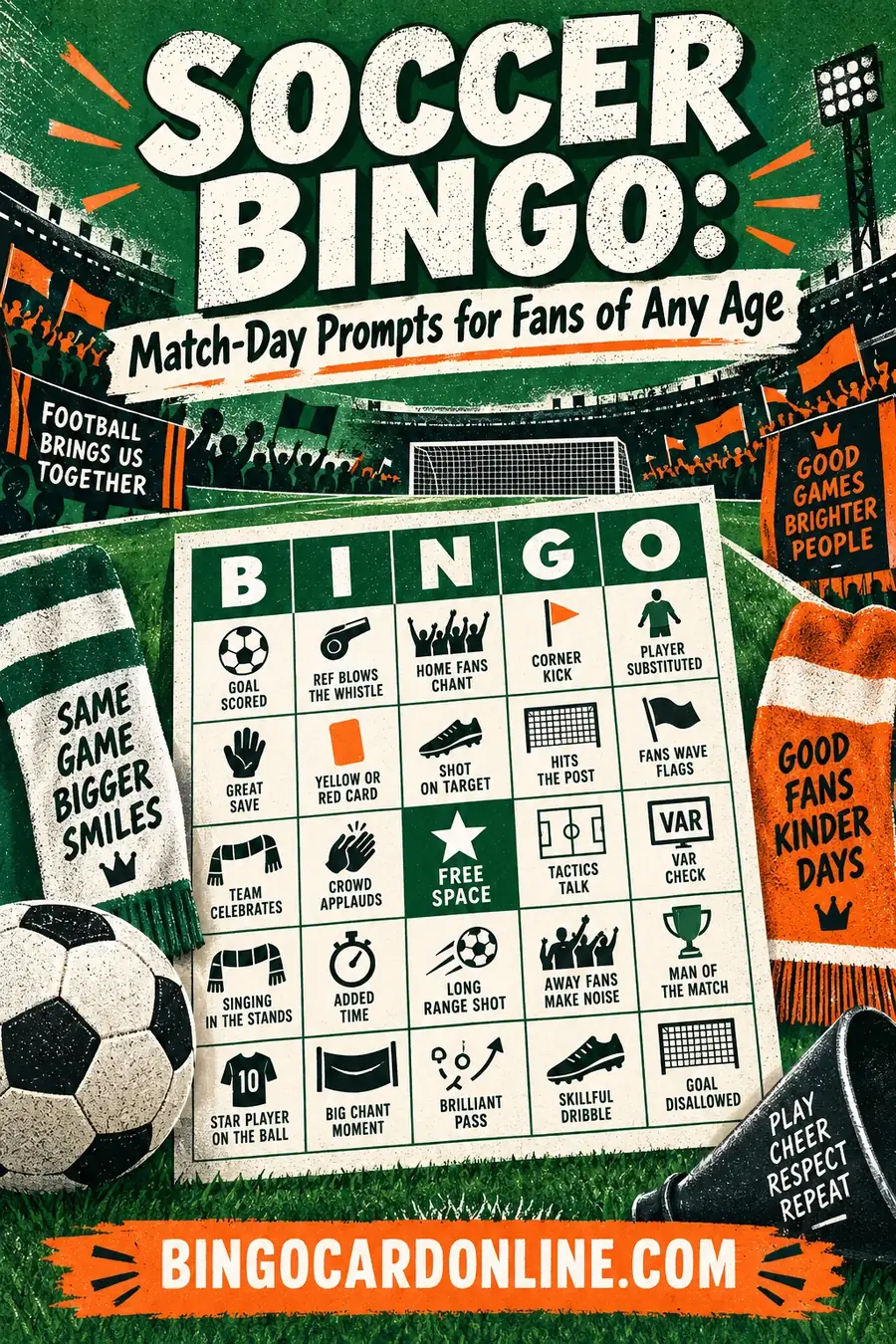
Soccer is harder to build a bingo card for than most sports, because the clock never stops and the discrete events are fewer. A ninety-minute match might produce two goals and a dozen genuinely notable moments. Fill a card with goal-dependent squares and most people will mark nothing.
The fix is to build the card around the things that happen constantly — throw-ins, substitutions, the referee's whistle, crowd behavior — and treat goals as a bonus.
Prompt Frequency Tiers
Near-certain (use 6-8 per card): throw-in, corner kick, goal kick, a foul given, substitution, the ball goes out for a goal kick, a player goes down and gets up.
Likely (use 8-10 per card): yellow card, header on target, a shot goes wide, keeper claims a cross, offside called, a player takes a long throw, injury-time board goes up.
Uncommon (use 4-6 per card): a goal, a save requiring a dive, a shot hits the woodwork, a player is booked for dissent, a counter-attack ending in a shot.
Rare (use 1-2 as bonus): penalty awarded, red card, own goal, a goal from outside the box, a goalkeeper coming up for a late corner.
A 5x5 card weighted like that fills somewhere in the second half, which is the right pacing for a full match.
Stadium Squares
For being there, where half the entertainment isn't on the pitch:
- A chant starts in your section
- Someone arrives after kickoff
- The person in front stands up at the wrong moment
- A scarf gets held up
- Someone shouts advice at a player who cannot hear them
- Half-time queue is longer than half-time
- A flag or banner unfurls
- The away end sings something you can't make out
- Someone leaves before the final whistle
- A stray ball goes into the crowd during warm-up
Broadcast Squares
For watching at home — these only work on TV:
- Replay of a foul from three angles
- Commentator mentions a manager's contract
- Graphic showing possession percentage
- "He'll be disappointed with that"
- Camera cuts to the manager reacting
- A statistic involving "since the start of the season"
- Slow-motion of a player's face after a miss
- Commentator says a team "needs to be more clinical"
- Shot of the fourth official's board
- Pundit disagrees with a decision at half-time
Youth Match Squares
For a parent at a kids' game with siblings in tow. These must stay positive — a square describing a child's error is a bad idea when that child's family is standing nearby.
- The whole team runs toward the ball at once
- A player waves to a parent mid-game
- Someone celebrates enthusiastically
- The coach shouts encouragement
- A player asks about snacks
- Someone stops to tie their laces mid-play
- A goal kick reaches the halfway line
- Everyone claps for a good save
- A player picks a daisy
- The ref explains a rule to a player kindly
Running It
Settle the interpretations first. Does a free kick count as "a foul given"? Does the keeper picking up a backpass count as a goal kick? Two minutes of agreement before kickoff prevents an argument at 70 minutes.
Free space in the middle helps considerably given the low event rate.
Consider halves as rounds. First to a line in the first half, full card by full-time. Keeps things alive if goals don't come.
One card per person is fine — matches are long enough that even children can manage their own.
Cards survive weather better on cardstock. Standing at a youth game in drizzle destroys paper.
Adapting for a Tournament
For a World Cup or similar, where people watch several matches:
Build a card that spans matches, not one per game. Squares like "a match goes to extra time," "a keeper saves a penalty," "a substitute scores" work across a tournament and produce a genuinely long-running game.
Group-stage cards can include table-based squares — "a team is eliminated on goal difference," "a group ends with three teams level."
Keep one card per person for the whole tournament and it becomes a running joke over weeks rather than ninety minutes.
Building the Cards
Each person needs a different arrangement, or the entire room shouts on the first throw-in. Shuffling one prompt list into distinct cards is the fiddly part of a custom set.
A bingo card generator takes your prompts and prints a set where every card differs. Worth deciding your grid size first — 3x3 for young children, 4x4 for a family, 5x5 for adults who'll watch the full ninety.
Grid Size by Group
| Group | Grid | Weighting | Expect to fill |
|---|---|---|---|
| Kids at a youth match | 3x3 | Near-certain only | Early second half |
| Family watching together | 4x4 | Balanced | Late second half |
| Adults, full match | 5x5 | Heavier on uncommon | Around full-time |
| Tournament, multi-match | 5x5 | Include rare + tournament squares | Across the group stage |
The Interpretation Rules Worth Settling First
Soccer produces more marginal calls than most sports, and two minutes before kickoff prevents an argument at 78 minutes.
What counts as a shot? Any attempt toward goal, or only ones on target? The common convention is that "a shot on target" means the keeper had to save it or it went in.
Does a free kick count as "a foul given"? Usually yes — a free kick implies a foul. But a handball or an offside also stops play without being a foul in the everyday sense.
Is a goal kick the same as "ball out for a goal kick"? Effectively yes, but be explicit if one square says "goal kick" and another says "ball goes out."
Does a substitution board count, or the actual change? They happen a minute apart and someone will notice.
Does injury time count as "the board goes up"? Yes, and it's a near-certainty in every match, which makes it a good early-mark square.
What about VAR checks, where the competition uses them? A check and a review are different events, and worth distinguishing if you include either.
Agree these out loud, or write the convention on the card itself. The second option is better for a group larger than four.
Tournament and Multi-Match Cards
A single-match card fills and it's over. A tournament card runs for weeks, which is a different and often better game.
Squares that only work across a tournament: a match goes to extra time, a penalty shootout, a team is eliminated on goal difference, a group ends with three teams level, a substitute scores, a keeper saves a penalty, a match finishes goalless, a red card in any match, a hat-trick, a goal in the first two minutes.
Group stage vs. knockout. Group-stage squares can reference tables and qualification scenarios. Knockout squares can reference extra time and shootouts, which cannot occur in a group.
Keep one card per person for the whole event. Marking a square once a week sustains the game across a month in a way that a per-match card never does.
Set a clear deadline. The final whistle of the final, and whoever has most marked wins if nobody completes a card.
Youth Match Considerations
Worth being explicit about, because this is the setting where a bingo card can go wrong.
Never write a square that names a child's mistake. No "a player misses an open goal," no "someone scores an own goal," no "a player cries." The child that square describes has a family standing on the touchline.
Avoid anything about the referee's competence. Youth referees are frequently teenagers, and a card mocking them is visible to them.
Avoid anything about coaching or parenting. "A parent shouts too much" is a real phenomenon and a terrible bingo square.
Positive and observational only. Enthusiasm, weather, snacks, someone waving, the team celebrating together. The card should be about the pleasure of watching rather than the quality of the play.
Give cards to the siblings, not the players. The point is occupying the younger brother or sister on the touchline, not scoring the match.
Group Formats
Family at home. One card each, 4x4, mixed prompts. Works across a full match without anyone needing to follow tactically.
Pub or bar viewing. 5x5, heavier on broadcast prompts and crowd reactions. Works well as a low-key group activity that doesn't require conversation.
Stadium trip. Cardstock, pens, 4x4. Weight toward the crowd and the occasion rather than the play, since sightlines and distractions mean people miss things on the pitch.
Youth touchline. 3x3 for siblings, entirely positive prompts, no scoring.
School or club event. Cards distributed before kickoff, small prize at full time. Keep prompts age-appropriate and avoid anything about individual performance.
Prompts That Work Across Any Match
If you want one card that suits any game rather than a specific fixture, these appear in essentially every match at every level:
Throw-in taken, corner kick, goal kick, free kick awarded, substitution, a player goes down and gets up, the ball leaves the pitch, a save of any kind, a header, a pass back to the keeper, a shot off target, injury time announced, a player asks the referee something, the ball hits a defender, offside given, a cross into the box.
Weight a card two-thirds from this list and one third from harder events, and it will fill at roughly the right pace regardless of who's playing.
Why Soccer Is Harder to Card Than Other Sports
Understanding the constraint makes the prompt-writing decisions obvious.
The clock never stops. There are no natural breaks to check a card during. In baseball or football, play stops constantly and everyone looks down. In soccer, looking down means missing something, which makes people reluctant to engage with a card at all.
Scoring events are rare. A typical match produces two or three goals. Build a card around goals and most squares stay empty for ninety minutes.
Much of the action is continuous rather than discrete. A period of sustained pressure isn't an event you can mark. A throw-in is. Cards have to be built from the discrete stuff.
Broadcast and stadium experiences diverge sharply. At a ground you can see the whole pitch and none of the replays; on television it's the reverse. A single card genuinely cannot serve both.
The practical consequence: weight heavily toward routine restarts. Throw-ins, corners, goal kicks and free kicks happen constantly, require no judgment, and are visible from anywhere. They're the backbone of a workable soccer card, with goals and cards as bonus squares rather than the core.
Running It During a Match
Distribute before kickoff. Handing out cards after the game has started means everyone misses the first few minutes twice over — once reading the card, once catching up.
Read the card aloud once. Thirty seconds covering the ambiguous squares saves the mid-match argument.
Nominate an adjudicator. One person decides marginal calls, and their decision stands. Without this, every disputed square becomes a discussion that lasts longer than the incident did.
Play to a line at half time, full card at full time. Gives the game two natural checkpoints matching the match structure.
Don't score it too seriously. The card is a way of watching together, not a competition. Prizes tend to sharpen disputes over exactly the marginal calls that are least worth arguing about.
Futbol Bingo for a Bilingual Group
Plenty of the households that watch a match together use two languages for it, and the card is an easy place to accommodate that.
Print the prompts in both. A square reading "corner kick / saque de esquina" costs nothing and means a grandparent and a nine-year-old can share the same card. Futbol bingo cards built this way get used more than either single-language version, because nobody is handed the sheet they can't read comfortably.
Watch the vocabulary, not just the language. The split isn't only Spanish and English. A card written in US terms — field, cleats, jersey, tie — reads oddly to anyone who learned the game as pitch, boots, shirt and draw. Pick one set and hold it consistently across the card, or the inconsistency becomes its own argument.
Names travel; descriptions don't. "Panenka," "rabona" and "nutmeg" are understood by fans everywhere and need no translation at all. "A cheeky finish" needs a paragraph. Lean on the technical vocabulary for a mixed-language group, because it's the part everyone already shares.
For a tournament, a bilingual card is close to essential. The group watching a World Cup match is usually much wider than the group who follow a club week to week.
Frequently Asked Questions
How do you make a soccer bingo card that isn't all goals? Weight it toward things that happen constantly — throw-ins, corners, substitutions, fouls — and use goals as one or two bonus squares. A card built around goals will leave most players with nothing marked.
What grid size works for a full match? 5x5 for adults watching all ninety minutes, 4x4 for a family, and 3x3 for young children whose attention won't stretch to full-time.
Can the same card work for watching at home and at the stadium? Not well. Stadium squares about chants, queues and the crowd don't apply on TV, and broadcast squares about replays and commentary don't apply in the ground. Build two prompt lists.
How do you handle disagreements about whether something counted? Agree the ambiguous cases before kickoff — particularly what counts as a foul, a save and a shot on target. Any consistent rule works as long as it's set in advance rather than argued mid-match.