Social Bingo: Icebreaker Cards That Get People Talking
Social bingo is a version of the game where every square holds a fact about a person instead of a number, and players fill their grid by walking the room, asking questions, and getting someone who matches the square to sign it. The winner is the first person to complete a line or a full card, but the real output is that forty strangers have now had forty short conversations they would never have started on their own.
It goes by several names: human bingo, mingle bingo, find-someone-who, getting-to-know-you bingo. The mechanics are the same in all of them. What changes is the prompt list, and that is the part most people get wrong. This guide covers how the format works, how to write squares that produce actual conversation, what grid size to use for a given headcount, and how to run the activity so it ends cleanly instead of trailing off.
What Is Bingo in This Version, and What Changes
To answer the obvious question first: what is bingo in its standard form? A caller draws random items, players mark matching squares on a grid, and the first grid to hit the winning pattern wins. It is a game of luck with no skill component at all.
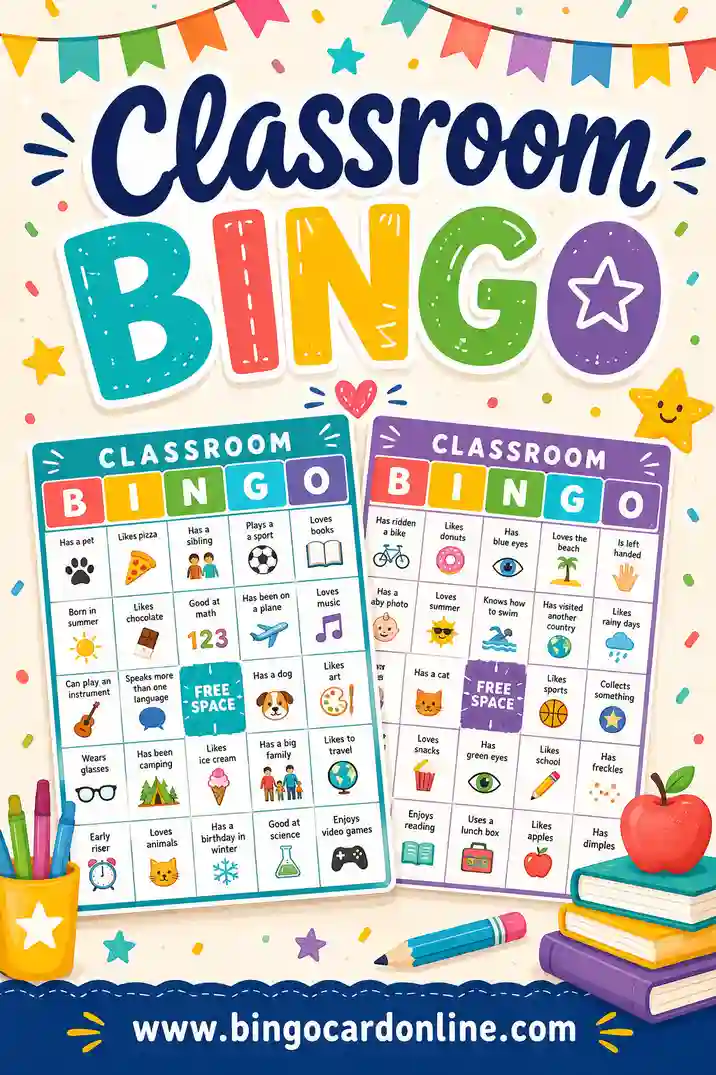
Social bingo keeps the grid and throws out the caller. Nothing is drawn. Instead, each square reads something like "has lived in another country" or "can name every state capital," and the player has to find a human being in the room who fits, then get that person's name written in the square. One signature per person is the rule that makes the whole thing work, because it forces players to keep moving instead of parking next to a friend who happens to match nine squares.
That single change flips the game from luck to legwork. Nobody wins by having a better card. They win by talking to more people, faster, and by being willing to interrupt a stranger politely.
Where Social Bingo Actually Earns Its Place
The format is not universal. It works when a group is new to each other and has a reason to keep meeting afterward. It falls flat when people already know each other well, because the answers are foregone.
Situations where it consistently lands:
- New-hire onboarding and first-week orientation. New starters have nothing to talk about yet. A card gives them a script.
- Conference and workshop openers. Ninety seconds of instruction buys twenty minutes of self-directed networking, and attendees remember faces afterward.
- First class of a semester. Teachers get to watch which students are confident approaching others and which are not, which is useful information in week one.
- Wedding receptions. Two families who have never met are placed in one room. Cards on the tables solve the awkward cocktail hour.
- Family reunions. Squares about the family itself ("was at the 1998 reunion," "knows what Grandma's middle name is") turn into storytelling.
- Community groups, church welcomes, volunteer kickoffs, club open houses. Any place where turnout is high and familiarity is low.
Where it fails: a team of six who have worked together for years, a group where most attendees have limited mobility or the room is too tight to circulate, and any event where people are seated and locked into a schedule. In those cases, a table-based version works better, which I cover further down.
Writing Squares That Produce Conversation
This is where a good social bingo card separates from a bad one. A weak square gets a yes or no and a signature. A strong square gets a yes, a signature, and a follow-up question.
The test is simple: after someone says "yes, that's me," is there an obvious next sentence? "Has a pet" fails the test. "Has a pet with a ridiculous name" passes it, because the very next thing anyone says is "okay, what's the name?"
Rewrite your prompts along these lines:
| Weak square | Stronger version | Why it works |
|---|---|---|
| Likes to cook | Has burned something on purpose to improve it | Invites a story |
| Plays an instrument | Can still play one song from childhood lessons | Specific and slightly self-deprecating |
| Has traveled | Has been on a trip that went completely wrong | Everyone has one |
| Likes sports | Has a team they refuse to give up on | Opinion, not fact |
| Reads a lot | Has re-read the same book more than twice | Names a title |
| Has siblings | Is the middle child | Sparks instant sorting |
Four more rules that hold up across every group I have run this with:
- Keep roughly a third of the squares easy. If every prompt is obscure, cards stall and people quit. Easy squares create early momentum.
- Avoid anything financial, medical, political, or appearance-based. A stranger should never have to disclose something private to help someone else win a game.
- Make squares answerable in one sentence. Long answers cause traffic jams and only two or three players get around the room.
- Localize a handful. Squares about the company, the campus, the town, or the couple getting married are the ones people remember.
Choosing a Grid Size for Your Headcount
Grid size is not aesthetic. It determines how long the activity runs and whether it is even completable. With the one-signature-per-person rule in force, a 5x5 card with a free center needs twenty-four different people to complete, so a room of eighteen makes a full card impossible.
| Grid | Squares to fill | Minimum people in the room | Runs about |
|---|---|---|---|
| 3x3 | 9 | 12 or more | 6 to 10 minutes |
| 4x4 | 16 | 20 or more | 12 to 18 minutes |
| 5x5 with free center | 24 | 30 or more | 20 to 30 minutes |
| 5x5 blackout | 25 | 30 or more | Too long for most events |
My default for a mixed corporate group is a 4x4 played to a single line rather than a full card. It ends while energy is still high. If you want the room to keep mingling after the first winner, announce that play continues until three winners are called, then stop.
Running the Activity Without Losing the Room
The instructions have to be shorter than people expect. Say this and nothing else: find a person who matches a square, have them sign it, one signature per person, shout when you have a line. Then start. Every extra sentence of setup costs you a minute of playing time.
A few practical points that make the difference between a smooth run and a mess:
- Hand out pens with the cards. Half a room will not have a pen, and they will not go find one.
- Play the first round yourself. A host standing at the front holding a clipboard is a signal that this is optional. A host circulating is a signal that it is not.
- Set a visible time limit. Ten or fifteen minutes on a screen keeps the pace up better than any amount of encouragement.
- Have the winner read out three squares and who signed them. This is the step almost everyone skips, and it is the payoff. The room learns six facts about four people, and the game stops feeling like busywork.
- Do not offer a big prize. The moment the stakes rise, people cheat by signing each other's cards in bulk.
Table Versions for Seated Events
When people cannot circulate, keep the cards and change the rule. Each table gets one set of cards and plays within the table. Instead of signatures, players take turns reading a square aloud and anyone at the table who matches raises a hand; every player who is holding that square marks it. Cards still differ from each other, so the winner is unpredictable.
For a wedding, seed the prompts with facts about the couple, and let the tables argue about which answers are true. For a family reunion, use squares about shared history. For a seated training session, use squares about the material people are there to learn, which quietly doubles as a pre-test.
Making the Cards
Every player needs a different card, which is the only technical requirement of the whole format. Write your prompt pool first, shuffle it into unique grids, and print. A pool needs at least a third more prompts than squares or the cards start to look identical; for a 4x4 card, write twenty-four to thirty prompts and let the shuffle do the rest.
A bingo card generator handles the shuffling and the printing in one step, which matters when you need forty unique cards the night before an event. Type the prompts once, set the grid size, and print the batch. Doing it by hand in a word processor is possible, but rearranging twenty-five cells forty times is how people end up with duplicate cards and two simultaneous winners.
If you want a paper-free version, project the prompt list and let players fill a blank grid themselves by writing names in any square. It is less controlled but requires nothing but a screen.
Free Bingo, Free Online Bingo, and What Those Searches Mean
People looking for this format search it a dozen different ways. Free bingo, free online bingo, bingo online free, bingo free online: these are all the same request phrased four ways, and what the person usually wants is a card maker they can use without an account, not a gambling site. It is worth knowing the difference, because the phrase bingo online carries two completely separate meanings.
Online bingo, in the commercial sense, means wagering games run by licensed operators. That is a different industry with different rules, and it has nothing to do with what an HR coordinator needs on a Tuesday morning. When a teacher or an event host types bingo online, they mean a browser tool that builds and prints cards. Knowing which one you are looking at saves a lot of wasted clicks.
For social bingo specifically, you need almost nothing technical. A grid, unique cards, a pen per player, and prompts that suit the room. The prompts are the only part that cannot be automated, and they are the only part that decides whether the activity works.
Twenty Prompts You Can Steal
Use these as a starting pool and swap in a few that are specific to your group:
Has broken a bone. Speaks more than one language at home. Has met someone they saw on TV. Can drive a stick shift. Has never had a cavity. Was born in a different state. Has a scar with a good story. Can whistle a tune on request. Has been on live television. Owns something older than they are. Has run a race longer than a 5K. Can name all seven continents in ten seconds. Has worked a night shift. Has the same first name as a grandparent. Has been up for a sunrise in the last month. Can fold a fitted sheet properly. Has camped in the rain on purpose. Plays a game every single day. Has read the book before seeing the movie. Has a signature dish they bring to every potluck.
Half of those are easy, half take some searching, and every one of them has a follow-up question sitting right behind it.
Common Mistakes
Cards that are all the same. If two people are holding identical grids, the game ends in an argument. Shuffle properly.
Prompts that only apply to a subset of the room. A card full of squares about parenting excludes everyone without kids, and they will notice within a minute.
Running it too long. Twenty-five minutes is the outer edge. Stop the activity before people start standing in clumps checking their phones.
Skipping the readout. Without it, players learned names and nothing else. Thirty seconds of sharing at the end is what makes anyone remember the game the next day.
Forcing participation. Give people an obvious way to sit out. A single visibly reluctant person can be handed the caller or timekeeper role and be perfectly happy.
Frequently Asked Questions
How many prompts do I need for a 5x5 social bingo card? Write at least thirty-two to thirty-five prompts for a 24-square card. Anything less and the shuffled cards start to overlap heavily, which means two players are chasing the same handful of people and the room bunches up.
Can one person sign more than one square on the same card? The standard rule is one signature per person per card, and it is the rule that makes the format work. If your group is small, relax it to two signatures per person, but never let it go unlimited or players will simply pair off.
What is a good grid size for a classroom? A 4x4 grid for a class of twenty to thirty students, played to a completed line rather than a full card. It fits inside a single period with time left to talk about what people found out.
Does social bingo work for a virtual meeting? Yes, with an adjustment. Put people in short breakout rooms of four to six, give everyone a 3x3 card, and rotate the rooms twice. Chasing signatures does not work on a video call, so switch to typed initials in a shared document or have players simply mark the square and name the person aloud at the end.