Thanksgiving Bingo Cards: Free Printable & Customizable
Thanksgiving is the one holiday organized around a single long meal, and that shapes how bingo works on it. The day has a slow morning in the kitchen, a stretch of waiting, a big sit-down dinner, and then a long, sleepy afternoon of pie and football. A good Thanksgiving bingo set is built to fill those gaps, not to compete with the food.
Instead of numbers, each card holds things you will actually see and hear that day, from a timer going off to a cousin asking for the gravy. Build a stack of different cards with the free bingo card generator, using the word list further down this page or your own family's traditions. It takes a few minutes, with no sign-up.
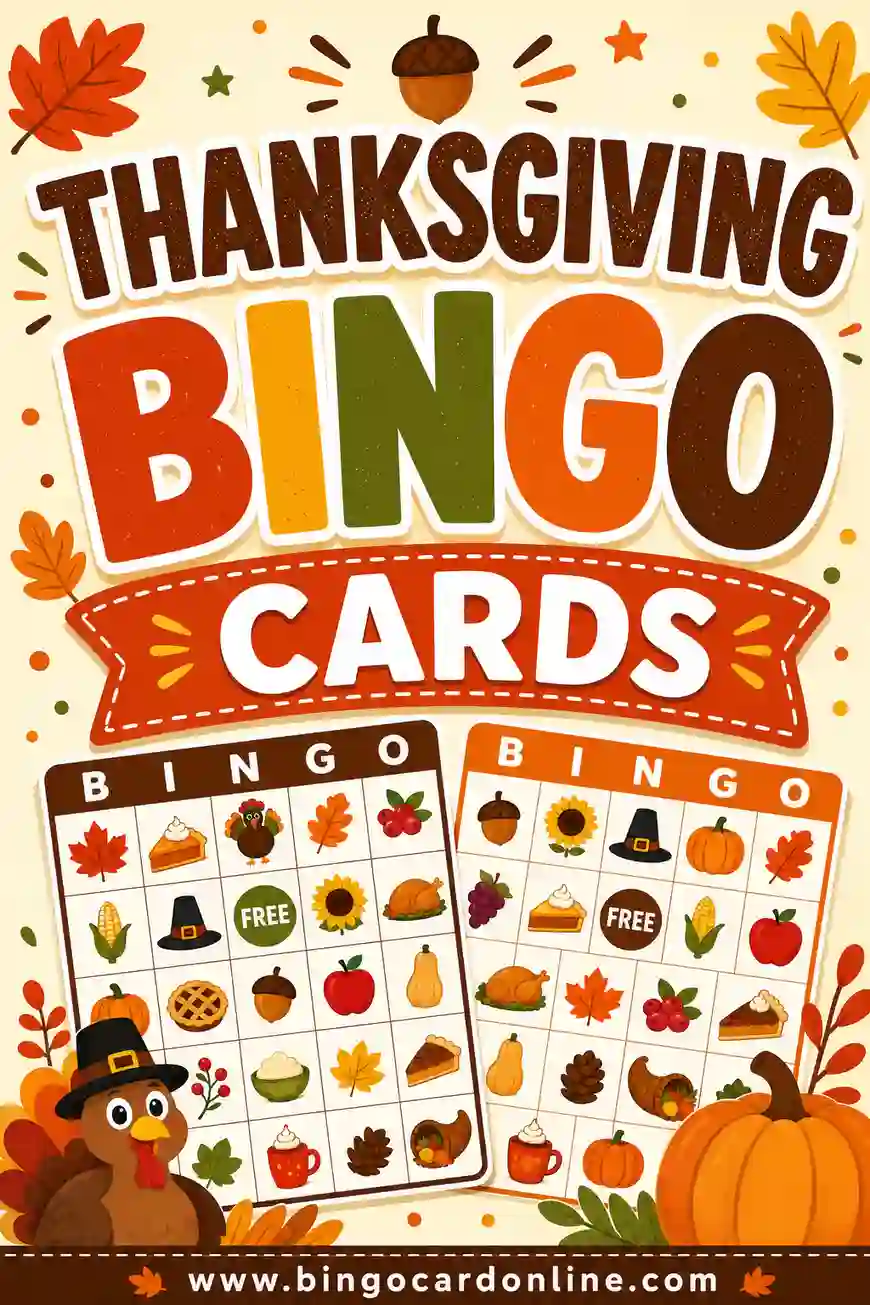
A Game Built Around One Long Meal
Most holiday bingo is about spotting decorations. Thanksgiving bingo works better as a game about the day itself. The holiday has a rhythm that repeats in almost every house: people arrive in waves, the cook stays busy, the table gets crowded, and then everyone slows down at the same time. Bingo can follow that rhythm.
That is why there are really three games hiding in one. A prep-hour card is for people hovering around the kitchen. A table card is for the meal itself. An afternoon card covers the football and the leftovers. You can hand out one card for the whole day or switch cards as the day moves on, and the generator will make as many different versions as you need.
It also helps that Thanksgiving gathers more age groups than most days. A card that a six-year-old and a great-grandfather can both play is worth more here than a clever one that only adults understand.
Before the Bird Comes Out: Kitchen and Prep-Hour Bingo
The hours before dinner are when the host is busiest and the guests are most underfoot. A kitchen card gives early arrivals something to do, and it can double as a light way to keep people out from between the stove and the counter.
Squares for this card tend to be sounds, smells, and small crises:
- The oven timer goes off
- Someone asks "Need any help?"
- A pot lid rattles
- The turkey needs a thermometer check
- Someone sneaks a roll
- A dish is missing a serving spoon
- Someone asks if there is room in the fridge
- The smell of sage or onions hits the living room
- A last-minute store run
Play it without a caller. Players mark squares as they happen and call "Bingo" quietly, so the cook is not interrupted. If you are the cook, ask a relative to be the unofficial referee so you do not have to stop and check cards.
Keep this card to a 3x3 or 4x4 grid. People wander in and out of the kitchen, and a smaller card lets them finish before dinner is announced.
The 30-Square Thanksgiving Word List
Here are 30 squares, split into three groups. Pick 24 for a 5x5 card (the center is your free space) or 8 for a 3x3 card with a free middle. Paste any mix into the generator. Taking some from each column gives cards that look different from each other.
| Food & Feast | Symbols & Season | Family Moments |
|---|---|---|
| Turkey | Pilgrim | Football game |
| Pumpkin pie | Cornucopia | Afternoon nap |
| Mashed potatoes | Autumn leaves | Saying grace |
| Cranberry sauce | Maple leaf | Second helpings |
| Stuffing | Scarecrow | Long table |
| Gravy | Wheat | Family photo |
| Dinner rolls | Acorn | Leftovers |
| Sweet potatoes | Harvest moon | Thankful list |
| Apple cider | Hay bale | Dish duty |
| Green bean casserole | Wild turkey | Parade on TV |
The first column is easy to see, so it suits younger players. The third column is the one that makes the game feel like your own Thanksgiving, and you should replace items in it freely. If your family always has a particular dish, a recurring argument over where to sit, or a grandparent who tells the same story each year, add it.
Setting Up the Kids' Table Game
The kids' table has its own atmosphere, and bingo suits it well. Children who finish eating before the adults are done can get restless, and a card gives them something to do while staying seated.
- Go with 3x3. Nine squares are enough for kids who are still learning to read. Choose picture-friendly words: turkey, pie, acorn, leaf, corn, pilgrim hat.
- Let the kids draw the squares. For toddlers and preschoolers, print blank cards and let them draw a turkey or a pie in each box before dinner. The card becomes a craft, and a few of the pictures will be funnier than any clip art.
- Appoint a table captain. An older cousin can read the calls and watch the cards. Being in charge keeps a ten-year-old engaged, and it takes one job off the adults.
- Use food as markers. Candy corn, popcorn kernels, or small crackers work as markers. Plan on some being eaten before the game ends.
- Pick a tiny prize. A first choice of dessert or a sticker is plenty. Avoid prizes that cause a fight over who got the better one, and have a small prize ready for every player.
If the kids' table and the adult table are in different rooms, give each its own set of cards with a slightly different word list, and let the winners compare notes later.
Football on the Big Screen: Game-Day Squares
For many households, the television is on from midmorning on, whether for the parade or for the games. A television card turns that background noise into something people play along with, including those who do not care who wins.
Some squares that need no knowledge of the sport:
- A commercial with a talking animal
- Someone shouts at the screen
- A player is shown on the sideline in a big coat
- An announcer says the same phrase twice
- A replay is shown from a different angle
- A flag is thrown
- Someone asks "Who is winning?"
- A marching band or balloon appears during the parade
Spot-it rules work best here. Nobody calls anything; players mark squares as they happen, which means the card keeps going through halftime and any long pauses. Because the game is passive, guests can look up from a conversation, check their card, and go back to their pie.
If the football fans and non-fans are at odds, make the squares about the people in the room rather than the game itself, such as "someone says it was a better game last year." That way the card is about the household, and nobody has to follow a play.
Grandparents, Cousins, and Everyone In Between
A multi-generation table has different needs at each end. The goal is to run one game that does not leave anyone out, rather than three separate ones.
| Who is playing | Card that works | One thing to do |
|---|---|---|
| Preschoolers | 3x3, pictures only | Let them color the card first |
| Elementary kids | 3x3 or 4x4, short words | Make them the caller for a round |
| Teens | 5x5, with inside-joke squares | Let them write a few squares themselves |
| Adults | 5x5, family-moment squares | Add a few squares only your family would get |
| Grandparents | 4x4, large print | Ask them to supply a square from an old tradition |
That last tip is worth trying. Asking an older relative to contribute a square, such as the name of a dish they remember or a custom from when they were young, gives them a role beyond just playing, and it often starts a story. When print is a concern, use a larger font and fewer squares per card so the writing is easy to read at arm's length.
Mixed card sizes can share the same called list. The little ones will finish a 3x3 line faster, so give the 5x5 players a full-line rule and the 3x3 players a single-line rule, and everyone gets a chance to win.
Timing the Game Around the Meal
The most common mistake is trying to play at the wrong moment. A caller reading words while the turkey is being carved will be ignored, and a long game during dinner interrupts the conversation. A few timing suggestions:
- Early arrivals (about an hour out): Hand out the prep-hour cards. They are passive and cost the host nothing.
- While the table is being set: Let kids decorate or fill in their cards so they are busy and nearby.
- During the meal: Keep any bingo silent. Spot-it cards stay on the table, and people mark squares between bites.
- After the plates are cleared: This is the best time for a called round. Everyone is seated, nobody is hungry, and the pace is slow. Keep it to one or two short rounds.
- During the afternoon game or movie: Bring out the football card or a blackout round that people can drift in and out of.
A rule of thumb: if the host has to stop what they are doing to run the game, it is not the right moment. Keep the game cheap in attention.
A Gratitude Round to Close the Table
Many families go around the table and say what they are thankful for. Bingo can make that custom easier, especially for people who feel awkward speaking on the spot.
Try a gratitude card, where each square names a kind of thing people tend to be thankful for: a person, a meal, a place, a skill, a small moment. When a player says what they are thankful for, anyone with a matching category marks it. It turns a round of speeches into something interactive, and it often gets shy kids to join in, because they only need to name one thing and not give a speech.
Abstract words like "gratitude" do not work as squares, since nobody can point to one. Stay with categories that people can name: "someone at this table," "a pet," "a home-cooked meal," "a friend far away," "a teacher."
Keep the tone light. The point is to get people talking about what they appreciate, not to grade anyone's answer.
Printing for a Crowded, Messy Table
A Thanksgiving table has gravy, cider, and elbows. A few practical points:
- Print on heavier paper. Cardstock holds up when it is passed around and set near a plate.
- Black and white is fine. Kids can color the cards while waiting, which saves ink.
- Use sleeves or lamination for reuse. Dry-erase markers wipe away, and the same set can come out next year.
- Print a few extras. Cousins appear, and a card or two will get a spill.
- Do a test page. Check that squares are not cut off at the margins before you print the whole stack.
For markers, use whatever is at hand: dried corn, candy, buttons, or a pen. Small leaves or acorns from the yard add a seasonal touch.
If you host other gatherings through the year, the same method works for our Halloween bingo cards and Christmas bingo cards.
Questions Hosts Ask About Thanksgiving Bingo
When during Thanksgiving is the best time to play?
The easiest time is after the plates are cleared, when everyone is seated and relaxed. Silent spot-it cards also work during the meal and the football game, since they need no caller. Avoid called games while food is being served or carved.
How many cards should I print for a big family?
Print one per person, plus a few extras for late arrivals and spills. If you plan to use separate cards for the kitchen, the table, and the afternoon, multiply accordingly, or let people keep one card and mark it all day. The generator makes each card different.
What can I do for guests who do not like games?
Make participation optional and passive. A spot-it card sits on the table and takes no effort. You can also ask reluctant guests to contribute a square, which lets them be part of it without playing.
Can I make a card for football without knowing football?
Yes. Use squares about the broadcast and the room: a commercial, someone yelling at the screen, a replay, a person asking who is winning. None of them depend on knowing the rules.
How do I keep little kids from getting upset when they do not win?
Use short games, a 3x3 grid, and a small prize for every player. Rotating the caller role also helps, because it gives kids another way to feel included.
Can I reuse the cards next Thanksgiving?
Yes. Print on cardstock, slide them into clear sleeves, and mark with dry-erase markers. Wipe them clean and store them with your holiday supplies. Swap a few family-moment squares each year to keep the game fresh.
Make Your Set Before the Guests Arrive
Choose a grid for each group, copy squares from the list above, and add a few that only your family would understand. Then open the free generator and print a stack of unique cards. Set them out with a pen or a bowl of candy corn, and let the game run quietly in the background of your Thanksgiving.