Halloween Bingo Cards: Free Printable & Customizable
Halloween has a built-in game structure: costumes to spot, porches to judge, candy to collect, and a whole evening of things jumping out of the dark. Halloween bingo cards simply turn that into a grid. Instead of numbers, each square holds something you might see or hear on October 31, like a ghost, a jack-o-lantern, or a black cat, and the first player to complete a line yells "Bingo!" A free bingo card generator shuffles one word list into as many unique cards as your group needs.
Short on time? Open the free generator, paste in the spooky word list further down, and print a stack. No sign-up, nothing to download.
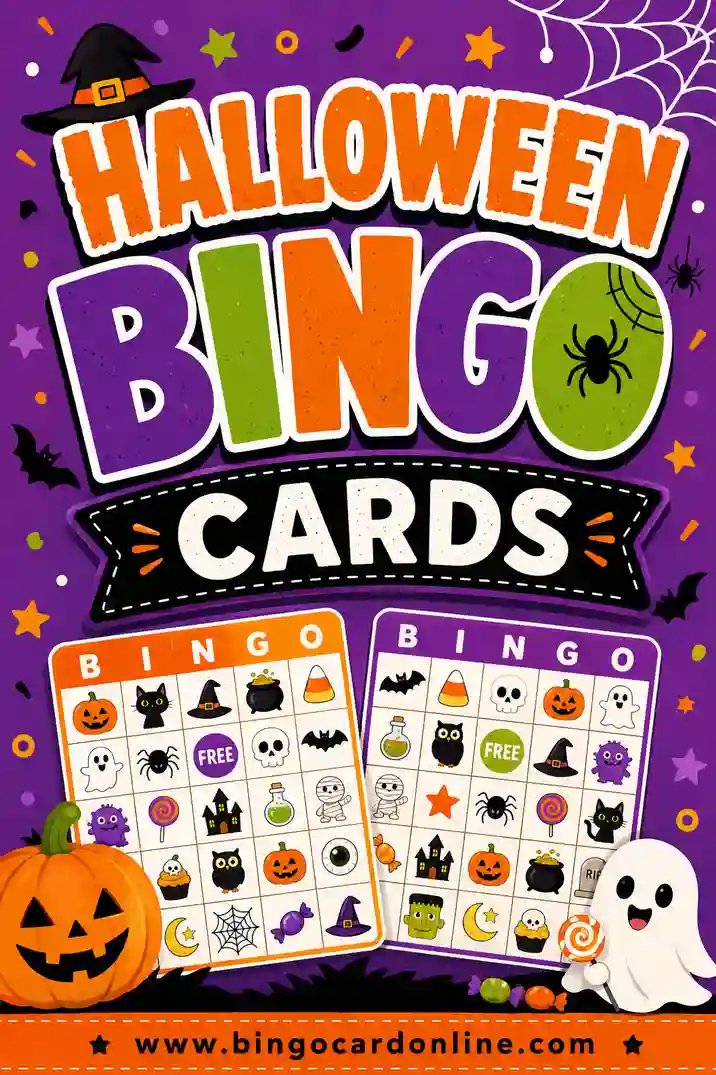
Why Halloween Suits a Bingo Card So Well
Most holidays happen at one table. Halloween spreads out: a school hallway in the afternoon, a neighborhood at dusk, a living room full of people watching a scary movie at night. A bingo card travels through all of it, which is why the same game can work as a classroom activity, a trick-or-treating companion, and a party icebreaker.
It also helps that the holiday comes with a famously recognizable cast of symbols. Jack-o-lanterns trace back to the Irish and Scottish custom of carving turnips and other root vegetables; immigrants in North America switched to pumpkins because they were bigger and easier to carve. Trick-or-treating grew out of older door-to-door traditions and became a fixture of American neighborhoods in the twentieth century. Costume parades, haunted houses, and candy corn all show up on cards without any explanation, so players of nearly any age already know what they are looking for.
Free Halloween Bingo Word List (Copy & Paste)
Here are 30 Halloween squares sorted into three columns. A 5x5 card needs 24 words plus the free center, a 3x3 card needs 8 or 9, and having 30 or more to draw from means the cards look noticeably different from one another. Copy a column or mix them.
| Spooky Classics | Costumes & Candy | Party & Decor |
|---|---|---|
| Ghost | Witch | Jack-o-lantern |
| Black cat | Vampire | Cobweb |
| Pumpkin | Skeleton | Cauldron |
| Bat | Werewolf | Candy corn |
| Spider | Mummy | Trick-or-treat |
| Full moon | Superhero | Haunted house |
| Witch's hat | Pirate | Tombstone |
| Owl | Zombie | Broomstick |
| Spooky tree | Ghoul | Candy bucket |
| Crow | Princess | Spider web |
Younger children do best with picture-friendly words such as pumpkin, ghost, and black cat. Older groups can swap in the odder items from the other columns, or write their own using the ideas below.
90 More Halloween Bingo Words by Theme
Thirty squares are enough for a small party, but a bigger word pool makes every card in a large stack look different and lets you build themed cards for different ages. Here are 90 more Halloween squares, grouped so you can copy a whole theme at once. Together with the list above, that is 120 Halloween bingo words to choose from.
Creatures, costumes, and candy
| Creatures & Monsters | Costume Ideas | Treats & Candy |
|---|---|---|
| Goblin | Astronaut | Lollipop |
| Troll | Ninja | Caramel apple |
| Gargoyle | Fairy | Chocolate bar |
| Frankenstein's monster | Dinosaur | Gummy worms |
| Headless horseman | Cowboy | Popcorn ball |
| Swamp monster | Robot | Taffy |
| Bigfoot | Firefighter | Pumpkin cookie |
| Dragon | Unicorn | Licorice |
| Raven | Clown | Mini pretzels |
| Rat | Homemade costume | Full-size candy bar |
Decorations, harvest, and spooky sounds
| Porch & Yard Decor | Fall Harvest | Spooky Sounds |
|---|---|---|
| Inflatable ghost | Scarecrow | Creaky door |
| Fog machine | Hay bale | Wolf howl |
| Orange string lights | Corn maze | Evil laugh |
| Glowing eyes | Apple cider | Thunder |
| Paper bats | Pumpkin patch | Rattling chains |
| Giant fake spider | Gourd | Hoot |
| Spooky door wreath | Autumn leaves | Doorbell |
| Flickering candle | Hayride | Footsteps |
| Window silhouette | Acorn | Scream |
| Light-up pumpkin | Corn stalk | Boo! |
The sound squares are fun for a caller game: instead of reading the word, the caller makes the noise (a creak, a hoot, a howl) and players guess which square it matches.
Little kids, movie night, and the class party
| Picture Words for Little Ones | Movie-Night Squares | Classroom Party Squares |
|---|---|---|
| Lantern | Secret passage | Costume parade |
| Mask | Creepy attic | Pumpkin seeds |
| Cupcake | Talking cat | Pumpkin carving |
| Star | Mysterious map | Story time |
| Red apple | Locked door | Glow stick |
| Cape | Old portrait | Spider ring |
| Magic wand | Spooky basement | Mummy wrap game |
| Toad | Crystal ball | Bobbing for apples |
| Wagon | Ghostly whisper | Coloring sheet |
| Flashlight | Storm outside | Teal pumpkin |
Mix and match columns to fit the crowd. A preschool card might use only the picture words and the friendliest creatures, while a teen or adult movie-night card can lean on the movie squares and the sounds.
Three Ways to Play on October 31
Halloween bingo changes shape depending on where the evening takes you. Pick the version that matches your plans.
Caller bingo for a party table
Someone draws words from a bowl or cauldron and reads them aloud while everyone marks their cards. It works best indoors where people are seated and listening, such as a class party or a pre-trick-or-treat gathering.
Spot-it bingo for the neighborhood
No caller needed. Players mark a square only when they actually see the item: a skeleton propped on a porch, a fog machine, an inflatable ghost, someone dressed as a hot dog. This version is built for the walk itself, and a card with 3x3 or 4x4 squares fits in a pocket.
Costume parade bingo
Squares list costume categories instead of objects: a witch, a superhero, a pirate, a character from a movie, a homemade costume, a group costume. Guests mark off what they spot as people arrive. It gives shy guests a reason to start conversations ("Are you the zombie I need for my row?").
A Caller's Script for the Witching Hour
Calling is half the fun on Halloween, because the voice does the work. A few habits keep the room hooked:
- Dim the lights, but not to darkness. A lamp or string lights set the mood, but players still need to read their cards. A battery candle on the caller's table is enough.
- Add a line of patter to each call. Instead of just "Bat," try "Something is flapping past the window... Bat!" Instead of "Cobweb," try "You just walked into something sticky... Cobweb!"
- Draw from a cauldron. Write each word on a paper slip and drop the slips in a pot or plastic cauldron. Pulling one out slowly makes the pause feel dramatic.
- Use a sound effect for a win. A squeaky door recording, a cackle, or a kitchen timer works better than a bell and lets the winner earn the "Bingo!" as a shout.
- Keep a master list. Set aside each slip as you call it, or cross the word off a list. When someone claims a win, read their squares back against it.
For adults, a call every 10 to 15 seconds is plenty. For children under seven, slow down and repeat each word, because they often spend a moment finding the right picture.
Classroom Party Day: Halloween Bingo at School
Many elementary schools hold a costume parade and class party on or near October 31, and teachers need something that works for 20 or more excited children in costume. Bingo suits that setting for a few reasons: it is quiet enough to run indoors, it can be tied to reading practice, and it lets you pause for a costume adjustment or a bathroom break without losing the game.
A realistic plan for a 30-minute party slot:
- Hand out cards before the costumes come out. Excited children settle faster when they have something in their hands.
- Run a first round with a simple goal. One line wins. Everyone gets the idea of the game before the rules get fancier.
- Move to four corners for round two. It ends quickly and keeps attention.
- Finish with a blackout round if time allows, so the winner of the full card gets the last prize.
For early readers, mix words and pictures, and let older students help as callers. A 3x3 grid with eight or nine words is a better fit for kindergarten than a full 5x5.
Food allergies and candy markers
Candy is the obvious marker choice, and it needs care at school. Some classrooms restrict candy, and peanut or tree nut allergies are common enough that many teachers avoid food markers entirely. Good non-food alternatives include paper pumpkin cutouts, plastic spider rings, small orange and black pom-poms, or a dry-erase marker on a sleeved card. If your school takes part in the Teal Pumpkin Project, which encourages non-food treats for trick-or-treaters with food allergies, bingo prizes like stickers, pencils, and glow bracelets fit right in.
Trick-or-Treat Night: Pocket Bingo and Safety
A spot-it card gives young trick-or-treaters something to look for between houses, which can slow down the sprint from door to door. A few practical notes for the evening:
- Use a small grid. A 3x3 card on a clipboard, or a card inside a clear zip bag, is easier to carry than a full-page sheet while holding a candy bucket.
- Choose squares that are safe to spot from the sidewalk. Items like "jack-o-lantern with a face," "porch skeleton," "fog," "glowing eyes," and "costume with a cape" mean no one needs to step off the path.
- Keep eyes up. A card is a distraction. Adults should stay close, and children should mark a square only when standing still, never while walking or crossing a street.
- Stay visible. A flashlight, glow stick, or reflective bracelet helps drivers and other walkers see children, and a card with large type is easier to read in porch light.
- Hold the candy check for home. It is common advice to look through treats at home before anyone eats them, so make "full candy bucket" the bonus square and a reason to head back.
Movie-Night and Grown-Up Party Cards
Older groups tend to enjoy Halloween bingo more when it becomes a running joke. Make your own squares from what usually happens:
- For a horror movie marathon: "the lights go out," "someone splits up from the group," "a creepy kid," "a jump scare," "a character says 'Hello?' into the dark," "someone investigates a strange noise."
- For a costume party: "a couples costume," "a costume nobody gets," "someone has already removed their mask," "a group costume," "an unplanned duplicate costume."
- For a haunted house visit or pumpkin patch: "a hay bale," "a scream from far away," "an actor in the dark," "a carved pumpkin with a funny face."
For a gentler family version of a movie night, pick a classic that isn't too frightening and use squares like "a talking animal," "a haunted house," "a spell goes wrong," and "a happy ending."
Prizes and Markers That Fit the Season
Halloween rewards are easy to find, but a few ideas make them more interesting than a handful of wrapped candy:
- First pick from the candy bowl is a classic and costs nothing.
- Winner chooses the next movie or the next pumpkin to carve. Small powers feel big at parties.
- Themed trinkets: plastic spider rings, glow-in-the-dark stickers, vampire teeth, mini erasers, or pencils with pumpkins on them.
- A booby prize: a rubber bat for the player who never wins gives everyone something to laugh about.
- A costume-judge bonus: in a costume-bingo round, award a separate prize for the best homemade costume.
Marker ideas
Candy corn is the classic, and small pumpkin erasers, bat-shaped confetti, orange buttons, dried beans, or crayons for crossing off squares all work too. If you plan to reuse the cards, sleeves and dry-erase markers are cleaner than anything sticky, and they will not leave chocolate smudges on cardstock.
Printing and Prep for a Messy Night
Halloween has more sticky fingers, wet gloves, and cider spills than most holidays. A few choices help your cards survive:
- Print on cardstock or slip each sheet into a clear sleeve.
- Choose black and white if you want children to color in the squares before the party, or full color for a ready-to-play look.
- Print one test card first to check margins and text size, particularly with 5x5 grids.
- Pick larger squares for dim rooms and for older relatives who join the fun.
- Print a few extra cards, since one dropped in the punch bowl does happen.
Looking for another seasonal game once the pumpkins are carved? Try our fall bingo cards for the whole season, or plan ahead with Thanksgiving bingo cards and Christmas bingo cards.
Ready-Made Halloween Bingo Sets: How Many Cards and Which Size
A pre-made pack locks you into a fixed number of cards. With the generator you decide the size of the set, and each card in the batch is shuffled differently. These are good starting points:
| Grid size | Best for | Words needed | Suggested set |
|---|---|---|---|
| 3x3 | Preschool, kindergarten, trick-or-treat pocket cards | 8 to 9, with 15 or more to draw from | One card per child plus a few spares |
| 4x4 | Early elementary grades and mixed-age family parties | 16, with 25 or more to draw from | 30 cards covers most classrooms |
| 5x5 | Older kids, teens, adults, long party games | 24 plus the free center, with 30 or more to draw from | One per guest, plus extras for late arrivals |
- Full page or half page. Full-page cards are easiest for small hands and dim rooms. Half-page cards save paper and fit on a clipboard for a walk around the neighborhood.
- Match the word pool to the grid. The more words you give the generator beyond the squares on one card, the less two cards will overlap, which means fewer ties.
- Pick a seasonal color scheme. The generator has a Spooky (orange and purple) and an Autumn (orange and brown) theme, or choose black and white so children can color their cards first.
For a full walkthrough of a big class, see our guide to Halloween bingo cards for 30 players, and compare grid sizes in 3x3 vs 4x4 vs 5x5 bingo cards.
Picture Halloween Bingo for Kids Who Can't Read Yet
Preschoolers and kindergartners can play the same game as everyone else if the squares show pictures instead of words. A pumpkin, a bat, and a ghost are easy to recognize, and matching a picture to a called word is good early reading practice.
- Use pictures you already have. The generator's Photos mode lets you upload your own images (up to 30) and shuffles them into unique picture cards, so photos of your own carved pumpkins, decorations, or costumes work well.
- Try an emoji card. Emoji cards are another quick route to a no-reading game; see our emoji bingo page for ideas.
- Pair the picture with a word. For children who are just starting to read, a small label under each picture builds sight-word recognition while they play.
- Hold up the picture when you call. Show the item, say the word, and give little players a few seconds to find it.
- Keep the grid small. A 3x3 card with nine friendly pictures is plenty for children under five.
For step-by-step tips, read how to make picture bingo for non-readers and our guide to bingo for toddlers and preschoolers.
Make a Printable Caller Sheet
Every game needs a way to check winning cards. A caller sheet is simply your full Halloween word list printed on one page, so you can tick each word off as you call it and read a winner's squares back against it.
- Copy your word list into a document, one word per line, using the same words you gave the generator.
- Add a checkbox or blank line beside each word so you can mark it during the game.
- Print a second copy and cut it into slips for drawing from a cauldron or candy bucket.
- Prefer the screen? After generating a set, the generator's Play caller button draws one word at a time with no repeats and keeps a history of what has been called.
For more tips on pacing and checking wins, see how to call a bingo game.
Running Halloween Bingo for a Class of 30
Thirty excited kids in costume can still play a calm, fair game with a little setup:
- Print 30 unique cards plus about five spares so a smudged or torn card can be swapped out quickly.
- Give the generator at least 30 words. A larger pool means fewer children reach Bingo on the same call.
- Pre-count markers into cups or snack bags, one per desk, so the game starts the moment cards are handed out.
- Name a few helpers. One student draws slips, another writes each called word on the board, which helps early readers keep up.
- Plan for ties. If two or three children call Bingo at once, give each a small prize, or let them play a quick rock-paper-scissors tiebreak.
- Play two or three short rounds (one line, four corners, then a full card) rather than one long one. Our guide to bingo patterns has more winning shapes.
Frequently Asked Questions
How many Halloween bingo cards should I print for a class party?
Print one per student plus a few spares, so a class of 25 gets about 30 cards. The generator makes each card unique in a single batch, which keeps two children from calling "Bingo!" on the same word.
What can I use instead of candy as bingo markers?
Paper pumpkin cutouts, plastic spider rings, pom-poms, buttons, or dry-erase markers on sleeved cards all work. They avoid peanut and tree nut concerns and keep the room tidier.
Can children play Halloween bingo while trick-or-treating?
Yes, with a spot-it card. Use a small 3x3 grid, choose squares they can see from the sidewalk, and keep an adult nearby. Players should mark squares when standing still, not while walking or crossing streets.
How do I make Halloween bingo less scary for toddlers?
Stick to friendly pictures like pumpkin, black cat, candy corn, and a smiling ghost. A 3x3 grid, a slow caller, and no gory squares keep it light for children under five.
What are good Halloween bingo ideas for adults?
Try squares based on a horror movie marathon or a costume party, such as "the lights go out," "a costume nobody gets," and "someone splits up from the group." A blackout round suits a long evening.
Can I reuse my cards next October?
Yes. Print on cardstock, use clear sleeves or lamination, mark with dry-erase markers, then wipe and store the stack until next year. Add a few new squares each fall to keep it fresh.
How many cards are in a Halloween bingo set?
As many as you need. Instead of a fixed pack, the free generator builds a set of any size, and every card is shuffled differently. Most classrooms print about 30, while a family party may need only 8 to 12. Add a few spares either way.
Is there a picture Halloween bingo version for kids who can't read?
Yes. Use the generator's Photos mode to upload up to 30 of your own Halloween pictures, try an emoji card, or pair simple pictures with words. A 3x3 grid with friendly images like a pumpkin, a bat, and a smiling ghost works best for preschoolers.
How do you play Halloween bingo with 30 kids?
Print 30 unique cards plus spares, use a word pool of 30 or more so wins are spread out, and pre-count markers for each desk. Let students help draw and write called words on the board, and run several short rounds instead of one long game.
What size Halloween bingo card is best for young children?
A 3x3 card with large squares suits preschool and kindergarten, and a 4x4 card works well for early elementary grades. Save 5x5 cards for older kids and adults, who can handle more squares and a longer game.
Print Your Cards Before the Doorbell Rings
Pick the version that fits your night, copy a column from the list above, and open the free bingo card generator to build a stack of unique cards in a few minutes. It costs nothing, and every card comes out different. Happy haunting, and may the first "Bingo!" be yours.