Christmas Bingo for 30 Relatives: How Many Unique Cards, Rounds and Prizes You Need
For 30 relatives, print 36 unique cards (players plus about 20% spares) on a 5×5 grid with a free center, built from a list of at least 40 Christmas words, and play six short rounds with about ten small prizes. A 40-word list is what keeps five people from shouting "Bingo!" on the same call. You can make the whole batch in one go with the free bingo card generator, which creates up to 100 different cards at once.
Below are the exact numbers for 25, 30 and 40 players, the math behind why small word lists cause pile-ups, step-by-step settings, a 40-word list you can copy, a round-by-round plan that gives toddlers and grandparents a real chance, and what to do when two people win at once.
▶ Make these exact bingo cards
The Quick Numbers: Cards, Words, Rounds and Prizes
Here's the short version for the most common big-family sizes. Every row assumes a 5×5 card with a free center, which needs 24 words per card.
| Relatives playing | Unique cards to print | Words in your list | Sheets at 2 per page | Rounds | Prizes to have ready |
|---|---|---|---|---|---|
| 20 to 25 | 30 | 35 to 40 | 15 | 5 | 8 |
| 26 to 30 | 36 | 40 to 45 | 18 | 6 | 10 |
| 31 to 35 | 42 | 45 to 50 | 21 | 6 | 10 |
| 36 to 40 | 48 | 50 | 24 | 6 to 7 | 12 |
Why these numbers?
- Cards: One per player, plus spares for the uncle who arrives late, the card that gets cocoa spilled on it, and the teen who suddenly wants to play after saying no. About 20% extra covers it.
- Words: At least 16 more words than the 24 squares on each card. That gap is what makes the cards truly different (the next section shows why).
- Rounds: Six rounds of mixed patterns take about an hour and give lots of people a turn to win.
- Prizes: One per round, plus a few for ties and a "kids' round" or two. Ten covers most 30-person parties.
If you only remember one thing, remember this: the number of words matters more than the number of cards. You can print 100 cards, but if they're all made from 24 words, everyone still finishes the full-card round together.
Why Big Families End Up With Five Winners at Once
Most hosts have seen it happen. You call "mistletoe," and half the room yells. Then you're stuck checking six cards while the kids lose interest and Grandpa wants to know who really won. Here's why it happens and how the word count fixes it.
"Unique" cards aren't always different
A 5×5 card with a free center has 24 squares to fill. If your word list has exactly 24 words, the generator can still make 30 "unique" cards, but each one is just the same 24 words in a different order. The free tool even warns you about this after you generate: it says every card has the same items, just shuffled, and suggests adding more.
That doesn't matter much for a single line, because rows land in different spots. But for a full card (blackout), every player needs the same 24 words. Whoever is playing, the round ends on the 24th call, and all 30 people win at the same moment.
What more words actually does
When your list is longer than 24, each card leaves some words out, and different cards leave out different ones. Now the full-card round can't end until a player's own 24 words are all called, and that happens at a different call for each card.
With 40 words and 24 squares, each card skips 16 words. The number of different 24-word sets you can pull from 40 words is more than 62 billion, so two cards in your batch landing on the same set is practically impossible, and the tool checks your batch for duplicate cards anyway.
Here's what that looks like for 30 players, based on running the numbers over thousands of simulated games:
| Words in list | Card | Full-card round ends around call | Average winners on that call | Games with a tie for full card |
|---|---|---|---|---|
| 24 | 5×5, free center | 24 | All 30 | Every game |
| 30 | 5×5, free center | 28 | About 3 | About half |
| 40 | 5×5, free center | 37 | Under 2 | About 4 in 10 |
| 50 | 5×5, free center | 45 | About 1.5 | About 3 in 10 |
| 20 | 4×4, no free space | 18 | About 3 | More than half |
So moving from 24 words to 40 takes you from a 30-way tie to usually one or two winners. Going to 50 helps a little more, but the round gets longer, which matters when you have toddlers in the room.
Line rounds behave differently
For a single line (across, down or diagonal), the numbers are much friendlier:
- With 40 words and 30 players, the first line usually comes around the 12th call.
- That's quick: about three minutes if you call every 15 seconds.
- Ties still happen in roughly one game in six, because with 30 cards, two players can complete a line on the same word.
So you'll want a tiebreaker ready no matter what. More on that later in this article.
For the deeper math, see card uniqueness and printing batches.
Why one batch matters
This part catches a lot of families. Say you send the link to your sister so she can print cards for her side of the family. The Copy shareable link button opens your exact setup on her device, but cards generated separately from a link are each shuffled on that device and aren't checked against your batch. Two copies of the same card could end up at one party.
The fix is easy: one person generates the whole batch, all 36 cards, in one go, and prints or saves the PDF. Then email the PDF to whoever needs to print some.
How to Make 36 Unique Christmas Cards With the Free Tool
Open the free bingo card generator on a computer if you can. A bigger screen makes it easier to read through a 40-word list. Here are the exact settings for 30 relatives.
Step-by-step settings
- Card type: Words. (Numbers works too, if your family prefers classic 1–75 bingo, but a Christmas word list is more fun for mixed ages.)
- Quick start with a theme: You can pick Christmas for Kids to fill the box with 30 ready words like snowman, reindeer, sleigh, mittens and hot cocoa, then add ten or more of your own. Or paste the 40-word list from the next section.
- Your words or items: One word or short phrase per line. Aim for 40 to 45 for 30 players. The tool removes duplicate lines for you, so if two cousins both typed "snowman," it only counts once.
- Card title: Something like "Ramirez Family Christmas Bingo" or "Christmas at the Lake House." People keep these.
- Card colors: Pick Red & Green — holidays, or turn on Ink-saver / black & white print to save color ink on a big batch.
- Grid size: 5 × 5.
- Free center space: Leave it checked. That brings the squares to fill down to 24.
- Free-space label: Change "FREE" to something fun, up to 16 characters. "GRANDMA!", "NANA'S COCOA" or a ⭐ all work.
- Number of unique cards: 36. (The box goes up to 100.)
- Cards per page: 2 for most adults, so 36 cards take 18 sheets. Use 1 per page for anyone with low vision (see the mixed-ages section).
- Click Generate cards. Read the note under the button: it tells you how many unique cards were made, and warns you if your list is too short.
- Click Print / Save as PDF. Save the PDF so you can reprint spares without remaking the set.
- Click Print master call sheet. This is your one-page list of every word, so you can check winners fast.
- Click Print winning patterns if you want a sheet showing what four corners, an X and a full card look like. Tape it to the wall.
The tool remembers your last setup in your browser, so if you close the tab and come back the same day, your list will usually still be there. Still, save the PDF; it's your real backup.
How much paper you need
| Cards | 1 per page | 2 per page | 4 per page |
|---|---|---|---|
| 30 | 30 sheets | 15 sheets | 8 sheets |
| 36 | 36 sheets | 18 sheets | 9 sheets |
| 42 | 42 sheets | 21 sheets | 11 sheets |
| 48 | 48 sheets | 24 sheets | 12 sheets |
Four per page saves paper, but 5×5 squares get small. For a big family, two per page is the sweet spot. Print the grandparents' cards one per page.
Making new cards between rounds
You don't need a fresh card for every round. Most families play all six rounds on one card, using a different color pen or clearing markers each round. If you want new cards for the second half of the party, just click Generate cards again and print a second batch. Each click shuffles a new set.
A 40-Word Christmas List Every Generation Knows
A big-family list has a tricky job. A five-year-old has to recognize the words, and a great-grandmother has to enjoy them too. The trick is plain, concrete things you can see at a family Christmas: decorations, food, clothes, sounds and traditions. Skip anything tied to one show, brand or app.
Here are 40 words grouped by type. Copy them into the box, one per line. Using groups also helps you spot gaps: if you have twelve food words and two decoration words, the cards will feel lopsided.
| Group | Words (8 each) |
|---|---|
| Decorations | Tinsel, wreath, star topper, ribbon, candle, holly, garland, ornament |
| Food and drink | Hot cocoa, fruitcake, gingerbread, candy cane, peppermint, roast, sugar cookie, pie |
| Clothes and cozy things | Ugly sweater, mittens, scarf, slippers, pajamas, stocking, earmuffs, blanket |
| Outside and nature | Snowman, pinecone, icicle, sled, snowflake, cardinal, frost, evergreen |
| Traditions and sounds | Mistletoe, sleigh bells, carolers, fireplace, wrapping paper, nutcracker, snow globe, chimney |
That's exactly 40. If you have 35 or more players, add another group of ten, like family words: "Grandma's recipe," "the kids' table," "group photo," "someone's late," "a toast with cocoa," "a dog in a sweater," "board game," "leftovers," "a new baby," "a hug at the door." Family words get big laughs, especially the true ones.
Words to leave off for mixed ages
- Look-alikes. "Snow," "snowman," "snowball" and "snowflake" on one list confuse young readers and make checking harder. Keep two at most.
- Long phrases. "Someone falls asleep on the couch after dinner" won't fit in a 5×5 square. Shorten to "couch nap."
- Inside jokes only one branch gets. If half the family doesn't know the story behind "the burnt turkey," leave it off or explain it before the game.
- Anything that singles someone out. "Cousin's breakup" isn't a square. Keep it warm.
A picture version for the little ones
Small kids can play on their own cards made from the same idea. Generate a separate kids' batch:
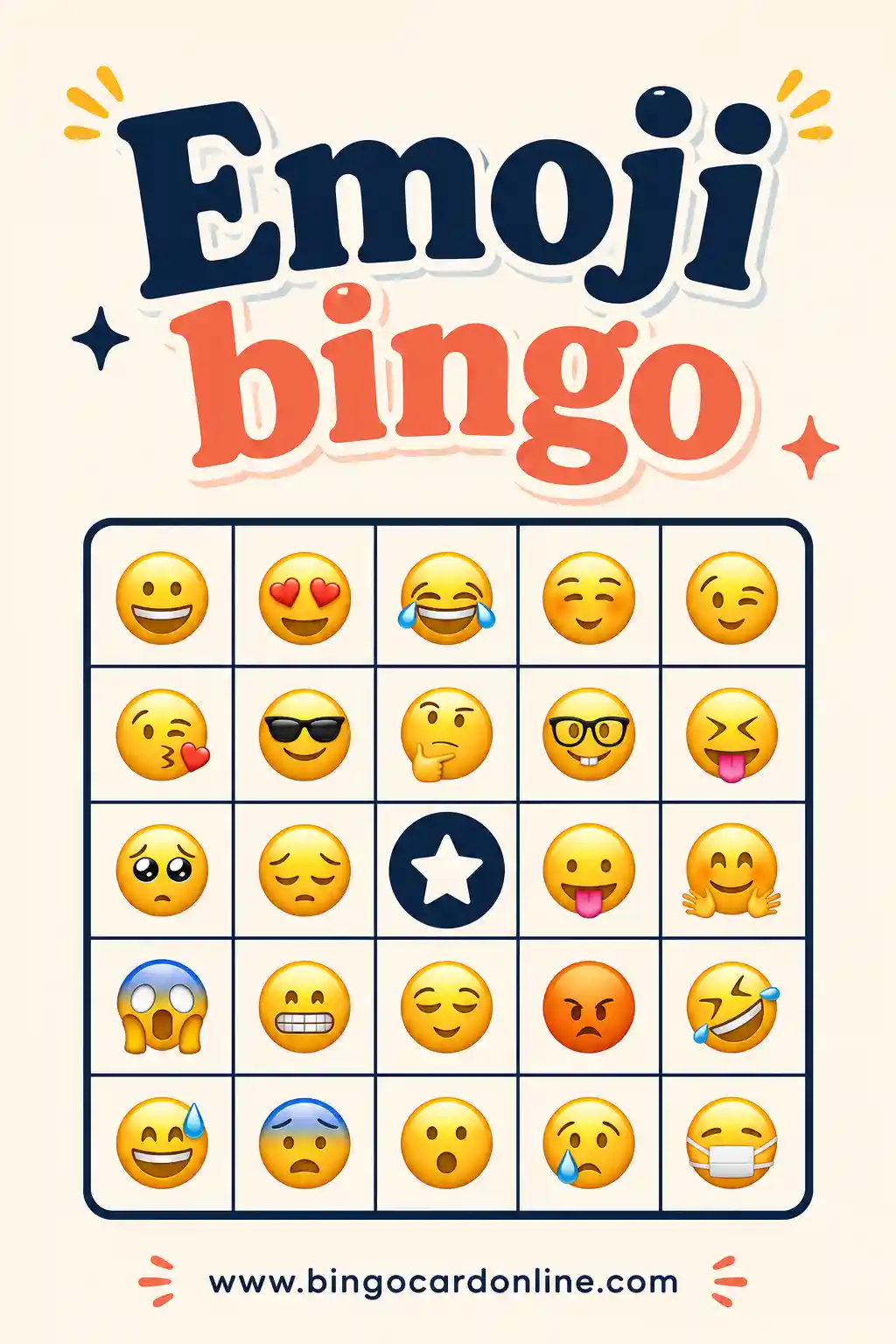
- Card type: Emoji, then choose the Christmas picture pack from the theme menu.
- Grid size: 3 × 3 or 4 × 4.
- Cards per page: 1 so the pictures are big.
- Number of cards: however many kids under seven you have, plus two.
When you call "snowman," kids look for the snowman picture while adults look for the word. Everyone's playing the same round. You can also mix words and pictures on one card by typing an emoji before each word in Words mode, like "⛄ Snowman."
Mixed Ages: Toddlers to Great-Grandparents at One Game
A 30-person Christmas usually spans four generations. The goal isn't one card that suits everybody. It's a setup where everyone has a fair, comfortable way to play.
| Who | Card | Cards per page | Markers | Helpful tweak |
|---|---|---|---|---|
| Ages 3 to 6 | 3×3 or 4×4 Emoji | 1 | Big stickers or a crayon | Sit with a parent or older cousin |
| Ages 7 to 12 | 5×5 words, same as adults | 2 | Crayon or dauber | Let one be the caller's helper |
| Teens and adults | 5×5 words | 2 | Pen, dauber or chips | Give teens a job: caller, checker, prize table |
| Grandparents with good eyesight | 5×5 words | 2 | Chips or buttons | Seat near the caller |
| Anyone with low vision or shaky hands | 5×5 or 4×4 words | 1 | Big chips or a thick marker | Ink-saver on for strong black-and-white contrast |
Large, easy cards for older relatives
For relatives who struggle with small print, three settings make a big difference:
- One card per page. The squares get much bigger.
- Ink-saver on. Black text on white paper is the clearest contrast.
- A 4×4 grid if 25 squares feels like too much to scan. A 4×4 card has no free center, so it needs 16 words; generate these as a small separate batch from the same 40-word list.
Seat these relatives close to the caller, and ask the caller to say each word twice and show it on a screen if you have one. For more on larger cards and calmer pacing, see bingo for large groups.
Show the calls on the TV
After you generate, click Play caller. A full-screen caller draws one word at a time with no repeats and keeps a history of everything called. It has an Undo button, a Voice option that reads each word out loud, and Auto-call every 5, 10 or 15 seconds.
In a room of 30, the screen does two jobs. People in the back can see the word, and when someone calls bingo, everyone can see the call history for themselves. Fewer arguments.
Pacing tip: In a mixed-age crowd, leave Auto-call off for the first round and tap Next yourself. Once people get the rhythm, 15 seconds a call works well for adults and older kids. If you have a lot of small kids or slow markers, stay manual.
A Six-Round Plan That Gives Everyone a Shot
The most common mistake with a big family is playing full-card rounds over and over. Each one runs 30-plus calls, kids drift away, and only one or two people ever win. Mixing short and long patterns keeps the energy up and spreads the wins around.
Here's a plan for 30 players with a 40-word list on 5×5 cards. Call times assume one call every 15 seconds. Add a minute or two per round for checking cards and handing out the prize.
| Round | Pattern | First winner usually around call | Calling time | Good for |
|---|---|---|---|---|
| 1 | Any line | 12 | About 3 minutes | Warm-up, teaches the rules |
| 2 | Kids' round: any line, kids under 12 only | 12 to 14 | About 3 minutes | Little ones get a guaranteed winner |
| 3 | Four corners | 17 | About 4 minutes | Easy to check from across the room |
| 4 | Two lines, or an X | Later than a single line | 5 to 6 minutes | Builds a little suspense |
| 5 | Grown-ups' round, or a "never won yet" round | 12 to 14 | About 3 minutes | Spreads the prizes |
| 6 | Full card (blackout) | 37 | About 9 minutes | The big finish, grand prize |
With checking and prizes, the whole game runs about an hour. If you need it shorter, drop round 4 and you're at about 45 minutes.
Fairness rounds
With 30 players and six rounds, most people won't win. That's normal, but at a family party you can tilt things toward people who haven't won:
- Kids-only round. Everyone keeps marking, but only players under 12 can claim the prize.
- "Never won before" round. Anyone who has already won a round this year sits out claiming.
- Generation round. "Only grandparents can win this one." Watching Grandma race her sister for four corners is half the fun of the night.
- One prize per person. If someone wins twice, the prize goes to the runner-up. Announce this rule at the start so nobody feels robbed.
You can print the shapes with Print winning patterns so people can see what an X or four corners looks like. You can also invent shapes, like a Christmas tree shape for a festive middle round.
Calling for a crowd of 30
- Use a mic or a strong voice. A crowded living room with a dishwasher running is loud. The Voice option on a speaker helps.
- Say it twice. "Wreath... wreath." People who were refilling their cocoa catch the second one.
- Wait for the room. Before the next call, glance at the kids' corner. If they're still hunting, give them three more seconds.
- Freeze on bingo. When someone calls it, stop calling right away. Don't draw the next word until the card is checked.
Prizes and Tiebreakers for a Big Family
How many prizes you actually need
Count it out from your round plan rather than guessing:
- One prize per round: 6
- Tie spares: 2 (ties happen in roughly one line round in six, and more often in a full-card round)
- Little-kid consolation prizes: 2 or a bag of stickers, for the kids' round
- Total: about 10 for 30 players
Make one prize clearly the "grand prize" for the full-card round. Everyone stays for the last round when there's something worth winning.
Prize ideas that suit every generation
Big families don't need expensive prizes. People mostly want bragging rights. A few ideas that cost little or nothing and work for any age:
- First pick of the dessert table or the leftovers to take home
- The good chair by the fire for the rest of the night
- Skip dish duty this year
- Choose the next game or the movie for the evening
- A homemade coupon from a grandparent: "One batch of my cookies, delivered in January"
- Keepsake ornament that the winner hangs on the tree and gets to take home
- A jar of homemade cocoa mix or a bag of cookies from the exchange
- The family trophy: an old ornament, mug or snow globe that gets passed to each year's champion and comes back next Christmas
That last one tends to become a tradition all on its own. For more ideas sorted by age group, see the bingo prize ideas guide.
Settling ties without hurt feelings
With 30 players, ties will happen. Decide your tiebreaker before the first call and announce it, so nobody thinks you made it up to favor your own kids.
Three tiebreakers that work well for families:
- Split the prize if it can be split (a plate of cookies, a pile of stickers).
- Sudden-death call. Keep calling. The first tied player whose card has the next word called wins. Since cards hold different words, this usually settles it in a few calls.
- Youngest wins, oldest picks. The youngest tied player takes the prize, and the oldest picks the pattern for the next round. Kids and grandparents both seem to like this one.
The bingo tiebreaker rules guide has more options if your family takes this seriously.
Checking a winner quickly
When someone calls bingo, check it fast, because 29 people are waiting:
- Have the winner read their winning words out loud.
- Look each one up on the master call sheet, or on the caller's history on the screen.
- If they're all called, it's a win. If one isn't, smile and say, "So close. Keep going," and resume calling.
Assign a teen or an adult as the official checker so the caller can keep the game moving. Having someone else do the checking also keeps the caller from looking like they're bending the rules for their own family branch.
Big-Family Bingo Timeline: Two Weeks Out to Christmas Day
Hosting 30 relatives is a lot of moving parts, and bingo shouldn't be one more last-minute scramble.
Two weeks before
- Get a head count, including how many kids under seven
- Ask a teen or two to be the caller's helper and checker
- Start gathering prizes and decide on a grand prize
One week before
- Make your 40-word list. Ask the group chat for two or three family words each
- Generate the full batch in the bingo card generator: 36 adult cards on 5×5 and a small Emoji batch for little kids
- Save both PDFs to your computer and to your phone
- Print a test page to check that the squares are readable
Two or three days before
- Print all the cards, the master call sheet and the winning patterns
- Print paper chips with Print bingo markers / chips if you're using them, and cut them out (a good job for kids who arrive early)
- Put markers in cups, one per table or couch group
Christmas Day
- Test the caller on the TV before guests arrive
- Put the cards, markers and pens in a basket by the door so people grab one as they settle
- Start the game after the main meal, when people are full and happy to sit
- Hand prizes out right after each round, not at the end, so kids don't wait an hour
Supplies for 30 relatives
| Item | How many | Notes |
|---|---|---|
| 5×5 adult cards | 36 | 18 sheets at 2 per page |
| Kids' picture cards | Number of small kids plus 2 | 1 per page |
| Large-print cards | As needed | 1 per page, ink-saver on |
| Pens, daubers or chips | 1 per player | Plus a few spares |
| Master call sheet | 1 | For the checker |
| Winning patterns sheet | 1 or 2 | Tape near the TV |
| Prizes | About 10 | Including one grand prize |
Troubleshooting Big-Family Christmas Bingo
| Problem | Likely cause | Fix |
|---|---|---|
| Five people call bingo on the same word | List too short, or every card has the same 24 words | Use 40 or more words and generate again |
| The tool notes every card has the same items | Your list has exactly as many words as squares | Add at least 16 more words |
| Someone has the exact same card as another person | Cards were made from a shared link on two devices | Generate the full batch on one device and share the PDF |
| The full-card round drags past 10 minutes | Long list and slow calling | Speed up to 10 seconds a call, or play two lines instead |
| Kids wander off after round two | Long rounds, no kid winners | Add a kids-only round and give out stickers |
| Grandparents can't read the squares | 2 or 4 cards per page | Reprint their cards at 1 per page with ink-saver on |
| People in the back can't hear | Big room and background noise | Put the caller on the TV, turn on Voice, say each word twice |
| Arguments over what was called | No visible record | Show the caller's history on screen and assign a checker |
| The same person wins three times | Luck, but it feels unfair | One prize per person; next one goes to the runner-up |
| Not enough cards when late guests arrive | No spares | Print 20% extra, or generate a few more at the party |
Ready to make your family's cards?
Hosting 30 people takes plenty of planning. The bingo part shouldn't. Open the free bingo card generator, start from the 20-word Christmas list with the button on this page, add another 20 or more words your family will love, set the grid to 5 × 5 with the free center on, type in your number of cards, and click Generate cards. For more holiday themes to mix in, the Christmas bingo cards page has extra lists.
▶ Make these exact bingo cards
Frequently Asked Questions
How many bingo cards do I need for 30 people?
Print 36: one per player plus about 20% spare. Spares cover late arrivals, spills and people who change their minds about playing. At two cards per page, that's 18 sheets of paper.
How many words do I need for Christmas bingo with a big family?
For 5×5 cards with a free center, use at least 40 words for 30 players. Each card needs 24 words, so 40 leaves 16 out of every card and makes the cards truly different. With only 24 words, everyone wins the full-card round on the same call.
How do I stop several people from winning at once?
Use a longer word list, generate all cards in one batch, and mix in patterns like four corners and two lines instead of only single lines. Ties can still happen in a group of 30, so announce a tiebreaker before you start.
How many rounds of bingo should we play at a family Christmas?
Five or six rounds fits nicely into about an hour for 30 people. Start with a single line, add a kids-only round and a four corners round, and finish with a full-card round for the grand prize. Drop a round if you have lots of very young kids.
Can toddlers and grandparents play the same game?
Yes. Give small kids picture cards from Emoji mode on a 3×3 or 4×4 grid, and give older relatives one-card-per-page prints with ink-saver on for strong contrast. Everyone listens to the same caller, so the whole family plays together.
How long does a full-card round take with 40 words?
With 30 players, the first full card usually comes around the 37th call. At one call every 15 seconds, that's about nine minutes of calling, plus a couple of minutes to check the card.
Can relatives print their own cards from a shared link?
They can open your setup from a link, but cards made separately on different devices aren't checked against each other, so duplicates are possible. It's safer for one person to generate the whole batch and send everyone the PDF.
How many prizes should I buy for 30 relatives?
About ten covers most parties: one per round for six rounds, two spares for ties and a couple of small extras for the kids' round. Prizes don't have to be bought at all. Skip-dish-duty passes and a traveling family trophy go over well.