Christmas Math Bingo: Free Addition, Subtraction and Multiplication Cards
Christmas math bingo is bingo where the squares are answers. You call a math fact like "6 times 7," and kids mark 42 if it's on their card. Below are three ready sets with full call lists: addition to 10 for K-1, adding and subtracting to 20 for grades 2 and 3, and multiplication for grades 3 to 5. Each one prints as unique cards in the holiday colors, so it's a perfect December math center for the last two weeks before winter break.
The button opens the multiplication set (5x5, free center, 30 answers). The links to the other two sets are in their own sections below.
▶ Make these exact bingo cards
How Christmas math bingo works
- Print cards for your grade level. Each card shows numbers (the answers) in a different order.
- Call a fact from the list below. Read it out loud and write it on the board. For a festive touch, wrap it in a little story: "Each of 8 reindeer has 4 legs. How many legs?"
- Kids solve it and mark the answer if it's on their card. No calculator, no shouting the answer.
- First to complete a line calls "Bingo!" and reads back their marked answers. If they can say the fact for each one, they win.
That last step is the secret. Making the winner explain each answer turns a lucky card into real practice, and it stops anyone from marking random numbers and hoping.
Set 1: Christmas addition bingo for K-1 (addition to 10)
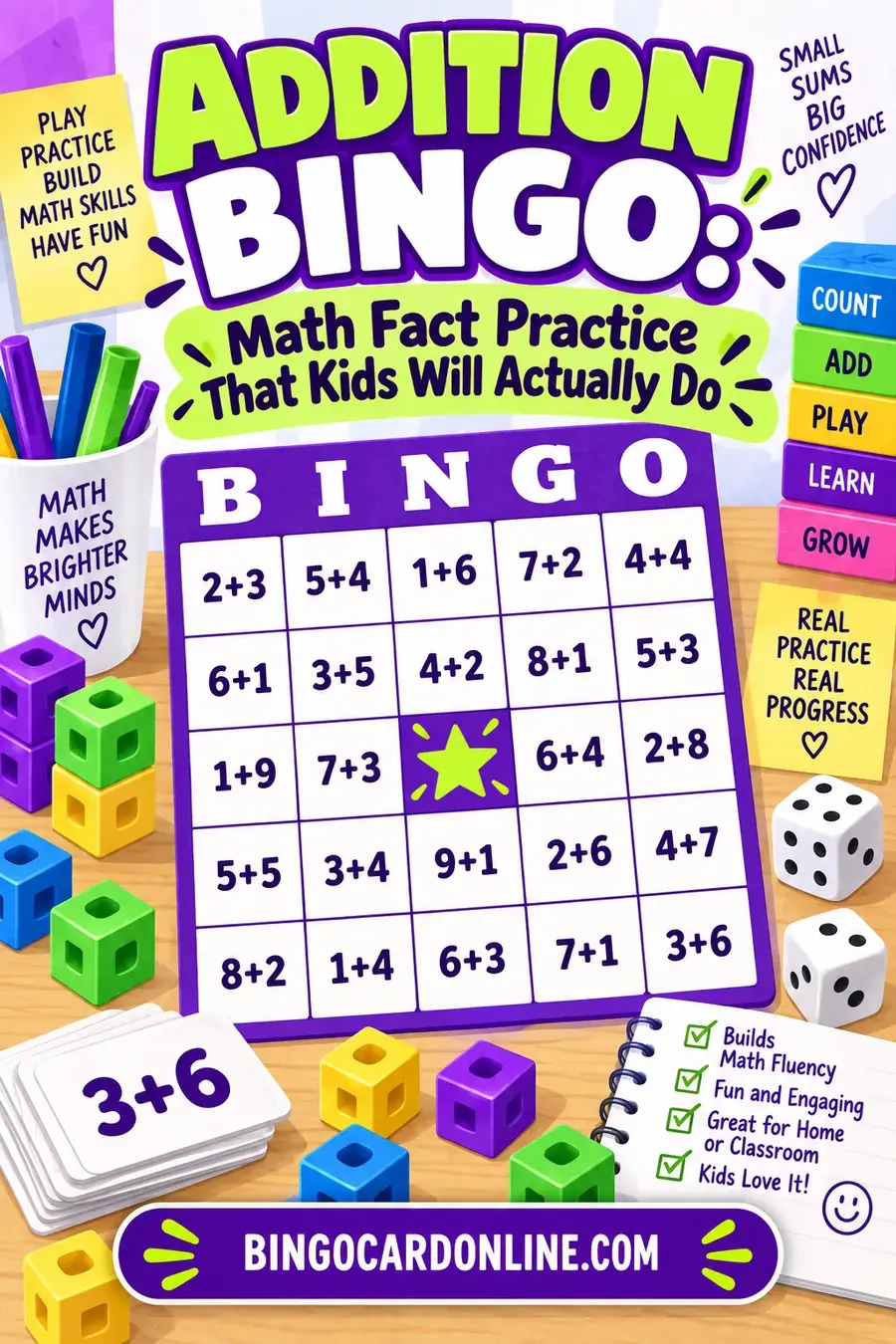
This set uses the answers 0 to 10 on a small 3x3 card, so it moves quickly and nobody gets overwhelmed. Make the K-1 addition cards (3x3, answers 0 to 10).
| Answer | Call | Say it like this |
|---|---|---|
| 0 | 0 + 0 | An empty stocking plus nothing more |
| 1 | 1 + 0 | 1 star on top of the tree, and no more |
| 2 | 1 + 1 | 1 mitten and 1 more mitten |
| 3 | 2 + 1 | 2 candy canes and 1 more |
| 4 | 2 + 2 | 2 snowmen and 2 more snowmen |
| 5 | 3 + 2 | 3 cookies on the plate and 2 more |
| 6 | 4 + 2 | 4 bells and 2 more bells |
| 7 | 5 + 2 | 5 ornaments and 2 more |
| 8 | 4 + 4 | 4 presents and 4 more presents |
| 9 | 6 + 3 | 6 snowflakes and 3 more |
| 10 | 5 + 5 | 5 fingers in one mitten and 5 in the other |
Tip for little ones: give each child ten small counters (mini marshmallows or pom-poms) so they can act out each fact before marking.
Set 2: Christmas addition and subtraction bingo for grades 2 and 3 (within 20)
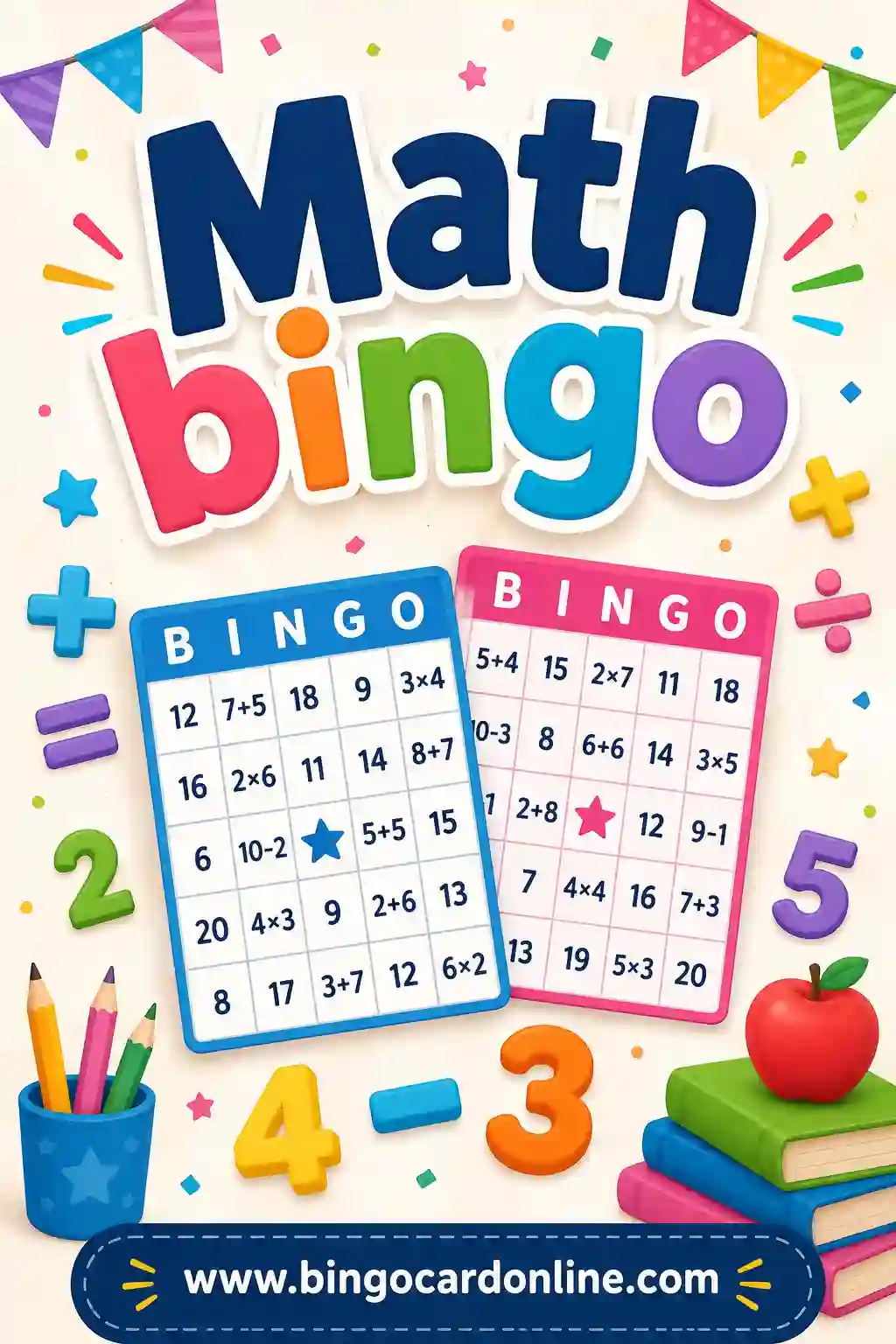
This set mixes adding and subtracting with answers from 0 to 20 on a 4x4 card. Make the grades 2 and 3 cards (4x4, answers 0 to 20).
| Answer | Call | Say it like this |
|---|---|---|
| 0 | 9 - 9 | 9 cookies, and Santa ate all 9 |
| 1 | 12 - 11 | 12 lights, 11 burned out |
| 2 | 11 - 9 | 11 gifts, 9 opened |
| 3 | 15 - 12 | 15 carolers, 12 went home |
| 4 | 13 - 9 | 13 candy canes, 9 eaten |
| 5 | 14 - 9 | 14 ornaments, 9 hung up so far |
| 6 | 15 - 9 | 15 snowballs, 9 thrown |
| 7 | 16 - 9 | 16 elves, 9 on a break |
| 8 | 17 - 9 | 17 stockings, 9 filled |
| 9 | 18 - 9 | 18 cards, 9 mailed |
| 10 | 6 + 4 | 6 bells and 4 more |
| 11 | 8 + 3 | 8 reindeer and 3 more |
| 12 | 7 + 5 | 7 gingerbread men and 5 more |
| 13 | 9 + 4 | 9 sleds and 4 more |
| 14 | 8 + 6 | 8 mittens and 6 more |
| 15 | 7 + 8 | 7 wreaths and 8 more |
| 16 | 9 + 7 | 9 stars and 7 more |
| 17 | 8 + 9 | 8 snowmen and 9 more |
| 18 | 20 - 2 | 20 cookies, 2 left for Santa |
| 19 | 11 + 8 | 11 presents and 8 more |
| 20 | 12 + 8 | 12 candles and 8 more |
Notice how many subtraction facts take away 9? That's on purpose. "Minus 9" is one of the trickiest fact families for second graders, so a December review is a good time to hit it.
Set 3: Christmas multiplication bingo for grades 3 to 5
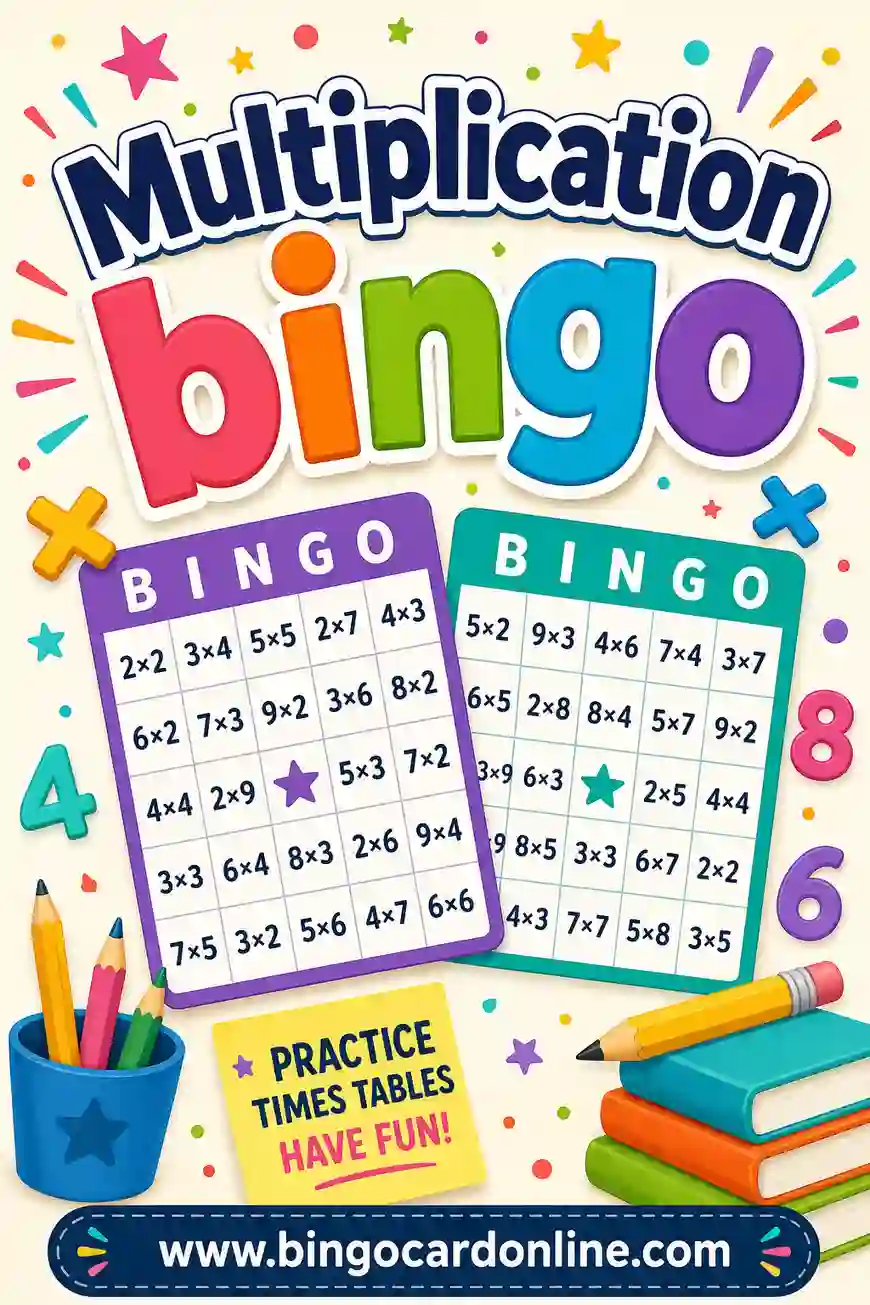
This is the set loaded in the button above: 30 products on a 5x5 card with a free center. Call each fact once, and cross the answer off your master list.
| Answer | Call | Answer | Call | Answer | Call |
|---|---|---|---|---|---|
| 12 | 3 x 4 | 28 | 4 x 7 | 54 | 6 x 9 |
| 14 | 2 x 7 | 30 | 5 x 6 | 56 | 7 x 8 |
| 15 | 3 x 5 | 32 | 4 x 8 | 60 | 6 x 10 |
| 16 | 4 x 4 | 35 | 5 x 7 | 63 | 7 x 9 |
| 18 | 3 x 6 | 36 | 6 x 6 | 64 | 8 x 8 |
| 20 | 4 x 5 | 40 | 5 x 8 | 70 | 7 x 10 |
| 21 | 3 x 7 | 42 | 6 x 7 | 72 | 8 x 9 |
| 24 | 4 x 6 | 45 | 5 x 9 | 80 | 8 x 10 |
| 25 | 5 x 5 | 48 | 6 x 8 | 81 | 9 x 9 |
| 27 | 3 x 9 | 49 | 7 x 7 | 90 | 9 x 10 |
Christmas story problems to read instead
Swap a plain fact for a story every few calls. Kids pay closer attention when there's a picture in their head.
- Santa's sleigh is pulled by 8 reindeer. Each has 4 legs. How many legs? (32)
- 6 stockings each hold 7 candy canes. How many candy canes? (42)
- A cookie tray has 5 rows of 9 cookies. How many cookies? (45)
- 7 elves each wrap 8 presents. How many presents? (56)
- A tree has 9 branches with 9 ornaments on each. How many ornaments? (81)
- The class makes 10 paper chains with 6 links each. How many links? (60)
Some answers have more than one fact (24 is 4 x 6 and also 3 x 8). That's fine. Just call each answer once, using whichever fact your class is working on. For a bigger times-table game, see multiplication bingo.
Fitting math bingo into the last weeks before break
The days before winter break are long, loud and short on focus. Math bingo helps because it's real practice that feels like a party.
- As a math center. One small group plays with a student caller while you work with another group.
- As a warm-up. One quick line game at the start of math class, about 10 minutes.
- At the class party. Swap one regular bingo round for a math round. The classroom Christmas party bingo page has a calm word game for the rest of the party.
- For mixed levels. Run two sets at once. Kids with the addition cards and kids with the multiplication cards can play in the same round if you call one fact from each list.
Looking for math bingo the rest of the year? Math bingo and addition bingo cover the same idea without the holiday theme.
Common mistakes with math bingo
- Calling the answer instead of the fact. It happens more than you'd think. Read from the "Call" column only.
- Forgetting to track calls. Cross off each fact so you can check a winner and never repeat one.
- A list that's too short for the card. With 9 squares and only 9 answers, every card wins at the same time. Each set here has more answers than squares.
- Going too fast. Give at least 10 to 15 seconds per fact, longer for multiplication. The generator's auto-call timer helps you keep a steady pace.
▶ Make these exact bingo cards
Frequently Asked Questions
How does Christmas math bingo work?
The squares are answers. The caller reads a math fact like 6 x 7, students solve it, and anyone with 42 on their card marks it. The first to finish a line wins if they can say the fact for each marked answer.
Is there a Christmas addition bingo for kindergarten?
Yes. Set 1 on this page uses answers 0 to 10 on a 3x3 card with simple facts like 2 + 2 and 5 + 5, plus Christmas story wording to read aloud.
How do I play Christmas multiplication bingo?
Print the 5x5 cards from the button on this page. They hold 30 products from 12 to 90. Call each fact from the list once, cross it off, and check the winner's answers against your list.
What is a good December math game for the last week before break?
Math bingo works well because it's real fact practice that feels like a party. Use it as a 10-minute warm-up, a math center with a student caller, or one round at the class party.
How many answers do I need for math bingo?
More answers than squares, so cards differ. A 3x3 card needs at least 10, a 4x4 card at least 17 and a 5x5 card about 30. The three sets here are 11, 21 and 30 answers.