Kindness Bingo: Free Printable Kind Acts Challenge
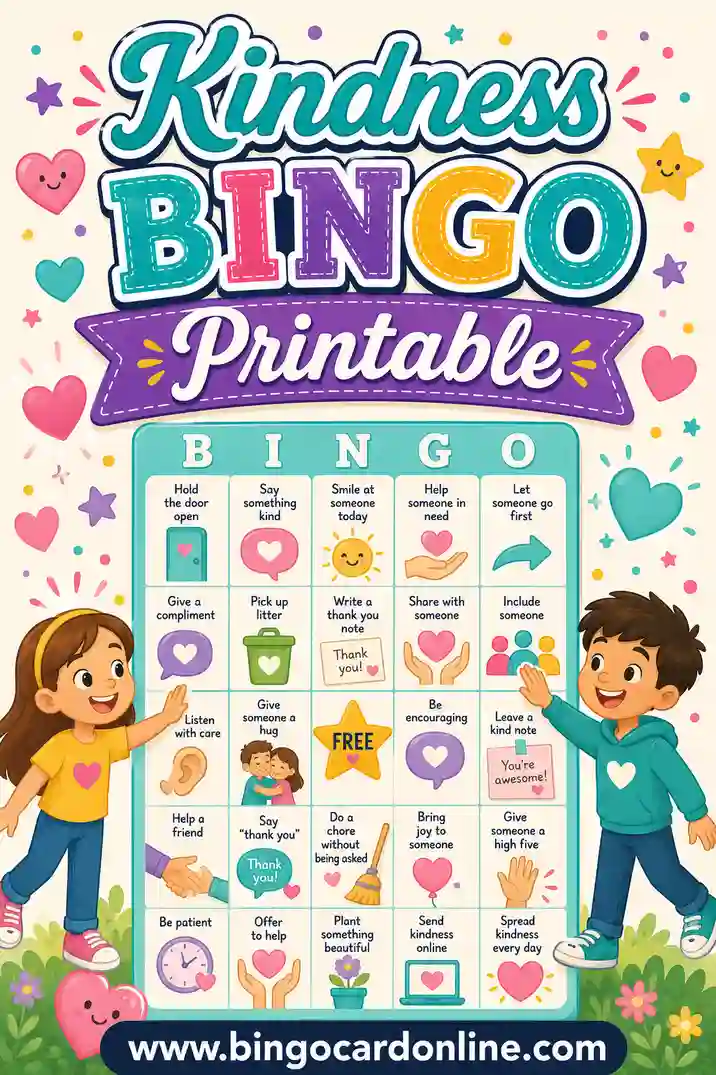
Kindness bingo is a bingo card where every square is a small act of kindness — "give someone a compliment," "hold the door," "write a thank-you note" — and instead of waiting for a caller, players do the squares. Complete a kind act, mark the square. Finish a line (or the whole card), and you've won something better than a prize: a genuinely nicer week. If you're after a kindness bingo printable for your classroom, family, or youth group, the free bingo card generator turns a list of kind acts into unique printable cards in about two minutes.
In a hurry? Open the free generator, paste the kind-acts list below, pick a grid size (4x4 is the sweet spot for a one-week challenge), and print a card for every participant. Free, no sign-up.
What Is Kindness Bingo?
Kindness bingo takes the familiar bingo grid and turns it into a challenge card. There's no caller and no luck — each square names a small, doable kind act, and players mark squares by actually doing them. It's played over time rather than in one sitting: a class period, a week, or a whole month, depending on how ambitious the squares are.
Because everyone can be "doing bingo" at once without anyone losing, it works beautifully in settings where competition would sour the point. The usual formats:
- 3x3 (9 squares) — a single-day challenge for young kids. "Kindness day" in preschool or a Sunday school hour.
- 4x4 (16 squares) — the one-week classroom classic. A line by Wednesday, a blackout by Friday for the go-getters.
- 5x5 with a free space (24 squares) — a full-month family or school challenge, one act every day or so.
The twist that makes it work: give each player a different card. When every kid has "share a snack" on a different day and a different neighbor has "invite someone to play," kindness spreads unpredictably instead of the whole class holding doors in unison on Monday. The generator shuffles one list into unique cards automatically.
Why Kindness Bingo Actually Works
Telling kids (or adults) to "be kind" is weather. A kindness bingo card is a forecast with checkboxes. A few reasons this format sticks where posters don't:
- It makes kindness concrete. "Be kind" is abstract; "write a thank-you note to the janitor" is an errand a seven-year-old can complete before lunch.
- The grid creates gentle momentum. Two marked squares in a row practically beg for a third. That's the bingo mechanic doing SEL work.
- It's self-directed. Nobody is watching or grading. Players choose which square to tackle next, which turns kindness into initiative instead of compliance.
- Everyone can win. A blackout card isn't a competition against classmates — it's a personal finish line. Shy kids and star students play the same game.
Teachers use it for social-emotional learning units and anti-bullying weeks; families use it to reset a cranky household; churches use it to make a sermon topic walk around in the world. Same card, different rooms.
Free Kindness Bingo Square List (Copy & Paste)
Thirty kind acts, sorted by where they happen. Copy a column into the generator, or mix all three for a card that follows kids from school to home.
| At School | At Home | Anywhere |
|---|---|---|
| Invite someone to play | Do a chore without being asked | Give a genuine compliment |
| Say thank you to a helper | Make someone's bed | Hold the door for someone |
| Help someone pick up spilled things | Set the table | Smile and say good morning |
| Sit with someone new at lunch | Read to a younger sibling | Pick up a piece of litter |
| Write a thank-you note to a teacher | Give a family member a hug | Let someone go ahead of you |
| Share your supplies | Help cook a meal | Make someone laugh |
| Cheer for a classmate | Say sorry and mean it | Draw a picture for someone |
| Teach someone something you know | Call a grandparent | Check on a friend |
| Give a high five | Put away someone else's dishes | Listen without interrupting |
| Say something kind to yourself | Leave a kind note for someone | Give an honest "great job" |
Writing your own squares
- Keep acts small and finishable. "End world hunger" is a mood-killer; "share a snack" gets done by recess.
- Include self-kindness. One or two squares like "say something kind to yourself" quietly teach that the circle includes them.
- Match the setting. For a workplace card, swap in "bring coffee for a teammate" and "reply to that email kindly." For church groups, add service-oriented squares — more on that in bingo for Sunday school.
- Avoid money squares for kids. "Donate to charity" depends on a parent's wallet. Keep acts within a child's own power.
How to Make Your Kindness Bingo Printable in 4 Steps
- Open the free generator and paste your kind acts, one per line. Aim for 25–30 so every player's card comes out different.
- Pick a grid size. 3x3 for a single day with little kids, 4x4 for a week, 5x5 for a month-long challenge.
- Add a title. "Room 12 Kindness Challenge" or "The Garcia Family Kindness Bingo" prints at the top of every card and makes it feel official.
- Print one unique card per player, plus spares. Save the PDF so you can reprint for the next round without redoing anything.
Marking works however you like: crayons, stickers, a dauber dot per completed act, or a parent's initials for verification if your players are the "creative accounting" type.
Who Kindness Bingo Is Great For
Elementary classrooms
The heartland of kindness bingo. Run it as a week-long challenge during an SEL unit or kindness week: hand out cards Monday, share stories in Friday circle time. The stories are the real payoff — "I sat with someone new and now we're friends" beats any sticker chart. For more curriculum-friendly formats, see classroom bingo.
Families
A card on the fridge for each family member (parents included — kids love auditing parents) turns a long school break or a grumpy season into a friendly competition to out-nice each other. Pair it with a reward the whole family shares, like picking the movie for family game night.
Sunday school and youth groups
Kindness squares make an abstract lesson practical: hand out cards after the lesson and review them next week. Squares like "pray for someone" or "help without being asked" tie directly back to the teaching.
Scouts, clubs, and counselors
Kindness bingo slots neatly into character-building badge work and small-group counseling, where a concrete, low-pressure activity gives kids something to do between sessions.
Printing Tips for a Challenge That Lasts All Week
- Cardstock or laminate. A challenge card lives on a fridge, in a backpack, or taped to a desk for days or weeks. Regular paper won't survive the journey.
- One card per page. Squares need room for stickers, initials, or a scribbled date. Skip compact layouts.
- Print a master list for yourself. The generator's call sheet doubles as the leader's overview of every act in play — handy for Friday share-outs.
- Send the PDF home. Teachers: saving as a PDF means absent kids and interested parents can print their own copy.
- A blank version invites ownership. Print a few blank bingo cards and let kids write their own kind acts — older students especially take the challenge more seriously when they authored the squares.
Ways to Run the Challenge
- Classic line. First line completed earns a small privilege. Fast and motivating for younger kids.
- Blackout month. Every square by the 30th. Best with a 5x5 and a calendar on the wall.
- Team grid. One giant shared card for the whole class or family; anyone can claim any square by doing it and writing their name in. Watch the last three squares become hot property.
- Story bingo. A square only counts once you've shared the story of doing it at dinner or circle time. Slows the pace, deepens the point.
- Secret square. The leader privately picks one square; whoever completes that act during the week gets a bonus. Keeps every square worth doing.
Common mistakes to avoid
- Squares that are too big. One un-doable square ("volunteer at a shelter" for a kid with no ride) stalls a whole card. Keep acts within players' own reach.
- Turning it into surveillance. Verification should be light — the honor system with story-sharing beats signature-hunting. It's kindness, not compliance.
- Prizes that overshadow the point. Small and shared works best: extra recess, the movie pick, first in line. A big prize makes kids kind at people.
- Same card for everyone. Identical cards mean the whole group does the same act the same day. Unique shuffled cards spread the kindness around.
Frequently Asked Questions
Is there a free kindness bingo printable?
Yes. The generator is completely free — paste a kind-acts list (the one above is copy-ready), pick a grid size, and print unique cards for your whole class or family. No account, no watermark.
How long should a kindness bingo challenge run?
Match the grid to the timeline: 3x3 for one day, 4x4 for a week, 5x5 for a month. A week is the sweet spot for classrooms — long enough to build a habit, short enough to keep momentum.
What ages does kindness bingo work for?
Preschool through adult. Use a 3x3 with picture-friendly acts for pre-readers, a 4x4 for elementary, and a 5x5 with meatier squares ("reach out to someone you've lost touch with") for teens and grown-ups.
How do kids prove they did a square?
Keep it light: the honor system, a parent's or teacher's initials, or sharing the story out loud. The goal is reflection, not auditing.
Can I make a card with our own family or class acts?
That's the best version. Type your own squares into the generator — inside jokes, house rules, your class's specific friction points ("let someone else feed the fish") — and every card prints with your custom list, shuffled uniquely.
Ready to Print Your Kindness Bingo Cards?
Copy the kind-acts list above, open the free bingo card generator, add your class or family name to the title, and print a unique card for every player. It costs nothing, takes five minutes, and by Friday someone will have made a new friend over a shared snack. That's a pretty good return on one sheet of cardstock.