Mixtape Bingo: Music Bingo for Any Playlist
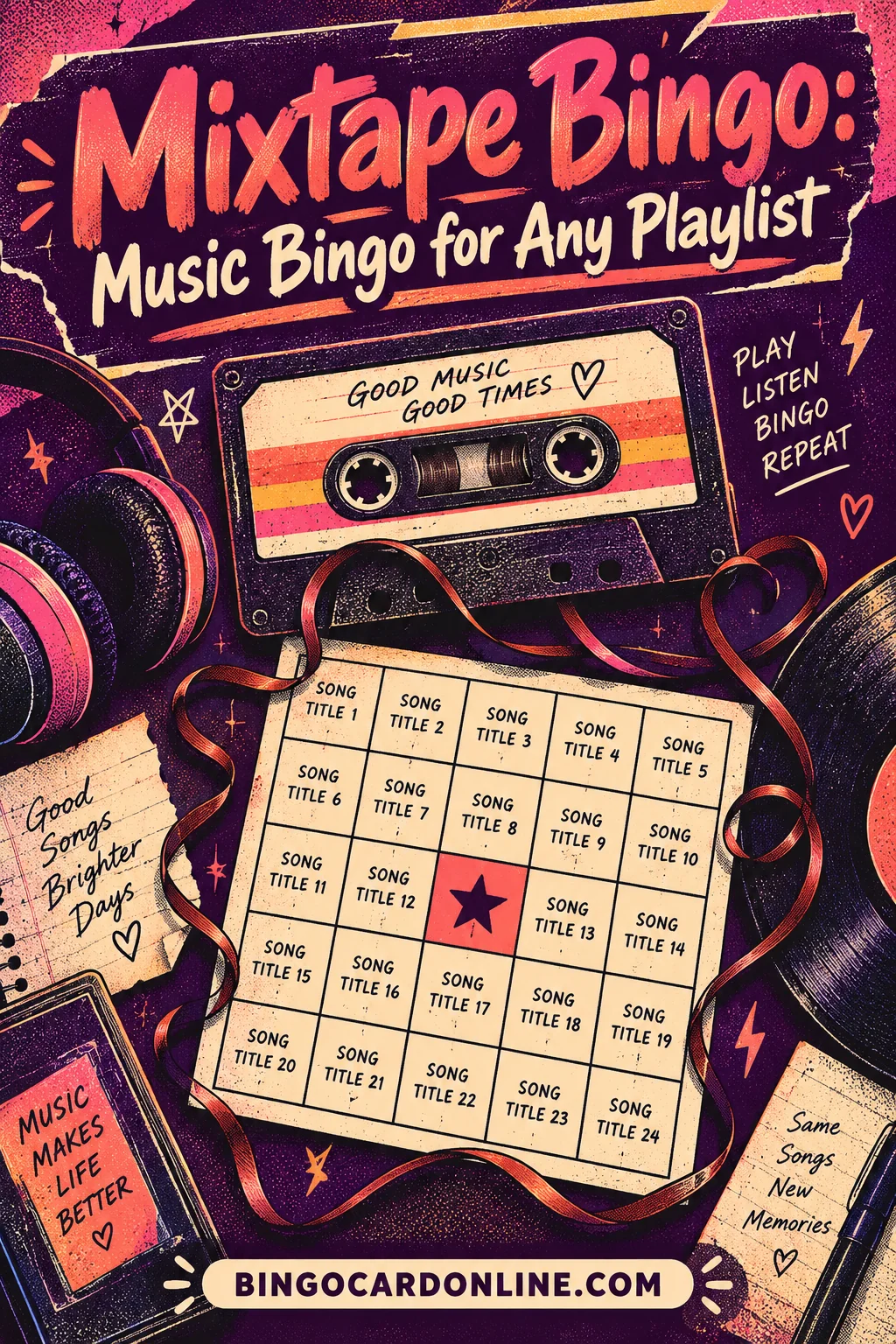
Mixtape bingo is music bingo built from a playlist you choose: each square holds a song title instead of a number, the host plays short clips in random order, and players mark the tracks they recognize until someone completes a line. Build it from 24 to 30 songs, give every player a differently shuffled card, and a round takes about twenty minutes.
It works because recognition is fast and satisfying. Players do not have to know lyrics, artists, or release years. They only have to hear four seconds of an intro and find the title on their card, which means a room with wildly different music knowledge can still play together.
How a round actually runs
The host prepares one playlist and a set of cards drawn from the same song list. Each card is a 5x5 grid with a free space in the middle, so 24 songs per card. If the playlist is larger than 24, different cards get different subsets, which makes the game less predictable.
The host plays a clip, long enough to recognize and short enough to stay brisk. Players scan their grid, find the title, and mark it. The host keeps a checklist of what has been played, because verifying a win later is impossible from memory once you are forty tracks deep.
Someone shouts. The host stops the music, reads back the claimed line, and checks each title against the played list. If it holds, that is the round. If it does not, play resumes, which happens more often than you would expect and is part of the fun.
Choosing the playlist
The playlist is the game. Everything else is logistics. Three rules make the difference between a room that lights up and a room that goes quiet.
Pick songs the room actually knows. Obscure tracks feel clever to the host and miserable to everyone else. If half the room cannot mark a square, the game stalls. When in doubt, choose the more famous song by the same artist.
Spread the difficulty. A playlist of nothing but instantly recognizable openings finishes too fast. A playlist of deep cuts drags. Aim for roughly two thirds obvious and one third that takes a moment, so there is a mix of instant hands and slow dawning recognition.
Use titles people would say out loud. A title that appears in the chorus is easier to match than one that never appears in the lyrics at all. This is the single most common reason a player hears a song, knows it perfectly, and still cannot find the square.
Theme the list if you can. A decade, a genre, a mood, songs from movies, songs with a color in the title, tracks from the year the guest of honor was born. A theme gives the room a frame, and it makes the near-misses funnier.
| Playlist theme | Works best with | Watch out for |
|---|---|---|
| One decade | Mixed-age groups | Everyone knows the same ten hits |
| Road trip songs | Long, casual sessions | Titles that never appear in lyrics |
| Movie soundtracks | Film-heavy crowds | Instrumentals with no title cue |
| One artist deep cut | Devoted fandoms | Excludes casual listeners entirely |
| Wedding floor fillers | Receptions, reunions | Very short recognition times |
| Songs with a name in them | Family parties | Runs out of options fast |
Building the cards
Write out the song list, then generate a card for each player with the titles shuffled into different positions. Every card should draw from the same pool so that any played song is markable by somebody, but no two cards should have the same arrangement.
A bingo card generator handles the shuffling and the printing, which is the part that goes wrong when people build cards by hand. Hand-built cards have a way of accidentally sharing a row, and then two people win simultaneously on the eleventh song.
Print more cards than you have guests. There will be latecomers, someone will spill something, and a second round always wants fresh grids. Keep a small stack in reserve.
Decide how players mark. Pens are simplest. Small candies or coins let players clear a card for reuse, which matters if you are running several rounds and do not want to reprint between them. Dabbers are the traditional choice and the messiest.
Clip length, and the one setting that sets the tone
Clip length controls the entire feel of the game.
Short clips of three to five seconds make it a reflex test. The room is loud, hands go up fast, and rounds finish quickly. This suits a high-energy crowd and a playlist of very familiar tracks.
Longer clips of fifteen to twenty seconds make it social. People sing along, argue, and remember things. Rounds take longer, the room is warmer, and the game becomes an excuse for the music rather than the other way around.
Most hosts want the second thing and set up the first by accident. If your party is a party rather than a competition, play the clips longer than instinct suggests, and let a chorus land occasionally.
Start each clip somewhere other than the very beginning for a harder game, or right at the intro for an easier one. Intros are the most recognizable part of most recorded songs, so starting mid-verse quietly raises the difficulty without changing the playlist at all.
Winning patterns worth using
A straight line is the default and it is fine. But a night of several rounds gets better when the pattern changes.
Line. Any row, column, or diagonal. Fast, and the right choice for a first round while people learn the rhythm.
Four corners. Very fast, good as a warmup or a tiebreaker while food is being served.
X or plus. Nine squares, moderate length, and visually satisfying to complete.
Blackout. The whole card. This takes the entire playlist and is best saved for the last round, since it guarantees everyone stays engaged to the end rather than losing interest after somebody wins early.
Announce the pattern before the round starts and repeat it once mid-round. Half the disputes in any bingo game come from someone playing a different pattern in their head.
How people search for it: online bingo bingo and other odd phrases
Look at how people actually type this into a search box and you will find a lot of repetition: online bingo bingo, bingo online bingo, free online bingo, bingo online free. These are not different products. They are people stacking the words they associate with the thing until the search box gives them a card generator.
That matters for one practical reason. When you are looking for a tool to build cards, the phrasing you use barely changes what you find, so search for the thing you actually need instead. "Music bingo card generator" or "custom word bingo" gets you where you want to go far faster than free bingo does, because it describes the function rather than the category.
It is also worth separating two very different meanings hiding under the same words. Playing bingo online can mean gambling with real stakes, or it can mean a group game with no stakes at all where the prize is a candy bar and bragging rights. Mixtape bingo is firmly the second kind. When you search, add words like "printable," "party," or "generator" to steer away from the gambling results.
Hosting a room of any size
Six to ten people. One host, one speaker, printed cards. No microphone needed. This size lets the host keep the running list on paper and verify wins by reading them out.
Twenty to forty people. Get the audio right first, because a playlist that sounds fine on a laptop speaker disappears in a room of thirty talking guests. Assign a second person to verify wins so the music does not stop for two minutes each time.
Fifty and up. Split into teams sharing a card. It halves the number of cards, it makes verification manageable, and it turns the quiet players into contributors, since somebody at every table will know the track nobody else does.
For any group larger than a dozen, put the played song list on a screen after each round. It settles arguments instantly and it lets latecomers see what they missed.
Variations once the basic game is familiar
Lyric bingo. Squares hold a line from the chorus rather than a title. Harder, and it rewards people who actually know the words.
Artist bingo. Squares hold artists rather than songs, so any track by that artist marks the square. This is much easier and works well for younger players.
First-second bingo. Play only one second of each track. Chaotic, very funny, and best as a short bonus round rather than a full game.
Decade shuffle. Every fifth song jumps to a different decade. Keeps a mixed-age room engaged, because nobody is ever more than a few tracks from their own era.
Guest playlist. Ask each guest to submit one song in advance and build the card from the submissions. The game becomes partly about guessing who chose what, which is a different and often better party game hiding inside the first one.
Mistakes that flatten a good playlist
Skipping the sound check. The most common failure has nothing to do with the game. A playlist that sounds full on headphones is thin and unintelligible through a small speaker in a room full of people. Test at party volume, in the room, with at least one other person talking.
No written list of what has been played. Without it, you cannot verify a win, and a disputed win in the last round of the night is a genuinely bad way to end. Tick each track as you play it.
Letting the game run too long. Three rounds of twenty minutes is a good night. Six rounds is a chore. Stop while people still want another one, and they will ask for it next time.
Announcing the pattern once. Say it before every round, even when you think everyone heard. Somebody was getting a drink.
Building the playlist alone the morning of the party. Rushed lists skew toward whatever you happen to be listening to, which is the least representative sample of what a room knows. Start the list a week out and add to it as songs occur to you.
Forgetting quiet players. In any group there is someone who knows every track and never shouts. Team play fixes this, and so does asking each table for their answer rather than waiting for the loudest voice.
What to give as prizes
Keep prizes small and slightly silly. A homemade trophy, the right to choose the next playlist, first pick of dessert, or naming rights over the next round's theme all work better than anything with real value, because they keep the game friendly.
If the group is competitive, run a points system across several rounds rather than a single winner-takes-all. Three short rounds with a running score keeps more people invested through the end of the night than one long round that somebody wins in the first ten minutes.
Frequently Asked Questions
How many songs do I need for a game of mixtape bingo? Twenty-four fills a standard card with a free center space, but thirty to thirty-five gives you enough variety that cards genuinely differ from each other. For a blackout round, expect to play nearly the whole list before anyone completes a card.
Do all the players need different cards? Yes, or you will get simultaneous winners on the same line. Generate a separate shuffle for every player, and print a few spares so latecomers can join a round in progress without waiting for the next one.
How long should each song clip be? Between five and twenty seconds, depending on the mood you want. Short clips make it a fast recognition contest, and longer clips let the room sing along, which usually produces a better party even though the round takes more time.
Can I run mixtape bingo with kids? Easily, with two adjustments. Use artist or theme squares instead of exact titles so the matching is simpler, and choose a shorter pattern like four corners so rounds finish before attention runs out.