How Many Calls to Win Bingo? Game Length by Player Count
How many calls to win bingo depends on two things: the pattern and how many cards are in play. In a 75-ball game with a free center, a single-line game with 25 cards usually ends around call 21, four corners around call 33, and a blackout around call 66. With only one card in play, those numbers jump to about 41, 61 and 73.
The table below gives typical call counts for 1, 10, 25, 50 and 100 cards on the three most common patterns, then turns them into minutes so you can plan your schedule. After the numbers, you will see exactly where they come from, so you can trust them and adjust them for your own game.
The Quick Answer Table
These are average calls until the first winner in 75-ball bingo on a standard 5x5 card with a free center. "Cards in play" means total cards in the room, not people. If each player holds three cards, 20 players means 60 cards.
| Cards in play | Single line (any row, column or diagonal) | Four corners | Blackout (coverall) |
|---|---|---|---|
| 1 | about 41 calls | about 61 calls | about 73 calls |
| 10 | about 26 calls | about 40 calls | about 68 calls |
| 25 | about 21 calls | about 33 calls | about 66 calls |
| 50 | about 19 calls | about 29 calls | about 65 calls |
| 100 | about 16 calls | about 25 calls | about 63 calls |
Real games swing around these averages. To show how much, here is the range that covers the middle 80 percent of games (the 10th to the 90th percentile):
| Cards in play | Single line | Four corners | Blackout |
|---|---|---|---|
| 1 | 28 to 54 | 44 to 74 | 70 to 75 |
| 10 | 17 to 33 | 26 to 54 | 65 to 72 |
| 25 | 14 to 28 | 21 to 45 | 63 to 70 |
| 50 | 13 to 24 | 18 to 40 | 61 to 68 |
| 100 | 11 to 21 | 16 to 35 | 60 to 66 |
So with 25 cards on a single-line game, most games end somewhere between call 14 and call 28, and the typical one ends near call 21.
Where These Numbers Come From
There are two kinds of numbers in this article: ones you can work out on paper, and ones that need a computer to count.
The paper math: one card
For one card and a fixed set of squares, there is a neat formula. In 75-ball bingo, balls are drawn without replacement. If your card needs k specific numbers, picture all 75 balls lined up in draw order. The other balls fall into the gaps before, between and after your k numbers, and on average they spread evenly across those k + 1 gaps. That gives the expected call on which your last needed number comes out:
expected call = k x 76 / (k + 1)
Plug in the common patterns:
- Four corners (k = 4): 4 x 76 / 5 = 60.8 calls.
- Blackout with a free space (k = 24): 24 x 76 / 25 = 72.96 calls.
- One specific line through the free space (k = 4): 60.8 calls.
- One specific line that misses the free space (k = 5): 5 x 76 / 6 = 63.3 calls.
The single-line answer for a whole card is lower than 60.8, because a card has 12 possible lines (5 rows, 5 columns and 2 diagonals), and you win on whichever finishes first. That "first of 12 overlapping lines" question has no simple formula, which is where the computer comes in.
The computer count: many cards
When there are many cards, the game ends when the first card in the room wins. That is the minimum of many random finishing times, and it does not have a tidy formula either. So we counted it directly.
We wrote a short program that deals real 75-ball cards (five numbers from 1 to 15 under B, 16 to 30 under I, four from 31 to 45 under N plus the free space, 46 to 60 under G, and 61 to 75 under O), draws all 75 balls in a random order, and records the call on which the first card wins. Each combination of pattern and card count was played 20,000 times. The averages and ranges in the tables come from those games, rounded to whole calls. The one-card results match the paper math above (60.9 simulated for four corners versus 60.8 by formula, and 73.0 for blackout versus 72.96), which is a good sign the program is dealing and calling correctly.
Two honest limits: these are averages over random games, so your next game can land anywhere in the range. And they assume every card is random and different. Cards made from a short list, or many identical cards, behave differently.
🎱 Ready to play? Turn these ideas into printable number bingo cards with the free generator: every card is unique, ready in seconds, no sign-up.
Make my bingo cards →Why More Players Means Fewer Calls
This is the part that surprises new hosts. One card waits about 41 calls for a line. Put 100 cards in the room and the first line arrives around call 16.
Every card is another lottery ticket in the same draw. Each card on its own still needs about 41 calls on average, but some cards get lucky and fill a line very early. With more cards, it becomes almost certain that at least one card is lucky. The game ends on the luckiest card, not the average one.
The effect is strongest on short patterns and weakest on long ones:
- Single line: going from 1 card to 100 cards cuts the game by about 25 calls, from about 41 to about 16.
- Four corners: from about 61 to about 25, a drop of about 36 calls.
- Blackout: from about 73 to about 63, only about 10 calls.
Blackout barely moves because there are only 75 balls. A card needs 24 of them, and even the luckiest card in a big room cannot finish much earlier than call 60. If you need a long game that fills a time slot no matter how many people show up, blackout is the dependable choice. If you need a quick game, a single line is.
Turning Calls Into Minutes
Calls become a schedule when you multiply by your calling speed. Time your own caller for one minute during a practice round, because pace varies a lot. Here is the math at 6 calls per minute, a common relaxed pace:
| Cards in play | Single line | Four corners | Blackout |
|---|---|---|---|
| 1 | about 7 min | about 10 min | about 12 min |
| 10 | about 4 min | about 7 min | about 11 min |
| 25 | about 3.5 min | about 5.5 min | about 11 min |
| 50 | about 3 min | about 5 min | about 11 min |
| 100 | about 2.5 min | about 4 min | about 10.5 min |
To adjust for your pace:
- Slower, at 4 calls per minute (common with seniors, young kids or paper daubers): multiply the times by 1.5.
- Faster, at 8 calls per minute (experienced players): multiply the times by 0.75.
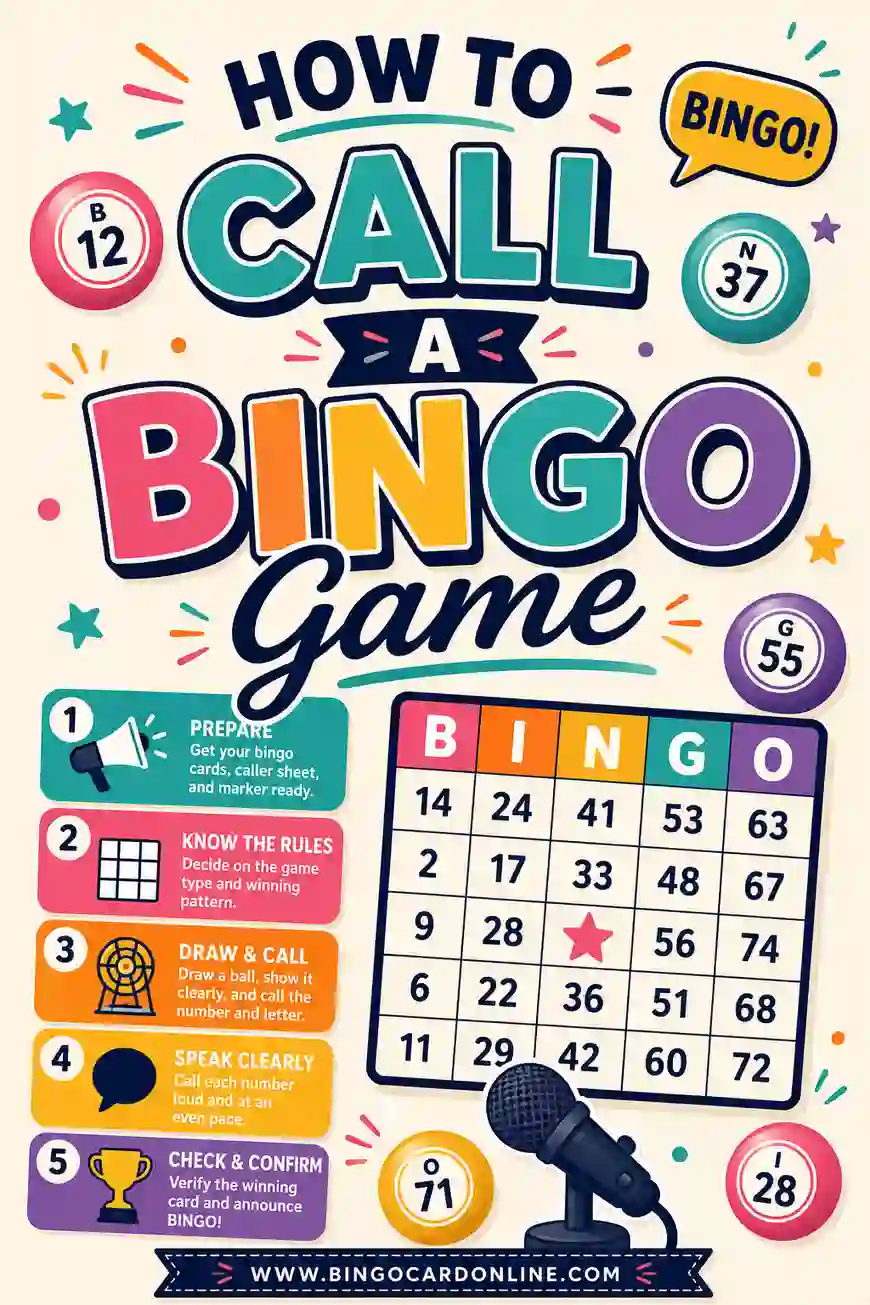
Then add time for everything that is not calling: checking a winner's card, handing out the prize, and resetting cards. Two to four minutes per round is a sensible pad. The how to call a bingo game guide has tips for keeping a steady pace and verifying winners quickly.
Example schedule
Say you have 30 players, each with one card, at 6 calls per minute:
- Round 1, single line: about 20 calls, or roughly 3.5 minutes, plus 3 minutes to verify and award. Call it 7 minutes.
- Round 2, four corners: about 32 calls, or roughly 5.5 minutes, plus 3 minutes. Call it 9 minutes.
- Round 3, single line again: 7 minutes.
- Round 4, blackout: about 66 calls, or 11 minutes, plus 4 minutes. Call it 15 minutes.
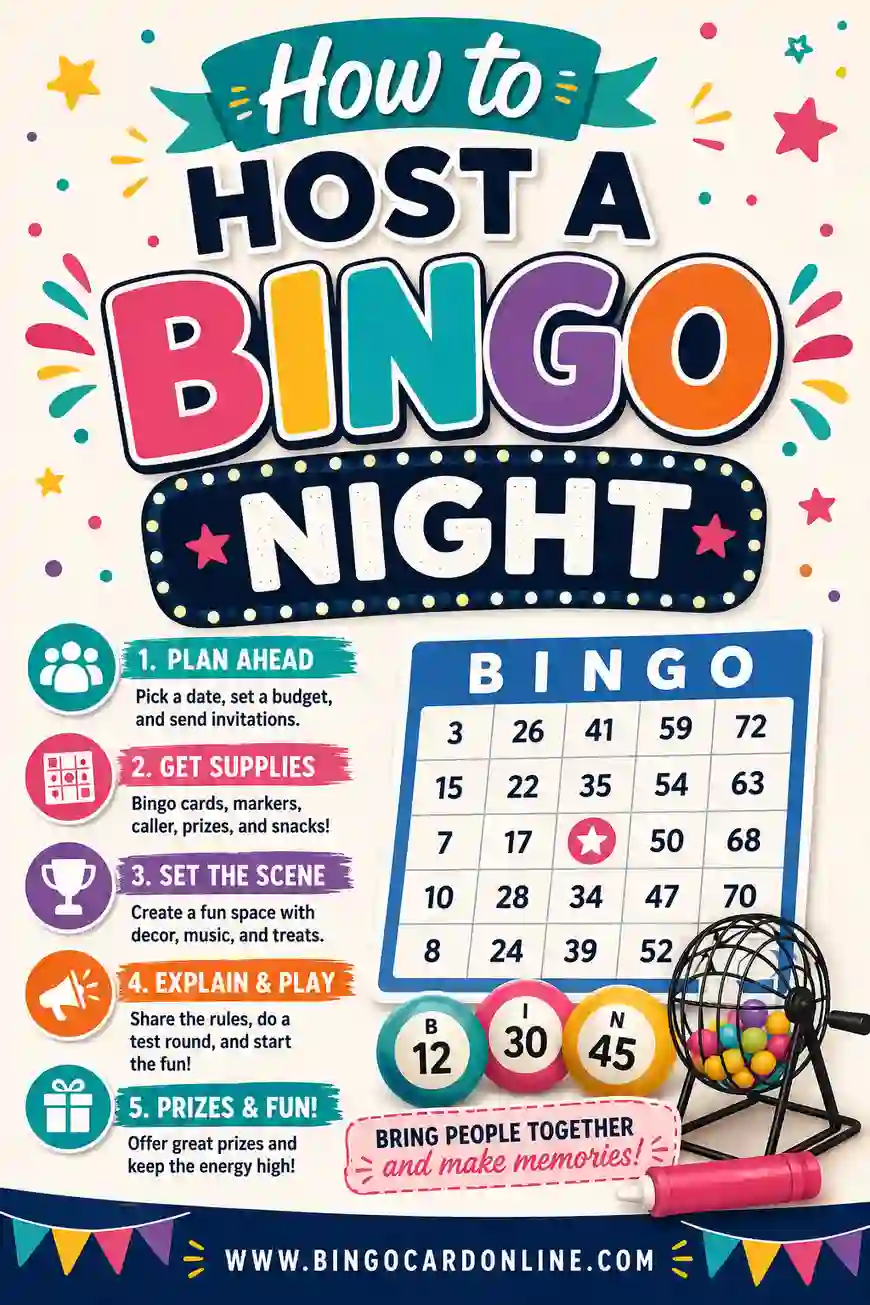
That is about 38 minutes of play for four rounds. Add a short welcome, a break and a few minutes of slack, and four rounds fit in a 45 to 50 minute slot. The bingo night hosting guide covers how to build the rest of the evening around it.
How Many Calls to Win Bingo With Other Patterns
The tables cover the three patterns most hosts use. For other patterns, you can estimate how many calls to win bingo by counting the squares the pattern needs.
The rule is simple: more required squares means a longer game. Patterns that need only four specific squares (four corners, a postage stamp in one corner) behave much like four corners in the table. Patterns that need 8 to 12 squares, such as an X, a letter shape or two lines, land between four corners and blackout. Big patterns like a picture frame (16 outer squares) sit close to blackout, because, like blackout, they are pressed up against the 75-ball limit.
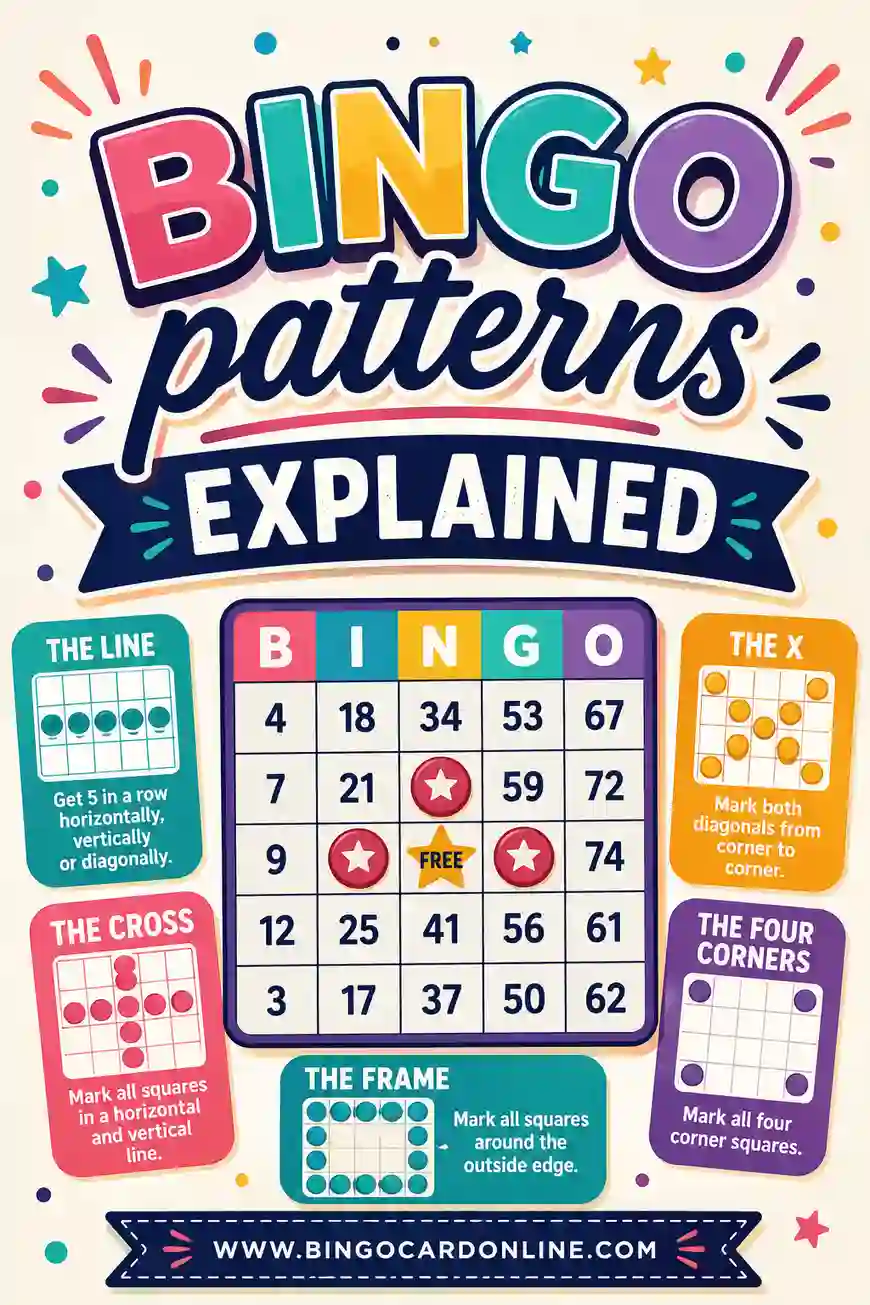
Patterns that use the free space get a small head start, because one square is already done. The bingo patterns explained page shows the common patterns square by square, so you can count them yourself.
For a single card, you can use the formula from earlier with any fixed pattern: count the required called squares k, then work out k x 76 / (k + 1). For example, a 9-square pattern on one card averages 9 x 76 / 10 = 68.4 calls. With many cards in play, expect it to finish sooner, following the same pattern as the tables.
Does the Free Space Change the Number of Calls?
Yes, but less than people think. The free space only helps patterns that pass through the center. A line through the center needs 4 called numbers instead of 5. Four corners never touches the center, so the free space does nothing for it.
For blackout, the free space saves less than one call on average. By the formula, a full card with a free space averages 72.96 calls, and without one it averages 25 x 76 / 26, about 73.1 calls. The difference is a fraction of a call. The coverall bingo page goes deeper into why blackout always runs nearly the whole cage.
Tips for Planning Game Length
Knowing how many calls to win bingo is only useful if it shapes your plan. These habits turn the numbers into a smoother event.
Count cards, not people. If players hold several cards each, multiply. More cards always means shorter games.
Use unique cards. The numbers in this article assume every card is different. The free bingo card generator shuffles each card separately, so your real games will behave like the tables.
Start with a short game. A single line ends fast, which gets the room warmed up and gives latecomers a quick way in.
Save blackout for last. It runs the longest and keeps people in their seats for the final prize.
Use a call limit for drama. Some hosts offer a bonus if someone gets blackout within a set number of calls, such as 55. With 25 cards, blackout landed at or under 60 calls in only about 3 percent of games in our count, and at or under 55 calls in fewer than 1 game in 500, so a limit in the mid-50s is a real long shot. Use it as a fun bonus, not as something to expect.
Expect ties in big rooms. With lots of cards, two cards often finish on the same call. In our count with 25 cards, roughly one single-line game in ten ended with two or more winners on the same call. Decide your tie rule before you start.
Keep a master sheet. Whether you call from a cage or a 1 to 75 number list, mark every called number so you can check winners in seconds.
Your number bingo game is one click away. Add your own squares, choose a 3x3, 4x4 or 5x5 grid and print up to 100 unique cards free.
Open the free bingo card generator →FAQ
How many calls does it take to win bingo on average?
The answer to how many calls to win bingo depends on the pattern and the number of cards. In 75-ball bingo with a free center, a single-line game takes about 41 calls with one card in play, about 21 calls with 25 cards and about 16 calls with 100 cards. Four corners takes longer, and blackout takes about 63 to 73 calls depending on how many cards are playing.
What is the fewest calls needed to win bingo?
A line through the free space or four corners can be won in 4 calls, if the first four numbers drawn are exactly the right ones. A line without the free space needs at least 5. A blackout needs at least 24 calls on a card with a free space. These are possible but very rare.
How many calls does a blackout game take?
With one card, a blackout takes about 73 calls on average out of 75. With 25 cards in play, about 66 calls, and with 100 cards, about 63. Blackout always runs close to the full set of balls, no matter how big the crowd.
Do more players make bingo games shorter?
Yes. Each card is another chance to finish early, and the game ends on the first winning card. Going from 1 card to 100 cards cuts a single-line game from about 41 calls to about 16. The effect is much smaller for blackout.
How long does a game of bingo take in minutes?
Multiply the expected calls by your calling speed. At 6 calls per minute, a single-line game with 25 cards takes about 3.5 minutes of calling, four corners about 5.5 minutes and blackout about 11 minutes. Add two to four minutes per round to check winners and hand out prizes.
Are these numbers the same for 90-ball bingo?
No. 90-ball bingo uses a different card, with 15 numbers spread across three rows, and different winning patterns (one line, two lines, full house). The numbers in this article are for 75-ball bingo on a 5x5 card.