Coverall Bingo: Blackout Rules, Strategy, and Printable Cards
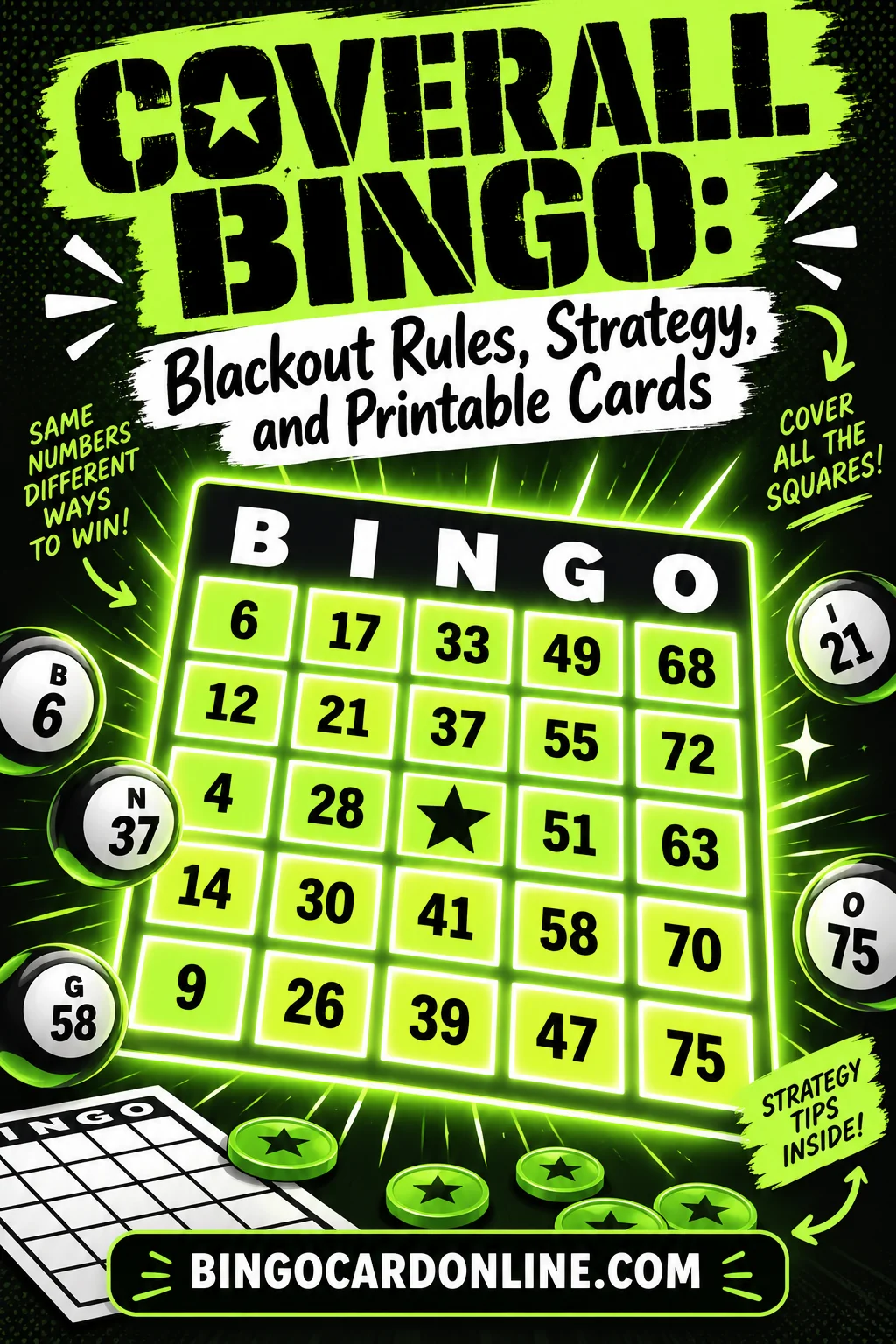
Coverall bingo is the game where nothing wins until every square on your card is covered. No lines, no corners, no shapes. The whole card, top to bottom, and the player who gets there first takes the round.
It is also the longest game in bingo by a wide margin, and that fact should drive every decision you make about it. Coverall is not a pattern you drop into a session on a whim. It is a block of time you have to plan for, and if you do not, it will eat the end of your event.
What Coverall Bingo Actually Is
Coverall goes by several names: blackout, full card, cover-all. They all mean the same thing, that every printed square on the card must be marked. On a standard 5x5 card with a free center space, a winning coverall looks like this:
B    I    N    G    O
[X]  [X]  [X]  [X]  [X]
[X]  [X]  [X]  [X]  [X]
[X]  [X]  FREE [X]  [X]
[X]  [X]  [X]  [X]  [X]
[X]  [X]  [X]  [X]  [X]
Twenty-four printed numbers plus the free space in the middle, which is N3. Every one of B1 through O5 has to have been called. There is no partial credit and no alternate shape, which makes coverall the easiest pattern in bingo to explain and the hardest to schedule.
Does the Free Space Count as Covered?
Yes, on cards that have one. The free space is covered from the moment the cards are handed out, so it is one of your twenty-five squares already done. That is the standard rule everywhere.
The confusion comes from cards that do not have a free space. Plenty of printable word, picture, and emoji cards use all twenty-five squares for real content. On those, coverall means twenty-five items, not twenty-four.
A third case comes up in fundraisers: cards with multiple free spaces. Say the number out loud before the round starts. "Your card has four free spaces, so you need twenty-one calls to fill it."
What Counts as Covered, and How the Caller Verifies
A coverall win is verified like any bingo, but there is more to read out and more that can go wrong.
Every marked square must match a number that was actually called. A daub on an uncalled square voids the card in most house rules, though in casual games it is normal to say "not yet" and keep drawing.
Verification is a read-back against the master call sheet, in a fixed order: down the B column, then I, N, G, and O. Column order is much faster to check than rows, because your master sheet is grouped by letter.
Announce the stop. When someone shouts, stop the draw before you verify, because if the call is bad you have advantaged everyone else. By ball seventy half the cards in play are one or two squares from done, and a bad verify then costs you the whole night's goodwill.
How Long a Coverall Round Really Runs
Here is the arithmetic, worth doing properly because most callers badly underestimate it. In 75-ball bingo you draw from seventy-five numbers without replacement. If your card needs k specific numbers, the question is how deep into the draw the last of those k numbers appears.
Picture the seventy-five balls laid out in draw order. Your k target numbers sit somewhere in that line, and the other 75 minus k balls fall into the k plus 1 gaps around them: before the first target, between targets, and after the last one. On average those non-target balls spread evenly across the gaps, so the expected number of balls sitting after the last target is:
(75 - k) / (k + 1)
Subtract that from 75 and you get the expected call on which you win:
E = 75 - (75 - k)/(k + 1) = k x 76 / (k + 1)
Now plug coverall in. With a free space, k = 24:
24 x 76 / 25 = 1824 / 25 = 72.96
Roughly 73 of the 75 balls. On a card with no free space, k = 25:
25 x 76 / 26 = 1900 / 26 = 73.08
Barely different, which surprises people: the free space saves you a fraction of one call, not five. Compare that to the patterns you would run earlier in a session:
| Pattern | Squares needed (k) | Expected call to win |
|---|---|---|
| Straight line through the free space | 4 | 60.8 |
| Four corners | 4 | 60.8 |
| Straight line, no free space | 5 | 63.3 |
| Picture frame, outer border | 16 | 71.5 |
| Coverall with free space | 24 | 73.0 |
| Coverall, no free space | 25 | 73.1 |
The shortest possible coverall is twenty-four calls, if the first twenty-four balls happen to be exactly your card. Plan around seventy-three.
Why a Bigger Room Barely Speeds Coverall Up
This is the part that catches experienced callers out. With a short pattern, adding cards shortens the game dramatically. Four corners on one card averages about sixty-one calls, but with thirty cards in the room somebody hits it far earlier, because each extra card is another chance at an early win.
Coverall does not work that way, because the average is already pressed against the ceiling. There are only seventy-five balls. If one card expects to fill on call seventy-three, no number of extra cards can pull the first win far below that. Doubling your card count buys a couple of calls, not fifteen.
The planning rule is blunt: a coverall round runs nearly the full ball cage regardless of how many people are playing.
Turning Calls Into Minutes for Your Schedule
Calls become a schedule once you multiply by your calling pace. Time your own caller for a minute and use the real number, but here is the arithmetic for three common paces on a seventy-three call round:
| Calling pace | Time for ~73 calls | Notes |
|---|---|---|
| 4 calls per minute (slow, mixed ages) | about 18 minutes | Kids, seniors, paper daubers |
| 6 calls per minute (normal) | about 12 minutes | Standard hall pace |
| 8 calls per minute (brisk) | about 9 minutes | Experienced players only |
Then add verification time. Reading back twenty-four numbers takes close to a minute, and you will often have two or three near-simultaneous shouts to check, so add three minutes. A realistic slot for one coverall round at a normal pace is fifteen minutes, twenty if the crowd is slow to daub.
Coverall in a Call Limit: The Progressive Jackpot
The classic fix for coverall being long is to make the length itself the drama. That is the progressive jackpot, and it is the version most halls run. The rule: blackout in 50 calls or fewer wins the jackpot. If nobody covers their card within the limit, the jackpot rolls over to the next session and the round is played out for a smaller consolation prize.
Why it works is exactly the math above. The expected win sits at call seventy-three, so a fifty-call blackout is genuinely rare, and that rarity is the point. The jackpot grows week after week and the round has a hard, visible deadline instead of grinding along invisibly. Choosing your number matters:
| Call limit | Feel | Best for |
|---|---|---|
| 45 or fewer | Almost never hits | Long-running venue jackpot |
| 50 or fewer | Rare, hits a few times a year | The standard choice |
| 55 or fewer | Uncommon but believable | Monthly club night |
| 60 or fewer | Hits reasonably often | One-off charity event with a fixed prize |
For a single-evening fundraiser with no next session to roll into, do not set the limit at 45. Nobody wins, the prize goes unclaimed, and the room ends flat. Set it at 58 or 60.
Two mechanics make the limited version much better to watch. Count out loud: "That's call forty-one, nine to go for the jackpot." And display the ball count large. The tension in a progressive round comes entirely from the calls remaining, and if the room cannot see it, there is no tension.
Running Coverall as the Last Game of the Night
Coverall belongs at the end, for three reasons that are about the room rather than the pattern.
It uses nearly the whole cage. Once you have drawn seventy-plus numbers you cannot follow it with anything, because the shorter patterns are all long since satisfied on somebody's card. Coverall goes last or you reset the draw.
It is the natural home for the biggest prize. Players accept a slow game when the payoff is obvious.
It clears the room in one motion. The game ends, the grand prize is handed over, everybody leaves at once. Ending on a two-minute line game leaves people milling around unsure whether there is another round.
A running order that works for a two-hour event:
| Round | Pattern | Budget |
|---|---|---|
| 1 | Straight line | 10 min |
| 2 | Four corners | 10 min |
| 3 | Postage stamp | 10 min |
| 4 | Letter X | 12 min |
| Break | Sell more cards | 10 min |
| 5 | Small picture frame | 12 min |
| 6 | Large picture frame | 15 min |
| 7 | Coverall, jackpot in 55 or fewer | 20 min |
The coverall slot is the largest single block on the sheet, and that is correct. If your schedule gives coverall the same ten minutes as a line game, your event runs late.
Coverall also has a dead stretch in the middle where nobody is close yet. Three things help: call a milestone at ball forty ("hands up if you have five or fewer left"), offer a small consolation prize to the first full straight line inside the round, and speed the pace up after ball fifty, when players are scanning rather than searching.
Printable Coverall Cards and Card Size
Coverall punishes sloppy cards, because every square gets used. Check that every square is legible at arm's length, since players read all twenty-five repeatedly for fifteen minutes. Settle the free space question at print time. And number your cards, because a twenty-four number read-back is far easier when you can find the master copy of card 47. If you are building your own set, the free bingo card generator produces unique 3x3, 4x4, and 5x5 cards with or without a free space, plus the master call list you need for verification.
Card size is the real lever if a seventy-three call round does not fit your event. A 4x4 card has sixteen squares and no free space, so a coverall on it finishes far sooner: that is the version for a classroom or a kids' party. A 3x3 card is faster still, short enough to play three times in a row with fresh cards. Shrinking the card beats rushing a 5x5 coverall, which just means people miss numbers and shout late.
House Rules to Announce Before the First Ball
Say all of these out loud before you draw.
Free space status. Covered from the start, or not present on these cards.
Call limit, if any. State the number and say what happens if nobody hits it.
Late calls. A bingo must be called before the next number is announced. This matters more in coverall, because the last few calls come fast and several players are one square out.
Split wins. Two verified coveralls on the same call split the prize, which is common here since most cards finish within a few calls of each other.
Marking errors. Decide in advance whether a wrongly daubed square voids the card or is simply corrected.
Common Mistakes
- Scheduling coverall for ten minutes. It needs fifteen to twenty with verification.
- Putting it in the middle of the session. It burns the ball cage and drains the room.
- Assuming more cards makes it faster. Seventy-three of seventy-five is already near the ceiling.
- Setting a 45-call jackpot at a one-night event. Nobody will win it.
- Verifying in row order. Read the columns instead.
Frequently Asked Questions
What is coverall bingo? Coverall bingo, also called blackout or full card, is a round where you must cover every square on your card to win. On a 5x5 card with a free center space that means all twenty-four printed numbers, with no partial or alternate winning shape.
Does the free space count in a coverall game? Yes. A free space is treated as covered from the moment play begins, so you need twenty-four called numbers rather than twenty-five. On cards printed without one, all twenty-five squares must be called.
How many numbers does it take to win a coverall? About seventy-three of the seventy-five balls. The expected winning call for a card needing k numbers is k x 76 / (k + 1), which for twenty-four numbers works out to 72.96. The fastest possible coverall is twenty-four calls, but that is effectively unheard of.
What does blackout in 50 or fewer mean? It is a jackpot condition: the prize is only paid if a player covers their entire card within the first fifty calls. That is rare given the seventy-three call average, so the jackpot usually rolls over and grows, and the round is played out for a smaller consolation prize.