How Many Words Do I Need for a Bingo Game? (By Card Size)
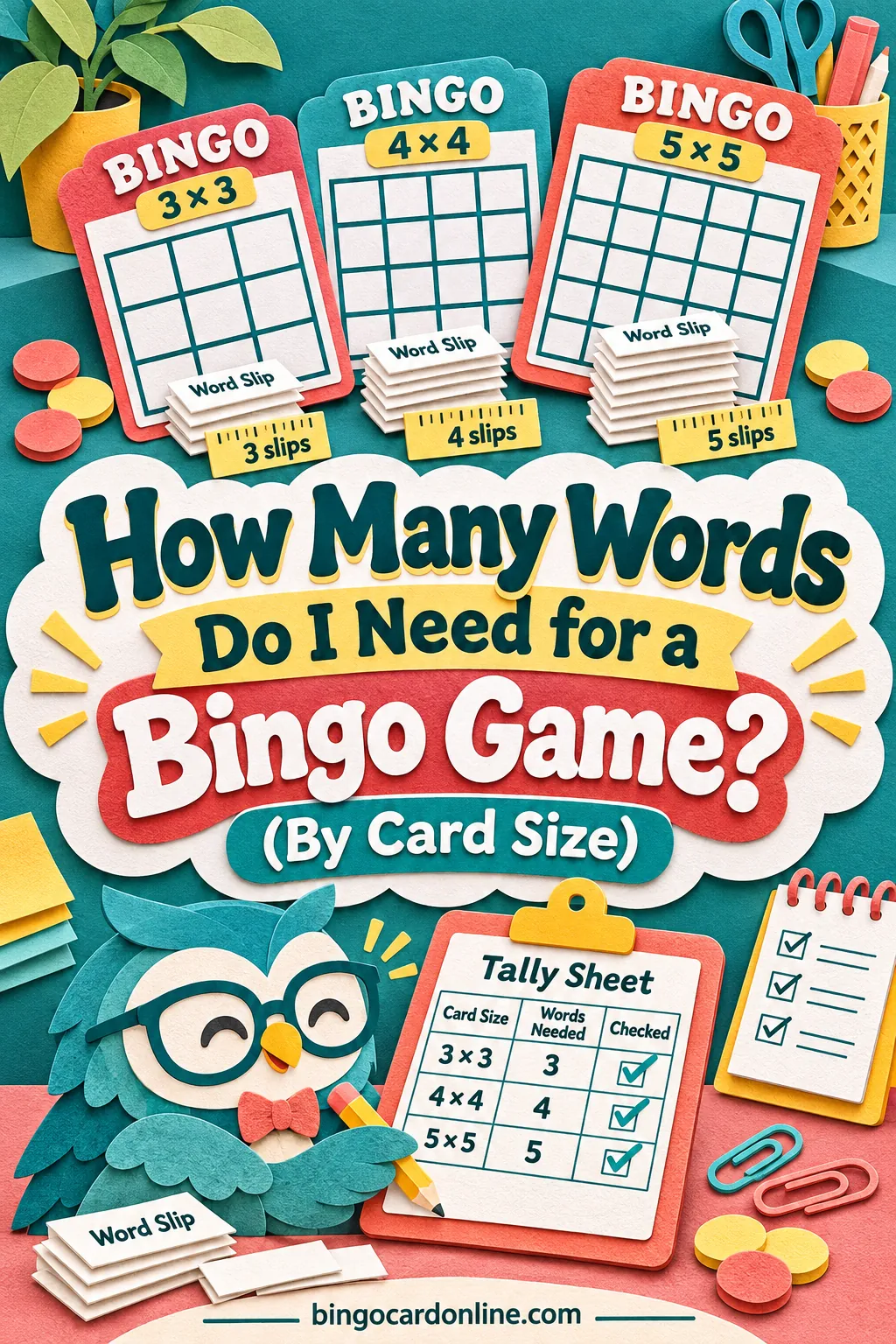
You need at least as many words as your card has squares: 9 for a 3×3 card, 16 for a 4×4 card and 24 for a 5×5 card with a free center. For a good game, plan on about 1.5 to 2.5 times that, so roughly 15 to 25 words for 3×3, 25 to 40 for 4×4 and 35 to 60 for 5×5. A bigger list makes every card look different and stops the game from ending in a handful of calls.
The free bingo card generator shows "How many words do you need?" guidance right on the page, so you can check your list as you build it. Below, you'll find a full table by card size, the simple math behind it, and how many cards to print for your group.
The Quick Answer by Card Size
Here's the chart most hosts need. "Minimum" is the smallest list that fills a card. "Shorter game" and "longer game" are comfortable ranges for a round that ends quickly or one that builds slowly.
| Grid | Squares to fill | Minimum words | Shorter game | Longer game |
|---|---|---|---|---|
| 3×3 | 9 | 9 | 12 to 18 | 20 to 27 |
| 4×4 | 16 | 16 | 24 to 30 | 32 to 45 |
| 5×5 | 24 (plus free center) | 24 | 35 to 45 | 50 to 60 |
These ranges aren't hard rules. They're starting points that keep cards varied without making the game drag. If you only remember one thing, remember this: more words means more different cards, fewer people winning at once, and a longer round.
Why the 5×5 card needs 24, not 25
A 5×5 grid has 25 boxes, but the center is usually a free space. That leaves 24 squares to fill with words. If you want the center to say something fun, the generator lets you type a custom free-space label. The free center still counts as already marked. The bingo free space guide explains how it works in play.
Why List Size Matters
A short list is the most common reason a word bingo game feels off. Here's what goes wrong, and the simple math behind it.
Every card has the same words
If your list has exactly 24 words and your card has 24 squares, every card uses all 24 words. The cards look different because the words are shuffled into different spots. But they all hold the same set.
That works fine for a single line, since the layout decides who gets a line first. It doesn't work for blackout. Every card fills up on the very last word called, so everyone wins at the same moment.
The game ends in a handful of calls
With a tiny list, every word you call is on almost every card. Lines fill fast across the room, and someone shouts bingo before the game has a chance to build any tension.
Lots of players win together
When most calls hit most cards, the cards move along in a pack. Several players end up one square away at once, and the next call can hand out three bingos. A bigger list spreads players out, so the race has a clear leader.
The simple math behind it
You don't need to be a math fan to get this. There's one idea to hold on to.
On each call, the chance that a given card has that word is the number of squares divided by the number of words in your list.
Let's try it with a 5×5 card, which has 24 squares to fill.
| Words in your list | Share of cards that have each called word |
|---|---|
| 24 | Every card (24 ÷ 24) |
| 30 | About 4 in 5 cards (24 ÷ 30) |
| 36 | About 2 in 3 cards (24 ÷ 36) |
| 48 | About half the cards (24 ÷ 48) |
| 60 | About 2 in 5 cards (24 ÷ 60) |
That's why doubling your list has such a big effect. With 48 words, each call only marks about half the cards in the room. Players spread out, the round lasts longer, and the end is more exciting.
The same idea works for any grid. A 3×3 card has 9 squares, so a list of 18 words means each call marks about half the cards. A 4×4 card has 16 squares, so 32 words gives you the same "about half" feel.
A handy rule of thumb
- About 1.5 times the squares: a quick, lively round. Good for warm-ups, little kids and short attention spans.
- About 2 times the squares: a balanced game. Good for most parties and classrooms.
- About 2.5 times the squares: a slower round that builds. Good for big groups, blackout and prize rounds.
How Many Words for Different Games
The right number also depends on the pattern you'll play and the group in front of you.
Single line games
A single line (across, down or diagonal) is the classic quick win. Since there are many lines on a card, someone finishes fairly fast. A list of about 1.5 to 2 times the squares is plenty. For a 5×5 card, that's about 35 to 45 words.
Four corners and small shapes
Four corners and the postage stamp (a 2×2 block in a corner) need specific squares, so they take a bit longer than a line. A middle-sized list, around 40 to 50 words on 5×5, works well.
Blackout
Blackout, also called coverall, means every square on the card. This is where list size matters most. With a list equal to the squares, everyone finishes together. Go big here. For 5×5, aim for 50 to 60 words.
Classroom vocabulary games
Teachers often build bingo from a unit's word list. If your unit only has 20 words, use a 4×4 card (16 squares), not a 5×5. If you have 40 or more, a 5×5 card works well. You can also add review words from earlier units to grow the list.
Little kids
For preschool and early grades, smaller is better. A 3×3 card with 12 to 18 picture or emoji items keeps the game short and the wins frequent. Kids stay excited, and you can play several rounds.
How Many Cards to Print
Once your list is ready, the next question is how many cards you need. The answer is simple: one unique card per player, plus a few spares.
Spares cover latecomers, spilled juice, and the kid who wants a second card after losing the first round. Three to five extra cards is a good cushion for most groups.
Sheets of paper by group size
The generator prints 1, 2 or 4 cards per page. Here's how many sheets you'll use.
| Players (plus spares) | 1 per page | 2 per page | 4 per page |
|---|---|---|---|
| 10 cards | 10 sheets | 5 sheets | 3 sheets |
| 20 cards | 20 sheets | 10 sheets | 5 sheets |
| 30 cards | 30 sheets | 15 sheets | 8 sheets |
| 50 cards | 50 sheets | 25 sheets | 13 sheets |
How many bingo cards for 30 players?
Print 30 unique cards plus three to five spares, so 33 to 35 cards in total. At four cards per page, that's 9 sheets. Use a 5×5 card with a list of 40 or more words, so all 30 cards look truly different.
For really big crowds, the guide to bingo for large groups covers seating, checking cards and keeping the room calm.
Photos, Emoji and Number Cards
Word lists can grow as long as you like. Photo, emoji and number cards work a little differently, so plan for them.
Photo bingo
The Photos card type lets you upload up to 30 of your own pictures. That's a great fit for family reunions, classroom faces or a trip recap. But 30 is the ceiling, so check the math:
- 3×3 card (9 squares): 30 photos is more than three times the squares. Cards will look very different. Great for a long, varied game.
- 4×4 card (16 squares): 30 photos is close to two times the squares. A nice, balanced game.
- 5×5 card (24 squares): 30 photos is only a little more than the squares. Each call will be on about 4 in 5 cards, so rounds go quickly and ties are more likely. Skip blackout here, or choose a 4×4 grid.
If you love the look of photo cards on a 5×5 grid, stick to single lines and four corners, and keep blackout for a word card.
Emoji bingo
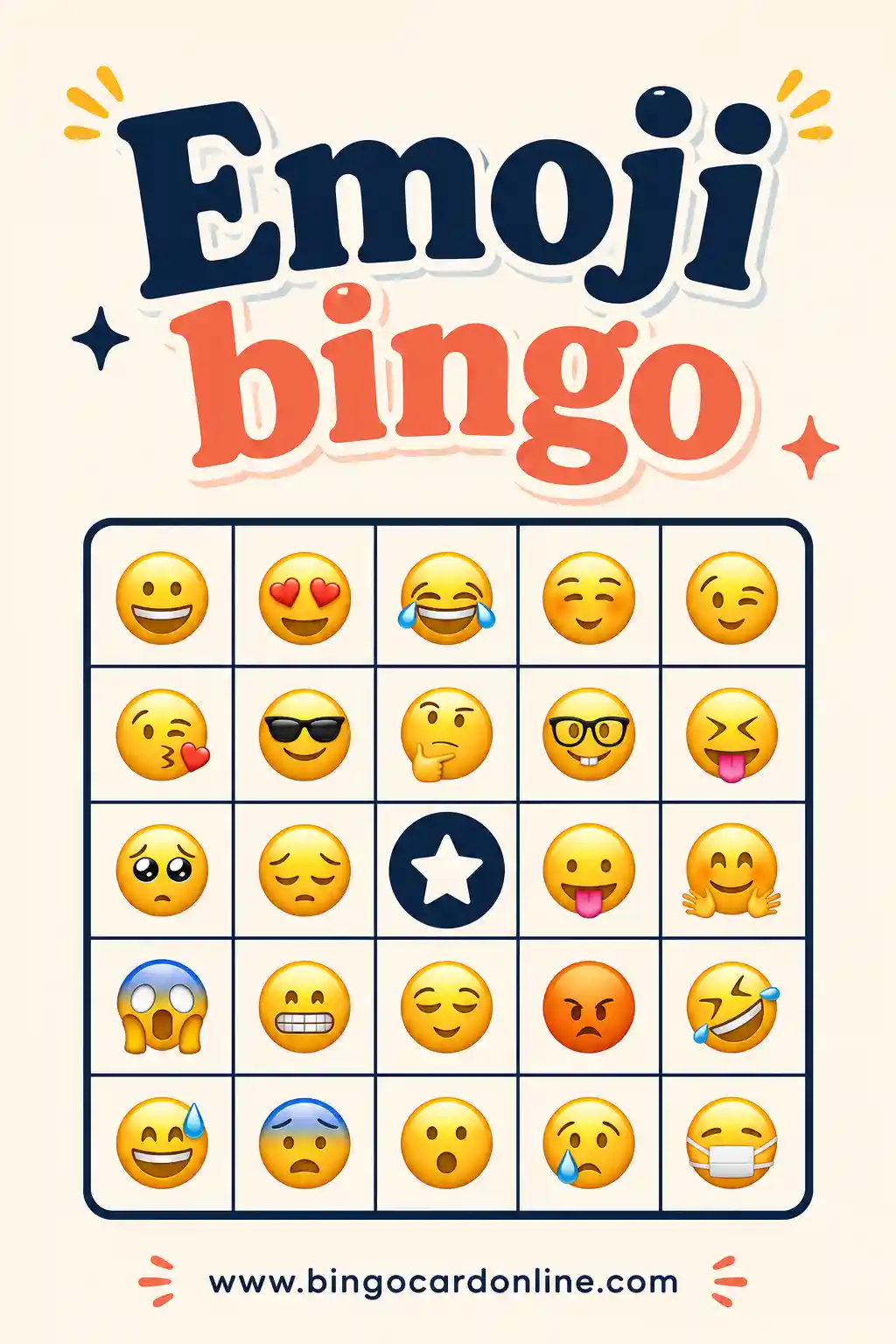
Emoji cards are a hit with kids and with groups that speak different languages. Picture squares are quick to spot, so players keep up easily. When you choose your own emoji, the same list-size math applies, so lean toward the larger end if you want a round to last.
Number bingo
Number bingo doesn't need a list at all. The generator's Numbers card type builds standard cards for you:
- 1–75 (B-I-N-G-O): the American style. Each column takes numbers from its own range of 15. B uses 1 to 15, I uses 16 to 30, N uses 31 to 45, G uses 46 to 60 and O uses 61 to 75.
- 1–90 (UK style): the British style, which uses numbers 1 to 90.
Because the pool is already large and fixed, number cards spread out well on their own. The list-size question only matters for word, emoji and photo bingo.
Mixing words and pictures
Each batch of cards uses one card type, but you can run separate rounds. A short 3×3 photo round for the little ones, then a 5×5 word round for older kids and adults, keeps everyone playing without one list having to do it all.
How to Fix It With the Generator
Here's the step-by-step setup on the bingo card generator so your list and your cards match.
- Pick Words as the card type. You can also choose Emoji, or Photos if you want to upload up to 30 of your own pictures.
- Choose your grid. Use 3×3 for little kids or short lists, 4×4 for medium lists, and 5×5 for full games. On 5×5, the free center is filled in for you, and you can add a custom free-space label.
- Add your words. Type your own words, one per line. Or click Quick start with a theme to fill in a ready-made list, then add your own words to make it longer.
- Check the guidance. The page shows "How many words do you need?" so you can see if your list is big enough for the grid you picked. If it's short, add more words or switch to a smaller grid.
- Set the number of unique cards. Enter one per player, plus a few spares. Every card is a different shuffle.
- Pick cards per page. Choose 1, 2 or 4. Four per page saves paper. One per page is easiest to read.
- Add a title and color theme. Give your cards a title, pick a color theme, or use ink-saver black and white.
- Print or share. Click Print / Save as PDF, or Download PNG. For phones, use Copy shareable link.
- Print the extras. Print master call sheet gives you the full list to call from and check claims. Print winning patterns shows players what to aim for.
Growing and Checking Your List
Where to find more words
Running out of words is common. Here are easy ways to stretch your list.
- Use a theme as a base. The Quick start themes fill in a list fast. Then add 10 or 15 words of your own.
- Add related words. A beach list can grow with sand, shells, waves, towel, sunscreen, kite, pier and gull.
- Mix in names. For family or office games, add people's names, pets or places.
- Ask your group. Have guests write one word each on a slip. You'll get a long, funny list in minutes.
- Use short phrases. Squares can hold one to three words. "Wears a hat" counts as one item.
- Borrow a theme. The list of bingo theme ideas is full of ready topics, from holidays to hobbies.
Keep items short. Long phrases get squeezed in small squares, especially on a 5×5 card printed four per page.
Common list mistakes
A few small slips cause most list problems.
Repeating a word. If the same word appears twice in your list, it may land twice on one card. Scan your list for repeats before you generate.
Words that mean the same thing. "Couch" and "sofa" on one list confuse players. Pick one.
Mixing very long and very short items. A square with one word next to a square with eight looks messy and is hard to read. Keep them similar.
Forgetting the free space. On a 5×5 card, you need 24 words, not 25. The center is free.
Picking a grid that's too big. If your list only has 18 words, a 5×5 card can't be filled. Drop to a 4×4 or 3×3 card, or add words.
To learn how card size changes the feel of a game, see bingo card sizes: 3×3 vs 4×4 vs 5×5.
Frequently Asked Questions
How many words do you need for a 5×5 bingo card?
You need at least 24 words, since the center is a free space. For a good game with different-looking cards, aim for 35 to 45 words for a shorter round and 50 to 60 for a longer one or blackout.
How many items do you need for 4×4 bingo?
A 4×4 card has 16 squares, so you need at least 16 items. A list of 24 to 30 makes a quick round, and 32 to 45 gives a longer game with more variety between cards.
Can I make bingo cards with only 24 words?
Yes, on a 5×5 card. Every card will hold the same 24 words in a different order. That's fine for a single line, but for blackout everyone will finish on the last call, so add more words if you plan to play coverall.
How many words do I need for 30 players?
The list size depends on the card, not the number of players. For 30 players on 5×5 cards, a list of 40 or more words keeps the cards truly varied. Then print 30 unique cards plus a few spares.
Do number bingo cards need a word list?
No. Number cards use a fixed pool of 1 to 75 for the American B-I-N-G-O style, or 1 to 90 for the UK style. The generator builds them for you.
What if my list is too short?
Switch to a smaller grid, or add words. A 3×3 card only needs 9, and a 4×4 card needs 16. You can also use Quick start with a theme to add ready-made words, then keep your own.
Build Your List and Print
Now that you know how many words you need, open the free bingo card generator, paste your list, pick a grid size that matches, and print one unique card for each player. Check the word guidance on the page, and you're ready to play.