Christmas Memory Bingo: Large-Print Cards for Seniors and Dementia Care
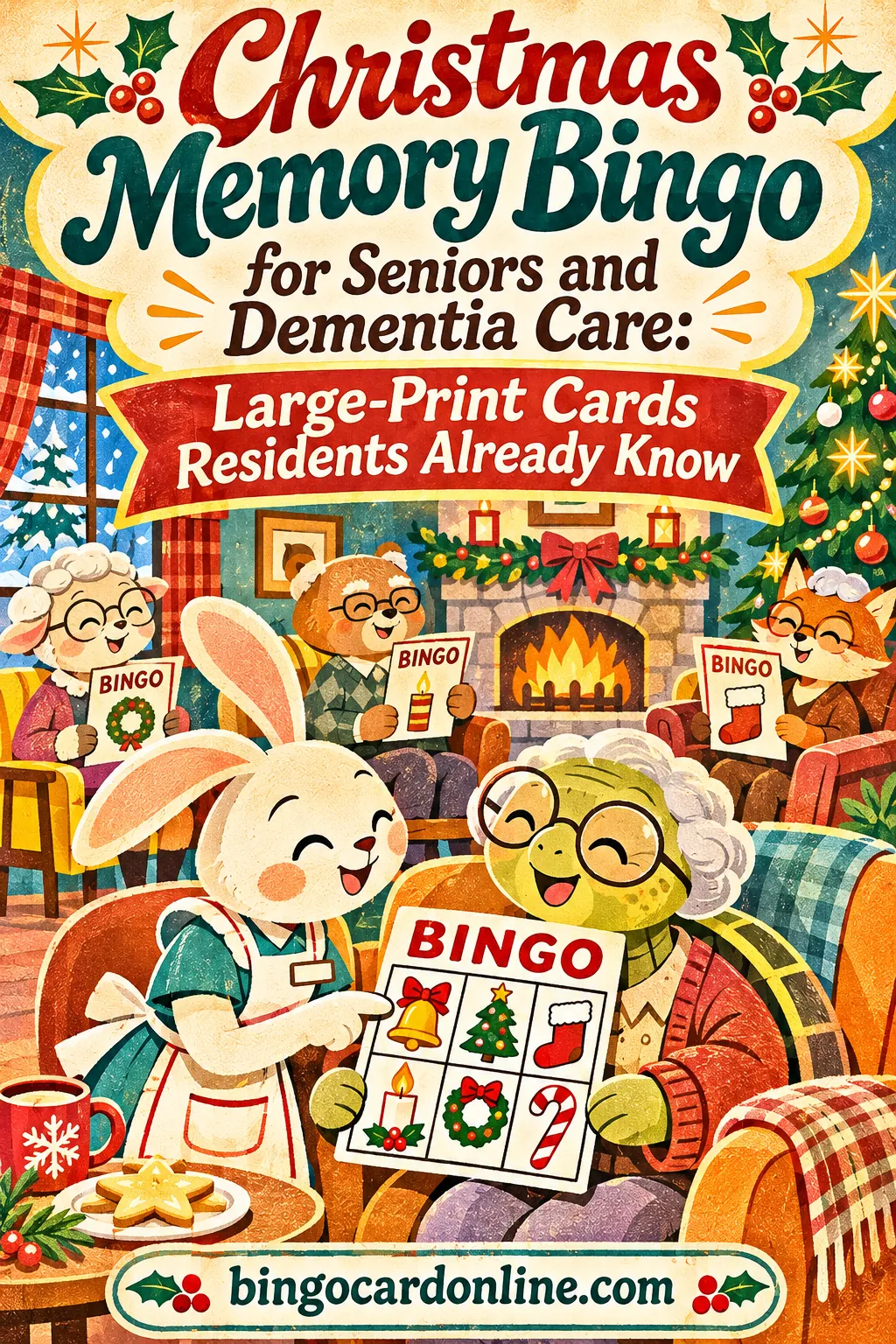
The best Christmas bingo for seniors with dementia uses a small card (3×3 or 4×4) printed one per page in very large type, filled with holiday things residents have known all their lives, like a Christmas tree, a stocking, bells and a candle. Keep rounds short, read every item twice, and treat each call as a chance to share a memory rather than a race to win. You can print a full set of large-print cards in a few minutes with the free bingo card generator.
This guide is for activity staff in memory care, assisted living and nursing homes, and for family caregivers who want a gentle holiday activity at home. It covers exact print settings, item lists, a calling script, adaptations for different abilities, and a December plan. It's practical advice for running an activity, not medical advice. If you have questions about a person's health, care plan or diet, talk to their doctor or care team.
▶ Make these exact bingo cards
Why Familiar Christmas Items Work So Well
Many people living with dementia find it hard to learn something new, but long-held habits and old memories often stay strong much longer. Bingo is a game many older adults played for years, at church halls, community centers, or around the kitchen table. Christmas is full of things they've seen every winter of their lives. Put the two together and you get a game that leans on what people already know.
That's the whole idea behind "memory bingo." Instead of numbers that move fast and mean nothing, each square holds something with a story attached:
- A stocking might bring back hanging one by the fireplace as a child.
- Bells might start someone humming a carol.
- A candle in the window may remind someone of their mother's house.
- Gingerbread can lead to a story about baking with grandchildren.
The game gives the session a simple structure. The memories are the real point.
What residents get out of it
Activity staff often see a few good things happen during a calm, familiar game:
- A sense of success. Finding a word you know and marking it feels good, even if you don't win.
- Something to talk about. Each item is an easy conversation starter for staff and visitors.
- Being part of the group. Residents who rarely join activities may join a game they already know.
- A holiday feeling. Christmas words, carols and decorations make the season feel present.
Every person is different, and a game won't suit everyone every day. Watch for signs of tiredness or frustration, and let anyone stop when they want to.
Why regular bingo can be hard
Standard 75-ball number bingo can be tough for people with memory loss:
- Numbers are called fast, with no meaning to hold on to.
- A 5×5 card has 24 or 25 small squares to scan.
- Hearing "B-12" and finding it on a crowded card takes several steps.
- Rounds can run long, and attention may fade.
Memory bingo fixes each of these. Fewer squares, bigger print, slower calls, words with meaning, and short rounds.
How to Make Large-Print Cards With the Free Tool
Open the bingo card maker on any computer or tablet. Nothing needs to be installed, and the words you type stay on your device. Here are the exact settings for large, easy-to-read cards.
Step-by-step settings
- Card type: Words. (Photos is a lovely option too, covered later.)
- Your words or items: Type one item per line. Use short, familiar words, like "Star," "Bells," "Wreath." The Christmas for Kids theme in the menu also fills in 30 simple holiday words you can trim down.
- Card title: Something warm and simple, like "Christmas Memory Bingo" or "Maple Wing Holiday Bingo."
- Card colors: Red & Green — holidays looks festive. For residents with low vision, high contrast matters more than color, so consider turning on ink-saver to print plain black on white.
- Grid size: 3 × 3 for moderate to advanced dementia, or 4 × 4 for mild memory loss and more independent players.
- Number of unique cards: Your group size plus two or three spares.
- Cards per page: 1. This is the most important setting. One card per page gives you the biggest squares and the biggest type.
- Ink-saver / black & white print: Turn on for the sharpest contrast.
- Click Generate cards, then Print / Save as PDF.
- Click Print master call sheet so the caller has every item on one page.
How big will the print be?
At one card per page, the generator prints big squares with large type. Short words print at the full size, and longer phrases shrink to fit the square, so short words read best.
| Grid size | Squares | Approximate square size at 1 per page | Type size for short words | Best for |
|---|---|---|---|---|
| 3 × 3 | 9 | A little over 2 inches | About 44 point | Moderate to advanced dementia, low vision |
| 4 × 4 | 16 | About 1.6 inches | About 32 point | Mild memory loss, good vision |
| 5 × 5 | 25 | About 1.3 inches | About 24 point | Independent seniors only |
For comparison, everyday printed text is usually around 10 to 12 point. Even the 4×4 card is roughly three times that size.
About the free space
The generator offers a free center space on 5×5 cards only, and you can change its label to something like "MERRY" or a star. On 3×3 and 4×4 cards every square holds an item. That's usually fine for memory care, because a smaller card is already easy, and a free square in the middle can confuse some players ("Why is this one already done?"). If a group expects a free space, you can mark the center square with a sticker for everyone before the round starts.
Settings by group at a glance
| Group | Grid | Items in your list | Cards per page | Round length |
|---|---|---|---|---|
| Advanced dementia, with one-to-one help | 3 × 3 | 9 to 10 | 1 | Until each person has a line |
| Moderate dementia, small group | 3 × 3 | 12 | 1 | About 10 minutes |
| Mild memory loss | 4 × 4 | 16 to 20 | 1 | 10 to 15 minutes |
| Assisted living, mixed group | 4 × 4 | 20 | 1 or 2 | 15 minutes |
| Family at home, one or two players | 3 × 3 | 9 to 12 | 1 | As long as it's enjoyable |
Why the number of items matters
On a 3×3 card with exactly nine items, every card holds the same nine words in a different order. The tool will tell you so after you generate. That can actually be a good thing in advanced memory care, because when every call matches a square on everyone's card, nobody waits long and everybody marks something every time.
For groups who can enjoy a bit more challenge, use 12 items on a 3×3 card or 20 on a 4×4 card. Each card then leaves a few items out, so cards really differ and winners spread out across the group.
Choosing Items Residents Already Know
The items on the card should feel like old friends. Think of what a Christmas looked like 50, 60 or 70 years ago: a real tree, paper chains, a stocking, an orange in the toe, carols at church, snow on the windows. Skip anything recent, anything that needs explaining, and anything tied to screens or shopping.
Familiar Christmas item lists
Pick one list, or mix and match. Keep the words short so they print large.
| List | Items |
|---|---|
| Classic decorations | Christmas tree, star, angel, wreath, holly, bells, candle, tinsel, stocking, ornament, garland, bow, ribbon, lights, nativity |
| Winter outdoors | Snowman, snowflake, sleigh, sled, mittens, scarf, icicle, pine tree, cardinal, snow boots, skates, frost |
| Kitchen and table | Gingerbread, pie, cookies, cocoa, oranges, nuts, roast, cranberries, candy cane, fruit bowl, gravy, rolls |
| Old-fashioned traditions | Christmas cards, carolers, church, fireplace, presents, paper chains, popcorn string, letter to Santa, wrapping paper, nutcracker |
| Traditional carols | Silent Night, Jingle Bells, Joy to the World, Deck the Halls, Away in a Manger, O Christmas Tree, The First Noel, Hark the Herald, O Come All Ye Faithful, We Wish You a Merry Christmas |
A ready 12-item list for a 3×3 card
This list mixes the easiest, most familiar items:
- Christmas tree
- Star
- Stocking
- Bells
- Candle
- Wreath
- Snowman
- Present
- Angel
- Candy cane
- Holly
- Fireplace
The button further down this page opens the generator with a 16-word version of this list already filled in, set to 4×4. For a 3×3 card, just switch the grid size and delete four words.
Carol bingo for memory care
Carols are often among the last things people lose. Many residents who rarely speak will still sing along to a carol they learned as a child. A carol card works like this:
- Fill the card with carol titles from the list above (traditional carols only).
- Instead of reading the title, you or a volunteer sing or hum the first line.
- Residents find the title on their card, and many will sing along first.
- Let the singing go on as long as people want. Then mark the square.
Carol titles are long, so they print smaller than single words. Use a 3×3 grid at one card per page, and pick the shorter titles if vision is a concern, like "Silent Night," "Jingle Bells," and "The First Noel."
Photo bingo with family pictures
The generator also has a Photos card type. You can add up to 30 of your own pictures, and it prints picture-matching cards. The photos stay on your device. They aren't saved between visits or included in share links.
This opens up two lovely options:
- Picture cards for residents who no longer read. Take simple photos of real Christmas objects in your building: the tree in the lobby, a wreath on the door, a stocking, a candle, a plate of cookies. The caller shows each photo on screen.
- A family version at home. Use old photos of past family Christmases, like grandma's tree, the house in snow, a holiday table. A family caregiver can play one-on-one and talk about each picture. Make sure the photos are clear and not too busy, with one main thing in each.
Because photos stay on your device, there's no need to upload family pictures anywhere.
Items to leave off
- Brand names, shows and characters. Even well-known ones can confuse people, and they don't hold the same memories for everyone.
- Abstract words. "Joy," "peace" and "spirit" are lovely, but hard to picture. Pick things you can hold or see.
- Sad or tricky items. If you know a resident lost someone around the holidays, or a certain item upsets them, leave it out. Staff who know residents well are the best guide.
- Foods someone can't have. Talking about cookies is usually fine, but if a resident has strict diet limits and food talk causes distress, choose non-food items.
- Lookalike words. "Snow," "snowman" and "snowflake" on the same card can be hard to tell apart. Keep one.
Running a Calm Session: A Calling Script
The caller sets the whole mood. In memory care, a good caller is slow, warm and happy to go off-script. Here's a simple way to run a 30-minute session for six to ten residents.
Before the game
- Set up in a quiet room with good light and as little background noise as you can manage.
- Seat residents at tables close to the caller, with hearing-impaired residents nearest.
- Hand out cards and markers, and help anyone who needs it to place their card flat.
- Have a helper for every two or three residents if you can.
The calling script
Read each item twice, add a picture in words, and leave time for memories. For example:
"Our next one is... the Christmas tree. The Christmas tree. Do you see the Christmas tree on your card? ... Wonderful, Ruth found it. Did you have a real tree when you were growing up? Who decorated it?"
"Next one... stocking. Stocking. The stocking you hang up by the fireplace. ... Harold, what did you find in your stocking as a boy?"
"Here's a good one... bells. Bells. Jingle, jingle. Shall we sing a little bit? Jingle bells, jingle bells..."
A few calling habits make a big difference:
- Say it twice, slowly. Pause between the two.
- Add a short description. "The candle, the kind you put in the window."
- Hold up a real object if you have one. A bell, a mitten, a pinecone or an ornament helps people connect the word to the thing.
- Wait. Give everyone time to find the item before moving on, and help gently if needed.
- Praise every mark. "You found it!" goes a long way.
- Follow the memories. If a story starts, let it run. The game can wait.
Memory prompts for each item
Keep a few open, easy questions ready for each call. Ask one, then listen. There are no wrong answers, and it's fine if someone answers a different question or tells a story from another time of year.
| Item | Easy prompts |
|---|---|
| Christmas tree | Did you have a real tree or an artificial one? Who put the star on top? |
| Stocking | Where did you hang your stocking? What was in the toe? |
| Candle | Did your family put candles in the windows? |
| Snowman | Did you build snowmen as a child? What did you use for the nose? |
| Gingerbread | Who did the baking at your house? What was your favorite cookie? |
| Bells | Did your church have bells? Shall we sing a carol with bells in it? |
| Sleigh | Did you ever ride in a sleigh or go sledding down a hill? |
| Presents | Do you remember a present you loved as a child? |
Write a few of these on the back of your master call sheet so helpers can use them too.
A sample 30-minute session
| Time | What happens |
|---|---|
| 0:00 to 0:05 | Welcome, sing one familiar carol together, hand out cards and markers |
| 0:05 to 0:15 | Round 1, calling slowly with a memory prompt for each item |
| 0:15 to 0:18 | Celebrate the winner, pass around a real ornament or bell |
| 0:18 to 0:27 | Round 2, or a carol round if energy is good |
| 0:27 to 0:30 | Small prizes for everyone, a closing carol, thank each person by name |
If the group is lively, add a third round. If people tire after the first round, skip straight to the closing carol. The plan is a guide, not a rule.
Using the caller on screen
After you generate, click Play caller. It opens a full-screen caller that shows one item at a time in large type, with no repeats and a history of what's been called. It also has an Undo button. On a big TV or projector, the current item is easy to see from across the room.
For memory care, leave Auto-call off and click Next yourself, so you can take as long as each call needs. The Voice option reads items aloud, but most groups respond much better to a familiar human voice, so use it only if your own voice is tired or you're running the game with a helper reading. For more on calling style, see how to call a bingo game.
When someone gets bingo
- Celebrate warmly, but keep the noise friendly.
- Check the card gently against the master call sheet, or just trust it. In memory care, a "close enough" win is still a win.
- Give a small prize and a round of applause.
- If someone marks a square that wasn't called, don't correct them in front of the group. Simply help them along on the next call.
Adapting the Game for Different Abilities
Every group is mixed. Here's how to adjust for common needs so each person can take part at their own level.
| Need | What to change | Why it helps |
|---|---|---|
| Moderate to advanced dementia | 3×3 card, 9 items, one-to-one helper | Every call matches a square, so there's always something to mark |
| Mild memory loss | 4×4 card, 16 to 20 items | A bit more challenge, still easy to scan |
| Low vision | 3×3 at 1 per page, ink-saver on, short words, good lighting | Large black type on white is the easiest to read |
| Hearing loss | Seat near caller, face them, show the item on screen or hold up the object | They can see the call as well as hear it |
| Arthritis or weak grip | Large chips, a stamp, a crayon, or a helper marks for them | Small chips are hard to pick up and place |
| Tremor | Card in a sheet protector, dry-erase marker, or a magnet board | Nothing slides or spills |
| Easily tired | One or two short rounds, then songs or chat | Stops before fatigue sets in |
| Doesn't read anymore | Photos card type, or real objects to match | Pictures and objects need no reading |
| Restless or anxious | Seat near a helper, give them a "job" like holding the bell | A role helps them feel part of things |
For a deeper guide to dementia-friendly bingo all year, see bingo for seniors with dementia. For more on print size, contrast and paper for low vision, the low-vision print guide goes into detail.
Playing one-on-one
Bingo doesn't need a crowd. A family caregiver, volunteer or staff member can play with just one person. In that case:
- Use a 3×3 card with exactly nine items, so every call is a match.
- Sit side by side rather than across the table.
- Take turns calling. Many people enjoy being the caller as much as playing.
- Skip "winning" entirely if it doesn't matter. Just enjoy filling the card and talking.
Markers and Prizes That Are Safe and Easy
Small plastic chips and loose candy are a poor fit for memory care. Chips are hard to grip, and small items can end up in mouths. Pick markers that are big, flat and easy to handle.
| Marker | Why it works | Tip |
|---|---|---|
| Large paper chips | Big and easy to see | Click Print bingo markers / chips in the generator, print on card stock, and cut them out |
| Thick crayon or marker | No small pieces at all | Use a bright color that shows up well on white |
| Self-inking stamp | One easy press, very satisfying | Good for weak grip |
| Felt or foam circles | Soft, light, easy to slide | Cut large circles from craft foam |
| Sheet protector and dry-erase marker | Reusable, nothing slides | Tape the sheet protector to the table |
| Helper marks the card | No hand use needed | The resident points, the helper marks |
Avoid food as markers. Residents may have diet restrictions, swallowing difficulties or textured diets in their care plans, and staff need to follow those. If you want to serve a holiday snack after the game, check each person's plan with the care team first.
Prize ideas for seniors
Prizes don't need to be big. The applause often matters most. Simple ideas:
- A holiday card signed by staff
- A small ornament or a paper snowflake for their door
- A pair of warm socks
- A framed copy of their winning card
- First pick of a holiday craft
- Choosing the next carol
- Being the caller for the next round
- A photo with the group's decorations
Many activity directors give every player a small prize at the end of the session, so nobody leaves empty-handed. It fits the season, too.
A December Plan for Activity Staff and Families
Christmas bingo works best as a small, repeated part of the season rather than one big event. Repetition helps, because the game feels more familiar each time.
A four-week plan for a care community
| Week | Game | Card | Extras |
|---|---|---|---|
| Week 1 | Decorations bingo | 3×3 or 4×4, classic decorations list | Bring in a few real ornaments to pass around |
| Week 2 | Winter outdoors bingo | Winter outdoors list | Look out the window, talk about snow days |
| Week 3 | Carol bingo | Traditional carols, 3×3 | Sing each carol, invite a volunteer musician |
| Week 4 | Family memory bingo | Photos type, or the kitchen and table list | Invite family members to join and share stories |
Run each session for 20 to 40 minutes. If the group is engaged, play another round. If people are tired, stop early and finish with a carol.
Getting cards ready ahead of time
- Make each week's set at the start of December so the busy weeks are easier.
- Save each set as a PDF with a clear name, like "Week 3 Carol Bingo."
- Print the master call sheet with each set.
- Print a few extra cards for visitors and family members.
- Keep the cards in a folder with the markers and any real objects you plan to use.
Playing at home over the holidays
Family caregivers can use the same game at home, and it's a nice way to include a loved one when relatives visit.
- Before guests arrive: Print a 3×3 card for your loved one and 4×4 cards for everyone else, all from the same item list.
- Let your loved one be the star: Sit them next to the caller, or let them hold up the objects.
- Keep it short: One or two rounds is plenty, especially on a busy day.
- Invite stories: Ask grandchildren to ask questions. "Grandpa, did you go sledding?"
- Watch for overload: A full house on Christmas Day can be a lot. A quiet game in a side room with two or three people may go better than a big group.
Troubleshooting Common Problems
| Problem | Likely cause | Fix |
|---|---|---|
| Residents can't find the item on their card | Card too busy or print too small | Switch to 3×3 at 1 card per page, use short words |
| People lose track and stop playing | Calls too fast | Click Next yourself, read each item twice, wait for everyone |
| Several people win at once | Every card has the same items | That's fine in memory care, or add a few more items so cards differ |
| One resident gets upset about an item | It touches a sad memory | Move on gently, and leave it off next time |
| Someone marks squares that weren't called | Confusion or eagerness | Help quietly on the next call, never correct in front of the group |
| The tool says you need more items | Your list is shorter than the number of squares, or has duplicates | Add items, or switch to a smaller grid |
| Long carol titles print small | Text shrinks to fit the square | Use shorter titles, or a 3×3 grid at 1 per page |
| Glare makes cards hard to read | Glossy paper or harsh lighting | Use plain matte paper and seat people away from bright windows |
| The group gets tired halfway | Session too long | Stop after one or two rounds and sing a carol instead |
Make Your Christmas Memory Bingo Cards
Open the bingo card maker, type your list of familiar holiday items or start from the button below, choose a 3×3 or 4×4 grid, set Cards per page to 1, turn on ink-saver for the sharpest print, and click Generate cards. For year-round ideas, the senior and nursing home bingo guide has more themes your group may enjoy.
▶ Make these exact bingo cards
Frequently Asked Questions
What size bingo card is best for seniors with dementia?
A 3×3 card with nine squares is easiest for most people with moderate to advanced dementia. People with mild memory loss can usually enjoy a 4×4 card. Print one card per page so the squares and type are as large as possible.
How do I make large-print bingo cards?
In the free generator, choose a 3×3 or 4×4 grid and set Cards per page to 1. Short words print largest, at about 44 point on a 3×3 card. Turn on ink-saver for black text on white, which gives the strongest contrast.
What Christmas items should I put on a dementia bingo card?
Use simple, concrete things people have known their whole lives, like a Christmas tree, star, stocking, bells, candle, wreath, snowman and presents. Avoid brand names, abstract words and anything that might bring up a sad memory. Staff who know residents well can help pick.
How long should a bingo session last in memory care?
Most groups do well with 20 to 40 minutes, including chat and singing. Keep each round to about 10 minutes, and stop early if people seem tired. It's better to end while everyone is still enjoying it.
Can people who no longer read play bingo?
Yes. Use the Photos card type with clear pictures of real Christmas objects, or hold up real items like a bell or an ornament as you call them. A helper can also guide one or two players through each call.
Should everyone win something?
In memory care, many activity staff give every player a small prize or a round of applause at the end. The goal is enjoyment and connection, not competition. A "close enough" win is still worth celebrating.
Can family members play too?
Yes, and it's a lovely way to visit during the holidays. Print a 3×3 card for your loved one and larger cards for younger relatives from the same item list. Ask visitors to share stories about each item as it's called.
Is bingo a treatment for dementia?
No. Bingo is a social activity, not a treatment, and this article isn't medical advice. Many people simply enjoy a familiar game and the company that comes with it. Talk to a doctor or care team about anything related to health or care.