Reading Challenge Bingo for Your Classroom (Genre Squares)
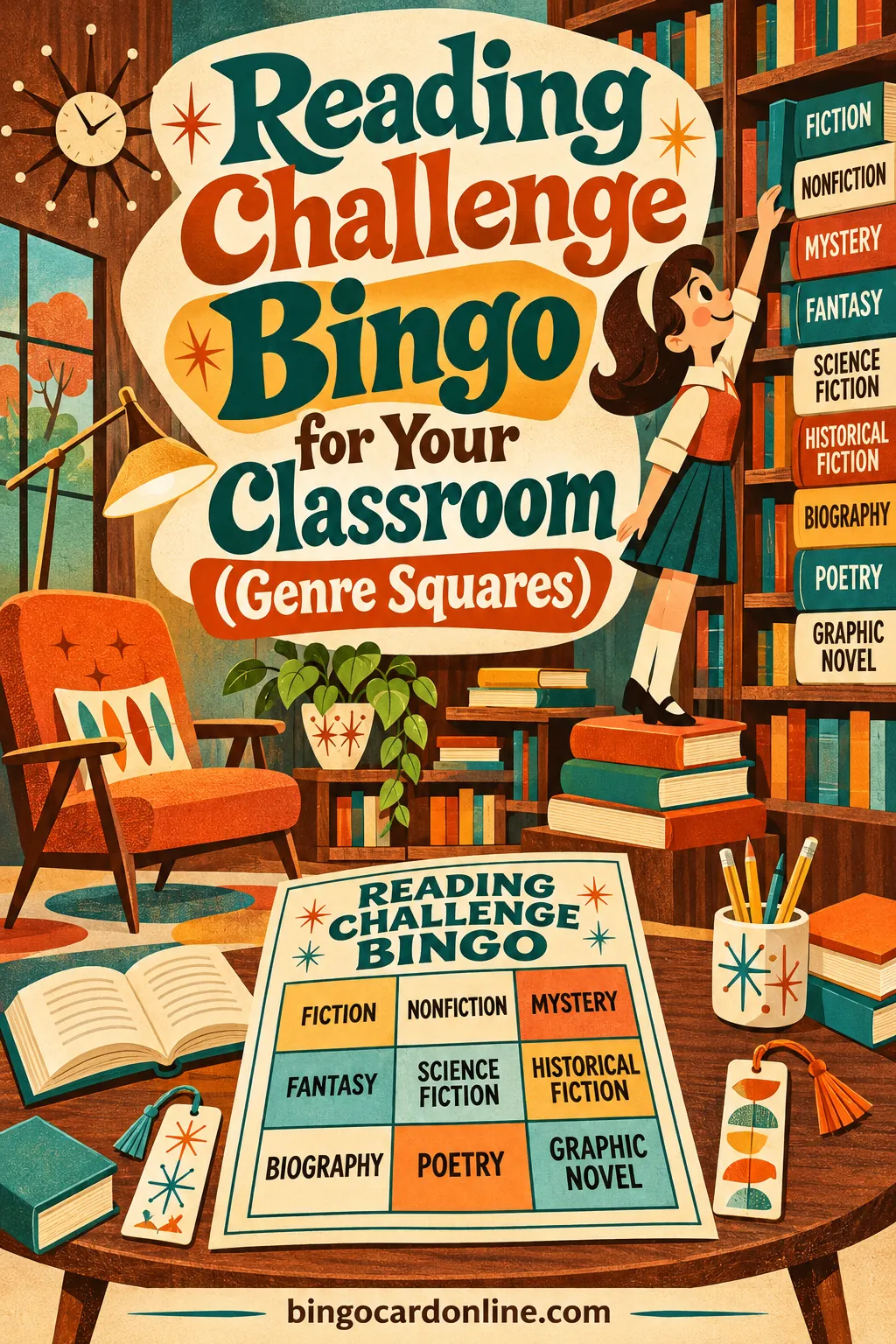
Reading challenge bingo gets students out of a one-genre rut by giving each child a card of genre squares, like mystery, biography, poetry and graphic novel, and asking them to cross off a square after every book they finish. A line of five means they've read across five different kinds of books. The card does the nudging, so you don't have to.
You can print a unique card for every student with the free bingo card generator, or hand out printable blank bingo cards and let students fill in genres themselves. Below you'll find genre lists by grade, rules, a tracking system and the exact settings.
▶ Make these exact bingo cards
Why Students Get Stuck in One Genre
Most classrooms have the reader who only picks graphic novels, the one who has read every book in one fantasy series twice, and the one who sticks to animal facts. That's not a bad thing. A favorite genre is often how kids learn to love reading in the first place.
The trouble is that a single genre can limit vocabulary, background knowledge and the kinds of writing students see. Telling a child "try something new" rarely works. It sounds like a chore, and they don't know where to start.
A bingo card turns "try something new" into a game with clear, small steps. Each square is one book. Students choose which square to try next, so they still feel in control. And because a win only takes one line, a student who loves fantasy can keep reading fantasy while picking up four other genres along the way.
How Reading Challenge Bingo Works
The setup takes one class period to explain and then runs on its own for weeks.
- Each student gets a card of genres, formats or reading tasks.
- After finishing a book, the student crosses off one matching square and writes the title in it or on a log.
- One book, one square. A book can only count once, even if it fits two genres. The student picks which square it fills.
- Five in a row is a bingo on a 5×5 card, across, down or diagonally. The free center counts.
- Keep going for more lines, four corners or a full card.
Launch it in one lesson
How you introduce the challenge matters as much as the card itself. Here's a simple plan for the first day.
- Show a sample card on the board and read the genre squares out loud.
- Book-talk one title per genre. Hold up a book from your class library for five or six squares. Thirty seconds each is plenty.
- Hand out the cards and give students five minutes to circle the three squares they want to try first.
- Do a library walk. Let students browse the class library or school library with their card in hand and pick a first book.
- Set the date. Write the end date on the card and on the board so everyone knows the time frame.
Students who choose their own first square are more likely to start right away. That early check mark is what keeps them going.
Stock the shelves to match the card
Before you print, check that your class library has at least a few books for every square. If you only have one biography, the whole class will fight over it, and the square turns into a wait list. Ask the school librarian for a rotating bin of books for the thinner genres, or sort a shelf by genre with labels that match your card. A small sign on each bin, like "Mystery" or "Poetry," helps students find a book for the square they want without asking.
Ebooks and audiobooks from your school or public library can fill gaps, too, as long as they fit your class rules.
Pick a time frame
| Time frame | Grid | Good for |
|---|---|---|
| One month | 3×3 | Younger grades, or a quick February challenge |
| One quarter or grading period | 4×4 | Most upper elementary classes |
| One semester | 5×5 | Middle school, or strong readers |
| Summer break | 3×3 or 4×4 | Take-home card for summer reading |
A shorter challenge with a smaller grid gives quicker wins. That matters most for reluctant readers.
Genre Square Ideas by Grade
Pick squares that match your students' level and your class library. You need at least 9 squares for a 3×3 card, 16 for a 4×4 card, and 24 for a 5×5 card.
Grades K–2
Young readers do better with simple labels and lots of picture-book options.
- Animal story
- Fairy tale
- Book about a family
- Funny book
- Book with rhymes
- Alphabet or counting book
- Book about a holiday
- Book of facts
- Book about feelings
- Book with no words
- Read with a grown-up
- Book about a place
- Book about a friend
- Book with a dog or cat
- Book about weather
For non-readers, try picture squares. The guide to picture bingo for non-readers shows how to use images in place of words.
Grades 3–5
Upper elementary students can handle genre names and a few format squares.
- Mystery
- Fantasy
- Realistic fiction
- Historical fiction
- Science fiction
- Biography
- Poetry book
- Graphic novel
- Folktale or myth
- Adventure story
- Sports story
- Book of facts
- Book in a series
- Award-winning book
- Book from the class library
- Book a friend recommends
- Book with a map inside
- Book set in another country
- Funny book
- Book about an invention
Grades 6–8
Middle schoolers can take on harder genres and "stretch" squares.
- Memoir
- Autobiography
- Novel in verse
- Dystopian
- Classic
- Short story collection
- Play or script
- Book about a real event
- Book over 300 pages
- Book by an author from another culture
- Book that became a movie
- Book about science or tech
- Horror (school-appropriate)
- Book published this year
- Book your teacher loves
- Book from the "new arrivals" shelf
- Book with a narrator your age
- Nonfiction about history
Fun task squares (any grade)
Mixing in a few task squares keeps the card from feeling like homework.
- Read outside
- Read to a pet or stuffed animal
- Read to a younger kid
- Read with a flashlight
- Reread an old favorite
- Read a book a classmate picked
- Listen to an audiobook
- Visit the school library
How to Make the Cards With the Generator
Here are the settings for a class of about 25 students.
- Open the bingo card generator on the homepage.
- Card type: choose Words to print genre names. Choose Blank if you want students to write their own genres or book goals in each square. Blank cards are also on the separate blank bingo cards page.
- Grid: choose 3×3 for K–2, 4×4 for grades 3–5, or 5×5 for grades 6–8.
- Free space label: on 5×5, change the center to "Free Read," "Reader's Choice" or your class name.
- Your words: paste your genre list, one per line. Quick start with a theme can fill in a list if you want a starting point, and you can edit it.
- Card title: "Reading Challenge Bingo," "Read Across Genres" or "Spring Reading Bingo."
- Number of unique cards: set it to your class size plus a few spares for new students. Every card is a different shuffle, so students' lines don't all line up the same way.
- Cards per page: choose 1 so there's room to write book titles in each square.
- Color theme: pick one that fits the season, or choose ink-saver black and white for the copier.
- Print / Save as PDF and make copies for your reading folders.
How many genres do you need?
| Grid | Squares per card | Minimum genres | Better list |
|---|---|---|---|
| 3×3 | 9 | 9 | 12 to 15 |
| 4×4 | 16 | 16 | 20 to 25 |
| 5×5 | 24 plus free center | 24 | 28 to 35 |
With a longer list, each student's card has a slightly different set of genres. That makes book talks more interesting, since kids are hunting for different things. If you want every student to try the same genres, use exactly the minimum.
Tracking Books and Checking Squares
Keep checking simple, or it'll eat your planning time.
Student book log
Staple a short log to the back of each card. Each line has the date, title, author, which square it fills and one sentence about the book. That sentence is enough proof for most classes.
Quick check-in options
- Book talk: a 30-second share at morning meeting.
- Sticky note: the student writes one fact or favorite line and sticks it on a class chart.
- Conference: a short chat during independent reading time.
Class chart
A wall chart with each student's name and a sticker per square gets the whole class cheering. You can also track the class total, like "Our class has read 120 books across 24 genres."
Halfway check
Pick a day in the middle of the challenge for a quick card review. Students look at their card, count their squares, and set a goal for the second half, like "finish my first line" or "try one genre I've been avoiding." This is a good time to spot students with only one or two squares and help them find a short, high-interest book. It's also the moment to notice which squares nobody has touched yet. If the whole class is skipping poetry, a five-minute poetry book talk the next morning often fixes it.
When a student wants to swap a square
Now and then, a genre just doesn't click for a student. Decide your swap rule ahead of time. A common one: each student may swap one square for the whole challenge, as long as the new square is a genre they haven't read yet. That keeps the challenge fair and still pushes students to try something new.
Rewards and Celebrations
You don't need big prizes. Readers love choice and recognition.
- First line: a bookmark or the choice of a read-aloud book.
- Two lines: a reading spot of their choice for a day, like a beanbag or the teacher's chair.
- Four corners: lunch in the classroom with a friend and a book.
- Blackout: name on the "Genre Explorer" wall and first pick of new class library books.
Some teachers also run a class-wide goal. When the class reaches a set number of bingos, everyone earns a pajama reading day.
Tips for Reluctant and Advanced Readers
For reluctant readers
- Use a 3×3 card so a win is only three books away.
- Let short books, picture books and graphic novels count for any square they fit.
- Add audiobooks and read-aloud squares.
- Celebrate each square, not just each line.
For advanced readers
- Use a 5×5 card and aim for blackout.
- Add stretch squares like "classic," "book over 300 pages" or "book in verse."
- Ask for a short written response for each square instead of one sentence.
For families
Send a card home with a short note so families can join in. Reading at home and at the public library can count too. If you work with your school librarian, the ideas for bingo for libraries pair well with a classroom challenge. And for a grown-up version, the bingo for book clubs guide has adult genre squares.
▶ Make these exact bingo cards
Frequently Asked Questions
What genres should go on a reading challenge bingo card?
Pick genres your students can find in your library, like mystery, fantasy, biography, poetry, graphic novel and realistic fiction. Add a few fun task squares, like "read outside" or "reread a favorite," so the card feels like a game.
Can one book count for two squares?
Most teachers say no. One book fills one square, and the student chooses which square. This keeps the challenge about reading widely.
How long should a classroom reading challenge last?
A month works well for a 3×3 card, a grading period for a 4×4 card, and a semester for a 5×5 card. Shorter challenges with quick wins are better for younger students.
Should I use blank cards or printed genre cards?
Printed genre cards are quicker and make sure every student sees a wide mix. Blank cards let older students set their own reading goals. Some teachers print genre cards with a few blank squares mixed in.
How do I check that students read the book?
Keep it light. A one-sentence book log, a short book talk or a quick conference is enough for most classes. The goal is reading more widely, not paperwork.
Can reading challenge bingo work for the whole school?
Yes. Many schools run one genre card for every grade, with a smaller grid for younger students and a bigger one for older students. Post a hallway chart with each class's total squares, and let the library host a celebration at the end. Using the same genre list across grades makes the hallway chart easy to read.
Print Your Class Reading Cards
Choose a grid for your grade, paste your genre list, and print a unique card for every reader with the free bingo card generator. Then watch your fantasy fans discover that they like mysteries too.