Ways to Win Bingo: Every Winning Pattern, Explained
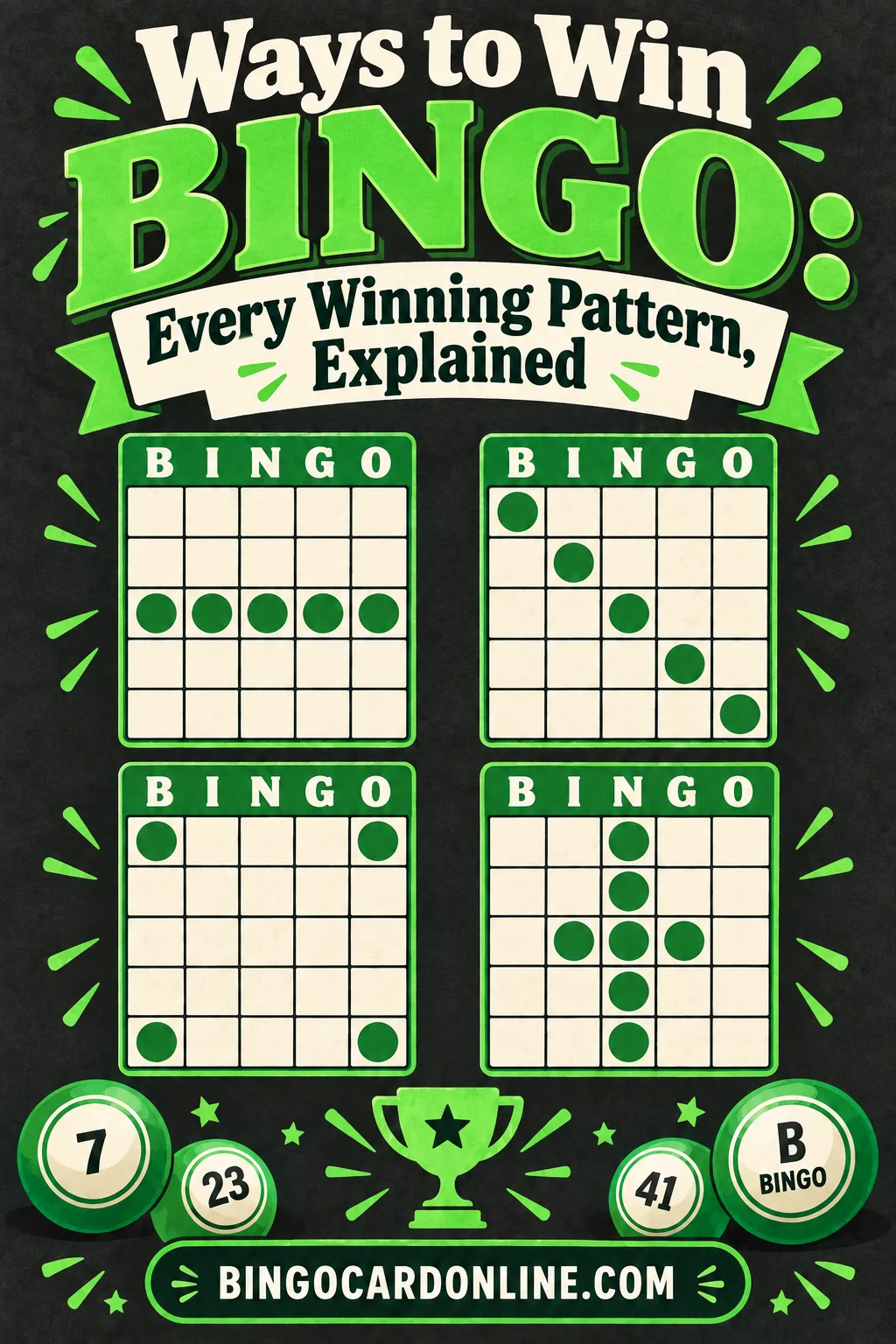
There are dozens of ways to win bingo, but they are all the same thing underneath: cover a specific set of squares before anyone else does, where the set is agreed before the first ball is drawn. A single line needs four or five squares. Four corners needs four. A postage stamp needs four. A picture frame needs sixteen. A blackout needs all twenty-four. The number of squares is the only thing that determines how long the round runs, and it is the only number worth knowing.
The second thing worth saying up front, because most pages on this subject dodge it: bingo is pure chance. No pattern you choose, seat you sit in, or ball you watch for changes your odds once the cards are dealt. The only two levers that exist are how many cards you hold and how many other people are holding cards. Everything below is about knowing the patterns and running a better game, not about beating a draw that cannot be beaten.
The Standard Card and Why It Shapes Everything
A 75-ball card is five columns by five rows. The letters B, I, N, G and O head the columns, each drawing from its own fifteen-number range, and the center square is usually free — covered from the moment the cards go out.
B    I    N    G    O
[ ]  [ ]  [ ]  [ ]  [ ]
[ ]  [ ]  [ ]  [ ]  [ ]
[ ]  [ ] FREE [ ]  [ ]
[ ]  [ ]  [ ]  [ ]  [ ]
[ ]  [ ]  [ ]  [ ]  [ ]
That free center is why so many patterns need four squares rather than five. Any line running through the middle — the third row, the third column, either diagonal — is already one-fifth complete before the game starts. It is a pacing device, and it is the single most consequential design decision on the card.
The Core Patterns
Single Line
The default. Five in a row horizontally, vertically or diagonally. Lines through the center need four called numbers; lines that miss the center need five.
This is the fastest common pattern and the right one to open a session with, because it explains itself and it ends quickly enough that latecomers only miss one round.
Four Corners
The four extreme squares: B1, O1, B5 and O5 in grid terms. Four specific numbers, one from each end of the B and O columns, and no help from the free space.
Four corners is the best short pattern in the game for one practical reason: it is verifiable from ten feet away. A caller can confirm it visually before touching the master list, which makes it ideal for a room full of children or a crowd that gets restless during a read-back.
Postage Stamp
A two-by-two block in any corner of the card — four squares touching, like a stamp on an envelope. Four numbers, none of them free.
Some house rules restrict it to one named corner, which makes the round substantially longer because there is only one target instead of four. Say which version you are running before the first call, every time. This is the most common source of a disputed win.
Blackout or Coverall
Every printed square on the card. With a free center that is twenty-four numbers; on a card printed without one, twenty-five.
Coverall is the traditional final round of an evening, and the reason is arithmetic rather than tradition. It uses so much of the ball cage that nothing can be played after it without resetting the draw.
Picture Frame
The complete outer border: sixteen squares around the edge, leaving the middle nine untouched. It is the natural step between a letter shape and a full blackout, and it looks impressive when it completes, which matters more in a room than it should.
Letter and Shape Patterns
The five-by-five grid holds recognizable letters, and calling them out gives a session variety without changing anything mechanically.
| Shape | Squares needed | What it looks like |
|---|---|---|
| Letter T | 9 | Full top row plus the center column |
| Letter L | 9 | Full left column plus the bottom row |
| Letter X | 8 | Both diagonals, sharing the free center |
| Letter H | 12 | Both outer columns plus the middle row |
| Letter Z | 12 | Top row, one diagonal, bottom row |
| Letter E | 15 | Left column plus three horizontals |
| Kite | 13 | A diamond in one corner plus a tail |
| Diamond | 12 | A rotated square touching each edge |
| Arrow | 9 | A point plus a shaft down the middle |
| Bullseye | 9 | The center square plus the ring around it |
| Small diamond | 4 | The four squares touching the free center |
| Double line | 8 to 10 | Any two complete lines |
Letter X is the best of these for a mid-session round. It uses both diagonals, both pass through the free space, and it needs only eight numbers, so it feels elaborate and finishes fast. Letter E is the longest realistic letter and belongs late in a running order.
Rule Variants Rather Than Shape Variants
Two variants change the rules instead of the shape, and both are worth having in your pocket.
Hardway bingo requires a straight line without using the free space. It turns a four-number pattern into a five-number one and lengthens the round without redrawing anything. Crazy bingo allows the chosen pattern in any of its four rotations, which multiplies the ways to win and shortens the round dramatically. One sentence each, and both give you a different game length from the same cards.
How Long Each Way to Win Takes
Here is the honest math, and it is simple enough to do on paper.
In 75-ball bingo you draw from seventy-five balls without replacement. If a pattern needs k specific numbers on your card, picture the seventy-five balls laid out in draw order. Your k targets sit somewhere in that line, and the other 75 minus k balls fall into the k plus 1 gaps around them. On average those non-target balls spread evenly, so the expected number of balls sitting after the last target is (75 - k) / (k + 1). Subtract that from 75:
E = 75 - (75 - k)/(k + 1) = k x 76 / (k + 1)
| Pattern | Squares needed (k) | Expected call to win, one card |
|---|---|---|
| Line through the free space | 4 | 60.8 |
| Four corners | 4 | 60.8 |
| Postage stamp | 4 | 60.8 |
| Line, no free space | 5 | 63.3 |
| Letter X | 8 | 67.6 |
| Letter T or L | 9 | 68.4 |
| Diamond or letter H | 12 | 70.2 |
| Picture frame | 16 | 71.5 |
| Coverall with free space | 24 | 73.0 |
Two things jump out. First, a four-square pattern and a sixteen-square pattern are only about eleven calls apart on a single card, which is far closer than people expect. Second, the top of the table is compressed: once a pattern needs more than about a dozen squares, adding more squares barely lengthens the round, because you are already pressed against the ceiling of seventy-five balls.
What Actually Changes Your Chances
This is where most advice goes wrong, so here is the honest version.
Card count helps, and it is the only real lever. Every additional card is an independent chance at an early completion, so holding more cards genuinely raises your probability of being first. The effect is real and it is large for short patterns. It is much weaker for long ones: with a coverall, the expected win already sits near seventy-three of seventy-five calls, and no number of cards can pull the first win far below that ceiling.
Fewer players helps. Your card does not get better in a smaller room, but the bar you have to clear does get lower, because there are fewer competing cards. A quieter session is objectively easier to win, and it is the second and last thing you can control.
Manageability matters more than card count past a point. Holding more cards than you can actually mark is worse than holding fewer. A missed call on a card you were not watching costs you the round outright, and the number of cards a person can track reliably is smaller than they think — usually three or four for a casual player at a normal calling pace.
Nothing else works. Not choosing cards with a particular spread of numbers, not sitting in a certain seat, not tracking which numbers came out last game. The draw has no memory, the balls do not know what happened previously, and every card in the room has exactly the same chance per call.
You will find pages recommending a strategy attributed to the British mathematician Leonard Tippett, usually summarized as choosing cards with numbers near 38 in long games and near the extremes in short ones. Treat it with skepticism. The underlying observation about how a random sample's median behaves is real, but the leap to picking cards does not follow, and it does not change your expected outcome in a game where numbers are drawn without replacement and every card is equally likely to be completed.
How to Win Bingo More Often, Honestly
People search how win bingo and how to win bingo expecting a trick, and the truthful answer is that there is no trick — but there are three things that make you win more rounds than the person next to you, and none of them involves the draw.
Mark accurately. The most common way to lose a round you had already won is failing to daub a called number. Use a marker you can see at a glance, keep your cards in a fixed arrangement, and do not rearrange them mid-round.
Call immediately. In most house rules a bingo must be called before the next number is announced. A player who hesitates for two seconds during a fast finish loses a valid win, and this happens constantly in the last ten calls of a coverall when several cards are one square out.
Know the pattern before the round starts. A surprising share of missed wins are people who completed the shape and did not recognize it, because they were watching for a line while the round was running corners. Ask what the pattern is, out loud, if the caller has not said it twice.
Running a Session With Multiple Ways to Win
If you are the one organizing, order the patterns by length and put the longest last. A running order that works for a two-hour event:
| Round | Pattern | Budget |
|---|---|---|
| 1 | Single line | 10 min |
| 2 | Four corners | 10 min |
| 3 | Postage stamp | 10 min |
| 4 | Letter X | 12 min |
| Break | Hand out fresh cards | 10 min |
| 5 | Letter H | 12 min |
| 6 | Picture frame | 15 min |
| 7 | Coverall | 20 min |
Three rules make it run cleanly. Announce the pattern and draw it where everyone can see it. Stop the draw the moment somebody calls, before verifying, because continuing after a bad call advantages everyone else. And verify by reading down the columns rather than across the rows, since the master list is grouped by letter and column order is far faster to check.
If you are building your own cards, this free bingo card generator produces unique 3x3, 4x4 and 5x5 cards along with the master call list you need for verification. Unique cards matter more than anything else on this page: duplicate cards produce simultaneous winners, and a round that ends in a four-way tie ends flat.
Winning Patterns on Other Formats
Not every game is 75-ball, and the ways to win change with the card.
90-ball does not use shapes at all. A ticket is three rows by nine columns with fifteen numbers, and the three ways to win are one line, two lines and the full house, awarded in that order during a single round. Everyone stays in contention to the end, which is the format's main virtue.
80-ball uses a four-by-four grid with colored columns, and it supports lines, corners and coverall but not the more elaborate letter shapes, because sixteen squares do not hold them.
30-ball speed bingo has exactly one way to win: cover all nine squares. A round takes under a minute, which makes it the right format for young children and short time slots.
Online bingo adds nothing to this list. Bingo online uses the same patterns and the same odds; what it changes is that marking and verification happen automatically, so the mistakes described above — missed daubs and late calls — largely disappear. Free online bingo and printable free bingo cards both run the standard patterns, and searching bingo online free will turn up the same shapes described here.
Frequently Asked Questions
What are all the ways to win bingo? On a 75-ball card the standard set is a single line in any direction, four corners, a postage stamp, letter and shape patterns such as X, T, L, H and diamond, the picture frame border, and a full blackout or coverall. On 90-ball tickets the ways to win are one line, two lines and the full house. On 30-ball cards there is only one: cover every square.
How to win bingo more often? Hold more cards than one, but only as many as you can genuinely track, and play in less crowded rounds where fewer cards are competing. Beyond that, the reliable gains come from marking accurately, calling the moment you complete the pattern, and being certain which pattern is in play. There is no way to influence the draw itself.
Which winning pattern is fastest? Any four-square pattern: a line through the free space, four corners, a postage stamp, or the small diamond around the center. All four have the same expected winning call on a single card, around sixty-one of seventy-five, because the number of squares is what governs the length rather than the shape.
Does the free space count toward a winning pattern? Yes, on cards that have one. The center square is treated as covered from the moment play begins, which is why a line through the middle needs four called numbers instead of five. Cards printed without a free space require the full five, and hardway bingo deliberately disallows using it.