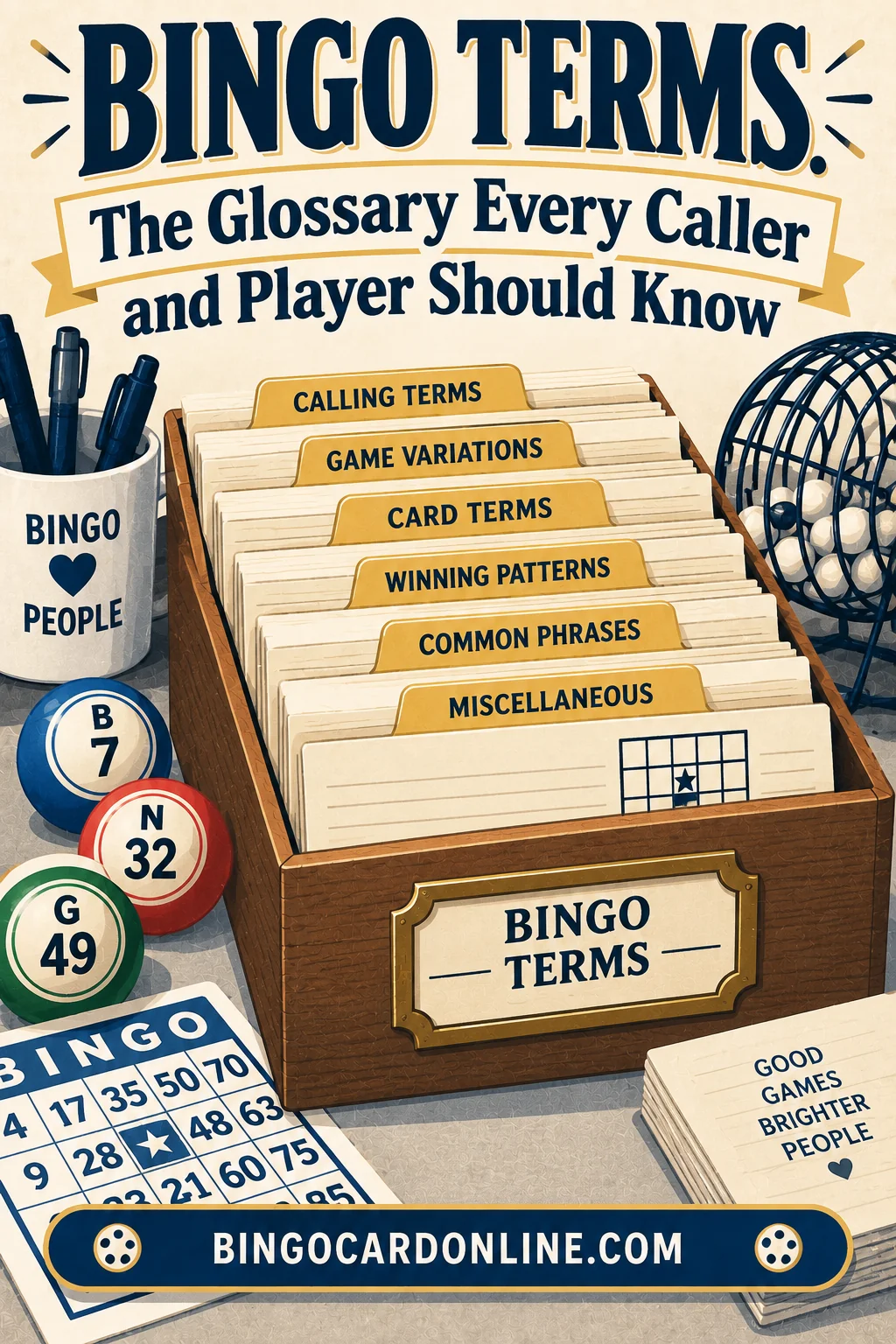
Bingo Terms: The Glossary Every Caller and Player Should Know
The bingo terms that actually matter at a table are the ones that describe three things: what you mark with, what shape you are chasing, and how close you are. Everything else is regional flavor. A dauber is the marker, a coverall is every square, a free space is the one you get without a call, and "on the way" means one number short. Learn those four and you can walk into any room and play.
This glossary sticks to real terminology - the words a caller uses to run a game and a player uses to describe a position. It deliberately leaves out the rhyming nicknames for individual numbers, which are a separate tradition with their own logic and their own page.
What Is Bingo, in the Language of the Game
Before the glossary, the one definition everything else hangs off. Strip out the theme and the prizes and what is bingo? It is a race between a random draw and a fixed grid. Each player holds a card filled with items from a shared pool. A caller pulls items one at a time and announces them. Players mark any cell holding the called item. When a player's marked cells form the agreed pattern, that player claims the win, and a floor worker verifies the claim against the caller's own record.
Four nouns carry that sentence: the card, the pool, the call and the pattern. Almost every term below is a name for a variation on one of those four, which is why the vocabulary looks large and is actually small. Get the four straight and the rest is labeling.
Equipment Terms
Dauber. The ink marker used to blot a called number. It is a bottle with a felt or sponge tip that leaves a translucent colored dot, so the number underneath stays readable for verification. Spelled and said dabber in Britain. The design matters more than it sounds: a dauber has to mark fast, dry fast, and not hide the digit, which is why a pen or a highlighter is a poor substitute.
Chip. A flat plastic disc used instead of ink, usually on a reusable hard card. Chips are standard in home sets and in any game where the cards get used again.
Shutter card. A rigid card with sliding windows over each number. You push the shutter closed to mark, and slide them all open to reset. Common in travel and home sets, and effectively indestructible.
Cage. The rotating wire drum that tumbles numbered balls. Turning it and letting one ball drop is the traditional draw method.
Flashboard. The lit display at the front of a hall showing every number called so far. A player who missed a call checks the flashboard rather than asking.
Master board. The caller's own tray or board where drawn balls are placed in order, used to verify a claimed win.
Card versus ticket. In the United States the playing slip is a card. In Britain it is a ticket, and "card" is barely used. Both refer to the same object: the grid of numbers a player marks.
Book. A stapled pad of cards or tickets covering a whole session, one page per game.
Pattern Terms
The pattern is the shape you have to complete to win, and it is announced before each game.
Line. Five marked squares in a row. In the American 75-ball game a line can be horizontal, vertical or diagonal. In the British 90-ball game only horizontal rows count, and the word means specifically one complete row of five.
Coverall. Every square on the card marked. Also called a full card. It is the longest pattern in the game and normally carries the biggest prize of a session.
Blackout. The same thing as a coverall. The two words are interchangeable, and which one a hall uses is purely regional. If a caller announces a blackout round, cover every square.
Full house. The British name for the same idea: all fifteen numbers on a 3x9 ticket. Slightly different in practice because the ticket has blanks, but identical in spirit.
Four corners. The four extreme corner squares of the card and nothing else. It is the fastest pattern in common use and often runs as a warm-up game.
Postage stamp. A 2x2 block of four squares in one corner, so named because it sits on the card like a stamp on an envelope.
Picture frame. The full outer border of the card - all sixteen edge squares - with the interior ignored.
Hardway. A line completed without using the free space. A hardway bingo is worth calling out as such because some halls pay it differently, and because a five-in-a-row through the center is easier than one that avoids it.
Crazy pattern. Any announced pattern that may be rotated ninety degrees in any direction. A crazy T, for example, counts whether the crossbar is at the top, bottom, left or right.
Progressive. A pattern or a jackpot that grows across a session or across days until somebody wins it, usually with a call limit attached.
Position Terms: How Close You Are
These are the words players use to describe where they stand, and they are the most useful terms in the whole glossary.
On the way. One number away from completing the pattern. A player who is on the way is watching a single number, and the phrase is used out loud at friendly tables so everyone knows the game is nearly over.
Waiting. The same meaning as on the way, and the more common phrasing in Britain. "I'm waiting on eleven."
Set. Similar, used in some regions to mean one number short.
Live card. A card still capable of winning the current pattern.
Dead card. A card that can no longer complete the announced pattern, usually because a needed number has already been called into a different column or the pattern has been won.
Sleeper. A number on a card that has been called but not marked, usually because the player missed it. Sleepers are the single most common reason a claim gets rejected on verification.
Bingo. The word a player shouts to claim a win in the American game. In Britain a player shouts "line" or "house" depending on the stage.
House. The British term for a completed full house, and by extension the shout that claims it. Also used in the older name for the game, housey-housey.
Good bingo. The caller's confirmation after checking a claim against the master board. The opposite is a bad bingo or a miscall, which does not usually carry a penalty in a casual game.
Number and Call Terms
Free space. The center square of a 75-ball card, marked for everybody from the start. It exists to shorten the game and to make center-crossing patterns possible: without it, every shape that runs through the middle needs one more call. Word and picture bingo cards often keep the free space purely by convention.
Wild number. A rule that opens a game up by making a whole group of numbers count at once. The most common version: the first ball drawn sets the wild digit, and every number on the card ending in that digit is marked immediately before play begins. If the first ball is 42, every number ending in 2 gets marked. It turns a slow coverall into a fast one and is normally announced as a wild round.
Money ball. A designated number that increases the prize if a player wins on it.
Call. One drawn number announced to the room. Game length is measured in calls, not minutes.
Dead ball. A ball drawn out of turn or dropped before being announced, returned to the cage without counting.
Eyes down. The British caller's phrase for the start of play: stop talking, start watching. It has no direct American equivalent.
Early bird. A game played before the main session begins, usually with a smaller field.
Blower. The air-driven machine that replaced the hand-turned cage in most commercial halls, mixing balls with a fan and pushing one at a time up a tube.
Coverall in N. A coverall that must be completed within a stated number of calls to win the top prize, with a smaller prize if it goes longer.
Room and Session Terms
Session. One sitting of consecutive games, usually sold as a book.
Caller. The person drawing and announcing numbers. A good caller keeps a steady rhythm, repeats each number once, and never speeds up because the room is excited.
Floor worker. The staff member who walks the room, verifies claims and sells extra cards between games.
Bonanza. A special coverall game, often played on a separate card bought ahead of the session and carried across multiple sessions.
Intermission. The break in the middle of a session, and traditionally when the largest game of the night is sold.
Six pack. Six numbers in a 2x3 block. Also nine pack for a 3x3 block, and both are used as fast patterns.
Strip. In the British game, a set of six tickets that between them contain all ninety numbers exactly once, so every call marks something on one of your tickets.
Terms That Mean Different Things in Different Rooms
A short warning. Several bingo terms are genuinely unstable across regions, and assuming your version is universal is the fastest way to a dispute.
| Term | Common reading | Other reading |
|---|---|---|
| Blackout | Every square marked | Occasionally, a room-wide silent round |
| Line | Any five in a row | Horizontal only, in British play |
| Card | The playing grid | The paper entry slip, in some halls |
| Set | One number away | A group of cards bought together |
| House | A full house win | The venue itself, as in house rules |
| Hardway | A line without the free space | Any line with no free square at all |
The fix is trivial and worth doing every time: before the first call, state the pattern out loud and say what counts. "One line, horizontal or vertical, diagonals do not count, free space counts." Ten seconds of announcement prevents most arguments.
Terms for Non-Number Bingo
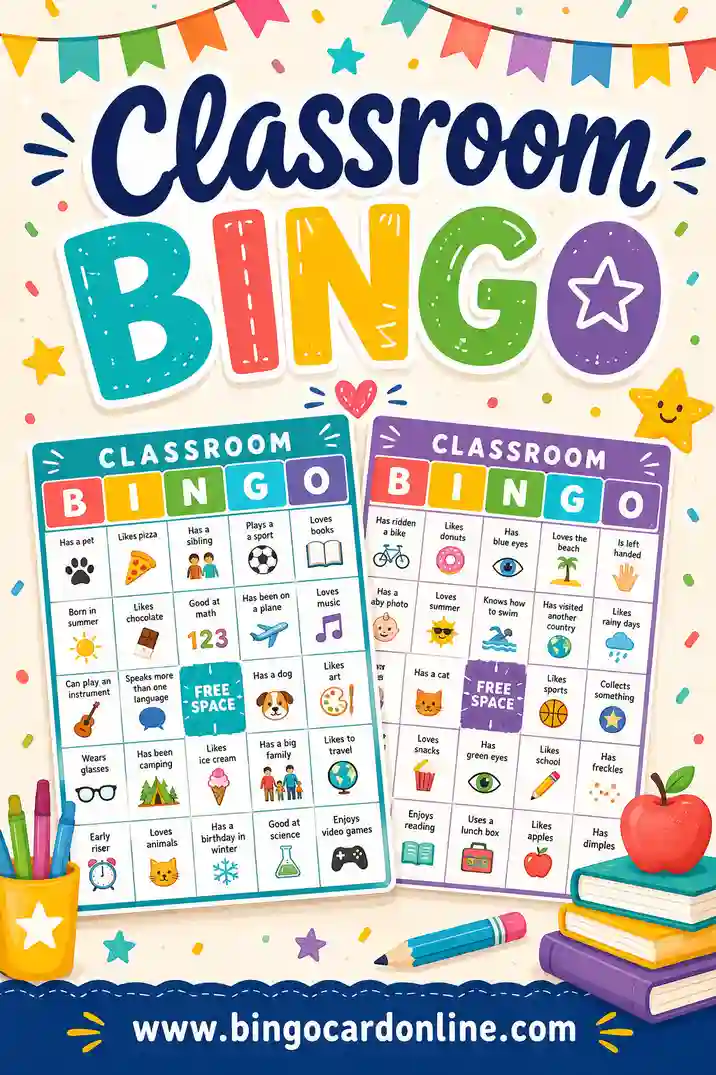
Word, picture and theme games borrow the same vocabulary but need a few extra terms.
Item pool. The full list of words, pictures or phrases the cards are drawn from. The ratio of pool size to grid size controls game length exactly the way the number pool does.
Call list. The caller's shuffled copy of the item pool. A word game needs one, because there is no cage to draw from.
Duplicate. Two cards with identical layouts, which is a real risk when the pool is barely larger than the grid.
Themed free space. A center square filled with a phrase relevant to the theme rather than the word "free."
If you are building word or picture cards for a classroom or a party, a bingo card generator handles the shuffling and the duplicate problem for you, which is the tedious part of running a themed game by hand.
Where the Free Bingo Search Terms Fit
One vocabulary note that has nothing to do with the table and everything to do with finding a game. People search free bingo, free online bingo, bingo online free and bingo free online interchangeably, and those phrases point at two unrelated things.
One meaning of bingo online is the licensed, age-restricted wagering industry, which is a regulated sector and not what a teacher or a party host is looking for. The other meaning of online bingo is a browser-based card maker: you type in your own items, it lays out the grids, you print. When somebody searches for free online bingo before a classroom lesson, the second is what they want. Knowing that the same four words describe both products saves a lot of clicking.
Frequently Asked Questions
What is the difference between a coverall and a blackout? Nothing. Both mean every square on the card marked, and which word a hall uses is regional. The British equivalent is a full house, which covers all fifteen numbers on a 3x9 ticket.
What does it mean to be on the way in bingo? It means you are one number short of completing the announced pattern. Some rooms say waiting or set instead, and at friendly tables players announce it out loud so everyone knows the game is close to ending.
What is a wild number in bingo? A rule that marks a whole group of numbers at once before play begins. Most commonly the first ball drawn sets a digit, and every number on the card ending in that digit is marked immediately, which shortens a long pattern considerably.
Why does a bingo card have a free space? It shortens the game and makes patterns that cross the center possible. Without a free center, every shape running through the middle needs an extra call, and a coverall takes noticeably longer. A line completed without using it is called a hardway bingo.