Shape Bingo: Free Printable Cards for Early Learners
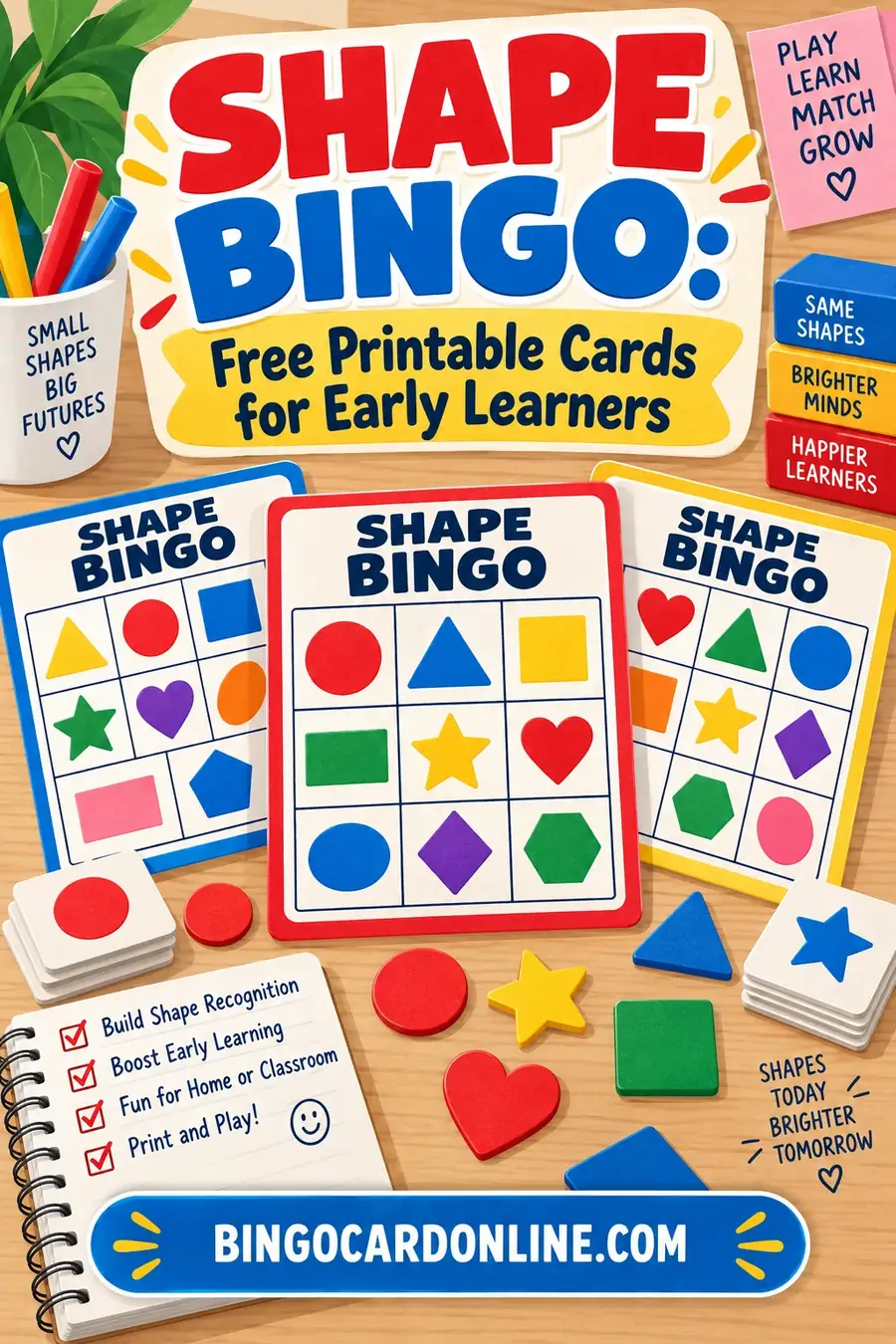
Shape bingo works with children who can't yet read because it asks them to match a picture to a picture — the earliest form of visual discrimination, and the foundation everything else in early math sits on. It's one of the few group games that genuinely works with a mixed-ability preschool room, because the difficulty scales just by changing which shapes are on the cards.
Which Shapes, at Which Age
| Age | Shapes to include | Grid |
|---|---|---|
| 2-3 | Circle, square, triangle | 2x2 or 3x3 |
| 3-4 | Add rectangle, star, heart | 3x3 |
| 4-5 | Add oval, diamond, pentagon | 4x4 |
| 5-6 | Add hexagon, octagon, trapezoid | 4x4 or 5x5 |
| 6-7 | Add 3D: cube, sphere, cylinder, cone | 5x5 |
Start narrower than feels right. Three shapes on a 2x2 grid sounds trivially easy to an adult and is genuinely absorbing for a two-year-old. A first game that finishes with everyone winning builds far more enthusiasm than a challenging one.
Setting Up
Same shape, same color, every time — at first. If the circle is red on the calling card and blue on the bingo card, a young child may not recognize them as the same thing. Color consistency removes a variable that has nothing to do with shape recognition. Once matching is solid, deliberately varying color becomes a useful next exercise, because it forces attention onto form rather than color.
Keep shapes large and solid. Outlines are harder to identify than filled shapes at this age, and small shapes are harder to distinguish — a small pentagon and a small hexagon look nearly identical to a four-year-old.
Use consistent orientation, then break it. A triangle sitting on its base is the canonical form most children learn. Rotating it later is a genuine and valuable challenge — many children don't initially recognize an upside-down triangle as a triangle at all.
Markers matter. Pom-poms, counting bears, plastic chips or dried beans all work better than crayons for the youngest players, because they can be moved when a mistake happens. Reusable cards plus loose markers is the setup that survives a term of use.
Running the Game
- Name the shape as you call it, and show it. "Triangle — three sides." Saying the property while showing the shape does the teaching.
- Let children check each other's cards. Peer checking is genuinely useful; children spot mismatches quickly and it keeps everyone engaged between calls.
- Use "full card" rather than a line for the youngest players. Line-based winning requires understanding rows and columns, which is a separate skill from shape recognition — and full-card play keeps everyone in the game longer.
- Call slowly and repeat. Twice, with a pause. Rushing turns a matching game into a listening test.
- Stop while there's still energy. Two short rounds beat one long one every time.
Variations That Extend the Game
Property calling. Instead of naming the shape, describe it: "three sides and three corners." The child has to work out which shape fits. This is a meaningful step up and the natural next stage.
Real-object shapes. Replace abstract shapes with photographs of real things — a clock for circle, a book for rectangle, a slice of pizza for triangle. Connects the abstract shape to the world, which is where the concept actually gets used.
Color and shape together. Cards show shapes in various colors; the call specifies both — "blue square." Adds a second attribute to hold in mind, appropriate around ages five and up.
Shape hunt bingo. Children find the shapes in the classroom or at home rather than on a card. Slower, more physical, and memorable.
3D shapes. For older children, swap flat shapes for cubes, spheres, cylinders and cones. The vocabulary is genuinely harder and is exactly what early primary math asks for.
Why Bingo Specifically
Plenty of activities teach shape recognition. Bingo has a few structural advantages worth knowing:
Everyone plays simultaneously. No turn-taking means no waiting, which is the failure mode of most group games with young children.
Self-paced within a shared frame. A slower child is still participating on every call, even if they take longer to find the match.
Repetition without tedium. A single game may present the same shape six or seven times. Direct drilling that many repetitions would lose a child completely.
Instant, visible feedback. Either the shape is on the card or it isn't. No ambiguity, no adult judgment required.
Making the Cards
Every card in a set must be different, or several children win simultaneously on the same call — which is fine occasionally and frustrating as a pattern. Building genuinely varied cards by hand is fiddly, since it means shuffling the same shape set into different arrangements for each card.
A bingo card generator handles the randomization and prints a set where every card differs, which is the part that makes a home-made set annoying to build manually. Print on cardstock and laminate if it's for repeated classroom use — shape bingo tends to get played a lot once it works.
What Children Are Actually Learning
Worth knowing, because it changes how you run the game and what you say while playing.
Visual discrimination. Telling a pentagon from a hexagon requires noticing and counting sides, which is a genuine perceptual skill that develops through practice rather than instruction. Bingo provides high-volume practice without it feeling like drilling.
Shape constancy. A triangle rotated onto its point is still a triangle. Many young children do not initially believe this, and it's one of the more important conceptual steps in early geometry. Deliberately rotating shapes on later cards teaches it directly.
Vocabulary attached to properties. Saying "triangle — three sides, three corners" during the call links the word to the defining feature rather than to a single remembered image. Children who learn shapes this way identify unfamiliar examples far more reliably.
Matching and one-to-one correspondence. Placing exactly one marker on exactly one matching square is a real early-math skill, and children who rush it are practicing something worth slowing down for.
Listening and turn-holding. Waiting for a call, acting on it, then waiting again is genuine self-regulation practice for a three-year-old.
Running It With a Mixed-Ability Group
Preschool rooms rarely contain children at the same stage, and bingo handles this better than almost any other group activity — if you set it up right.
Differentiate by card, not by call. Give the confident children cards with nine shapes including pentagons and hexagons; give the less confident children cards with four basic shapes. Everyone plays the same game with the same calls, and nobody can tell from across the room that the cards differ.
Call the property as well as the name. "Triangle — three sides." Children who know the shape hear confirmation; children who don't get a route to the answer.
Pair a confident child with a hesitant one on a shared card. The explaining does as much for the confident child as the help does for the other.
Use full-card wins rather than lines. Line wins end the game while some children have marked almost nothing. A full-card game keeps everyone participating until nearly the end.
Have a second round ready. The first round is often spent learning the format. The second is where the shape practice actually happens.
Making the Set Last
Shape bingo gets played repeatedly once it works, so a set built to survive is worth the extra ten minutes.
Print on cardstock. Standard paper curls and tears within a few sessions of small hands.
Laminate if you can. A laminated set with dry-erase markers or loose counters survives a full school year.
Store cards and markers together. A set missing its markers doesn't get used. A zip bag or small box per set solves it.
Make more cards than children. Spares cover damage, absent children returning, and the child who wants to play again immediately.
Keep a master call list with the set. Reconstructing which shapes are in a set from the cards themselves is tedious.
Extending Into Early Geometry
Once basic shape recognition is solid, the same format carries a surprising amount of further content.
Sides and corners. Call the property rather than the name: "three sides, three corners." Children work backwards to the shape, which is a genuine step up from recognition.
Comparing shapes. "A shape with more sides than a triangle." Now they're reasoning across the set rather than matching one item.
Composite shapes. Cards show shapes made of two others — a square split into two triangles, a hexagon built from triangles. Calls name the components.
Symmetry. "A shape with a line of symmetry." Harder, and appropriate for the upper end of primary.
3D shapes. Cube, sphere, cylinder, cone, pyramid. The vocabulary is genuinely more difficult and the pictures need to be clear, but it's exactly what early primary curricula ask for.
Shapes in the environment. Photographs of real objects rather than abstract shapes — a clock face for a circle, a door for a rectangle. Bridges the gap between the classroom shape and the world, which is where children frequently fail to connect the two.
Group Sizes and Timings
| Group | Grid | Round length | Rounds |
|---|---|---|---|
| 2-4 children | 2x2 or 3x3 | 4-6 minutes | 2-3 |
| 5-10 children | 3x3 | 6-8 minutes | 2-3 |
| Full class | 3x3 or 4x4 | 8-12 minutes | 2 |
| Mixed ages | Varies by child | 8-10 minutes | 2 |
Two rounds is almost always right. The first teaches the format; the second is where the shape practice actually happens. A third round usually loses the youngest children.
Keep total time under twenty minutes including setup. Beyond that, attention fragments regardless of how well the game is going.
Adapting for Home Use
Shape bingo works with two players, which most group games don't.
Play alongside rather than against. One card each, both marking, no competition. For a young child, playing "with" an adult rather than "against" removes an obstacle that has nothing to do with the shapes.
Let them call sometimes. Handing a four-year-old the calling cards and having them read shapes aloud to you is genuinely valuable — producing the name is harder than recognizing it, and they enjoy the authority.
Use household objects as markers. Buttons, coins, dried pasta, small toys. The novelty of the marker does real motivational work.
Keep a set in the car or bag. Laminated cards and a small bag of counters is a compact activity for waiting rooms and restaurants, and it beats a screen for a short wait.
Troubleshooting a Session That Isn't Working
Children marking squares that weren't called. Almost always over-eagerness rather than misunderstanding. Slow the calling and ask them to point at the shape before placing a marker.
One child finishing far ahead. Give them a card with more shapes next round rather than asking them to wait. Differentiation by card is invisible and effective.
A child not marking anything. Check they can see the card clearly, then check the shapes aren't too similar. If a set includes both a pentagon and a hexagon, a four-year-old may genuinely not be able to distinguish them at printed size.
Everyone winning simultaneously. The cards aren't different enough. This happens when a set is built by hand from a small shape pool — with only four shapes on a 3x3 grid, cards repeat.
Losing attention halfway. The round is too long. Shorten to a 2x2 grid and run more rounds instead.
The Bingo Dog Song Is a Different Thing
Search for shape bingo alongside anything else aimed at preschoolers and you will run into the bingo dog song — "There was a farmer had a dog, and Bingo was his name-o." It is the same word attached to a completely different activity, and it's worth knowing the difference before you plan a session around one and end up running the other.
The song is a spelling and rhythm exercise. Children clap out the letters B-I-N-G-O and drop one letter per verse, replacing it with a clap. That builds letter sequencing, working memory and beat-keeping. It teaches nothing about shapes and involves no cards at all — the bingo dog of the rhyme is a farm animal, not a game piece.
The two do pair well in one session, though. Singing it once settles a group and makes a natural transition into handing out cards. Children who already associate the word "bingo" with the song accept the card game faster, because the name arrives familiar rather than new. The refrain "and Bingo was his name-o," which turns up in searches as bingo nameo, is usually the part they remember first and the part they will sing back at you unprompted for the rest of the morning.
Picture Bingo Beyond Shapes
Once the format works with shapes, the same cards carry any set of pictures a child can recognize — and swapping the images is the cheapest way to get a second term out of one printed set.
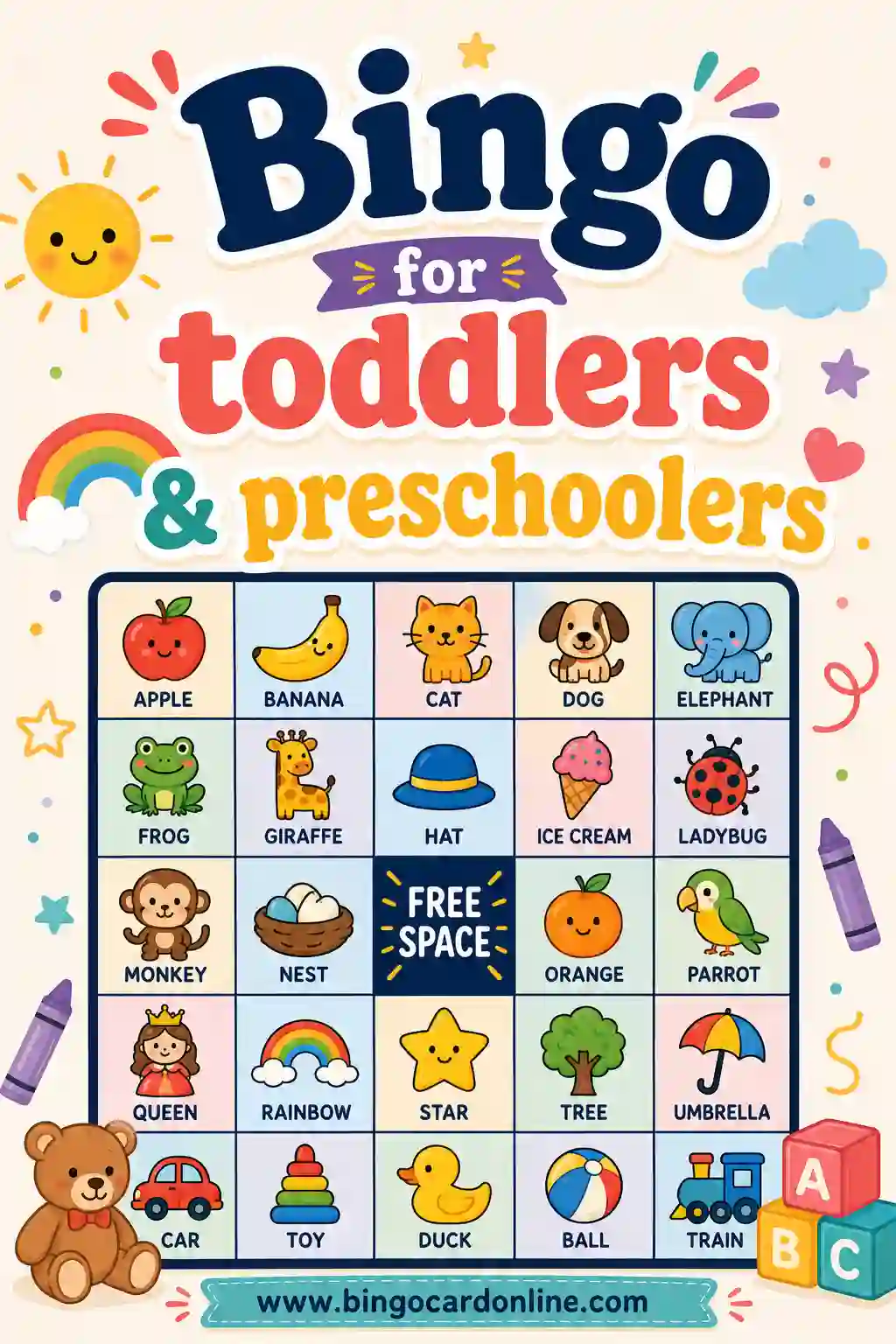
Fruit bingo. Apple, banana, grapes, strawberry, orange. Fruit bingo is the usual next step after shapes because the images are unmistakable, the vocabulary is already in place for most three-year-olds, and it carries straight into snack-time conversation.
Animals, vehicles and household objects. Same principle. Pick categories where the pictures stay visually distinct — a car and a truck are harder to tell apart at printed size than a car and a boat.
Pokemon bingo. For older children, a pokemon bingo card built from a dozen familiar characters holds attention far longer than shapes do, and the matching skill being practiced is identical. Six- and seven-year-olds who have outgrown circles and squares will happily play the same game with characters they care about.
Drive bingo. Take it out of the room entirely. A drive bingo card for the car uses what's visible from the back seat, and it keeps the shape vocabulary alive on a journey: a stop sign for octagon, a yield sign for triangle, a billboard for rectangle, a traffic light for circle. No markers needed, just a pencil.
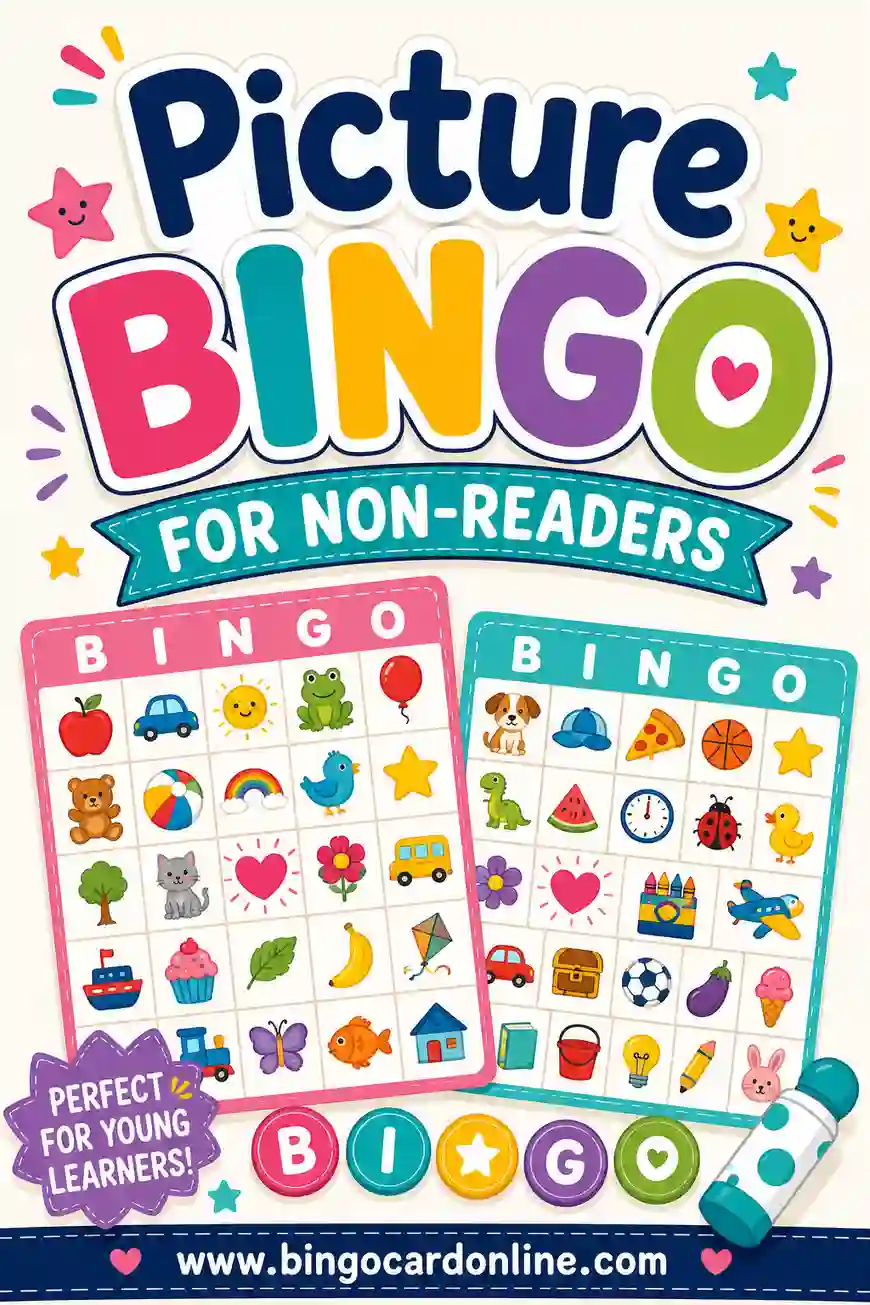
One note on images: searches for bingo pics usually mean simple clip-art pictures for cards rather than photographs. Clean line art on a white background prints better and is far easier for young eyes than a detailed photo.
Frequently Asked Questions
What age is shape bingo appropriate for? From around age two with three basic shapes on a small grid, up through age six or seven using 3D shapes and property-based calling. The core version suits preschool and kindergarten.
How many shapes should be on a card? Nine (a 3x3 grid) suits most preschoolers. Use a 2x2 grid with three or four shapes for toddlers, and 4x4 or larger once children recognize a dozen shapes confidently.
Should shapes be the same color on every card? At first, yes — color consistency lets children focus on form alone. Varying color later is a deliberate and useful progression that forces attention onto shape rather than color.
What can children use as markers? Pom-poms, counting bears, plastic chips or dried beans all work well and can be repositioned when a child changes their mind. Crayons work but make the cards single-use.