Bingo Calendar: Monthly Habit and Goal Tracker Cards
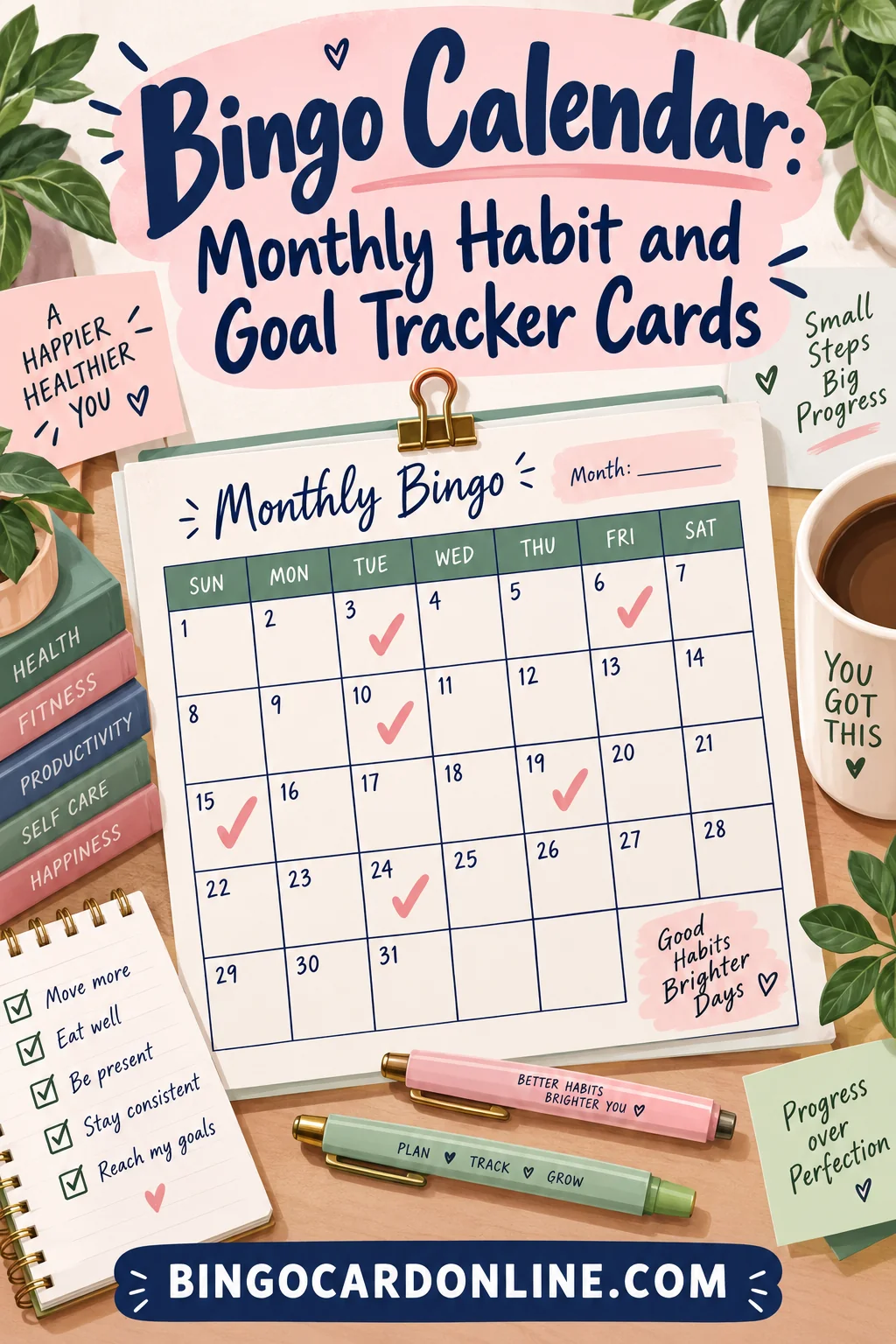
A bingo calendar is a grid where every square is a day of the month or a task you want done that month, and you fill squares in as you go — the difference from an ordinary tracker is that completing a row, a column, or the whole card is a defined win. That win condition is the point. A checkbox list gives you nothing until it's finished; a grid gives you a small, visible target three days from now.
It also gives you a way to survive a bad week, which is where most habit trackers die. A row you can still complete is a reason to pick the card back up on the eighth of the month. A broken 31-day streak is a reason to throw it away.
The catch is that months and bingo cards are not the same shape. So let's start there.
The 25-Square Problem
A standard bingo card is 5x5. That's 25 squares. Months have 28, 29, 30, or 31 days. There is no clever trick that makes 25 equal 31, so you have to pick one of four honest fixes.
| Layout | Squares | Best for | Trade-off |
|---|---|---|---|
| 5x6 | 30 | Dated month cards | 31-day months need a bonus square; February wastes one or two |
| 4x7 | 28 | Weekly rows, weekday columns | Doesn't cover a full 30 or 31-day month |
| 5x5 | 25 | Tasks instead of dates | Loses the day-by-day calendar feel |
| 6x6 | 36 | Dates plus bonus squares | Bigger card, more white space, longer to fill |
5x6, thirty squares. Six rows of five days each. April, June, September and November fit exactly. For a 31-day month, add one square under the grid labeled "31 — bonus." For February, gray out the last one or two squares so nobody thinks they're falling behind.
4x7, the week grid. Four rows, seven columns. Each row is a week, each column a weekday, Monday through Sunday. This is the most calendar-like arrangement and the only one where rows and columns mean something real: a completed row is a perfect week, a completed column is the same weekday four weeks running. "I have never once done this on a Saturday" shows up as an empty column, plain as day.
5x5 as tasks, not dates. Drop the calendar idea entirely. The 25 squares are things you want to do this month, done in any order — "walk 5,000 steps," "cook a new recipe," "call Grandma." Most people enjoy this version most, because you can knock out three squares on a good Sunday, and it is the one that works for goals rather than habits.
How to Mark a Day
Decide the marking rule before you print, and write it on the card. Ambiguity here is what makes a shared card fall apart in week two.
Full fill versus check. A solid color fill reads from across the room; a small check does not. Wall card, fill the square. Notebook card, a check is fine.
Same-day marking, or a catch-up window. Strict version: you mark the square on the day it happened, nothing later. Forgiving version: you get until the end of the next day. Pick one, because a card anyone can fill at any time stops being a record of what happened.
Partial credit. Half-filling a square for a partial effort — ten minutes of reading instead of thirty — keeps people marking. A half-filled square counts as half toward a points total but does not complete a row, which keeps the win meaningful without turning an off day into a zero.
Write the actual number. For anything countable — steps, pages, minutes, glasses of water — put the number in the square instead of a check. At the end of the month you have a data set, not just a pattern.
What Counts as a Win
In a dated grid the geometry means something, so a bingo calendar needs more thought here than a plain card. On a 4x7 week grid:
- A row is seven consecutive days. That's a real streak and a real win.
- A column is the same weekday four weeks running. Also a real win, and often the harder one.
- A diagonal is Monday of week one, Tuesday of week two, and so on. It means nothing. Don't count it.
On a 5x6 date grid, rows are arbitrary blocks of five days, which is fine — a five-day streak is still a streak — but columns and diagonals are meaningless. Say so on the card. Dated cards work better with win conditions built for them:
| Win | What it takes | Feels like |
|---|---|---|
| Any full row | 5 or 7 consecutive days | A clean week |
| Any full column | Same weekday, every week | Fixing your worst day |
| Four corners | Day 1, the last day, and two mid-month days | Start strong, finish strong |
| Points target | 20 of 30 squares, partials count | Realistic for a first month |
| Blackout | Every square | The full-month prize |
Set two targets, not one: a row for the first win and a points target for the month. People who miss the blackout on day nine need something left to play for.
The Missed Day Rule
Every habit tracker faces this on about day six. Handle it in advance and the card survives; improvise and the card goes in a drawer.
Never restart the card. This is the whole ballgame. A missed day costs you one square, not the month. Cross it out with a light diagonal line so the record is honest, and keep going.
One amnesty square per month. Declare one square in advance as a free space. If you miss a day, move the amnesty onto it and the row still completes. One per month, no rollover. It rescues the single bad Tuesday without letting the card become fiction.
Make-up squares. You can restore a row by doing double on any later day in that same row. Rows can be saved; columns cannot. This keeps a week from being written off on a Wednesday.
Two misses ends the row, not the card. Once a row has two gaps, circle it, move to the next row, and go for the points total instead. The point of a thirty-square card is that there is always another row.
Weekly Reset or Monthly Reset
A monthly card is one commitment and one prize at the end. A weekly card — a 4x7 grid printed four times — resets every Monday, so the recovery cost of a bad week is exactly one week.
Use a weekly reset for a new habit, for kids, and for anything you have failed at before. Use a monthly reset for a habit you already have some grip on, and for goals bingo, where single squares take more than a day. A workable middle path: print a monthly 5x6 card but rule a heavy line after every fifth square, so each row is visibly its own mini-game.
Square Banks You Can Lift Straight onto a Card
Pick a bank, take what you need, and print. Mix banks freely — a mixed card is usually more sustainable than a single-theme one.
Habit tracker bank. Drink eight glasses of water. Bed made before 9am. Ten minutes outside. Phone off an hour before bed. Journal three lines. Vitamins taken. In bed by 11. No screens at breakfast. Inbox to zero. Walk after lunch. Counters clear before bed. One thing thrown away. Message a friend. No snacks after dinner. Read before scrolling. Plan tomorrow in three lines.
Fitness bank. 5,000 steps. 8,000 steps. 10,000 steps. Twenty push-ups. A full plank minute. Stairs all day, no elevator. A twenty-minute walk. Thirty minutes of cardio. Stretch after training. A rest day taken on purpose. Exercise before 9am. Twenty squats. A workout you did not feel like doing. Train with someone. Sleep seven hours. A ten-minute workout when the day was terrible.
Reading bank. Twenty pages. A full chapter. Read at breakfast. Read before bed instead of the phone. Thirty minutes with no notifications. Finish a book. Start a book. Read outside. Read something you'd normally skip. A short story in one sitting. Read aloud to someone. Write one sentence about what you read. Library visit. One poem. Recommend a book to someone. Abandon a book you're not enjoying.
Household bank. Dishes done before bed. One drawer sorted. Laundry folded, not just washed. Floors in one room. Bathroom wiped. Fridge shelf cleared. Mail opened and dealt with. One thing donated. Bed linens changed. Ten-minute tidy with a timer. Car cleared out. Something repaired instead of replaced. Meal planned for the week. Groceries with a list. Plants watered. Receipts filed.
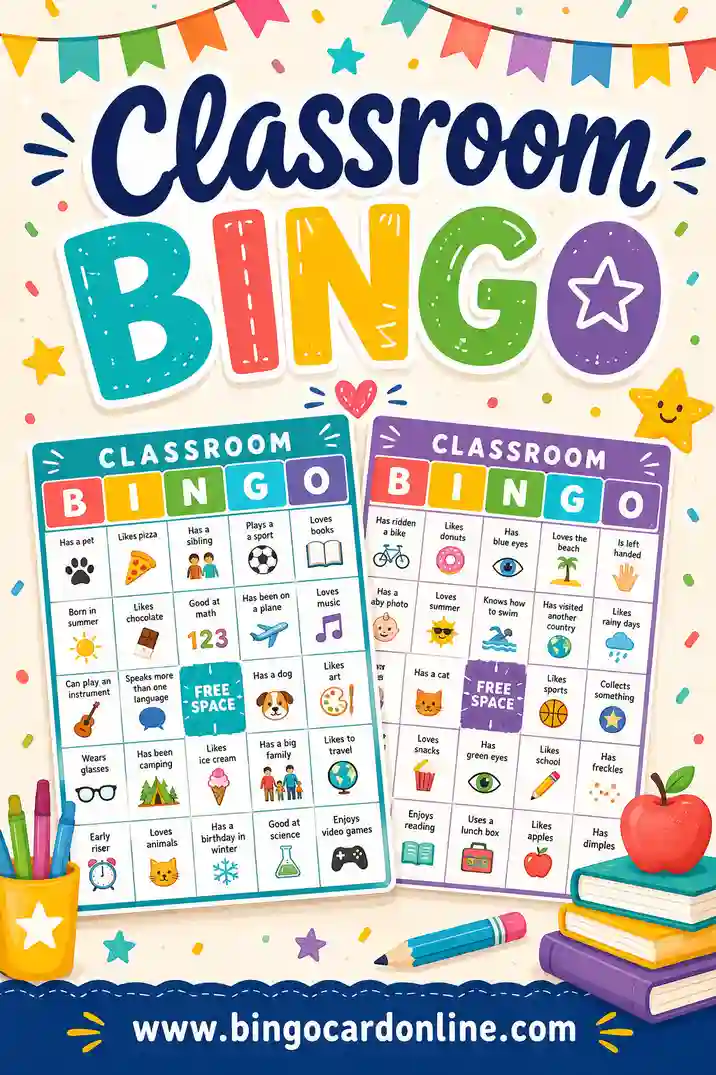
Classroom bank. Read for fifteen minutes. Homework in before the bell. Ask one question out loud. Help a classmate. Neat handwriting for a full page. Desk tidy at the end of the day. Times table practiced. Five new spelling words. Show your work on every problem. Try again after a wrong answer. Say something kind. Pack your bag the night before. Read to a younger student. Check your work before handing it in. Effort on the hardest subject.
Goals Bingo Versus Habit Squares
A goals bingo card is a different animal from a daily habit card. Squares are outcomes, not repetitions: "book the dentist," "finish the tax folder," "run 5k without stopping," "have the conversation I've been avoiding." They take an hour or a week, not a morning, and they get done in whatever order suits the month. Three rules make goals bingo work.
Size the squares evenly. Every square should be roughly one sitting. "Write the report" is not a square; "outline the report" and "draft section one" are two. A card with one enormous square and twenty small ones produces a permanently unfinished row.
Make each square pass the done test. You should be able to look at a square and answer yes or no with no argument. "Get fitter" fails. "Three workouts in one week" passes.
Put the dreaded ones on one line. Scatter the five things you're avoiding across a single row, so finishing it is worth a real reward. You'll do them for the line when you wouldn't do them for their own sake.
Building a Bingo Planner for a Family, a Class, or a Team
The layout barely changes. What changes is who marks it and who wins.
Family. One card per person on the fridge, plus a shared square that only fills when everyone does it — a family walk, a screen-free dinner. Kids do better on a 4x7 weekly grid with a small Friday prize than a 30-day card with a distant one. Let each person pick five of their own squares.
Classroom. Print one card per student from an identical square bank, plus three blank squares each student fills in themselves. Run it as a bingo planner for the month: first row wins a small privilege, blackout wins the bigger one, and the class total unlocks something for everyone — that last part keeps the slowest kid in the game in week three. You can build a class set with the free bingo card generator.
Team or workplace. Keep it to behaviors, not output. "Documented a decision," "closed a stale ticket," "took a real lunch break." Output targets on a public grid turn into a leaderboard, and a leaderboard turns a good idea into a morale problem. One shared card, no names attached to rows.
Printing and Layout Details That Matter
- Big squares beat pretty squares. If a number is going in the square, make it at least three-quarters of an inch. A dense, tiny grid never gets filled in.
- Day number in the corner, not the center. Small gray type in the top-left stays readable under a full color fill.
- Print the rules on the card. Marking rule, amnesty rule, win conditions, one line each. A card that has to be explained gets argued about.
- A color per person on a shared card. You can read a month of progress from six feet away.
Common Mistakes
- Twenty-five squares for a thirty-one-day month. Choose your layout before you choose your squares.
- Counting diagonals on a dated grid. They don't correspond to anything. Say it on the card.
- Only a blackout prize. Everyone who slips early has nothing left to chase. Add a row prize and a points target.
- Backfilling a whole week on the 30th. It feels great and records nothing. Same-day or next-day, then stop.
Frequently Asked Questions
What is a bingo calendar? It's a bingo-style grid used as a month-long tracker, where each square is a day or a task and you fill it in when you complete it. Unlike a checklist, you win by completing a row, a column or the full card, which gives you short-term targets inside a long month.
How do you fit 31 days on a 5x5 bingo card? You don't — 5x5 holds 25 squares. Use a 5x6 grid for 30 days plus a bonus square for the 31st, a 4x7 grid where rows are weeks and columns are weekdays, or keep the 5x5 and make the squares tasks rather than dated days.
What should I do if I miss a day? Cross the square out lightly and keep going — never restart the card. Give yourself one amnesty square per month that can be moved onto a missed day to rescue a row. Two gaps ends that row, not the month.
What's the difference between a bingo planner and goals bingo? A bingo planner tracks repeated daily habits, so squares are things you do again and again. Goals bingo squares are one-off outcomes sized to roughly one sitting each, done in any order across the month, which suits projects and errands better than daily routines.